
When your child’s future is on the line, understanding your rights matters most. The thought of a custody battle is enough to keep any parent up at night, but "winning" isn't about scoring points against the other parent. It's about showing a judge that you can provide the most stable, loving, and supportive home for your child.
The entire process boils down to one guiding principle in Texas family law: the best interest of the child. Everything else is just details.
Your Path to a Stable Future in Texas Custody

Let's be honest—navigating a child custody dispute in Texas is one of the toughest things a parent, grandparent, or guardian will ever go through. The legal jargon feels like another language, and the stakes couldn't be higher. It’s completely normal to feel a mix of fear, anger, and deep uncertainty. Our goal is to cut through that anxiety and give you clarity and confidence.
Think of this guide as your practical, no-nonsense roadmap. We're going to translate the complex legal concepts into plain English and give you actionable steps you can start taking today to protect your relationship with your child.
Understanding the Real Goal
In a Texas courtroom, the judge has a singular focus: ensuring your child's physical and emotional well-being. That’s it. They will look at a whole range of factors to figure out which environment best supports your child's growth and happiness. "Winning," then, means proving that you are the parent best equipped to meet those needs day in and day out.
This guide will help you understand:
- The "Best Interest of the Child" Standard: We’ll break down what this really means in court and the specific factors a judge is looking for.
- Key Legal Terms: You'll learn the difference between "Joint Managing Conservatorship" and a "Possession Schedule" so you can follow along with confidence.
- Evidence and Preparation: We’ll show you exactly how to gather the right documents and proof to build a solid, convincing case.
- Mediation vs. Litigation: You'll discover why most cases never see the inside of a courtroom and how you can use negotiation to maintain more control over the final outcome.
The truth is, the vast majority of custody cases are resolved through negotiation, not a dramatic courtroom trial. This puts more power in your hands than you might realize, allowing you to help shape a possession schedule that actually works for your family.
This process is a marathon, not a sprint. By staying organized, focusing on your child's needs above all else, and understanding your legal options, you can move forward with a clear strategy instead of just reacting.
How Texas Determines Custody: The "Best Interest of the Child" Standard

When you walk into a Texas family courtroom, you need to understand one thing above all else: every single decision the judge makes will hinge on one single, powerful concept—the best interest of the child. This isn't just a feel-good phrase; it's the legal standard that governs every custody ruling in the state under Texas Family Code Chapter 153.
The most critical shift you can make is to stop thinking about this as "winning against" the other parent. Instead, you need to focus all your energy on "proving what's best for" your child. Your entire case—every piece of evidence, every testimony—should be built to demonstrate that you provide a safe, stable, and loving environment where your child can thrive.
What Are the Holley Factors?
So, how does a judge actually determine what’s in a child’s best interest? They use a set of guidelines known as the “Holley Factors.” Think of these not as a rigid checklist, but as a series of questions the court considers to get the full picture of your family’s unique situation.
Getting familiar with these factors helps you zero in on the exact evidence and testimony the court needs to hear from you. The list isn’t exhaustive, but it generally covers:
- The child’s emotional and physical needs, both right now and down the road.
- Any emotional or physical danger the child might face, now or in the future.
- The parenting skills and abilities of each person seeking custody.
- Any programs available that could help the parents better serve the child's interests.
- The stability of the home (or homes) being proposed.
- Any actions or failures to act by a parent that suggest the current parent-child relationship isn't a healthy one.
- Any explanation for those actions or failures.
A judge will carefully weigh these elements to craft a parenting plan that puts your child’s well-being first. The foundation of any strong custody strategy is truly understanding how to prove the best interest of the child.
Key Texas Custody Terms Explained
The language used in family law can feel foreign, but you’ll see a few key terms pop up over and over. Getting a handle on them now will help you feel more in control and prepared to discuss your case with confidence.
| Quick Guide to Texas Custody Terms |
| :— | :— | :— |
| Legal Term | Plain-English Explanation | What It Means for You |
| Conservatorship | This is what Texas calls "custody." It defines each parent's legal rights and responsibilities. | This is the legal framework for who gets to make big decisions for your child (medical, school, etc.). |
| Joint Managing Conservatorship | The most common arrangement where both parents share rights and duties to make major decisions. | You'll likely share decision-making power, but it doesn't automatically mean a 50/50 time split. |
| Possession Order | The court-ordered schedule that lays out exactly when the child is with each parent. The "parenting schedule." | This is the calendar your family will follow for weekends, holidays, and summer vacation. |
| Standard Possession Order (SPO) | Texas's default schedule that's presumed to be in the child's best interest. It gives specific weekends and holidays. | If you and the other parent can't agree, the judge will likely start with the SPO as a baseline. |
Grasping this vocabulary will make court documents and conversations with your attorney much less intimidating. It empowers you to understand exactly what's being decided for your family.
Conservatorship is simply the Texas word for custody. In most cases, courts will presume that Joint Managing Conservatorship is what's best for the child. This means both parents get a say in the big decisions affecting the child’s life—things like education, medical treatments, and religious upbringing.
It's a common misconception that "joint" custody means a 50/50 split of time. In Texas, Joint Managing Conservatorship is about shared rights and duties, not necessarily equal possession time.
Even in a joint arrangement, one parent is usually named the "primary" conservator. This parent has the exclusive right to decide where the child lives (usually within a certain geographic area) and is the one who receives child support payments.
Possession Orders: The Parenting Schedule
A Possession Order is the nitty-gritty, court-ordered schedule that spells out when each parent has the child. It's the practical, real-world calendar your family will actually live by.
While you and the other parent can agree on any schedule that works for your family, Texas has a Standard Possession Order (SPO) that courts assume is in the child's best interest. The SPO typically gives the non-primary parent possession on the first, third, and fifth weekends of a month, plus alternating holidays and a longer stretch of time in the summer. Judges often lean on this because it provides a consistent and predictable routine for the child.
By getting a firm handle on these core concepts—the best interest standard, conservatorship, and possession orders—you can focus your efforts where they matter most. Your goal is to present a clear, compelling case backed by evidence that shows why your involvement and your home are absolutely vital for your child's happiness, stability, and future.
Gathering Evidence That Makes a Difference
A Texas custody case isn't won with a dramatic, last-minute courtroom speech. It's won long before you ever see a judge, built piece by piece with undeniable proof. Your story of being a loving, capable parent needs that tangible support, and this is where gathering the right evidence becomes your most powerful tool.
This isn’t about digging for dirt or looking for ways to attack the other parent. It’s about methodically building a factual record that showcases your consistent, positive involvement in your child’s life. Think of it as creating a compelling narrative backed by concrete documentation.
What Your Evidence Needs to Accomplish
Every text message, school email, and doctor’s receipt you save should serve one primary goal: to paint a crystal-clear picture for the judge of your child's world and your essential role in it.
Your evidence file should prove a few key things:
- You’re an active, hands-on parent: Show up for the parent-teacher conferences? Help with the science fair project? Drive to soccer practice? Document it.
- You can co-parent effectively: Prove that you communicate respectfully with the other parent to make decisions that are truly in your child's best interest.
- You provide a stable, safe home: Document that your home is a secure and nurturing place for your child to land at the end of the day.
- You understand your child's unique needs: Show the court you're attuned to your child’s specific physical, emotional, and educational requirements.
You are the primary historian of your child's life right now. The more organized and thorough you are, the stronger and more credible your case will be.
Building Your Case File, Document by Document
So, what does this evidence actually look like? It’s rarely one single bombshell. More often, it's the everyday documentation that tells the most convincing story. Get a dedicated folder—physical or digital—and start collecting anything that validates your role as an engaged parent.
Here are some of the most impactful items to gather:
- School Records: Report cards are good, but emails with teachers about homework or attendance records showing you handled sick days are even better. They prove your involvement.
- Medical and Dental Logs: Keep a simple log of every doctor's visit. Note who took the child, what was discussed, and any follow-up care you managed.
- Communication Records: Saved texts, emails, or messages from co-parenting apps like OurFamilyWizard or AppClose are gold. These can show your sincere efforts to coordinate schedules, or, if necessary, they can reveal a pattern of uncooperative or difficult behavior from the other side.
- A Personal Calendar or Journal: This is huge. Maintain a detailed calendar marking your possession days and any extra time you have with your child. Briefly note what you did together—"went to the park," "helped with book report." It creates a powerful, undeniable timeline of your involvement.
A well-organized binder of documents does more than just back up what you say. It shows the court you are a responsible, proactive parent who takes this process—and your child’s future—seriously. That level of preparation speaks volumes about your character.
This practical guidance applies equally to both mothers and fathers. For fathers, this documentation is especially critical. It can powerfully dismantle any outdated biases and prove your consistent, hands-on role in your child's daily life. For mothers who have legitimate safety concerns, factual evidence is everything. Instead of making broad statements, you need to present specific, documented incidents. A police report, a time-stamped photo, or a sworn statement from a neighbor carries infinitely more weight than an accusation without proof.
The Role of Witnesses and Testimony
While documents form the backbone of your case, human testimony can bring your story to life. Witnesses offer a third-party perspective on your parenting and can corroborate the claims you make.
Good witnesses are people who have seen you with your child firsthand. Think about people like:
- Teachers or daycare providers
- Coaches or tutors
- Family friends or neighbors who see you day-to-day
- A counselor or therapist
These individuals can speak to your parenting skills, your bond with your child, and the stability you provide.
Of course, preparing for your own testimony is just as important. Down the line, you may need to answer questions under oath in a deposition. Being ready with clear, honest, and fact-based answers is vital. Understanding the types of custody deposition questions you might face ahead of time is one of the best ways to prepare.
Ultimately, gathering evidence is about building a foundation of truth. By meticulously documenting your commitment, you arm yourself with the facts needed to show a judge that your child's best interest is, and always has been, your number one priority.
Choosing Your Path: Mediation vs. Litigation
When you think of a custody battle, you probably picture a tense courtroom drama straight out of a movie. But that’s not the reality for most Texas families. The truth is, most custody cases get resolved collaboratively, long before a judge ever needs to make a final decision.
Understanding your two main paths—mediation and litigation—is the first step toward choosing the one that best protects your child and your own peace of mind. The real goal isn't just to "win" in court; it's to find a solution that actually works for your family. For many parents, that means staying out of the courtroom altogether.
Why Mediation Is Often the Stronger Choice
Mediation is basically a structured negotiation. You, the other parent, and your attorneys meet with a neutral third-party mediator whose only job is to help you find common ground and craft an agreement yourselves. It’s a process with some serious advantages.
First and foremost, you and the other parent keep control. Instead of handing over life-altering decisions about your child to a judge who only knows your family from a stack of papers, you get to create a custom possession schedule and parenting plan that truly fits your lives.
Other key benefits include:
- It’s far less stressful. Mediation is less adversarial than a court battle, which can be huge for preserving a functional co-parenting relationship for your child's sake.
- It’s more private. Your family's personal business is discussed behind closed doors, not aired out in a public courtroom.
- It saves a ton of time and money. A successful mediation can resolve your case in a day or two. Litigation can drag on for months, racking up staggering legal fees along the way.
The numbers overwhelmingly back this up. It can feel overwhelming to step into a custody battle, but what if you knew that 90-91% of child custody cases are resolved outside of court? This powerful statistic, drawn from multiple family law analyses, highlights a fundamental truth: negotiation and mediation are your strongest tools.
A skilled family law attorney is your advocate during mediation, making sure any agreement you reach is fair, legally sound, and protects your parental rights. It's smart to do your homework and learn more about child custody mediation tips to get the most out of your session.
This flowchart shows the kind of foundational evidence you'll need to build your case, whether you're heading to mediation or preparing for a potential trial.
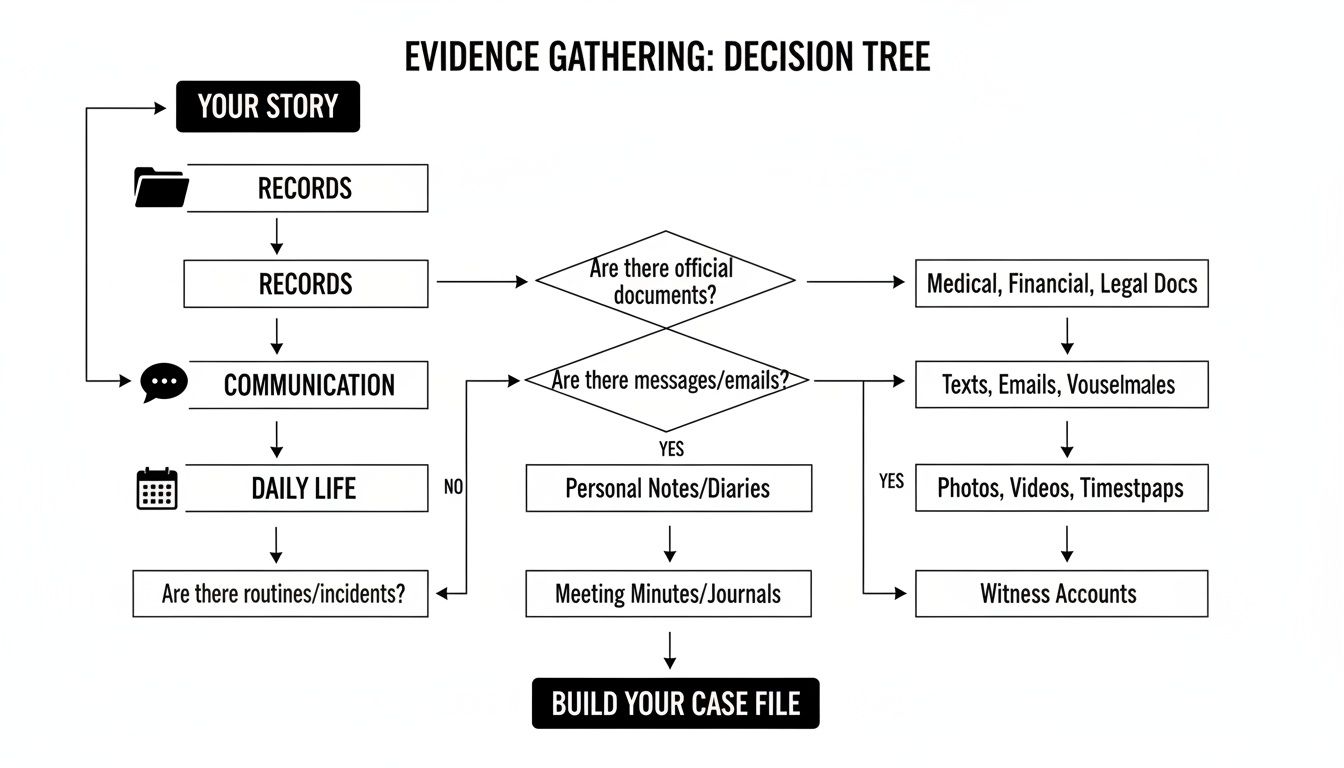
When you organize your story into clear categories—like records, communications, and daily life—you create a powerful and credible foundation for any negotiation.
When Litigation Becomes Necessary
While mediation is almost always preferred, it just isn't possible sometimes. Litigation—the formal court process—becomes the only path forward when you and the other parent simply cannot reach an agreement.
This is especially true in cases involving serious safety concerns like family violence, substance abuse, or neglect. In those situations, a judge’s intervention is essential to protect the child.
If mediation fails or isn't appropriate for your situation, your case will proceed to court. This process is much more structured and formal, involving stages like filing petitions, exchanging evidence (a process called "discovery"), attending hearings for temporary orders, and, ultimately, a final trial.
But even on this path, you are not powerless. The evidence you've gathered and your clear focus on your child’s best interests are still your strongest assets. An experienced attorney will guide you through each step, presenting your case clearly and professionally to the judge. The goal is always the same: to secure a stable, loving future for your child, whether it's through a negotiated agreement or a court order.
Handling Special Custody Circumstances in Texas
When your child’s future is on the line, the details matter. Not every custody case fits a neat, standard box. Many Texas families find themselves dealing with unique challenges that demand a very specific legal approach.
Maybe you're serving in the military, a grandparent fighting for your grandchild, or you just got a job offer in another state. Knowing exactly how Texas law sees your situation is the first step toward a successful outcome. These complex scenarios can feel overwhelming, but they don't have to be. With the right information and a solid game plan, you can protect your child's stability and your parental rights, no matter how complicated things seem.
For Our Military Families
Serving our country while navigating a custody case brings its own unique set of pressures. Deployments, relocations, and unpredictable schedules just don't mesh well with standard possession orders. The good news is that Texas law provides special protections for service members to make sure their parental rights aren’t put at risk because of their military duties.
One of the most powerful tools for military parents is a Military Parenting Plan. This is a detailed, customized agreement that gets written directly into your custody order. It should spell out things like:
- How you'll communicate with your child during deployment (video calls, emails, etc.).
- Who the child will live with while you are away—often a stepparent or grandparent.
- Specific arrangements for your leave time and a clear post-deployment possession schedule.
Creating this plan ahead of time prevents a world of confusion and conflict down the road. It gives both you and your child a predictable routine during what can be a very uncertain time. More importantly, it shows the court you've been proactive and have a clear plan for your child's best interests, even while serving far from home.
When Grandparents Step In
In Texas, we all know how special the bond between grandparents and grandchildren is. Legally, however, the path to gaining custody or even guaranteed visitation can be a steep climb. Unlike parents, grandparents don't have an automatic right to see their grandchildren. To get a court to order visitation or custody (what Texas law calls conservatorship), you have to meet a very high legal standard.
To gain custody, a grandparent has to prove to the court that the child’s current living situation would significantly harm their physical health or emotional well-being. This is a tough bar to clear, but it's not impossible—especially when a child’s safety is truly at risk.
Proving this almost always requires rock-solid evidence of neglect, abuse, substance abuse, or extreme instability in the parental home. It's a fight born from love and serious concern, and winning it requires meticulous documentation and a sharp legal strategy from day one.
Relocation and Move-Away Cases
Life happens. A fantastic new job, a second marriage, or the need to be closer to family might mean one parent wants to move away with the child. In Texas, we call these relocation cases, and they are hands-down some of the most emotionally charged custody battles we see.
If your custody order has a geographic restriction—a very common clause that limits where the child can live—you can't just pack up and go. You must get either the other parent’s written permission or a court order before you can move. A judge will only sign off on the move if you can prove it is in the child’s best interest.
The court is going to look at everything, including:
- The real reason for the move and the opportunities it offers the child.
- The impact the move will have on the child's relationship with the non-moving parent.
- Whether a realistic, long-distance possession schedule can actually work.
When you're dealing with these kinds of special custody situations, particularly when co-parenting is already a challenge, having effective strategies for co-parenting with a narcissistic parent can be critical to protecting your child’s peace of mind.
Next Steps: Taking Control of Your Custody Case
Navigating a custody dispute in Texas can feel absolutely draining, but every single step you’ve taken to understand this process has built a stronger foundation for your child’s future. It's easy to get caught up in the conflict, but remember, the real goal isn’t to “beat” the other parent—it’s to secure a stable, loving environment for your child.
Winning means protecting that precious relationship you have with them.
It's completely normal to feel overwhelmed right now. The key is to shift from just gathering information to taking decisive, proactive steps. Your real power lies in your preparation and your unwavering focus on what truly matters most: your child's well-being.
Key Takeaways to Guide You Forward
As you get ready for what’s ahead, keep these core principles at the front of your mind. Think of them as the pillars of a strong case—they’ll help you stay centered when things get tough.
- It’s All About the Kids: Every decision, every piece of evidence, and every legal argument must circle back to the best interest of the child standard. That's the only thing the judge truly cares about.
- Organization is Your Superpower: Your documentation is everything. Meticulously organized records, communication logs, and calendars give the judge the concrete proof they need to see the full picture.
- Communicate with Care: Keep your interactions with the other parent as business-like and child-focused as you can. Avoid emotional blow-ups that can—and will—be used against you in court.
- Get Professional Guidance: A good family law attorney does more than just file paperwork. They give you a clear strategy, manage the deadlines you can't afford to miss, and advocate for you when your own emotions are running high.
Once the dust settles and your custody arrangements are finalized, a consistent and clear schedule becomes critical for your child's stability. For some great ideas on organizing your shared parenting duties, check out a complete guide to co-parenting calendars.
You have options, and you are stronger than you think. The information you've learned here is the first step toward taking control of your situation and building a positive path forward for your family.
You are your child's greatest advocate. Now, it’s time to put what you know into action.
If you need help with a child custody or visitation case in Texas, our experienced attorneys can guide you every step of the way. Contact The Law Office of Bryan Fagan, PLLC today for a free consultation.
Common Questions We Hear About Texas Custody
When you're staring down a custody battle, it’s normal for questions and worries to keep you up at night. We get it. Here are some straightforward answers to the concerns we hear most often from parents just like you.
How Much Will a Custody Battle Really Cost in Texas?
This is the million-dollar question, isn't it? The honest answer is: it varies—a lot. A case that’s settled through mediation will almost always be significantly less expensive than one that escalates to a full-blown trial.
Once you head to court, the costs pile up fast. Litigation means more attorney hours, mounting court fees, and sometimes, the expense of expert witnesses. Keeping things as amicable as possible is the best way to protect your wallet.
Can My Child Choose Who They Live With in Texas?
This is one of the biggest misconceptions in Texas family law. While a judge is required to interview a child 12 years or older to hear their preference, the child’s wish isn't the final say. Not even close.
A judge will consider what your child wants, but that desire is just one piece of a much larger puzzle. The court's decision will always come down to what is truly in the child’s overall best interest. A child never gets to "choose" a parent.
What Are Temporary Orders and Why Are They So Important?
Think of temporary orders as the initial ground rules the judge sets at the very beginning of your case. These orders put a temporary possession schedule in place, establish who pays child support, and outline other rules that everyone has to follow until a final decision is made.
Don't underestimate the power of these early rulings. They often set the tone for the entire case. If an arrangement is working well and providing stability for the child, a judge is much more likely to make those temporary orders permanent.
How Do I Change an Existing Custody Order?
Life happens, and sometimes, a court order that worked a year ago no longer makes sense. To modify a custody, visitation, or child support order, you have to prove to the court that there's been a “material and substantial change” in circumstances.
This can’t be a minor inconvenience. The change has to be significant enough that altering the current arrangement is necessary to better serve your child’s best interests.
If you need help with a child custody or visitation case in Texas, our experienced attorneys can guide you every step of the way. Contact The Law Office of Bryan Fagan, PLLC today for a free consultation.