
When a custody order is ignored, it can feel like the ground is shifting beneath your feet, especially when it involves your children. If your co-parent is not following your court-ordered possession schedule, it’s natural to feel frustrated and powerless. But you are not without options. When the future of your relationship with your child is on the line, understanding your rights is the first step toward stability.
In Texas, you have a specific legal tool for this exact situation: a Motion to Enforce Custody. This is your direct path to compelling a non-compliant parent to follow the custody order and bring predictability back to your child's life.
How to Respond When Your Custody Order Is Violated

It’s one of the most stressful moments a parent can face. You arrive for your scheduled weekend, holiday, or even a simple weeknight visit, only to be turned away. The frustration is immense, but the feeling of helplessness can be even worse. It is vital to know that you have clear legal options.
A Texas custody order, often called a possession order, isn't a suggestion—it's a legally binding directive from a judge. When one parent deliberately ignores its terms, they are violating that court order. This is where a Motion to Enforce becomes your most powerful tool. This legal filing, governed by Texas Family Code Chapter 157, asks a judge to step in and require the other parent to comply.
Understanding Enforcement vs. Modification
It is critical to understand the difference between enforcing an order and modifying one. Getting this right from the start saves parents time, money, and emotional energy.
- Enforcement: This action is about upholding the current custody order. Your goal is to make the other parent follow the rules that are already in place.
- Modification: This action seeks to change the terms of the custody order. This is usually pursued when there has been a material and substantial change in the family's circumstances.
If the other parent is simply ignoring the agreed-upon schedule, enforcement is the correct path. You're asking the court to hold them accountable for breaking the existing agreement. If your circumstances have changed and the current order no longer serves your child's best interests, you would file a Motion to Modify the Custody Order.
This situation is unfortunately common for Texas families. For instance, in a single year, Tarrant County courts managed 1,883 post-decree litigation cases. A significant portion of those—478 cases—were enforcement actions, making up nearly 11% of all family law matters. This shows that when a parent violates an order, the other parent often successfully uses the legal system to protect their rights.
Common Violations and Potential Remedies
The first step is recognizing that what the other parent is doing is a legal violation. These actions can range from subtle interference to outright refusing to hand over your child.
Some of the most frequent violations we see include:
- Denying Scheduled Possession: The other parent flatly refuses to let you pick up your child for your court-ordered weekend or holiday time.
- Returning the Child Late: The other parent consistently returns your child hours or even a day late, cutting into your time and disrupting routines.
- Interfering with Communication: Your order may grant you the right to phone or video calls, but the other parent blocks these calls or refuses to make the child available.
- Making Unilateral Decisions: In a Joint Managing Conservatorship (where both parents share the rights and duties of raising a child), one parent might make a major decision about the child's education or health without consulting the other, violating the court order.
When a judge finds a parent has violated the order, they have a wide range of tools to correct the behavior and compensate you for lost time. These remedies are not just about punishment; they are designed to restore your rightful time and ensure it doesn't happen again.
The table below outlines some of these common violations and what a court can do in response.
Common Custody Violations and Potential Court Remedies
| Common Violation | Potential Court-Ordered Remedy |
|---|---|
| Denial of a weekend or holiday | Order additional "make-up" possession time for the parent who was denied. |
| Consistent late return of the child | Order the violating parent to post a bond to ensure future compliance. |
| Interference with phone/video calls | Clarify the communication schedule and order specific times for calls. |
| Failure to pay travel costs | Order the parent to reimburse all associated travel expenses. |
| Withholding the child's passport | Order the parent to turn over the passport and may impose fines. |
| Contempt of court (willful violation) | Impose fines, order jail time, and require payment of the filing parent's attorney's fees. |
Judges have significant power to enforce their orders. They can award you the time you lost, order the other parent to pay your attorney's fees, and even find the other parent in contempt of court, which can lead to fines or jail time. You can learn more by exploring the details of custody enforcement in Texas.
Why a Vague Custody Order is Difficult to Enforce
A successful enforcement action hinges on having a clear, specific, and unambiguous custody order. Your possession order needs to be written so precisely that there’s no room for interpretation.
For example, a custody order that just says "reasonable visitation" is nearly impossible to enforce. What does "reasonable" mean? To you, it might mean every other weekend. To your co-parent, it could mean one visit a month. A judge cannot hold someone in contempt for violating a term that is wide open to interpretation.
A strong, enforceable order will clearly define:
- Exact dates and times for every exchange.
- Who is responsible for pick-ups and drop-offs.
- A clear schedule for all holidays, birthdays, and summer vacation.
- Specific guidelines for communication, like phone or video calls.
If your current order is vague, you may need to file a motion to modify it first. Clarifying the terms makes them enforceable.
Next Steps
A Motion to Enforce doesn't change your custody plan; it ensures the existing plan is followed. It is your legal right to demand compliance and protect your court-ordered time with your child. A single, clear violation is enough to file a Motion to Enforce. You do not need to wait for a pattern of misbehavior to take action.
If you are dealing with a co-parent who is not following the custody order, you don't have to navigate this complex process alone. A knowledgeable family law attorney can review your order, explain your rights, and help you take the next steps.
If you need help with a child custody or visitation case in Texas, our experienced attorneys can guide you every step of the way. Contact The Law Office of Bryan Fagan, PLLC today for a free consultation.
How to Prepare and File Your Motion to Enforce
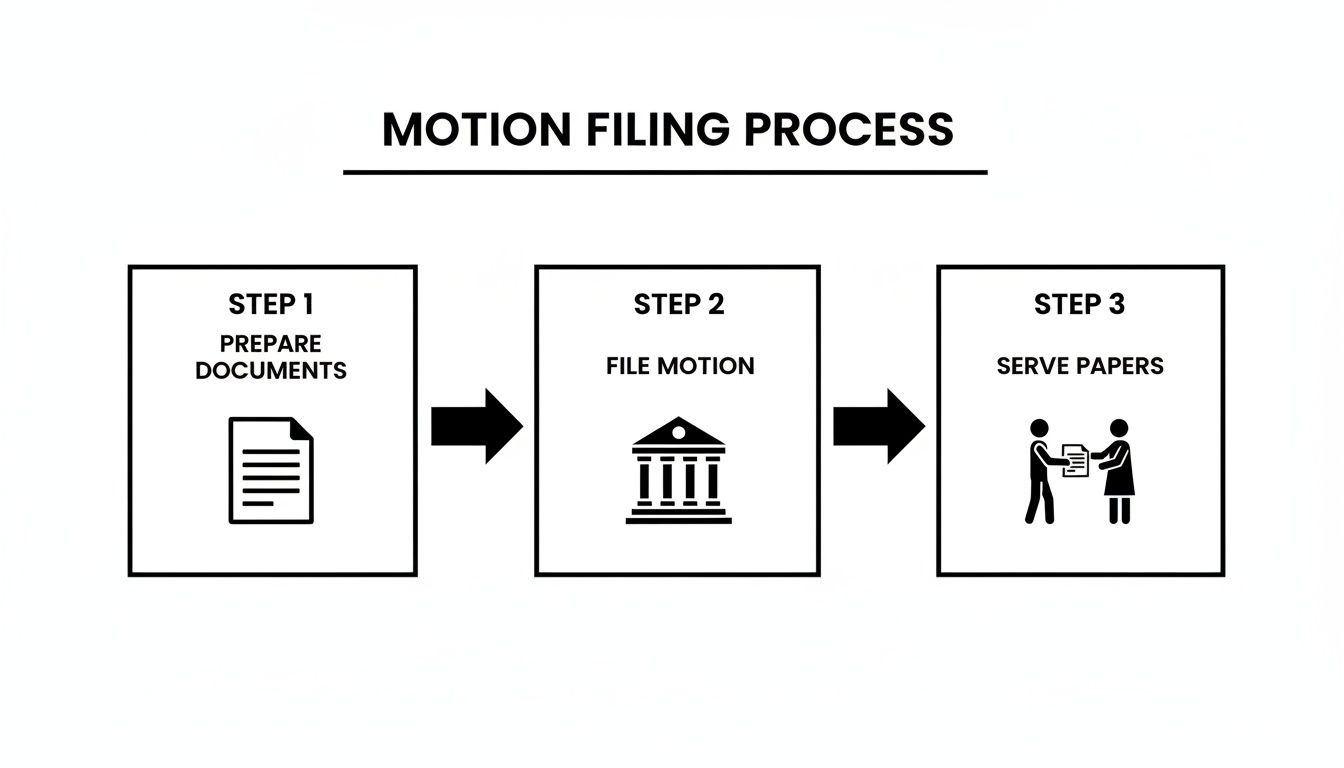
When your rightful time with your child is denied, the legal process can seem daunting. The good news is that Texas law provides a clear path forward. Filing a motion to enforce custody involves specific, actionable steps, and understanding them can empower you to move forward with confidence.
First, you’ll need a certified copy of your current, final custody order. This isn't just a photocopy; it's the official version from the district clerk, which proves to the court exactly which rules are being broken. You can obtain this from the clerk’s office in the county where your order was originally issued.
The Essential Legal Paperwork
With your certified order ready, the next step is to draft the main legal document: the Petition for Enforcement of Possession or Access. This is your formal request to the court, and it needs to be precise.
Under the Texas Family Code, your petition must clearly state:
- The exact part of the custody order that was violated.
- The specific date, time, and location of each violation.
- A detailed account of how the other parent failed to follow the order.
- What you are asking the court to do (e.g., order make-up time, award attorney’s fees, or hold the other parent in contempt).
Think of this document as telling the story of each violation to the judge. For example, a mother might state, "On Friday, May 24th, at 6:00 PM, I arrived at the Respondent's home at 123 Main Street to pick up our child for my first weekend of the month, as ordered in Paragraph 5 of our Final Decree. The Respondent refused to open the door." A father could attach screenshots of texts where the other parent says, "You are not getting him this weekend."
A meticulously detailed petition is the foundation of a strong enforcement case. Vague claims may be dismissed; specific, documented allegations demand the court's attention.
Getting the Other Parent to Court
Just filing the petition isn't enough. The other parent must be legally required to appear in court. This is done by having the judge sign an Order to Appear, sometimes called a "Show Cause Order." This document is a legal command for the other parent to attend a hearing and "show cause" why the judge shouldn't grant your enforcement motion.
Without this signed order, the other parent has no legal duty to appear, and your case cannot proceed. This document turns your petition from a complaint into a court-mandated action. For more guidance on drafting legal documents, check out our guide on how to write a court motion.
The Critical Step of 'Service'
Once your petition is filed and the judge signs the Order to Appear, the other parent must be formally notified. This legal notification process is called service of process, and it is not optional.
"Service" means a neutral third party—usually a sheriff, constable, or private process server—personally delivers a copy of the filed documents to the other parent. Simply mailing the papers or sending a text is not sufficient. Proper service is your proof to the court that the other parent was made fully aware of the allegations and the hearing date.
If the other parent is not properly served, the court has no jurisdiction over them, and any orders made at the hearing would be invalid. This is why working with a professional to handle service is so important—it prevents procedural mistakes that could derail your case.
Building a Strong Case with Compelling Evidence
When you’re fighting to enforce your custody order, your word against your co-parent’s isn’t enough. Judges hear conflicting stories all day. What makes them listen? Clear, documented proof. Once your motion is filed, your focus should shift to building a case so well-documented that the judge has no room for doubt.
A simple claim that the other parent denied your weekend can be met with a simple denial. But when you back up that claim with a timestamped text message, a photo from the exchange point, and a detailed journal entry, the story changes. You are no longer just telling the judge what happened—you’re showing them.
How to Gather Undeniable Proof
Connect every piece of evidence back to a specific violation you listed in your petition. This is about building a meticulous case file that your attorney can present powerfully in court.
Here is a practical checklist of evidence we advise parents to gather:
- Your Visitation Journal: This is your most important tool. For every violation, log the date, time, and specific details. What was supposed to happen according to the order? What actually happened? What excuses were given? Write it down while it’s fresh.
- Electronic Communications: Save every text, email, or social media message related to visitation. A message from your co-parent saying, "Sorry, you can't see them this weekend," is powerful evidence.
- Photos and Videos: If you show up for an exchange and no one is there, take a quick, geotagged photo or short video of yourself at the location. This proves you were where you were supposed to be, when you were supposed to be there.
- Receipts as Timestamps: If you're at the exchange location, buy something small at a nearby store. The timestamped receipt is a third-party record proving your location at that exact time.
- Witness Testimony: Neutral third parties who witnessed what happened can provide powerful testimony. This could be a grandparent who was with you or a neighbor who saw you arrive.
What to Expect in the Courtroom
Walking into an enforcement hearing can feel intimidating, but knowing what to expect can make a world of difference. This hearing is your chance to tell your story, backed by all the evidence you’ve carefully gathered. Your attorney will present your case, and you will testify under oath about the violations.
The most important thing you can do is stay calm and stick to the facts. Answer questions directly and truthfully. The other parent will have a chance to offer a defense, which is why your organized proof is so crucial. To get a better feel for testifying, you can review our guide on common custody deposition questions, as the principles of clear, factual testimony are very similar.
By preparing your evidence and understanding the court process, you can approach the hearing with confidence. Remember, you are not just fighting for your time; you are fighting for your child's right to a stable and consistent relationship with both parents.
If you need help with a child custody or visitation case in Texas, our experienced attorneys can guide you every step of the way. Contact The Law Office of Bryan Fagan, PLLC today for a free consultation.
Possible Outcomes of a Custody Enforcement Hearing

When a judge rules in your favor after an enforcement hearing, it is a moment of immense relief. But what happens next? A Texas judge has a wide range of powerful tools to not only address the violation but, more importantly, to get things back on track and ensure it doesn't happen again.
Understanding these potential outcomes helps you see that filing a motion to enforce custody in Texas is about restoring balance and protecting your child’s right to a consistent relationship with you.
Contempt of Court: The Court's Strongest Message
One of the most significant findings a judge can make is holding the other parent in contempt of court. In plain English, this is the court formally declaring that your co-parent intentionally and knowingly violated a direct judicial order. It is a serious finding with real consequences.
There are two forms of contempt a judge can use:
- Criminal Contempt: This is about punishment for past actions. A judge can sentence the violating parent to jail time—up to 180 days for each violation—and impose fines. This sends a clear message that defying court orders will not be tolerated.
- Civil Contempt: This is coercive and designed to force immediate compliance. For example, if the other parent is still withholding your child, a judge can order them to jail until they follow the order and turn the child over to you.
The threat of jail is often a powerful motivator for ensuring future compliance with a possession order.
Restoring Your Lost Time and Money
While contempt is a strong tool, most parents are more focused on practical remedies that directly benefit them and their child. The main goal is often to be made whole again.
A judge can order several remedies aimed at restoring what you lost:
- Makeup Possession Time: This is one of the most common remedies. The judge will order a specific schedule for you to get additional time with your child to make up for the weekends, holidays, or vacation days you were wrongfully denied.
- Payment of Attorney's Fees: The Texas Family Code allows the judge to order the violating parent to pay for your court costs and reasonable attorney's fees. You should not have to bear the financial burden of going to court because the other parent refused to follow the rules.
- Posting a Bond: If the judge is concerned about a pattern of non-compliance, they can require the parent to post a cash bond with the court. If they violate the order again, they risk forfeiting that money.
Ensuring It Never Happens Again
Beyond makeup time and financial penalties, a judge can put other orders in place to prevent future problems. These proactive measures often focus on the root cause of the non-compliance.
For instance, a judge might order the violating parent to attend parenting classes or co-parenting counseling. The goal is to improve their understanding of their legal obligations and the negative impact their actions have on your child. These orders demonstrate that the court is focused on the best interest of the child, which always includes a stable, predictable, and low-conflict environment.
Key Takeaway
The primary goal of an enforcement action is to restore your parental rights and ensure stability for your child. The court's remedies are designed not just to penalize past actions but to safeguard your future relationship and possession schedule. By understanding all the possible outcomes, you can approach your hearing with clear expectations, knowing the law is on your side to fix the problem.
If you need help with a child custody or visitation case in Texas, our experienced attorneys can guide you every step of the way. Contact The Law Office of Bryan Fagan, PLLC today for a free consultation.
Common Questions About Enforcing a Custody Order
When you are fighting to get your court-ordered time back with your child, your mind is likely racing with questions. It’s a frustrating and confusing situation, and you just want straight answers. We understand.
We hear these same questions every day from Texas parents who are tired of being denied their rightful possession. Let's tackle some of the most common ones to give you the clarity you need to move forward.
How Long Does a Motion to Enforce Custody Take in Texas?
This is the first question on every parent's mind, and the honest answer is: it depends. The timeline for a motion to enforce custody in Texas can vary based on the court's schedule, your county, and the specifics of your case.
Generally, you can expect a hearing to be scheduled within a few weeks to a couple of months after filing your petition.
Several factors can affect the timeline:
- The Clarity of the Violation: If the denial is blatant and you have clear proof—like a text from your ex admitting they are keeping the child—the process can move faster.
- A Contested Motion: If the other parent hires an attorney and decides to fight the motion, it can extend the timeline.
- The Court’s Caseload: Courts in major metropolitan counties are often very busy, which can mean a longer wait for a hearing date.
- Mediation Requirements: Judges often order parents into mediation first to try and resolve the issue before a formal hearing, which adds a step to the process.
An experienced family law attorney can help streamline everything by ensuring paperwork is filed correctly and navigating the court system efficiently.
Can I Stop Paying Child Support if My Ex Denies Visitation?
We hear this question constantly, and our answer is always an emphatic no, you should not. It is a completely understandable reaction. You may think, "If they aren't holding up their end of the bargain, why should I?" But in the eyes of Texas law, you would be making a significant mistake.
Under the Texas Family Code, child support and visitation (or possession) are two completely separate legal obligations. Withholding child support will not get your possession time back. Instead, it will put you in legal jeopardy, potentially facing a separate enforcement action from the other parent or the Attorney General's office.
The penalties for not paying child support are serious, including wage garnishment, driver’s license suspension, and even potential jail time. The only legal way to address a visitation denial is to file a Motion to Enforce the possession order. Do not create a second legal battle for yourself.
What if My Co-Parent Has an Excuse for the Violation?
You can expect that the other parent will come to court with an excuse for why they violated the order. In legal terms, this is called an "affirmative defense." They might claim there was a family emergency, an unexpected illness, or some other "unavoidable" event that made the exchange impossible.
The key, however, is that the burden of proof is entirely on them to convince the judge their excuse was legitimate and truly unavoidable. A flimsy excuse, like "the child didn't want to go," almost never holds up in court as a legal reason to deny court-ordered possession.
This is where a skilled attorney becomes your biggest asset. We know how to challenge weak defenses, cross-examine the other parent, and keep the judge’s focus on the undeniable fact: a court order was violated.
Can I Enforce a Custody Order From Another State in Texas?
Yes, you can. Families move, and it's common for a parent to need to enforce a custody order in a different state from where it was created. This process is governed by a law called the Uniform Child Custody Jurisdiction and Enforcement Act (UCCJEA), which has been adopted by nearly every state, including Texas.
To make your out-of-state order enforceable here, you first have to "register" it with the appropriate Texas court. This involves filing a certified copy of your original order along with other required forms. Once the judge signs off on the registration, your order is treated as if it were a Texas order.
After it's registered, you can file a motion to enforce custody in Texas and pursue all the same remedies as any other parent. It's a standard procedure designed to ensure your parental rights are protected, no matter where you live.
If you need help with a child custody or visitation case in Texas, our experienced attorneys can guide you every step of the way. Contact The Law Office of Bryan Fagan, PLLC today for a free consultation.