
When your child’s future is on the line, understanding your rights matters most. You have a court-ordered plan designed to give your child stability, but your co-parent treats it like a suggestion. The late pickups, denied phone calls, and missed weekends aren't just frustrating—they can make you feel powerless. It's a deeply unsettling feeling when the rules you rely on are broken.
But you are not powerless. A Texas custody order is a legally binding document. When it's ignored, the law provides powerful tools for custody enforcement in Texas to protect your time with your child and restore predictability to their life.
What It Means When Your Custody Order Is Ignored

It’s natural to feel angry and anxious when a court-ordered possession schedule is violated. You plan your life—and more importantly, your child's life—around that order. When it’s disregarded, it creates chaos and uncertainty for everyone.
The key is to understand that you don't have to just accept it. A violation isn't just about a completely missed weekend; it’s any failure to follow the specific terms in your Texas Possession Order. In plain English, this order is the official rulebook for co-parenting. It’s designed to uphold what is in the "best interests of the child"—a legal standard focused on their emotional and physical well-being—by ensuring they have a consistent and meaningful relationship with both parents.
How to Recognize a Violation
The first step toward enforcement is identifying what a violation actually looks like. It’s often more subtle than an outright refusal to hand over your child. Common violations we see from both mothers and fathers include:
- Chronic Lateness: Consistently showing up late for pickups or drop-offs, stealing precious minutes or hours from your court-ordered time.
- Refusing Communication: Denying scheduled phone calls or video chats between you and your child.
- Unilateral Changes: Making plans for the child during your possession time without your consent.
- Withholding the Child: Simply refusing to return the child when your possession period ends.
Each of these actions chips away at the stability your court order was designed to create. The legal enforcement process is the tool Texas law gives you to get things back on track.
The Power of Enforcement in Texas
Filing for enforcement isn't about seeking revenge—it's about compelling compliance and making sure the violations stop. And Texas courts take this seriously. Just look at how the state handles child support, a related area of family law. The state's Child Support Division manages 1.5 million active cases for 1.7 million children and collects an incredible $11.34 for every $1 spent on its program. These child support enforcement statistics in Texas show just how committed the state is to upholding family court orders.
That same level of seriousness applies to custody. When you file a Motion to Enforce, you are formally asking a judge to hold your co-parent accountable. It takes the issue out of the realm of frustrating text messages and puts it into a courtroom, where the non-compliant parent must answer to a judge. This is the single most effective way to re-establish boundaries and protect your time with your child.
Building Your Case: The Power of Documentation
When a co-parent ignores your custody order, your first impulse might be to fire off an angry text or make a frustrated phone call. While those feelings are completely valid, the most powerful thing you can do isn't emotional—it's methodical.
Long before you step into a courtroom, the real work of a successful custody enforcement Texas action begins with documentation. This isn’t about being petty; it’s about building a factual, undeniable record that gives a judge a clear picture of what’s been happening. Your frustration is real, but a judge needs evidence.
Start an Enforcement Log—Today
The moment you notice a violation, start a dedicated log. This can be a simple notebook, a note on your phone, or a feature within a co-parenting app like OurFamilyWizard. The tool doesn't matter as much as your consistency.
For every time the possession order is violated, no matter how minor it seems, write it down. This isn't just a list of grievances; it's a timeline that shows a pattern of non-compliance.
- Date of the violation: What day did it happen?
- Exact time: Was the exchange at 6:00 PM? Note they arrived at 6:45 PM.
- What happened (the facts): Be concise and factual. "Denied my scheduled 8:00 PM phone call with our son," or "Refused to let me pick up our daughter for my first weekend of the month."
- The reason given (if any): Did they offer an excuse? Write it down word-for-word. For example, "Said she was 'too tired' for the exchange."
This log turns your valid frustration into the kind of black-and-white evidence that holds up in court. A judge might dismiss one missed visit as a mix-up. But a log showing ten late exchanges in three months tells a much more compelling story.
Your Phone is an Evidence Goldmine
Beyond your log, your digital communications are a treasure trove of evidence. You must save everything. Never delete text messages, emails, or app messages, even if they're infuriating.
Organize these messages by date so they tell a coherent story. Screenshots of your call log showing unanswered calls during your scheduled phone time can be incredibly persuasive. A text where the other parent flat-out says they won't follow the order is a smoking gun—direct proof of their intent.
A well-organized file of dated screenshots and printed emails can be the difference between a judge seeing a simple disagreement and a clear pattern of intentional disregard for a court order.
Judges in Texas are more tech-savvy than ever, which makes your documentation even more critical. Well-organized digital files have become a staple in successful custody enforcement Texas cases. It’s a classic legal principle: if you can't prove it, it didn't happen. As you build your case, it's also helpful to explore how Texas judges now view parenting time and documentation to understand their current priorities.
Essential Documentation for Your Enforcement Case
Putting together a rock-solid case means gathering specific proof. Your attorney will use this evidence to draft the Motion for Enforcement and present a powerful, fact-based argument to the judge. The table below is a checklist of the critical evidence you should start collecting now.
| Evidence Type | What to Record | Why It's Important |
|---|---|---|
| Possession Log | Dates, times, and specific details of every violation, including lateness, missed visits, and denied contact. | Establishes a clear, undeniable pattern of non-compliance over time for the judge to review. |
| Communications | Screenshots of texts, emails, and co-parenting app messages related to the violations. | Provides direct quotes and context, often proving the other parent's intent to violate the order. |
| Witness Information | Names and contact information of anyone who witnessed a violation (e.g., a family member present at a failed exchange). | Third-party testimony can corroborate your account and add significant weight to your claims. |
| Financial Records | Receipts for any costs you incurred due to a violation, such as non-refundable plane tickets for a missed trip. | Demonstrates financial harm and allows the judge to order the other parent to reimburse you for these losses. |
This might seem like a lot of work, but every piece of evidence you gather strengthens your position. A well-documented case makes it much harder for the other parent to deny their actions and gives the judge the tools they need to enforce your order.
How to File a Motion to Enforce in Texas
You’ve done the hard work of documenting every violation. Now what? It’s time to turn those detailed records into a powerful legal tool: the Motion for Enforcement. This is the formal document you file with the court when your co-parent refuses to follow the custody order. It's your official request for a judge to step in and force compliance.
Think of the motion as your official complaint. It must specifically list every time the order was broken, with the date, time, and the exact part of the order that was ignored. You’re essentially creating a clear, undeniable story of non-compliance for the judge to review.
The documentation process we've talked about is the foundation for a strong motion. It’s a simple but critical three-part strategy.
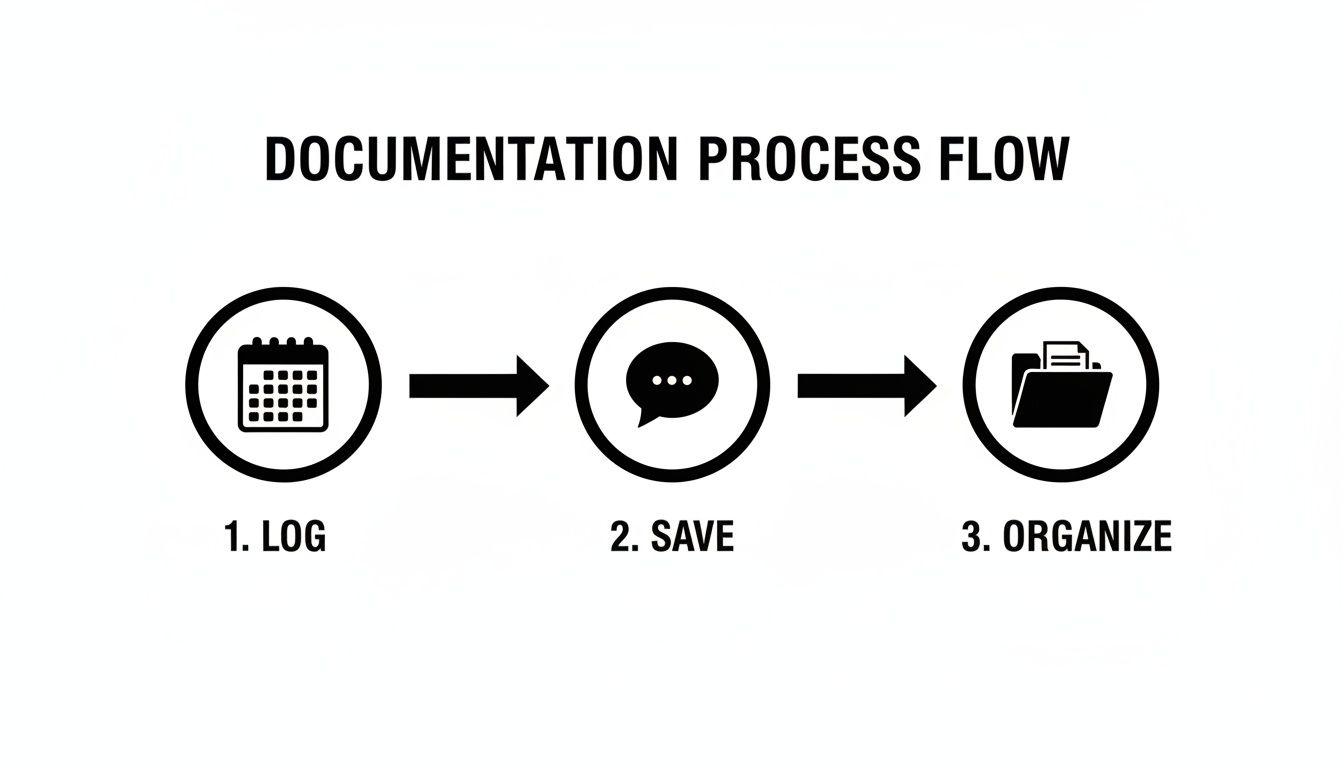
When you meticulously log violations, save every relevant text or email, and keep all your evidence organized, you give your attorney the concrete proof needed to draft an airtight Motion for Enforcement.
Getting the Case Officially Started
Once your attorney drafts the motion, it’s officially filed with the district clerk in the county where your original custody order was granted. This step requires submitting the paperwork and paying a filing fee, which formally puts your case on the court's radar.
But filing isn't the final step. The other parent must be officially notified about the lawsuit, a legal process called "service." A text message or email won't cut it. Service is a mandatory step that ensures your co-parent knows they are being sued and have a chance to respond. This is usually handled by a professional process server or a sheriff's deputy who hand-delivers a copy of the lawsuit.
That personal delivery is a wake-up call. It clearly signals that this is no longer a personal dispute—it's a serious legal matter.
The Order to Appear: Facing the Judge
Along with the motion, the court issues an "order to appear." This isn't a suggestion; it's a direct command from a judge requiring your co-parent to show up in court on a specific date and time to answer for the violations you've laid out.
The order to appear is often a game-changer. It legally forces the non-compliant parent to stand before a judge and explain their actions. This raises the stakes dramatically and can be a powerful motivator for them to start following the rules, sometimes even before the court date arrives.
Ignoring an order to appear is a huge mistake. A judge can issue a warrant for their arrest if they fail to show up. This is how custody enforcement in Texas works. It's the legal mechanism designed to bring accountability back to your co-parenting relationship and give your child the stability they need. It’s how you make sure your court-ordered rights are a reality, not just words on a page.
Navigating the Courtroom Enforcement Hearing

Stepping into a courtroom to fight for your time with your child can be daunting. It’s completely normal to feel a mix of anxiety and frustration that it has come to this. But knowing what to expect during an enforcement hearing can help you channel that anxiety into confidence and focus on what truly matters: protecting your relationship with your child.
An enforcement hearing is a formal process where you, your attorney, the other parent, and their lawyer appear before a family court judge. This is your moment to present the evidence you’ve so carefully collected and explain exactly how your possession order has been violated.
Your goal is to clearly prove three things to the judge:
- A valid, final court order exists.
- The other parent knew the specific terms of that order.
- They knowingly violated those terms.
What Happens in the Courtroom
The hearing begins with you (the petitioner) presenting your case. Through your attorney, you’ll submit your log of violations, text messages, emails, and any other evidence. You might also be asked to testify, which is simply your chance to answer questions under oath about the violations you’ve documented. Your job is to stay calm, focused, and factual. Let your documentation do the talking.
After you've presented your side, the other parent (the respondent) gets their turn. They will try to offer what’s known as an "affirmative defense"—a legally recognized reason for why they couldn't comply with the order. Common excuses range from a legitimate emergency to confusion over vague language in the original order. A judge will scrutinize these claims carefully. A single, genuine emergency is one thing; a pattern of flimsy excuses is something else entirely.
The Power of a Texas Judge
When a judge finds that a parent has willfully violated a court order, they have a wide range of powerful tools at their disposal. The judge's decisions will always be guided by what's in the "best interest of the child."
Possible remedies include:
- Ordering Make-Up Possession: The judge can—and often does—order a specific schedule for you to get additional time with your child to make up for every hour you were denied.
- Clarifying the Order: If the original order was vague, the judge can rewrite it with specific dates, times, and exchange locations to prevent future arguments.
- Awarding Financial Judgments: The judge can order the non-compliant parent to reimburse you for the court costs and attorney’s fees you spent to bring the enforcement action.
For repeated or serious violations, a judge can find the other parent in contempt of court. This is a serious finding that can lead to fines, community supervision (like probation), or even jail time—up to six months for each violation. To learn more, check out our guide on what is contempt of court and its implications.
This courtroom hearing is your definitive opportunity to restore order. It’s where your diligent documentation pays off and where a judge can finally step in to ensure your rights—and your child's rights—are no longer ignored.
Handling Special Enforcement Scenarios
Sometimes, a custody violation is more than frustrating—it’s an emergency. When a denied visit escalates into your child being illegally kept from you, the panic can be overwhelming. In these high-stakes moments, you need to know that Texas law offers powerful and immediate tools to protect your child and enforce your rights.These aren't typical enforcement motions. They are specialized legal actions designed for crisis situations, and understanding how they work before you need them is your greatest asset.
When Your Child Is Being Illegally Withheld
This is the scenario every parent dreads. Your co-parent has taken your child and is flat-out refusing to return them, ignoring the terms of your court order. In this situation, you don’t have to wait weeks for a standard hearing. You can seek immediate court intervention by filing for a Writ of Habeas Corpus.
This isn't just another motion; it's an emergency directive that commands law enforcement to bring a person illegally detaining a child to court immediately. The judge will hold a hearing solely to determine who has the superior right to possession. If your order is clear, the judge will order your child's immediate return.
A Writ of Habeas Corpus is one of the most powerful tools in family law. It cuts through red tape and forces an immediate resolution when your child has been wrongfully taken or withheld from you, prioritizing their prompt and safe return.
The process is built for speed. A hearing on a Writ of Habeas Corpus is often set within just a few days. For parents facing this kind of urgent crisis, our guide on a temporary restraining order for custody in Texas also offers critical insights into other protective measures.
What Happens When Your Co-Parent Moves Out of State
So, your co-parent packed up and moved to another state, and now they're ignoring your Texas custody order. It’s easy to feel powerless, but your order is still legally binding. Interstate custody enforcement is governed by a law that nearly every state has adopted: the Uniform Child Custody Jurisdiction and Enforcement Act (UCCJEA).
The UCCJEA establishes a clear rulebook for which state has the authority—or "jurisdiction"—to make and enforce custody decisions, preventing a parent from simply running from their obligations.
- Registering Your Order: The first step is to formally "register" your Texas custody order in the state where your child and co-parent now live. This makes your Texas order legally enforceable by the courts in that new state.
- Enforcing Across State Lines: Once it’s registered, you can file an enforcement action in the new state's court system. That court will then use its authority to compel your co-parent to follow the original Texas order.
Thanks to the UCCJEA, crossing a state line doesn't erase a court order. It provides a reliable legal pathway to continue your custody enforcement Texas case, no matter where the other parent lives.
Clarifying the Role of Law Enforcement
When a custody exchange goes south, your first instinct might be to call the police. But it’s critical to understand what officers can—and can’t—do in these civil disputes.
Police officers cannot force a child exchange. They are not judges, and their job is not to interpret or enforce civil court orders on the spot. Their primary role is to keep the peace and prevent a conflict from escalating.
So, when is it a good idea to call them?
- To Document a Violation: If you arrive for a scheduled possession and the other parent refuses to hand over your child, calling the police is a smart move. The officer can create an official police report that documents the time, place, and details of the violation. That report becomes a powerful, neutral piece of evidence for court.
- If You Fear for Safety: If the situation feels hostile or you have any reason to believe your child is in immediate danger, do not hesitate. Call 911.
While an officer won’t be able to make your co-parent comply, their incident report can be the objective, third-party proof that makes all the difference when you’re standing in front of a judge.
Next Steps: Taking Control of Your Custody Order
Feeling like your custody order is just a suggestion is a frustrating and unacceptable situation. But you aren’t powerless. You have clear, effective legal tools to stop the violations and protect your time with your child.
Your first and most important step is to become a dedicated record-keeper. Every missed visit, late exchange, and denied phone call needs to be written down. This isn't just about keeping notes—it's about building the foundation of your case with the undeniable proof a judge needs to see.
From there, the Motion for Enforcement becomes your most powerful tool. This is a formal legal filing that forces the other parent to appear in court and answer for their non-compliance. It sends a clear message: the court's order is not optional.
Your custody order grants you a legal right to the time you were awarded. Texas judges don’t take kindly to parents who disregard their orders. They have the power to order make-up visitation, force the other parent to pay your attorney’s fees, and even impose jail time for repeated violations.
This process isn't about punishment; it's about restoring the stability your child deserves and ensuring your rights as a parent are honored. You don’t have to live with the constant stress of broken promises. Taking decisive legal action is the most effective way to safeguard your precious time.
If you need help with a child custody or visitation case in Texas, our experienced attorneys can guide you every step of the way. Contact The Law Office of Bryan Fagan, PLLC today for a free consultation.
Frequently Asked Questions About Texas Custody Enforcement
When your co-parent ignores the possession order, your mind can race with a hundred questions. It's a frustrating and unfair situation, especially when your time with your child is being taken from you. Let's get straight to the answers you need.
Can I Stop Letting My Ex See Our Child if They Don't Pay Child Support?
This is one of the most common questions we hear, and it comes from a place of pure frustration. The short answer, however, is no. In Texas, child support and visitation (possession) are two completely separate legal duties.
One parent's failure to pay support does not give the other parent a legal right to block their court-ordered possession time. If you withhold visitation, you could be on the receiving end of an enforcement action, even if your ex is thousands behind on support. The correct legal path is to file a separate enforcement case just for the unpaid child support.
How Much Does Filing a Custody Enforcement Case Cost?
It’s true that starting an enforcement case has costs, including court filing fees and the cost to have the other parent formally served with the lawsuit.
But here’s the good news: Texas law is on your side. If the judge agrees that your co-parent violated the order, they have the power to order the non-compliant parent to reimburse you for all of your attorney's fees and court costs. This provision exists to ensure you don't have to choose between your wallet and your parental rights.
What if My Co-Parent Is Always Late for Exchanges?
Chronic lateness isn't just a minor annoyance—it's a violation. When a parent is consistently 30 or 45 minutes late for every pickup or drop-off, they are actively chipping away at your court-ordered time with your child. It adds up, and it's disrespectful to both you and your child's schedule.
Meticulously document every instance of tardiness. A detailed log with dates, scheduled times, and actual arrival times turns a frustrating pattern into compelling evidence for your Motion for Enforcement.
Can We Change the Custody Order During an Enforcement Case?
While an enforcement action is designed to force compliance with the current order, it can absolutely lay the groundwork for a future modification. A clear pattern of repeated violations can be powerful evidence in a separate lawsuit to modify the custody order.
For example, if one parent repeatedly shows they are either unwilling or unable to follow the schedule, you can argue that the current order is no longer workable or in your child’s best interest. This could be grounds to ask the court for a change in the possession schedule, to be named the parent with the right to determine the child's residence (primary conservator), or to gain exclusive rights to make certain decisions for your child. The legal term for this is “joint managing conservatorship,” where parents share rights and duties, but one parent is often designated as primary.
If you need help with a child custody or visitation case in Texas, our experienced attorneys can guide you every step of the way. Contact The Law Office of Bryan Fagan, PLLC today for a free consultation.