
When your child’s future is on the line, understanding your rights matters most. You have a gut feeling that your child’s living situation isn’t working anymore, and it’s hard to ignore. Life changes, and what was best for your child a year or two ago might be the exact opposite of what they need today. But in Texas, changing who has the right to decide where your child lives—the primary conservator—isn't as simple as just wanting things to be different.
Before a judge will even consider modifying your custody order, you have to get past a major legal hurdle. You must prove there’s been a material and substantial change in circumstances since the last order was signed. This is the absolute starting point for any parent, whether you are a mother or a father, seeking to protect your child's well-being.
The Legal Standard for Changing Primary Conservatorship
Texas courts don’t take custody changes lightly. Their main goal is to provide stability for children, so they've set up a high bar to prevent parents from running back to court over every little disagreement. This process can feel daunting, but it's designed to ensure decisions are made carefully and with the child's future in mind.
To convince a judge to change the primary conservator, you have to prove two things, and you must prove both:
- First, that a material and substantial change has occurred in the life of the child or one of the parents.
- Second, that changing the primary conservator is in the child's best interest.
That "best interest" standard is the North Star for every family court judge in Texas. It's the core principle found in Texas Family Code § 153.002, and it guides every single decision a court makes about a child.
How Texas Determines Custody: What Key Terms Mean
Family law is full of jargon, but the concepts are pretty straightforward once you break them down. In most Texas cases, parents are named Joint Managing Conservators (JMCs), which is a plain-English way of saying they share the rights and duties of parenting. It reflects the state's belief that both parents should be actively involved.
Within that JMC relationship, one parent is usually named the Primary Conservator. This is the parent who has the exclusive right to decide where the child lives (within a certain geographic area) and who typically receives child support. The other parent is the Possessory Conservator; they have a visitation schedule, known as a possession schedule, and usually pay child support.
When you file to change the primary conservator, you’re asking the court to flip those roles entirely. It’s a significant request, and the court will require compelling reasons to do so.
Key Takeaway: You can't change custody just because you and the other parent don't see eye-to-eye or you'd prefer a different visitation schedule. You need rock-solid proof that a major life event has made the current order unworkable and that a new arrangement would genuinely serve your child’s physical and emotional well-being.
What Is a Material and Substantial Change?
This legal phrase is the gatekeeper for any custody modification. The change can't be a minor spat or a temporary problem; it has to be something significant that has permanently altered the family's landscape. For a much deeper look at this, check out our article on what constitutes a substantial change in circumstances in Texas custody cases.
So, what kinds of real-world situations might a court see as a material and substantial change? We have guided countless families through this, and some scenarios come up more often than others.
Here's a look at common events that might meet the legal standard.
Examples of a Material and Substantial Change
| Situation | Why It May Qualify | Key Considerations for the Court |
|---|---|---|
| Parental Relocation | The primary parent moves far away, making the current possession schedule impossible and disrupting the child's life. | How far is the move? What is the reason for the move? How will it impact the child’s school, friends, and relationship with the other parent? |
| New Relationship or Marriage | The primary parent's new partner has a criminal history, a substance abuse problem, or is abusive toward the child. | Is there evidence of risk? Has CPS been involved? What is the new partner's background? |
| Substance Abuse | A parent develops a drug or alcohol problem that endangers the child or makes them unable to provide proper care. | Is there documented proof (e.g., DUI, positive drug tests, witness testimony)? How does it directly affect the child? |
| Child Abuse or Neglect | There is clear evidence of physical abuse, emotional harm, or neglect (e.g., failure to provide food, shelter, or medical care). | Are there police reports, CPS findings, or medical records? Is the child in immediate danger? |
| Significant Change in Child's Needs | The child develops a medical condition or special need that the primary parent is unable or unwilling to manage properly. | What are the child's specific needs? Which parent is better equipped to meet them? Is there medical documentation? |
| Parent's Criminal Activity | The primary parent is convicted of a crime, especially one that involves violence, drugs, or family offenses. | What was the nature of the crime? Does it make the parent a danger or an unfit role model? Is the parent incarcerated? |
Just because one of these situations exists doesn't mean a modification is automatic. The parent asking for the change—that’s you—carries the burden of proof. You have to walk into that courtroom with compelling evidence showing the judge why the current order is broken and why your proposed solution is what's truly best for your child.
Steps to Modify a Custody Order in Texas
So, you’ve recognized a major shift in your family's life—a "material and substantial change," as the law calls it. Now what? Taking that first legal step to change who is the primary conservator in Texas can feel like standing at the bottom of a mountain, unsure of the path forward.
But knowing the road ahead makes the climb a lot less intimidating. The process kicks off when you file a key document: the Petition to Modify the Parent-Child Relationship. This isn't just bureaucratic paperwork. It's your formal request to the court, the place where you start telling your story and explain exactly why the current custody order isn't right for your child anymore.
Initiating the Case and Notifying the Other Parent
Your Petition to Modify is where you lay your cards on the table. It has to clearly state the "material and substantial change" that's occurred since the last court order was signed.
This is no time for vague accusations. You need to lay out the specific facts with enough detail to show the judge that your request is serious and has a solid basis.
Once your petition is filed with the court clerk, the next critical step is making sure the other parent is legally notified. This is called service of process, and you can't just text them a screenshot or email a PDF of the lawsuit. Texas law is strict: a neutral third party, like a sheriff, constable, or private process server, must formally hand them the paperwork. This ensures they are officially aware of the lawsuit and have a fair chance to respond.
For a deeper dive into the entire modification process, our guide on how to modify custody in Texas breaks down every step.
This simple diagram shows the two-part test at the heart of any custody modification case in Texas.
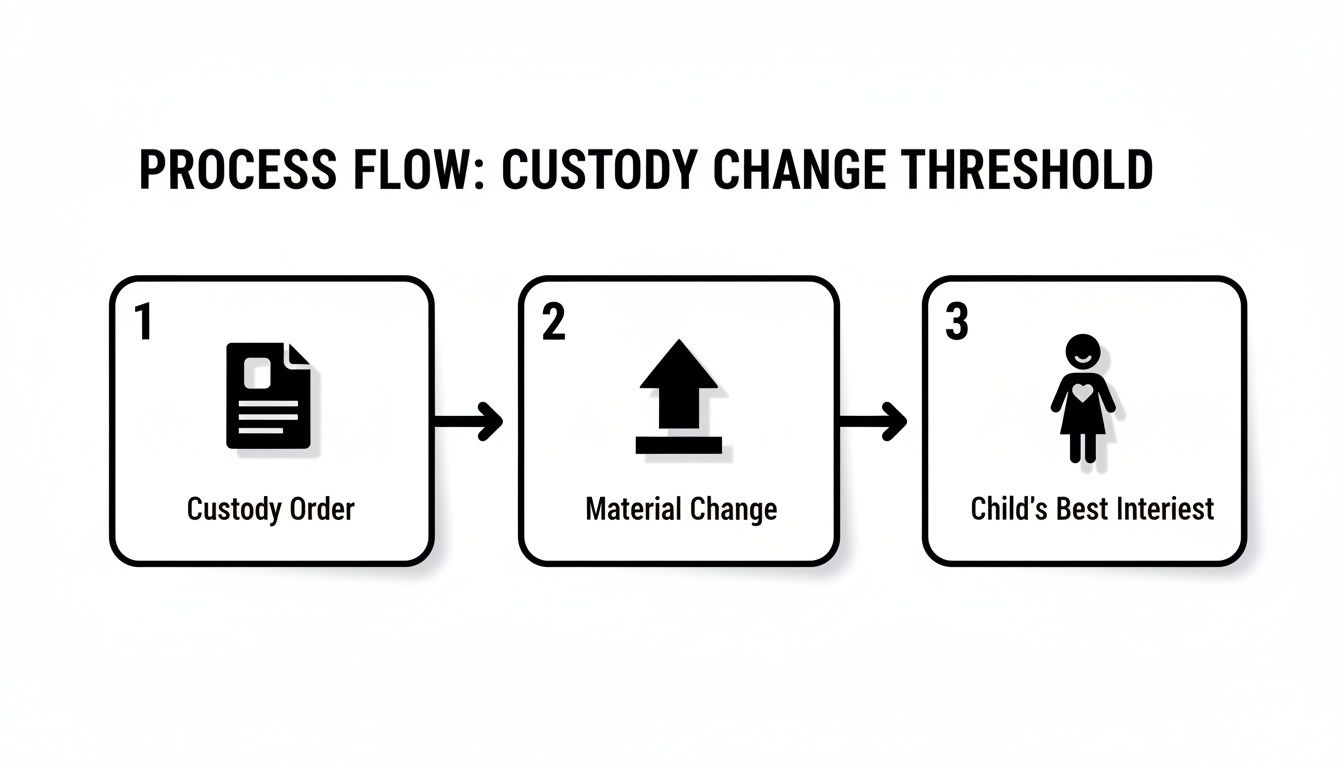
You have to prove both parts: first, that a significant change happened, and second, that changing the order is what’s truly best for your child.
Temporary Orders and the Discovery Phase
But what if you can't wait months for a final decision? What if your child’s well-being is at risk right now?
If you have serious concerns about your child's immediate physical or emotional safety, you can ask the court for Temporary Orders. This might involve requesting that you be named the temporary primary conservator or asking that the other parent’s time be supervised while the case is sorted out. A judge will schedule a hearing to decide if these temporary changes are necessary to protect your child.
Once the case is officially moving, you’ll enter a phase called discovery. This is the formal process of gathering evidence. It’s where you build the factual foundation for your case. Through discovery, your attorney can:
- Request for Production: Ask the other parent for documents like bank statements, text messages, emails, and social media posts.
- Interrogatories: Send written questions that the other parent is required to answer under oath.
- Depositions: Question the other parent and other witnesses under oath in front of a court reporter.
This is where you uncover the proof you need to show the judge why the current situation isn't working and why your proposed change is in your child's best interest.
Mediation: The Path to an Amicable Resolution
Before you ever step into a courtroom for a final trial, almost every county in Texas will require you and the other parent to go to mediation. This is a confidential meeting where a neutral third-party mediator works with both sides to try and reach a settlement.
A good mediator doesn’t pick sides. Their job is to help parents find common ground and craft their own solution, giving you control over the final outcome instead of leaving it in a judge's hands.
If you reach a deal, it's written down in a Mediated Settlement Agreement (MSA). An MSA is a powerful document—it’s binding and irrevocable, so once you sign, you can’t back out. Your attorneys then use the MSA to draft a final order for the judge to sign, ending your case without the time, expense, and stress of a trial.
Of course, if mediation doesn't work out, your case will be scheduled for a final trial. At that point, both sides will present their evidence, and the judge will make the final call on whether to change the primary conservator.
Building a Compelling Case with the Right Evidence

When you ask a judge to change who is the primary conservator, you're not just telling your side of the story—you're building a legal case. Your feelings about the situation are completely valid, but in a courtroom, facts and proof are what carry the day.
A successful modification hinges on showing the judge that things have changed significantly and that this change negatively impacts your child. It's not enough to say the other parent has become difficult; you have to prove it with solid evidence. Every document, text message, and witness statement should help paint a clear picture for the judge, leading them to the unavoidable conclusion that a change is what's best for your child.
From Concerns to Concrete Proof
Your firsthand experience is powerful, but it has to be translated into a language the court understands: evidence. Telling a judge the other parent is uncooperative is one thing. Showing them a log of 50 unanswered texts about your child's medical care tells a much more convincing story.
This is where you shift from a "he said, she said" argument to a fact-based presentation. Here’s the kind of documentation that can make all the difference:
- Communication Logs: Keep a detailed record of every text, email, and app message. This can reveal a pattern of hostility, an inability to co-parent, or a general disregard for your parental rights.
- School Records: A sudden drop in grades on a report card, a string of tardies, or emails from a concerned teacher are hard facts that point to instability in the primary parent's home.
- Medical and Mental Health Records: Can you show a pattern of missed doctor's appointments? A failure to give a child prescribed medication? This is powerful proof that the child's basic needs aren't being met.
- Police or CPS Reports: If safety is your concern, official reports documenting domestic violence, substance abuse, or neglect are some of the most compelling pieces of evidence you can have.
- A Personal Journal: Keep a dated log of every concerning event. Write down every missed visit, every time the child comes home visibly distressed, and every promise the other parent breaks. Over time, this journal creates a timeline that shows a consistent pattern of problems.
The task might feel huge. Texas courts manage a high volume of family law cases, and judges are careful about changing orders. But with the right proof, you can absolutely succeed.
The Power of Witness Testimony
Your evidence isn't just about paperwork. The people who see your child and interact with your family regularly can provide objective, powerful testimony. A judge often sees these third-party witnesses as more credible because they don't have a personal stake in the outcome—their only concern is your child.
Think about asking people like these to testify:
- Teachers or school counselors who've noticed changes in your child's behavior or schoolwork.
- Therapists or doctors who can speak to your child's emotional or physical health.
- Coaches, tutors, or daycare staff who see your child and both parents.
- Family friends or neighbors who have witnessed concerning behavior or can speak to the positive, stable home you provide.
A teacher's testimony that your child has become withdrawn and anxious at school can be more powerful than anything you say yourself. It's objective validation of the very concerns you're bringing to the court.
In some cases, the court may appoint an amicus attorney. This is a neutral lawyer whose sole job is to investigate the situation and tell the judge what they believe is in the child's best interest. They will interview everyone involved—you, the other parent, the child, and witnesses—before making a recommendation. To ensure depositions and interviews are captured accurately, many firms use specialized legal transcription services to create a perfect record.
Each document and witness adds a new layer to your argument, making it more and more persuasive. To get a better handle on the legal standard, you can read also: How to Prove Best Interest of the Child in a Texas Custody Case.
Special Considerations for Dads, Grandparents, and Military Families
When you're fighting to change who has primary conservatorship in Texas, the rulebook isn't a one-size-fits-all guide. Every family is different, and the law recognizes that. Your role as a dad, grandparent, or service member brings its own unique set of legal hurdles and strategic opportunities.
Getting a handle on these specific nuances is the first real step toward building a case that truly reflects your situation and gives you the strongest shot at a successful outcome.
Practical Guidance for Fathers Seeking Primary Conservatorship
On paper, Texas law is completely gender-neutral. Judges are explicitly forbidden from favoring a mother over a father based on old-school assumptions. In the real world, however, many dads feel like they’re starting the race from behind and have to work twice as hard to prove they are the best choice.
The key to overcoming this unspoken bias is to build a case that paints a vivid picture of your deep, consistent involvement in your child’s day-to-day life. You have to show the court you’re not just the "fun weekend parent"—you are absolutely essential to their stability and well-being.
Your evidence should hammer home these points:
- Active Daily Involvement: Keep a log. Show how you're the one handling homework, taking them to the doctor, showing up for teacher conferences, and driving to soccer practice.
- Providing a Stable Home: Demonstrate that you have a safe, clean, and appropriate home environment ready for your child right now.
- Effective Co-Parenting: This one is huge. Even when things are tense, showing you can communicate respectfully and consistently put your child's needs ahead of the conflict is incredibly persuasive to a judge.
Rights and Hurdles for Grandparents
Grandparents often become the last line of defense when a child's parents can't—or won't—provide a safe home. Your love for your grandchild might be unquestionable, but in the eyes of Texas law, that love alone isn't enough. You first have to clear a high legal bar known as standing just to get your foot in the courthouse door.
To file a suit for conservatorship, a grandparent usually has to prove that the child's current home presents a serious and immediate risk to their physical health or emotional well-being. This is a tough standard to meet. It typically requires showing that both parents are unfit due to major issues like drug or alcohol abuse, serious neglect, or incarceration.
A recent family law case highlighted how specific, detailed evidence can tip the scales. The court’s decision hinged on which parent provided a superior living arrangement and could better communicate about the child's needs, particularly since the child had special needs. It’s a perfect example of how proving you are better equipped to handle day-to-day challenges can make all the difference.
Protections for Military Families
Serving our country adds a whole other layer of complexity to custody battles. Deployments, training, and relocations are a reality of military life, and unfortunately, the other parent can try to use them as leverage to change the custody order. The good news is that both federal and state laws are in place to protect you.
The Servicemembers Civil Relief Act (SCRA) is a powerful federal law that can prevent a custody case from moving forward against you while you're deployed and physically unable to appear in court. On top of that, the Texas Family Code has its own provisions for military parents. A deployment, by itself, cannot be the sole reason to permanently modify a custody order.
For military families, it's also important to understand how military protective orders affect family life, as these can dramatically change living situations and parental roles. When a modification is needed because of your military service, a Texas court can issue temporary orders that automatically revert back once your service-related absence is over, protecting your parental rights in the long run.
Common Mistakes That Can Derail Your Custody Case
A case to change the primary conservator is an emotional marathon. Under that kind of stress, it’s all too easy to make mistakes that can sink your case and—more importantly—hurt your child. Knowing the common pitfalls is the first step to avoiding them, helping you stay focused on what truly matters: your child's best interests.

One of the biggest mistakes we see parents make is letting their emotions run their communication. Sending a furious text, leaving a hostile voicemail, or firing off accusations in a shared parenting app might feel justified in the heat of the moment. But it’s not.
Every one of those messages creates a paper trail the other side can—and will—use against you. A judge won’t see righteous anger; they’ll see an inability to co-parent effectively.
Bad-Mouthing the Other Parent
It’s so tempting to vent, but speaking negatively about the other parent is toxic, especially if your child can overhear you. This is poison for both your child’s emotional health and your legal standing. Texas courts want to see parents who can support their child’s relationship with the other parent, even when it's hard.
When you bad-mouth your co-parent, you aren't just creating more conflict. You're actively damaging your child's sense of security. A judge could easily view this behavior as parental alienation, which can be a deciding factor against you in a custody fight. The best approach? Keep conversations brief, informative, and focused only on the child. Think of it as "staying professional." It shows the court you are mature and child-centered.
Involving Your Child in the Conflict
This is a critical error. Asking your child to pick sides, relay messages to the other parent, or report back on what’s happening in the other home puts an unbearable emotional weight on them.
Children are not pawns in a legal game. A judge will be deeply concerned if it seems you’re using your child to gather information or manipulate the situation. This behavior flies directly in the face of the "best interest of the child" standard that guides every decision a Texas court makes. Your job is to shield your child from the conflict, period.
Key Insight: A court’s primary role is to protect children from their parents' conflict, not to reward the parent who involves them the most. Proving you can insulate your child from the legal fight is a sign of good parenting and a major strength in your case.
Misusing Social Media
In a custody modification, think of your social media accounts as an open book for the other attorney. Posting emotionally charged rants, photos of you partying, or anything that could possibly be twisted out of context is like handing ammunition to the other side.
Even an innocent post can be reframed to hurt you. A photo from a much-needed vacation might be spun as you neglecting your responsibilities. A frustrated comment about your ex can be used to paint you as unstable. The safest rule to follow is simple: assume a judge will read every single post.
The smartest strategy is to either temporarily deactivate your accounts or lock down your privacy settings. Even better, just don't post anything about your personal life or the case until it's over.
Making the right moves is just as important as avoiding the wrong ones. Here’s a quick guide to help you stay on track.
Modification Do's and Don'ts
| Do This | Don't Do This |
|---|---|
| Keep all communication with your ex brief, informative, and child-focused. | Send angry, emotional, or accusatory texts, emails, or voicemails. |
| Keep your child completely out of the legal conflict and adult conversations. | Ask your child to "spy" on the other parent or carry messages for you. |
| Assume a judge will see everything you post online. Adjust your social media habits accordingly. | Post rants, party pictures, or anything that could make you look unstable or irresponsible. |
| Show up to every exchange on time and be polite and professional. | Argue with your ex in front of your child during drop-offs or pick-ups. |
| Follow the current court order to the letter, even the parts you don't like. | Withhold visitation or refuse to follow parts of the order you disagree with. |
| Document everything calmly and factually, focusing on events, dates, and times. | Exaggerate claims or make false accusations to gain an advantage. |
By sticking to the "Do's," you demonstrate to the court that you are a stable, reliable parent who always puts your child first—which is the ultimate goal.
Family law statistics show that cases to change the primary conservator in Texas are common. Success, however, is far from guaranteed, especially for those who represent themselves. Avoiding these simple mistakes is crucial. Steering clear of these pitfalls significantly strengthens your position and boosts your chances of a positive outcome. You can learn more about recent family law statistics and see why professional guidance makes a real difference.
Next Steps: Common Questions When Changing Conservatorship
When you're thinking about changing who has primary custody, your mind probably races with questions—most of them starting with "how" or "what if." It’s a huge decision, and the path forward can feel foggy. Getting clear, direct answers from a trusted advocate is the first step toward feeling back in control.
Let's walk through some of the biggest concerns we hear from parents in your exact situation.
How Much Does It Cost to Change Primary Conservator in Texas?
This is often the first question on every parent's mind, and the answer almost always comes down to one thing: whether you and the other parent can agree.
If you’re on the same page, you can file what’s called an uncontested modification. This is, without a doubt, the fastest and most affordable way to get things done. In this scenario, your costs are usually just the attorney’s fees for drafting the "Agreed Order to Modify" and the standard court filing fees.
But if the other parent is determined to fight the change, you're looking at a contested modification, and the costs can climb quickly. You’ll need to budget for:
- Higher Attorney Fees: When a case is contested, your lawyer spends significantly more time on discovery, preparing for hearings, and potentially going to trial.
- Court Costs: This includes more than just filing fees. Think service fees for having the other parent served with paperwork and costs for court reporters during depositions and hearings.
- Expert Witness Fees: In some cases, you might need to hire a professional, like a child psychologist or custody evaluator, to review your case and testify on your child’s behalf.
- Amicus Attorney or Ad Litem Fees: If the judge feels the child needs their own lawyer to represent their interests, the court will appoint one. Typically, both parents are ordered to split the cost of these fees, which can be substantial.
Can My Child Decide Who to Live With?
We get this question a lot, especially from parents with teenagers. The Texas Family Code is very clear on this: if your child is 12 years of age or older, they have a legal right to speak with the judge. You can file a "Motion to Confer with Child," and the judge is required to meet with them privately in chambers to hear their preference.
But here’s the critical part: the child’s preference is not the final word.
A judge will absolutely listen to what a child has to say, but the court’s decision must always be based on the overall "best interest of the child." The judge will weigh the child’s wishes as just one piece of a much larger puzzle, considering everything else—each parent's stability, the child's emotional and physical needs, and any evidence of danger.
What Happens If the Other Parent Agrees to the Change?
If the other parent agrees, you’ve hit the best-case scenario for everyone involved, especially your child. An agreed modification saves an incredible amount of time, money, and emotional stress by keeping your family out of a courtroom battle.
When the other parent consents to you becoming the primary conservator, the process is quite simple. Your attorney will draft a legal document called an Agreed Order to Modify the Parent-Child Relationship. This document lays out all the new terms, including who will be the primary parent, the updated possession schedule, and any adjustments to child support.
Once both parents and their lawyers sign off on the Agreed Order, it’s submitted to the judge. As long as the judge agrees that the new arrangement is in your child's best interest, they will sign it. At that point, it becomes a new, legally binding court order, and your family can move forward on positive terms.
If you need help with a child custody or visitation case in Texas, our experienced attorneys can guide you every step of the way. Contact The Law Office of Bryan Fagan, PLLC today for a free consultation.