
When a child’s future is on the line, understanding your rights matters most. If you’ve stepped up to be a child’s primary caregiver but aren’t their legal parent, the future can feel incredibly uncertain. For so many grandparents, aunts, uncles, or other relatives, securing non-parent custody in Texas is the legal path to finally creating a stable future for a child you love. This process, known legally as “conservatorship,” gives you the authority to care for the child and make the big decisions that shape their life.
How Texas Determines Custody for Non-Parents

When a child’s well-being is at stake, Texas law always circles back to one core principle: the “best interests of the child.” This simple but powerful idea opens the door for dedicated caregivers—people who aren't biological or adoptive parents—to seek legal custody. If you've been the one providing a steady hand and a stable home when no one else could, the law recognizes just how critical your role is and gives you a way to formalize it.
The legal process to do this is called a Suit Affecting the Parent-Child Relationship (SAPCR). It’s how the court officially decides who will get the rights and responsibilities to care for a child. For countless grandparents, stepparents, and other relatives we've worked with, filing a SAPCR is the first real step toward protecting a child and keeping their life as stable as possible.
Key Custody Terms You Need to Know
In Texas, we don't really use the word "custody." The legal term is conservatorship, and it defines the specific rights and responsibilities an adult has for a child. Getting a handle on these terms is the first step in understanding your options.
There are two main types of conservators:
- Managing Conservator: This is the person who gets to make the major decisions about the child's life—choices related to schooling, non-emergency medical care, and psychological treatment. The managing conservator is almost always the person the child lives with day-to-day.
- Possessory Conservator: This person has the right to spend time with the child, usually based on a specific visitation schedule called a possession schedule. While they have the right to know what's going on in the child's life, they don't typically make the major decisions.
In non-parent custody cases, the court’s entire focus is on creating an arrangement that serves the child’s physical and emotional needs. The goal is to provide a safe, stable, and loving environment, even if that means placing the child with someone other than a parent.
When both the biological parents and a non-parent are involved, a court might set up a joint managing conservatorship, where everyone shares some decision-making rights. Even then, one person is typically named the "primary" managing conservator—the one who gets to decide where the child lives.
Sorting out the differences between these roles and seeing how they apply to your family’s unique situation is a huge part of the process. For a deeper dive, you can learn about the differences between custody and guardianship in our detailed guide. Your commitment to this child is the foundation; the law provides the tools to build a secure future.
Proving You Have the Right to File for Custody ("Standing")

Before a Texas judge will even listen to why you should have custody, you have to get your foot in the courthouse door. This first, critical step is called standing. Think of it as your legal right to be heard; without it, the court can't consider your case, no matter how much you love the child or how compelling your reasons are.
The rules for who can file a custody case are laid out in the Texas Family Code, specifically Chapter 153. This law is very clear about who—grandparents, aunts, uncles, or other caregivers—can start a Suit Affecting the Parent-Child Relationship (SAPCR). It’s the legal system’s way of ensuring only people with a real, significant connection to a child can ask a court to step into a family’s life.
Proving you have standing isn't about winning your case. It's about earning the right to make your case in the first place.
The Six-Month Rule for Standing
The most common path to standing for a non-parent is showing you’ve had “actual care, control, and possession of the child for at least six months.” Critically, this six-month period must have ended no more than 90 days before you file your petition with the court.
What does "actual care, control, and possession" really mean? It means you've been the one acting as the parent. You’re the person making sure they have meals, get to school on time, go to the doctor, and feel safe at night. For all intents and purposes, you’ve been their primary caregiver.
This rule recognizes the stability you've already provided when the biological parents couldn't or wouldn't. It gives you a legal voice to protect the bond you’ve built. When you need to prove this history in court, a formal notarized sworn statement is a powerful tool to lay out the facts for the judge.
Other Ways to Establish Standing
While the six-month rule is common, it’s not the only way. Texas law recognizes that families are complicated, and there are other situations where a child’s well-being depends on a non-parent.
The table below summarizes some of the most common grounds a non-parent can use to establish standing under Texas law.
| Method For Standing | Key Requirement |
|---|---|
| The Six-Month Rule | You had actual care, control, and possession of the child for at least six months (ending no more than 90 days before filing). |
| Consent | You have consent from both parents, the surviving parent, or the child's current managing conservator to file the suit. |
| Living with the Child | You lived with the child and a parent/guardian for at least six months, and that parent/guardian has now passed away. |
| Named in a Will | The last surviving parent named you as the person they wanted to be the child’s guardian in their will. |
| Risk of Harm | You are a close relative (within the third degree of consanguinity) and can show the child's current home would seriously harm their physical or emotional well-being. |
Each of these paths exists because the law understands that sometimes, protecting a child means looking beyond biology.
It’s crucial to know which of these situations fits your circumstances. An experienced family law attorney can help you identify the strongest legal argument for your case from day one.
A critical part of any non-parent custody case in Texas is preparing an affidavit—a sworn statement—that clearly explains the facts supporting your right to file. This document lays the groundwork for your entire case.
Figuring out if you have standing is the first conversation you need to have. It’s the key that unlocks the courthouse door, allowing you to take the next step toward securing a safe and stable future for the child you care about.
Meeting the "Best Interest of the Child" Standard
Once you’ve established your legal right to be in the courtroom—your standing—your case pivots to what is, without a doubt, the single most important principle in Texas family law: the best interest of the child. This is the North Star for every Texas judge. It guides every decision they make about a child's life.
It sounds straightforward, but how the court defines "best interest" is where the rubber meets the road.
Texas law operates on a powerful default setting called the parental presumption. The courts begin with the belief that a fit parent acts in their child's best interest, and the best place for a child is with that parent. As a non-parent, this is the first and biggest legal mountain you have to climb.
Overcoming the Parental Presumption
To win conservatorship over a parent, it’s not enough to show you’d be a better caregiver. You have to prove something much more specific. The law requires you to present "clear and convincing evidence" that leaving the child with their parent would "significantly impair the child's physical health or emotional development."
Let's be clear: this is an incredibly high bar. It demands powerful, specific facts showing the parent's actions or home environment poses a genuine, substantial risk. Vague worries or simply disagreeing with their parenting style won't cut it. The court needs to see that the impairment would be significant.
What Are The Holley Factors?
So, how does a judge figure out what's in a child's best interest? It’s not a gut feeling. They work from a checklist of factors laid out in a landmark Texas Supreme Court case, Holley v. Adams. We call them the Holley Factors.
A judge will look at evidence related to:
- The child’s emotional, physical, and future needs.
- The emotional or physical danger the child faces, now and in the future.
- The parenting abilities of the people seeking custody.
- Any programs available to help those individuals promote the child's best interest.
- The plans each person has for the child.
- The stability of the home (or homes) being offered.
- Any parental acts or failures to act that suggest the current parent-child relationship is improper.
- Any valid excuses for those acts or omissions.
This list isn't the final word, but it's the framework the court uses. Your entire case should be built to answer these questions with solid evidence. Learning more about how to prove the best interest of the child is a critical next step in getting prepared.
A judge can't just decide to grant you custody and move on. They are required to state in the final order that the parental presumption was overcome and list the specific facts that proved it. This isn't just a technicality—it’s a mandatory legal finding.
Gathering The Right Evidence
To meet that "significant impairment" standard, your job is to gather compelling evidence that speaks directly to the Holley Factors. You need to paint a clear, factual picture for the judge showing why your involvement is necessary for the child’s health and well-being.
Powerful evidence often includes things like:
- School Records: Report cards, attendance logs, or notes from teachers can be hard proof of instability or neglect.
- Medical Records: These can reveal a failure to provide necessary medical or dental care.
- Witness Testimony: Credible, neutral third parties—like teachers, counselors, or doctors—can provide unbiased accounts of the child's condition and the parent's conduct.
- Your Own Documentation: A detailed journal tracking events, your efforts to step in, and any concerning incidents can be invaluable.
- Evidence of an Unsafe Environment: This is where things like photos, police reports, or CPS records showing drug use, criminal activity, or abuse in the parent’s home become critical.
Building a non-parent custody case in Texas is a strategic effort. It’s not about launching personal attacks; it’s about methodically showing with objective facts why the child’s physical health and emotional development depend on you.
Navigating the Legal Process Step by Step
The court system can feel like a foreign country with its own language and rules. But when you have a roadmap, the journey becomes a whole lot less intimidating. A non-parent custody case in Texas follows a predictable path, and knowing what’s around the next corner can give you the confidence to keep moving forward.
Think of it as a three-part challenge you have to win. This flowchart breaks down the core legal hurdles every non-parent must clear.
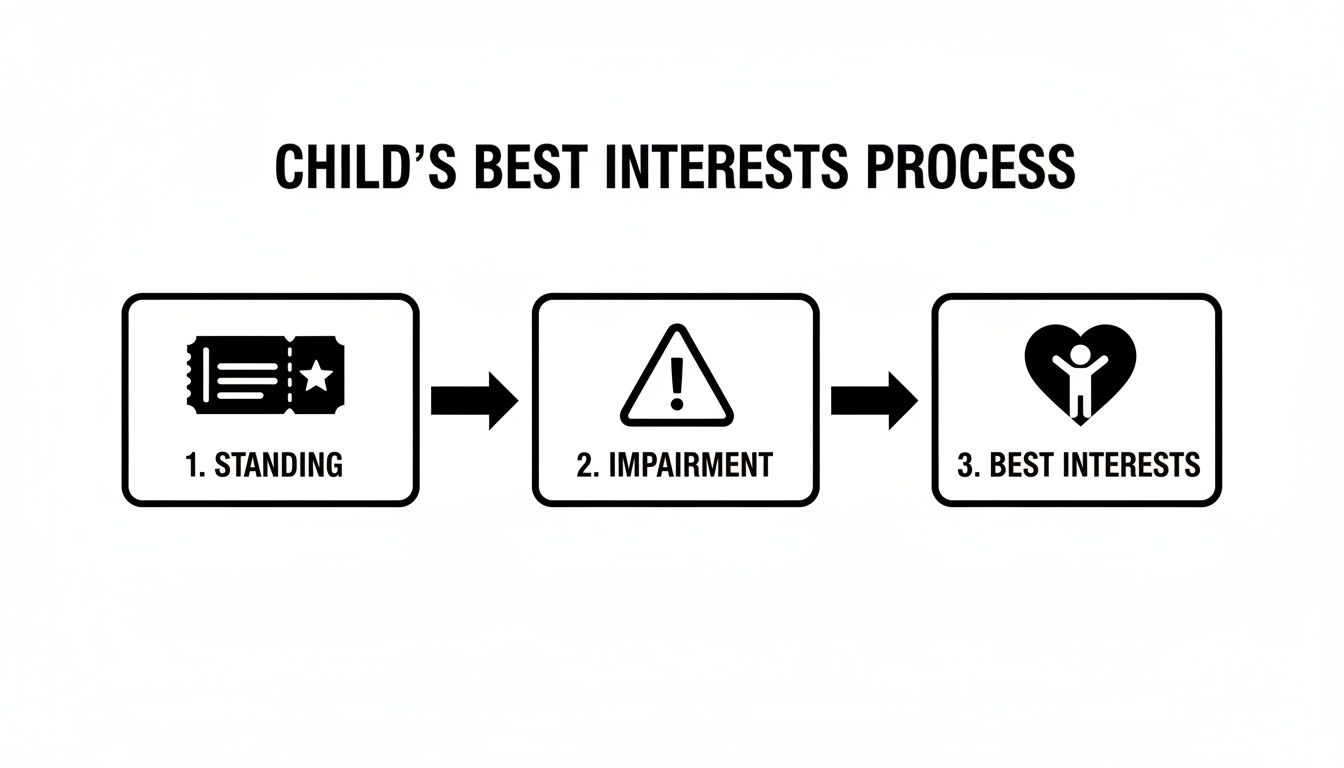
First, you have to prove you even have the right to be in court (Standing). Then, you must show that leaving the child with their parents is harmful (Impairment). And throughout it all, you have to convince the judge that your involvement is what’s truly best for the child.
Step 1: Filing the Initial Petition
Every custody case kicks off when you file an Original Petition in a Suit Affecting the Parent-Child Relationship (SAPCR). This is the formal document that tells the court who you are, who the parents are, and why you believe you should be granted conservatorship (custody).
But as a non-parent, you have an extra, critical step. You must also attach a sworn statement, or affidavit, detailing exactly how leaving the child with their parents would significantly impair the child's physical health or emotional development. This statement is the foundation of your entire case, so it must be built on facts you know firsthand.
Step 2: Service and Temporary Orders
Once your petition is filed, the child’s legal parents have to be formally notified of the lawsuit. This is called service of process. A constable, sheriff, or private process server will deliver a copy of the paperwork, making sure they know about the case and have a chance to respond.
Since final decisions can take months, you can ask for Temporary Orders right out of the gate. These orders are designed to create stability for the child while the case unfolds. They can address immediate needs like:
- Where the child will live in the meantime.
- Who makes the day-to-day decisions.
- A temporary visitation schedule for the parents.
The goal here isn't to win the case, but to keep the child’s world as stable as possible until a final ruling is made.
Step 3: Gathering Evidence Through Discovery
Next comes the discovery phase. This is where both sides formally collect the evidence they need to build their arguments. It’s a structured process that can include written questions (Interrogatories), requests for documents (Requests for Production), and sworn testimony taken outside of court (Depositions).
This is your chance to gather the school records, medical reports, text messages, and other proof that supports your claim of significant impairment. The parents will be doing the same to defend their parental rights. With so much paperwork flying back and forth, having an effective document management workflow is key to staying organized.
During discovery, your own life and history of caring for the child will be under a microscope. Every doctor’s appointment you took them to, every meal you made, and every school event you attended becomes powerful, concrete evidence of your bond and commitment.
Step 4: Mediation and Reaching an Agreement
Before setting a case for a full-blown trial, nearly every Texas court will require you to try mediation. Here, a neutral third-party mediator sits down with you and the parents to help you negotiate a solution on your own terms. It’s confidential, less stressful than court, and often surprisingly effective.
If you hash out an agreement, it’s put into writing, signed by the judge, and becomes a final, enforceable order. If you can’t find common ground, your case gets scheduled for a final hearing in front of the judge.
Step 5: The Final Hearing
If mediation doesn't work out, your case heads to a final hearing. This is where both sides present their evidence, call witnesses to testify, and make their legal arguments directly to the judge. It’s your last, best chance to tell your story and show the court why the child’s best interest is served by your involvement.
After hearing everything, the judge will issue a final ruling that decides conservatorship, possession, and child support for the future.
Grandparent Rights and Other Common Scenarios
While Texas law sets a high bar for any non-parent seeking custody, some of the most common cases we see involve relatives who’ve already stepped into a parental role. Often, it's a grandparent, aunt, or uncle who took charge during a family crisis.
Understanding the specific legal paths available in these situations is critical. The law recognizes that these aren't strangers—these are family members fighting to protect a child they already love and care for.
Grandparent Possession and Access
The bond between grandparents and their grandchildren is special, and Texas law provides a specific, though narrow, path for them. For many grandparents we work with, the goal isn't to take full custody (conservatorship) but simply to ensure they aren't cut out of the child’s life.
This is legally known as seeking “possession and access,” which is what most people call visitation.
To get a court-ordered visitation schedule, a grandparent has to file a lawsuit and prove that being denied access would significantly impair the child’s physical health or emotional well-being. It’s a tough standard, but it’s focused on one question: is the parent’s decision to block your visits actively harming your grandchild?
The court’s starting point is that a fit parent acts in their child's best interest—and that includes choosing who the child spends time with. Your job is to present a case so compelling that it overcomes that assumption.
It's also important to note that at least one of the child's biological or adoptive parents must still have their parental rights. This legal route is about gaining access within an existing family structure, not stepping in after a parent’s rights have been terminated. For a much deeper dive, we strongly recommend our guide on grandparents' custody rights in Texas.
De Facto Custodians: The Unofficial Parents
Beyond grandparents, we often see other relatives who have become a child’s primary parent in every way that matters. You might be the aunt who took in your nephew when his parents couldn't cope, or the older sibling who has been providing meals, shelter, and stability for months on end.
When you've been the one handling the day-to-day responsibilities—the school runs, the doctor's appointments, the bedtime stories—the court may view you as a "de facto custodian." While this isn't an official legal title, it describes a powerful, real-world role that judges take very seriously. Your right to even file for custody often comes from having "actual care, control, and possession" of the child for at least six months.
In these situations, your case will hinge on two key things:
- Your history of care: You’ll need to meticulously document how you have been the child’s primary caregiver and source of stability.
- The risk of harm: You still have to prove that removing the child from your care and placing them with the parent would cause significant impairment to their well-being.
Whether you're a grandparent trying to secure visitation or an aunt who has become a child's safe harbor, the court's ultimate goal is to create a safe and stable future for that child. We know these cases are emotionally draining, but your role is to clearly show the judge why your continued presence is absolutely essential for the child's best interest.
Your Next Steps in a Non-Parent Custody Case
You’ve learned the hard truths about non-parent custody cases in Texas. It's an uphill battle, emotionally draining, and legally complex. But knowing what you're up against is half the fight. Now it’s time to take that knowledge and forge a clear path forward for you and the child you’re fighting to protect.
This entire process boils down to clearing three major legal hurdles. First, you have to prove you have standing—your legal ticket to even get in the courthouse door. Second, you must overcome the powerful parental presumption by showing that leaving the child with their parent would cause significant impairment to their well-being. And finally, every argument, every piece of evidence, must tie back to the best interest of the child, the single principle that guides every decision a judge makes.
Turning Knowledge into Action
With this legal reality in mind, it's time to shift from learning to doing. The actions you take right now can make or break your case down the road.
Here are the most critical steps to take immediately:
- Gather Your Documentation: Start collecting everything that proves your history of caring for the child. Think school records, medical bills, photos, text messages, and even a detailed journal of your day-to-day involvement. Every document helps paint a picture of you as the child’s stable, consistent caregiver.
- Prepare Emotionally and Financially: These cases are marathons, not sprints. You need to brace yourself for a long and difficult journey. Building a strong support system of friends and family is just as crucial as building your legal case.
The single most important step you can take is to get professional legal advice. An experienced attorney can look at the unique facts of your situation, lay out your real options, and help you build the strongest possible case from day one.
How an Attorney Can Help
Trying to win a non parent custody Texas case on your own is like trying to perform surgery on yourself—it’s incredibly risky, and the stakes are just too high. The legal standards are deliberately difficult to meet.
An experienced family law attorney is your guide and your advocate. They know how to translate your love and dedication for the child into a legal argument that a judge will understand and respect. They handle the filings, represent you in court, and help you present your evidence in the most compelling way possible.
Your commitment has brought you this far. Let an expert help you take the next, most important step.
If you need help with a child custody or visitation case in Texas, our experienced attorneys can guide you every step of the way. Contact The Law Office of Bryan Fagan, PLLC today for a free consultation.
Your Non-Parent Custody Questions, Answered
When a child’s future is on the line, you need clear, straightforward answers. We get it. A non-parent custody Texas case can feel like trying to find your way in the dark, and a lot of questions come up along the way. We’ve heard them all, and we’ve put together answers to the most common ones to help you see the path forward.
Can I Get Emergency Custody If a Child Is in Danger?
Absolutely, yes. If you have a legitimate fear that a child is in immediate physical or emotional danger, you can ask the court for a Temporary Restraining Order (TRO) and emergency temporary orders. This isn't a standard custody hearing; it's an urgent legal SOS for situations where the child’s current home poses a real and immediate threat.
To get this kind of emergency relief, you can't just tell the judge you're worried. You have to show them with compelling evidence why waiting for a regular hearing would put the child in harm's way. Our attorneys can help you file the right paperwork immediately to get the child—and you—the protection you need.
What If the Parents Agree to Let Me Have Custody?
When a child's legal parents agree to let you take custody, things get a whole lot simpler. Their consent can be written into a formal court order, which lets everyone sidestep a long, expensive, and emotionally draining court battle.
But even when everyone is on the same page, getting that agreement signed by a judge is non-negotiable. A verbal promise or a handshake deal won't cut it. Only a formal court order makes your custody rights legally enforceable and gives you the authority to make critical decisions for the child.
A handshake deal is not enough to protect you or the child. Only a formal court order can grant you the legal authority to make decisions about the child's schooling, medical care, and other vital matters.
How Much Does a Non-Parent Custody Case Cost?
The cost of a non-parent custody case in Texas can vary dramatically. An uncontested case, where everyone agrees on the outcome from the start, will always be significantly less expensive than a contested case that goes all the way to a trial.
The final price tag usually comes down to a few key factors:
- Attorney's fees for legal strategy, paperwork, and court appearances.
- Court filing fees to officially start the case.
- Extra costs for things like mediation or having an amicus attorney appointed to represent the child.
During a free consultation, one of our attorneys can give you a much clearer cost estimate based on the specific facts of your situation.
What Rights Do I Have As a Stepparent?
In Texas, stepparents don't automatically get custody rights, no matter how involved they are in their stepchildren's lives. To get legal rights, you have to establish "standing" in court, just like any other non-parent.
The most common path for a stepparent is to show the court that they've had the primary care, control, and possession of the child for at least six months. If you're looking to gain the full rights of a legal parent, the only way to do that is through a formal stepparent adoption, which requires terminating the other biological parent's rights.
If you need help with a child custody or visitation case in Texas, our experienced attorneys can guide you every step of the way. Contact The Law Office of Bryan Fagan, PLLC today for a free consultation.