
When your child's future is on the line, understanding your rights matters most. Forming a deep bond with your stepchild is a profound experience, but in Texas, love alone doesn't automatically grant you legal custody rights. While state law naturally prioritizes a child's biological parents, it doesn't leave dedicated stepparents without options. You may have a specific legal pathway to gain rights, but you'll have to go through a formal court process to get there.
Understanding Your Role as a Stepparent vs. Your Legal Rights
When you marry someone with a child, your role often evolves far beyond "mom's new husband" or "dad's new wife." You quickly become a confidant, a homework helper, a chauffeur, and an integral part of that child's daily life. Legally speaking, however, your position as a stepparent doesn't automatically grant you the authority to make decisions for your stepchild or guarantee you the right to see them.
This can be a tough pill to swallow, especially when you are deeply involved in raising the child. The good news is that Texas law provides a way for stepparents to ask a court for legal rights, though it’s not always a simple process.
The First Step: Filing a SAPCR
To seek any form of custody or visitation, you must first file a lawsuit known as a Suit Affecting the Parent-Child Relationship (SAPCR). This is the formal legal proceeding used in Texas for all matters involving children, including:
- Establishing custody (which Texas calls "conservatorship")
- Creating visitation schedules (known as a "possession order")
- Ordering child support
Think of filing a SAPCR as knocking on the courthouse door. It’s the very first step you have to take to get a judge to listen to your case and consider granting you the legal rights you're seeking to protect the relationship you have with your stepchild.

Why Rights Aren't Automatic
Texas law is built on a strong presumption that a child's biological parents should have the primary authority to raise their children. This is why a stepparent’s role, no matter how loving or significant, isn’t automatically recognized with legal rights.
A court’s main focus is always protecting the “best interest of the child.” While you may feel that your involvement is clearly in their best interest, the law requires you to formally prove it through the court system before any rights can be granted.
This legal framework is designed to provide stability for children and honor the fundamental rights of parents, but it can also create hurdles for stepparents who have become essential caregivers. Understanding your legal standing often goes hand-in-hand with fostering healthy family dynamics, which highlights the importance of relational therapy for Texans' mental health. The legal process can be stressful, and our goal is to demystify these first steps and show you that you have options to protect the bond you’ve worked so hard to build.
How to Get Your Foot in the Courthouse Door: Proving "Standing"
Before a Texas judge can even consider your request for custody or visitation, you have to prove you have a legal right to be there. This critical first hurdle is called “standing,” and you can think of it as your non-negotiable ticket to the main event.
For most stepparents, the rulebook for getting that ticket is found in Texas Family Code Section 102.003. This law spells out exactly who, other than a biological parent, can file a Suit Affecting the Parent-Child Relationship (SAPCR). If you don't meet these strict requirements, a judge has no choice but to dismiss your case, no matter how much you love your stepchild or how deeply involved you are in their life.

The Six-Month Care and Control Rule
For years, the most common path for a stepparent to establish standing was to show they had “actual care, control, and possession” of the child for at least six months. This meant proving to a judge that you were a primary, hands-on caregiver in the child's daily life.
This six-month window is also very specific: it must have ended no more than 90 days before you file your petition with the court. It’s a tight timeline designed to ensure the person filing the suit has a recent and significant relationship with the child. However, a major legal shift has made this route much harder for stepparents.
The Impact of the 2025 "Exclusive Care" Requirement
The landscape for stepparent rights in Texas changed dramatically in 2025. A new law raised the bar significantly for most stepparents. The old standard of "actual care" was replaced with a far stricter requirement of "exclusive care." This one-word change might seem small, but it represents a huge barrier. If you want to dive deeper, you can explore the details of how this legislative update narrows stepparent access to children, but the bottom line is that proving standing is now tougher than ever.
So, what does this new standard actually mean for you?
- Shared Care Is No Longer Enough: Under the old rule, you could have standing even if you shared caregiving duties with your spouse (the biological parent). Now, the law requires you to prove you were the only person providing care, control, and possession for that six-month period.
- Parental Involvement Is a Major Hurdle: If the biological parent was also actively involved—making meals, helping with homework, taking the child to the doctor—it will be almost impossible to argue that your care was "exclusive."
- Documentation Is Everything: This change means you absolutely must have overwhelming proof. Proving you had exclusive care requires rock-solid evidence that you were the sole person managing the child’s day-to-day life.
This stricter standard reinforces a core legal principle: biological parents have superior rights. For a stepparent, this means you can no longer just be a fantastic co-parent; to gain standing under this rule, you must have effectively been the only parent for a solid six-month stretch.
Building Your Case for Standing
Given this much higher legal bar, gathering detailed evidence isn't just a good idea—it’s a necessity. If you believe your situation meets the tough new "exclusive care" requirement, you need to start compiling proof that documents your role as the one and only primary caregiver.
This isn't just about your word against theirs. You'll need concrete evidence, such as:
- School records that list you as the sole emergency contact.
- Emails and texts with teachers, doctors, and coaches where you are clearly the only point of contact.
- Receipts and bank statements showing you alone paid for the child’s daily needs, medical bills, and extracurriculars.
- Testimony from neutral third parties like friends, neighbors, or teachers who can confirm the biological parent was absent or uninvolved during that specific six-month period.
Proving you have a right to be in court has always been the first and biggest hurdle in Texas stepparent rights cases. With the "exclusive care" requirement now in effect, getting over that hurdle requires a smart legal strategy. An experienced family law attorney can help you determine if your situation meets this demanding new standard and, if not, explore any other possible avenues for getting your case in front of a judge.
How Texas Determines Custody: The "Best Interest of the Child"
Once you’ve proven you have the right to be in court (what lawyers call “standing”), the judge’s focus shifts to one single, powerful question: what is in the “best interest of the child?”
This isn't just a feel-good slogan. It’s the absolute bedrock of Texas family law and the legal standard a judge must use for every decision they make about a child, whether the case is between two biological parents or involves a stepparent like you.
For a stepparent seeking rights, this means showing the court that your continued presence is more than just a nice bonus—it’s truly vital to the child’s happiness, stability, and overall well-being.
Understanding the Holcomb Factors
To guide their decisions, Texas courts use a specific list of criteria known as the “Holcomb Factors.” While a judge can consider other relevant information, these factors are the main framework they use to get a full picture of the child's world and the abilities of each person asking for custody.
The key factors include:
- The emotional, physical, and developmental needs of the child, both now and in the future.
- Any emotional or physical danger the child might face.
- The parental abilities of the individuals seeking custody.
- The stability of the home or proposed home.
- Programs available to help those individuals promote the child's best interest.
- Acts or failures to act by a parent that suggest the current parent-child relationship isn't a proper one.
- Any explanation for those acts or omissions.
For you as a stepparent, this list is your roadmap. It tells you exactly what you need to prove to build a compelling case, showing the judge how you positively impact each of these areas in the child's life.
Proving Your Case as a Stepparent
You can't just walk into court and tell the judge you're a great stepparent; you have to show it with undeniable proof. Your attorney's job is to help you gather concrete evidence that speaks directly to those Holcomb factors.
For example, you might demonstrate the stability of the home by providing proof that you’ve lived in the same house for years, creating a consistent and safe environment. To show your parental abilities, you could have teachers testify that you help with homework, or bring in neighbors who have watched you interact lovingly and patiently with the child.
Evidence is everything. We use photos, videos, school records, report cards, and testimony from witnesses like coaches, counselors, or family friends who have seen your positive influence firsthand. Your entire case comes down to painting a clear picture for the judge: that this child’s life is measurably better and more stable because you are in it. A strong case often involves knowing what kind of legal arrangement to ask for. You can learn more by reading our guide on conservatorship in Texas.
Stepparent Legal Options: Conservatorship vs. Adoption
When you've poured your heart into raising your stepchild, wanting to make your role official is a natural next step. But in the eyes of Texas law, there are two very different roads you can take: conservatorship (what Texas calls custody) and adoption.
It’s crucial to understand that these paths lead to dramatically different outcomes. This isn't just about paperwork; it's about defining your legal relationship with the child you love. One route gives you specific, protected rights as a non-parent, while the other makes you a legal parent, forever.
What is Conservatorship?
For most stepparents, seeking conservatorship is the most common and attainable goal. When a court names you a conservator, you are granted specific, legally enforceable rights and responsibilities.
Think of it as the court officially recognizing you as a vital guardian in the child’s life. These rights often include:
- The right to a possession schedule, which is a court-ordered, enforceable visitation schedule.
- The right to make certain decisions about the child's life, usually shared with the biological parents.
- The right to be informed about the child's education, health, and well-being.
However, conservatorship does not make you a legal parent. The child’s biological parents keep their parental rights, and your role, while legally protected, comes second to theirs.
What is Stepparent Adoption?
Stepparent adoption is a much more permanent and legally significant process. Unlike conservatorship, adoption completely ends the parent-child relationship with one of the biological parents and creates a brand-new, legal parent-child relationship between you and your stepchild.
In the eyes of the law, adoption makes the child your own, forever. You gain all the same rights and responsibilities as a biological parent, and the child's original birth certificate is replaced with a new one listing you as their legal parent.
This is an incredibly powerful way to solidify your family, but it comes with a major legal hurdle.
The "Two Legal Parents" Rule in Texas
Texas law is firm that a child can have no more than two legal parents at any given time. This rule is the foundation for how both adoption and custody cases involving stepparents work.
Before you can adopt your stepchild, the parental rights of the other biological parent—the one you aren't married to—must be legally terminated. You can learn more about the process of relinquishing parental rights in our detailed guide on the topic.
This termination can happen in two ways:
- Voluntary Termination: The other biological parent willingly signs away their parental rights. This is the smoothest path for stepparent adoptions.
- Involuntary Termination: This is a much tougher fight. A court must be convinced to terminate the other parent's rights against their will, usually due to serious issues like abandonment, neglect, or abuse.
Additionally, children who are 12 years old or older must give their own legal consent to the adoption. A judge will typically have a private conversation with the child to ensure their consent is genuine. The choice between pursuing conservatorship or adoption depends entirely on your family's unique situation and goals.
Navigating the Legal Process: A Step-by-Step Overview
When your relationship with a stepchild hangs in the balance, the thought of a court battle can be overwhelming. Knowing the road ahead can make all the difference.
A stepparent custody case, or Suit Affecting the Parent-Child Relationship (SAPCR), is a series of steps. Understanding this process demystifies the court system and lets you focus on what's most important: protecting that precious bond with your stepchild.
The First Steps: Filing the Petition and Notifying Everyone
Your legal journey officially kicks off when your attorney files an Original Petition with the court. This document tells the court who you are, describes your relationship with the child, and clearly states what you're asking for—like being named a conservator with a formal possession schedule.
Once filed, the other parties (usually the child's biological parents) must be legally notified through a process called service of process. This ensures that everyone has a fair chance to respond to your lawsuit.
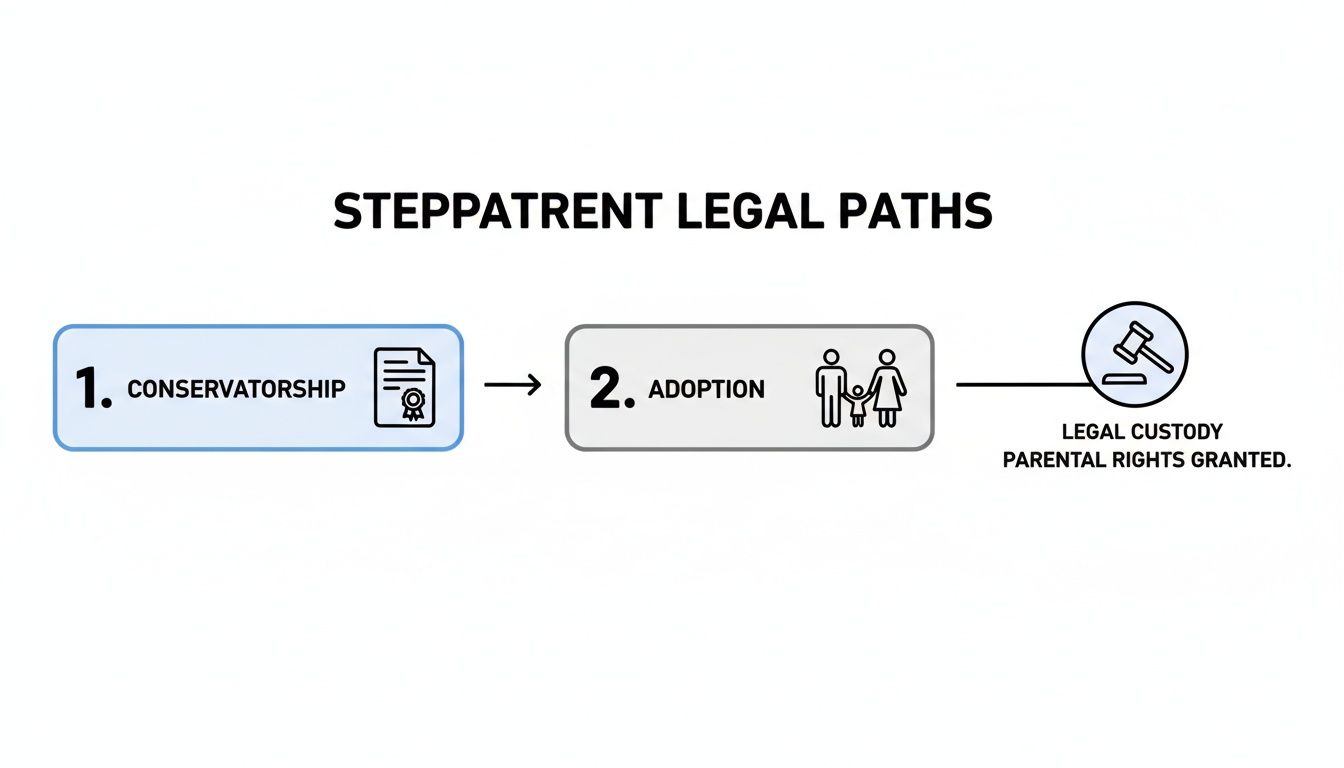
As you can see, while both options provide legal security for your relationship, adoption is the only one that creates a complete, permanent parent-child relationship in the eyes of the law.
The Middle Game: Discovery and Mediation
After initial filings, the case enters the discovery phase. This is the formal process where both sides gather facts and evidence. You can request documents, send written questions, and conduct formal interviews under oath (depositions). This is where you lay the groundwork to prove that granting you rights is in the child’s best interest. Knowing how to prepare for deposition is a key part of this stage.
Before trial, Texas courts almost always require mediation. This is a confidential meeting where a neutral professional—the mediator—helps you and the other parent try to negotiate a settlement. The goal is to find a compromise everyone can live with, saving the time, money, and emotional toll of a trial. A huge number of cases are successfully settled here. For a deeper dive, take a look at our guide on non-parent custody rights in Texas.
The Final Stretch: Hearings, Trials, and Safeguards
If you can't reach an agreement in mediation, your case will be set for a hearing or final trial. This is your day in court, where you and your attorney present all your evidence and arguments to a judge. The judge will listen to all sides before making a final, legally binding decision based on the child's best interest.
It's crucial to remember why a formal court order is so important. Divorce rates for second marriages remain high. This creates profound uncertainty for stepchildren. A formal custody order is your family’s best safeguard, providing your stepchild with the stability and security of knowing your relationship is protected, no matter what the future holds.
Key Takeaways and Next Steps
You’ve taken the time to understand the legal landscape of stepparent rights in Texas, which is the first real step toward protecting the family you’ve helped build. It can feel like navigating a maze, but you now have a map of the territory.
Securing your rights as a stepparent is possible, but it’s an uphill climb. The law is built to protect the rights of biological parents, so you’ll face significant legal hurdles, starting with proving you have “standing” to even ask the court for help.
Core Pillars of Your Case:
- Standing is Your Key: You must prove you have a legal right to file a case. The shift to an "exclusive care" standard makes this tougher than before. You’ll need documented proof that you were the primary person caring for the child.
- The Child's Best Interest is Everything: Once in court, the judge’s focus is solely on what is best for the child. Your job is to prove, with concrete evidence, that you provide crucial stability, love, and support.
- Know Your Goal (Conservatorship vs. Adoption): These are two completely different legal paths. Conservatorship secures your relationship through custody and visitation. Adoption is permanent and creates a legal parent-child relationship, but only after a biological parent’s rights have been terminated.
Your love for your stepchild has brought you this far, but you don't have to walk the rest of this path alone. Your role in your stepchild's life is special, and while Texas law is tough, it provides a way to protect that bond. The smartest, most practical thing you can do now is get an experienced legal guide in your corner.
If you need help with a child custody or visitation case in Texas, our experienced attorneys can guide you every step of the way. Contact The Law Office of Bryan Fagan, PLLC today for a free consultation.
Frequently Asked Questions About Stepparent Rights in Texas
As a stepparent, you are an integral part of your stepchild's family. You help with homework, drive to soccer practice, and provide comfort after a bad dream. But when legal questions come up, it's easy to feel like you're on the outside looking in. Here are straightforward answers to the questions our attorneys hear most often from stepparents across Texas.
Can I get custody if the other biological parent objects?
Yes, but it is one of the toughest fights in family law. When a fit biological parent objects to you getting custody, the court starts with a powerful legal assumption that the child belongs with their biological parent. This is called the parental presumption.
To overcome this, you must prove that giving custody to that parent would "significantly impair the child’s physical health or emotional development." This is a monumental bar to clear. You'll need overwhelming evidence of serious issues like neglect, abuse, endangerment, or severe substance abuse to persuade a judge. This is why having a seasoned attorney to build a rock-solid case is not just helpful—it's essential.
What happens if my spouse and I get a divorce?
This is a fear that keeps many stepparents up at night. If you and your spouse—the child's biological parent—divorce, any access you have to your stepchild is not guaranteed unless you have a formal court order. Without that legal order, the biological parents' rights almost always come first, and you could find yourself completely cut out of the child's life.
This is precisely why it’s so critical to formalize your relationship with your stepchild through a Suit Affecting the Parent-Child Relationship (SAPCR) while you are still married. A court order can grant you the legal right to visitation and access, even if your marriage unfortunately ends.
How much does a stepparent custody case cost?
The cost of a stepparent custody case can vary widely. The final cost depends on the complexity of your family's situation and, most importantly, whether everyone is in agreement.
- Uncontested Case: If every party agrees, the legal process is much quicker, more streamlined, and far less expensive.
- Contested Case: If the other biological parent fights your case and it heads toward a trial, the costs will climb significantly due to the extensive legal work involved.
The only way to get a realistic estimate is to sit down with an attorney and walk them through the specific details of your situation.
If you need help with a child custody or visitation case in Texas, our experienced attorneys can guide you every step of the way. Contact The Law Office of Bryan Fagan, PLLC today for a free consultation at https://texascustodylawyer.net.