
When your child’s future is on the line, understanding your rights matters most. It's a gut-wrenching feeling when your child, who once looked at you with adoration, suddenly becomes distant, angry, or shut down for reasons that make no sense. One day you’re sharing inside jokes, and the next, you feel like a stranger.
This isn’t just a tough co-parenting phase; it could be the devastating result of parental alienation. In plain English, it's when one parent's actions deliberately sabotage a child's relationship with the other parent, often using manipulation and false narratives. While it feels like a personal heartbreak, Texas courts see it as a direct threat to a child's well-being and offer legal ways to fight back. This guide is for you—the loving parent who feels like they're being erased from their child's life. We want you to know that you are not alone, and there is a path forward.

How Texas Law Views Parental Alienation
The Texas Family Code is built around one guiding principle: the “best interest of the child.” This is the legal standard judges must use for every decision. The courts view parental alienation as a direct and serious violation of that standard because it can cause significant emotional harm, leaving lasting scars on a child's development and mental health. This isn’t just a simple parenting disagreement; it’s a form of emotional manipulation that Texas law takes very seriously.
The tough reality is that parental alienation isn't rare. A staggering 59.1% of divorced parents report dealing with specific alienating behaviors from their ex-partner. This statistic shows just how common it is for one parent to systematically undermine the child's other parent through badmouthing, false accusations, or interfering with visitation, especially in high-conflict cases. You can discover more insights in discussions about proving parental alienation in Texas family law.
Your First Steps Toward a Solution
Feeling powerless is completely normal when you’re in this situation. But taking clear, intentional action is the only way to reclaim your role as a parent and protect your child. The journey starts with three critical steps:
- Understand the Signs: Learn to spot the specific behaviors that add up to alienation.
- Document Everything: Keep a detailed log of every incident, missed visit, and manipulative text or email.
- Know Your Legal Options: Get familiar with how Texas courts can step in to stop the harmful behavior.
These initial actions are the most powerful moves you can make to start rebuilding your relationship and safeguarding your child’s emotional health. This guide will walk you through each piece, giving you the clarity and confidence you need to move forward.
Recognizing the Signs of Parental Alienation
Parental alienation isn’t a single, explosive event. It's more like a slow, quiet poison—a pattern of damaging behaviors that build up over time, chipping away at the foundation of your relationship with your child. For a parent on the receiving end, it can feel like a confusing, heartbreaking erosion of everything you once had.
Identifying these patterns is the very first step toward getting back on solid ground. The signs often show up in both the alienating parent's actions and the child's reactions, creating a toxic dynamic that Texas courts take very seriously.

It all starts with recognizing that what you're experiencing isn't just normal co-parenting friction. It’s a deliberate campaign—whether conscious or subconscious—to sever a healthy parent-child bond.
Behaviors of the Alienating Parent
The alienating parent often casts themselves as the hero in the story, the “good” parent, while painting you as the villain. Their actions are meticulously designed to interfere with your relationship and force your child into an impossible loyalty conflict.
Here are some of the classic moves you might see:
- Constant Criticism: They relentlessly badmouth you, your new partner, or your family right in front of your child. Normal life events get twisted and framed as more "proof" of your supposed flaws.
- Interfering with Your Time: They might suddenly schedule conflicting activities during your legally ordered possession schedule (the Texas term for a visitation schedule), "forget" to have the child ready for exchanges, or severely limit phone calls and video chats.
- Creating Loyalty Binds: This is emotional manipulation at its worst, forcing the child to choose sides. Think of phrases like, “If you really loved me, you wouldn’t want to go to your dad’s house this weekend.”
- Sharing Inappropriate Details: They might overshare adult details about the divorce or, in severe cases, make false allegations of abuse or neglect, causing the child to feel genuine fear or anxiety about spending time with you.
These actions aren't just petty disagreements. They represent a coordinated effort to dismantle your parental authority and your child's natural affection for you.
Heartbreaking Changes in Your Child
The most painful signs of parental alienation are often the ones you see in the child you love. Their sudden, intense rejection can feel like it came out of nowhere, but it’s almost always a direct result of the other parent's influence. To help you connect the dots, here’s a look at how an alienator's actions can manifest in a child's behavior.
| Behavior of the Alienating Parent | Resulting Behavior in the Child |
|---|---|
| Constantly badmouths the targeted parent. | Child parrots adult criticisms, often using language they don't fully understand (e.g., "You ruined our finances"). |
| Creates loyalty conflicts, forcing the child to choose. | Child shows unwavering, reflexive support for the alienating parent, seeing them as "all good" and the targeted parent as "all bad." |
| Interferes with communication and visitation time. | Child gives weak, illogical, or nonsensical reasons for not wanting to see the targeted parent. |
| Shares inappropriate adult information or false allegations. | Child shows no guilt or remorse for their cruelty and rejects the targeted parent’s entire extended family without reason. |
A child caught in the middle of parental alienation is not just "acting out." They are often parroting adult grievances and adopting a worldview that isn't their own. The rejection you feel is a symptom of a much deeper problem that requires intervention to protect your child's emotional well-being.
How Texas Determines Custody in Alienation Cases
When you’re fighting to protect your relationship with your child, it can feel like a deeply personal and emotional battle. But make no mistake: in the eyes of Texas law, parental alienation isn’t just bad co-parenting. It’s a serious legal issue that directly threatens a child’s safety and well-being.
The entire Texas Family Code is built on one foundational principle: every decision must be made in the “best interest of the child.” This isn't just a vague guideline; it's the legal standard defined in Texas Family Code Chapter 153 that every judge must follow. When one parent launches a calculated campaign to destroy your bond with your child, they are directly violating this core principle.
The Best Interest of the Child Standard
So, what does “best interest” actually mean in a courtroom? Texas courts look at a long list of factors, and alienating behaviors run contrary to almost all of them. A judge will weigh things like:
- The emotional and physical needs of the child, both now and in the future.
- The parental abilities of each person seeking custody.
- The stability of each home environment.
- Any actions or failures to act by a parent that suggest the current parent-child relationship isn't a proper one.
When a parent actively works to sabotage a child’s relationship with the other parent, they are fundamentally failing to prioritize the child’s need for a healthy connection with both parents. This isn't just poor behavior; it's a direct failure to act in the child's best interest.
Joint Managing Conservatorship and Alienation
In Texas, the default custody arrangement is a Joint Managing Conservatorship. This is a legal term meaning both parents share the rights and responsibilities of raising their child. The law is designed this way because the state presumes it’s best for a child to have both parents actively involved. Parental alienation is a direct attack on that presumption.
By manipulating a child and interfering with your court-ordered possession time, the other parent isn't acting like a responsible joint conservator. Proving this pattern of behavior can give you powerful grounds to ask a court to step in and modify your existing custody order. Research shows that children exposed to this kind of manipulation face higher risks of anxiety, depression, and future relationship problems. You can learn more about how courts view the impact of alienation on custody decisions.
Legal Actions to Protect Your Relationship
When parental alienation is proven, a judge has several tools to protect your child and your rights. This isn’t just about punishment; it’s about fixing a harmful situation. The court might consider:
- Modifying the Custody Order: This is the most common remedy. A judge could change who has the exclusive right to decide where the child lives.
- Altering the Possession Schedule: The court might adjust the visitation schedule to give the targeted parent more time, helping to counteract the alienator's influence.
- Ordering Supervised Visitation: In severe cases, the alienating parent’s time with the child could be restricted to supervised visits to ensure the manipulation stops.
- Appointing Professionals: A judge can order reunification therapy with a qualified counselor or appoint an amicus attorney to represent the child's best interests independently.
Ultimately, Texas law provides a clear pathway to intervene. By framing your case around the best interest of your child, you are speaking the language the court understands. You're using the legal system not just to fight for your rights, but to protect the most important bond in your life.
Building a Compelling Case for Court
In a Texas family courtroom, your feelings of hurt and frustration are valid, but it's the cold, hard evidence that moves the needle. To protect your child, you must build a case that shows the judge exactly what's been going on. Your mission is to create an undeniable timeline of the alienating behavior. This visual guide breaks down how Texas law recognizes parental alienation as a harmful act that can justify modifying a custody order.
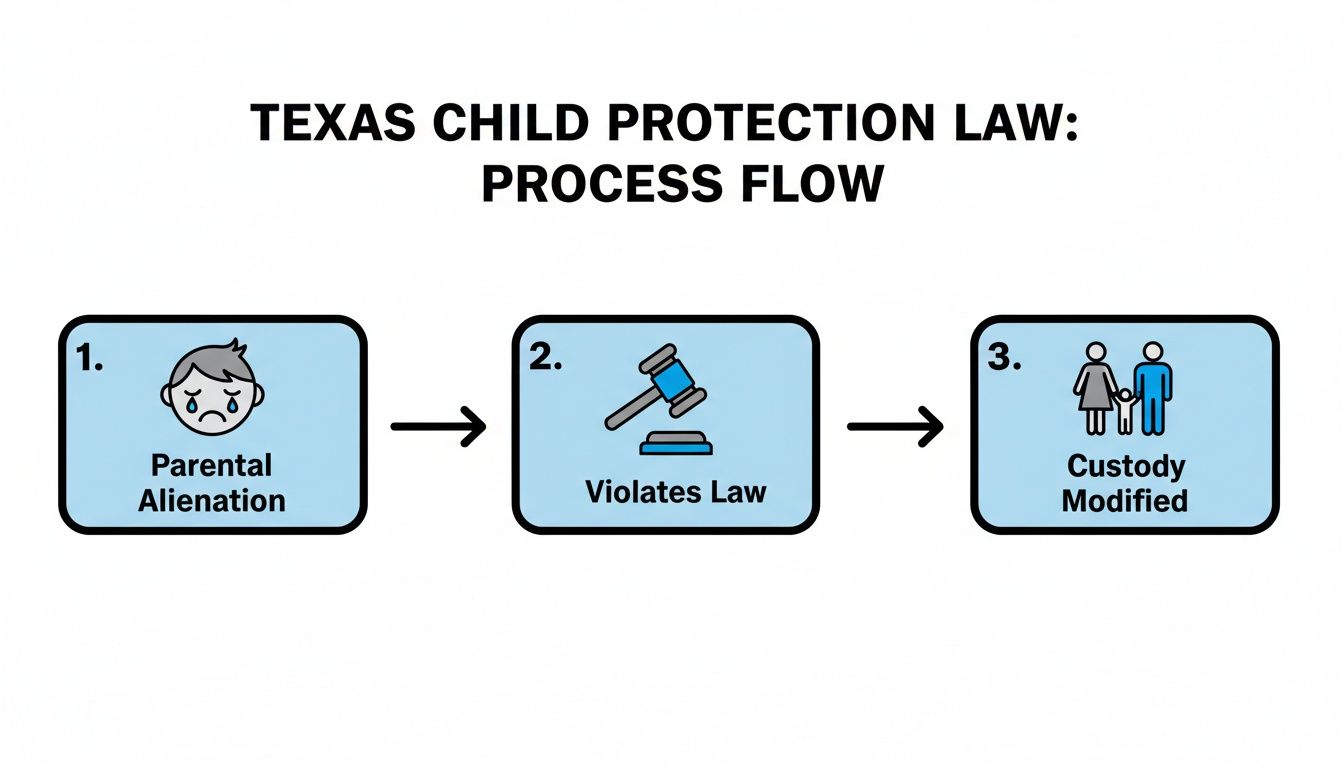
As you can see, there's a clear legal path from identifying the destructive behavior to securing a court-ordered solution designed to start healing the parent-child bond.
Gathering Your Evidence
Proving parental alienation takes more than just your word against the other parent’s. It demands a collection of credible, organized evidence that paints a clear picture of manipulation and interference over time.
Here are the types of evidence that carry the most weight in a Texas courtroom:
- Documented Communications: Save every single email, text message, and social media post that shows the other parent badmouthing you, interfering with your possession schedule, or trying to block communication with your child.
- A Detailed Journal: Keep a running log of every missed visit, late pickup, and troubling comment your child makes. Write down the date, time, location, and exactly what was said or done. Consistency is key.
- Witness Testimony: Statements from neutral, third-party individuals can be incredibly powerful. Think teachers, school counselors, pediatricians, or even family friends who have seen the negative change in your child's attitude toward you.
Pulling together a strong case often comes down to meticulous organization. For complex situations with a lot of data points, professional legal data integration and reporting services can be a game-changer for managing all the moving parts.
The Role of Experts and Legal Professionals
Sometimes, what you've gathered on your own just isn't enough. Texas courts often lean on the objective assessments of trained professionals to make sense of the tangled family dynamics that come with parental alienation. These experts can give the court a clear, unbiased picture of what's truly in the best interest of the child.
- Custody Evaluator: The court can appoint a neutral mental health professional to conduct a deep-dive investigation. They will interview you, the other parent, the child, and other important people to make a formal recommendation to the judge.
- Child Psychologist or Therapist: If your child is already in therapy, their counselor might be able to offer insight into the child’s emotional state and the source of their anxiety (with the right legal permissions, of course).
- Amicus Attorney: In really tough cases, a judge might appoint an amicus attorney. This lawyer doesn't represent either parent; their one and only job is to represent the child's best interests, acting as the "eyes and ears" of the court.
The stakes in these cases are incredibly high. For example, a 2020 U.S. Justice Department-funded study revealed a harsh reality resonating in Texas courts: when mothers face abuse allegations that are countered by claims of parental alienation, their risk of losing custody roughly doubles. This underscores why credible, well-documented evidence is absolutely critical, as judges scrutinize each parent’s credibility with extreme care. You can read the full research about these family court findings.
Gathering this evidence takes time and precision. Knowing what to collect and how to present it in a way a judge will understand can make all the difference. You can learn more about how to prove parental alienation in court in our detailed guide.
Court-Ordered Solutions to Stop Alienation
When you can prove that parental alienation is hurting your child, a Texas court has a range of powerful tools to step in and protect your family. This isn't just about punishing the other parent; it’s about taking decisive, court-ordered action to stop the emotional damage and start the healing process.
The number one goal is always to protect the child's best interest, and that absolutely includes having a healthy, loving relationship with both parents. A judge will craft orders specifically designed to counteract the alienating parent's harmful influence and bring stability back into your child's life.
Custody Modification and Possession Schedules
The most direct and powerful remedy is often a modification of the custody order. If a judge finds that one parent has been deliberately undermining the child's relationship with the other, they can make significant changes to the existing arrangement.
This could mean:
- Changing the Primary Conservator: The court could change which parent has the exclusive right to decide where the child lives, effectively making you the primary parent.
- Altering the Possession Schedule: A judge might award you, the targeted parent, more time with your child to help re-establish your bond away from the alienator's influence.
- Ordering Supervised Visitation: In severe cases, the judge can order that the alienating parent’s time with the child be supervised by a neutral third party.
A court will only take a drastic step like this when there's clear evidence that the change is necessary to protect the child’s emotional well-being.
Therapeutic and Communication Interventions
Beyond changing the calendar, courts often order specific therapeutic interventions to actively repair the damage. One of the most effective tools is reunification therapy. This is a specialized, court-ordered type of counseling designed specifically to help rebuild a fractured parent-child bond in a safe, structured way. The therapist works with both the child and you to address the false beliefs and anxieties the alienation has created. You can explore the different approaches and treatments available for parental alienation to better understand the process.
A Texas court can also appoint a Parenting Coordinator or Parenting Facilitator. Think of them as neutral referees who help parents manage high-conflict communication, follow court orders, and make day-to-day decisions without falling back into destructive patterns. Their involvement can bring much-needed accountability and structure.
Injunctions and Clear Court Orders
Finally, a judge can issue specific injunctions, which are legally binding orders that forbid the alienating parent from doing certain things. Violating an injunction can lead to serious legal trouble, including fines or even jail time.
The court might order the alienating parent to stop:
- Speaking negatively about you in front of the child.
- Interfering with your phone calls or other communications with your child.
- Scheduling activities that conflict with your possession time.
These clear, enforceable rules create boundaries that protect your time with your child and remove the gray areas the other parent may have been exploiting.
| Legal Remedy | Purpose | Potential Outcome |
|---|---|---|
| Custody Modification | To change the legal and physical custody arrangement to protect the child from further harm. | The targeted parent may become the primary conservator or receive more possession time. |
| Reunification Therapy | To professionally guide the repair of the damaged parent-child relationship in a therapeutic setting. | The child and targeted parent rebuild trust and communication, addressing false narratives. |
| Supervised Visitation | To ensure the child's safety and prevent further alienation during the alienating parent's time. | The alienating parent's visits are monitored by a neutral third party. |
| Injunctions | To legally prohibit specific alienating behaviors with clear, enforceable rules. | The alienating parent is legally barred from badmouthing the other parent or interfering with communication. |
| Parenting Coordinator | To manage high-conflict communication and ensure compliance with court orders. | A neutral professional helps parents resolve disputes and focus on the child's best interests. |
Next Steps: Protecting Your Family and Yourself
Realizing your child is a victim of parental alienation is devastating. But when your child's future is on the line, understanding your rights is the first step toward solid ground. Combating this behavior is not a passive waiting game; it demands courage and a clear strategy. Taking decisive action is the only way to protect your child's emotional health and your legal rights. Your immediate focus should be on documenting every incident, understanding your rights under the Texas Family Code, and finding an experienced legal guide.
Creating Stability Amidst the Chaos
While the legal process unfolds, your most important job is to be the calm in the storm for your child. Every moment you have with them during your possession time is a chance to counteract the negativity and reinforce your unconditional love.
Here's how you can make a difference:
- Be the Safe Harbor: Make your time together fun, calm, and completely free from conflict. Let your home be their sanctuary.
- Avoid Confrontation: Never confront the other parent or discuss the legal case in front of your child. It only adds to their burden.
- Find Your Support System: You can't pour from an empty cup. Lean on friends, family, or a therapist. Taking care of yourself is essential.
This focused approach does more than just strengthen your bond—it insulates your child from further conflict. For more strategies, you can read our guide on how to deal with parental alienation.
Remember, the goal isn't just to win a court case; it's to protect your child from emotional harm and restore the precious bond you share. Your consistency and unconditional love are your most powerful tools.
The most critical step you can take is to sit down with a seasoned family law attorney who understands the specific challenges of proving parental alienation in a Texas courtroom. They can help you transform your documentation into a compelling case and fight for the court-ordered solutions your family needs to start healing.
If you need help with a child custody or visitation case in Texas, our experienced attorneys can guide you every step of the way. Contact The Law Office of Bryan Fagan, PLLC today for a free consultation.
Frequently Asked Questions About Parental Alienation
When you’re grappling with parental alienation in Texas, it’s natural to feel uncertain. Getting clear, straightforward answers is the first step toward protecting your relationship with your child. Here are some of the most common concerns we hear from parents.
How Quickly Should I Act If I Suspect Alienation?
Immediately. Parental alienation is a progressive problem that tends to get worse, not better, on its own. The longer damaging behaviors go unchecked, the more entrenched a child's manufactured beliefs become, making it much harder to undo the harm. From a legal standpoint, hesitating can be misinterpreted by the court as you being okay with the situation. It is critical to start documenting every incident right away and contact a family law attorney who understands parental alienation in Texas.
Can a Child’s Testimony Prove Parental Alienation?
While a judge can interview a child (usually 12 or older) in their chambers to hear their wishes, Texas courts are incredibly careful about taking a child's word as the whole truth in these cases. Judges know that an alienated child might just be repeating a script they've been fed. That’s why a child’s statements are almost always weighed against other, more objective evidence, such as reports from a custody evaluator, a therapist, or an amicus attorney—professionals trained to uncover what’s really going on.
For the court, the critical question is this: Are the child's feelings genuinely their own, or are they just an echo of the alienating parent's agenda? Expert testimony is often the key to helping a judge make that call, always based on the best interest of the child.
Is It Possible to Reverse the Effects of Alienation?
Yes, it is often possible to heal that broken bond, but it almost always takes professional help and strong legal action. The most common and effective tool is court-ordered reunification therapy. This is a specialized process designed to repair the parent-child relationship in a safe, structured, and therapeutic setting. A court order is crucial because an alienating parent will rarely agree to this kind of therapy on their own.
What Is the Difference Between Alienation and Estrangement?
This is a crucial distinction. Estrangement happens when a child pulls away from a parent because of that parent’s own harmful actions or the child's genuine negative experiences. The child's feelings are based on their reality. Alienation, on the other hand, is manufactured. An alienated child will often repeat grievances that aren't their own and see things in black and white—the targeted parent is "all bad," and the alienating parent is "all good." A professional custody evaluator is skilled at helping the court tell these two very different family dynamics apart.
If you need help with a child custody or visitation case in Texas, our experienced attorneys can guide you every step of the way. Contact The Law Office of Bryan Fagan, PLLC today for a free consultation.