Skip to content
When your child's future is on the line, the word 'father' means more than just a biological connection—it's a legal status that protects your relationship with your child. In Texas, understanding the difference between being a dad emotionally and being a father legally is the first, most critical step toward protecting your parental rights.
This legal recognition is the key that unlocks your ability to have a secure, court-ordered relationship with your child. Without it, you have no enforceable rights to custody or visitation, leaving your role in your child's life vulnerable.

How Texas Law Defines Fatherhood
The question "what makes a father?quot; carries a ton of emotional weight. But in a Texas courtroom, the answer is surprisingly straightforward: it's a legal title. Your rights to custody (conservatorship), visitation (possession), and making decisions for your child only kick in once you are legally recognized as the father through a process called establishing paternity.
Think of it this way: no matter how involved you are—how many diapers you’ve changed or games you’ve coached—you have no enforceable rights until paternity is established. As a father, you can’t ask a judge to grant you a possession schedule or a say in your child's medical care. For mothers, this also means you can't get a court to order child support until paternity is legally confirmed.
The Different Ways Texas Law Recognizes a Father
Texas law provides several paths to legal fatherhood, and understanding which one applies to you is the first step in protecting your rights. A man can be a biological father, but without that legal stamp of approval, the law may see him only as a putative father, which is a potential father with very limited rights.
Here’s a look at the different ways Texas law can recognize you as a father, each with its own legal weight.
Types of Fatherhood Recognized in Texas
| Type of Father | How It Is Established | Key Legal Implication |
|---|---|---|
| Presumed Father | Automatically, if married to the mother at or near the time of the child's birth (born within 300 days of the marriage ending). | The law assumes you are the legal father unless proven otherwise in court. This gives you immediate legal standing. |
| Acknowledged Father | Unmarried parents sign a valid Acknowledgement of Paternity (AOP), usually at the hospital after birth. | A voluntary and legally binding way to establish paternity without court action. It has the same effect as a court order. |
| Adjudicated Father | A judge declares fatherhood in a paternity lawsuit, often after a court-ordered DNA test. | Establishes paternity through a final court order, which is enforceable and settles the matter legally. |
Each of these avenues leads to the same destination: a legally recognized parent-child relationship. This relationship is the foundation for all custody, visitation, and support orders. It’s what gives you the standing to fight for your child and your rights as their parent.
The Modern Father's Evolving Role in Family Courts
The old-school image of a father as just the "breadwinner" is long gone, and Texas family courts are finally catching up. What it means to be a father has expanded far beyond simply providing a paycheck. Today, being a dad means active, hands-on involvement in your child’s daily life—and that involvement is a game-changer in modern custody decisions.
Think of it this way: you're a co-builder of your child's life. Every time you help with homework, drive to a doctor's appointment, or coach the little league team, you're laying another crucial brick in the foundation of their well-being. This isn't just good parenting; it's a powerful statement to the court about your essential, irreplaceable role.
Demonstrating Your Active Role as a Parent
When you're in a custody dispute, your actions carry far more weight than your words. Texas courts are legally bound to make decisions based on the “best interest of the child,” a standard that puts your child’s physical and emotional well-being above everything else. A judge will look very closely at which parent has truly been the primary caregiver.
Your consistent, day-to-day involvement proves you aren't just a visitor in your child’s life, but a central, stabilizing force. Courts are increasingly recognizing and rewarding this kind of dedication.
A father's value is measured not just by the support he provides, but by the presence he maintains. Your active participation in the small, everyday moments is what builds a strong, legally significant bond with your child.
How Your Actions Connect to Legal Standards
When a court is deciding on conservatorship (your decision-making rights) and possession schedules (visitation), it's really just examining the parent-child relationship from every angle. Showing that you're deeply involved in the nuts and bolts of your child’s life directly supports the argument that granting you significant rights and time with your child is in their best interest.
This shift isn't happening in a vacuum; it’s backed by huge societal changes. Modern research shows that fathers today are more engaged in direct caregiving than ever before. In a global study across 15 countries, between 70% to 90% of men said they feel just as responsible for care work as their partners. Here in the United States, fathers with kids under 18 spend about an hour each day on direct care and helping their kids, focusing on things like playing, bathing, and dressing. For dads with young children under age 6, that time jumps to over an hour and a half daily, proving that active caregiving is now a core part of what it means to be a modern father. You can read more about the evolving role of fathers in the 2023 global report.
What This Means for Your Custody Case
The bottom line? Your daily contributions are legally significant. To build the strongest possible custody case, you need to document your involvement. We often advise clients to keep a detailed log or journal of activities with their child.
Here are some real-world examples of what to track:
- School Involvement: Note every parent-teacher conference you attend, the times you help with homework, and any school events you show up for.
- Medical Care: Keep records of doctor's appointments, ER visits, and any time you're the one administering medication or caring for a sick child.
- Daily Routines: Document your role in morning and bedtime routines, who prepares the meals, and who handles transportation to and from school or activities.
This kind of evidence helps paint a crystal-clear picture for the court. It proves you're an irreplaceable part of your child’s life, validates your role as a modern, engaged father, and ties your actions directly to the legal standard that matters most: your child’s best interest.
How to Legally Establish Paternity in Texas
When it comes to your child, simply being "dad" isn't enough in the eyes of the law. For parents in Texas, establishing paternity is the legal key that unlocks everything—it grants a father enforceable rights to custody and visitation, but it also creates the legal duty of financial support.
Without that legal recognition, even the most dedicated father has no standing to ask a court for time with his child. It's a critical step that secures your role, and there are two main ways to get it done in Texas. The path you take will depend on whether you and the child's mother are on the same page.
The Acknowledgment of Paternity (AOP) for Unmarried Parents
For many unmarried parents who agree on who the father is, the most direct route is signing a Voluntary Acknowledgment of Paternity (AOP). This is a powerful legal affidavit where both the mother and the man claiming to be the biological father swear under oath that he is, in fact, the father.
You'll usually see this form at the hospital right after the child is born. It might look like just another piece of paperwork, but its legal weight is enormous. Once signed and filed, an AOP has the same force as a court order declaring paternity.
Before you sign, here’s what you need to know:
- It's Voluntary: No one can force either parent to sign an AOP.
- It's Binding: Once the ink is dry and it's filed, an AOP is incredibly difficult to undo. You have only a very short window to rescind it before it becomes final.
- It Creates a Legal Parent: The man who signs becomes the legal father, inheriting all the rights and responsibilities that come with that title.
The AOP is a straightforward tool, but it's vital that both parents are 100% certain of the child’s biological father. If there's any doubt whatsoever, do not sign it. For a deeper look into this document, you can learn more about the Acknowledgement of Paternity in Texas and what it means for the long haul.
This flowchart shows how modern fatherhood often hinges on active, daily involvement, moving beyond traditional roles.
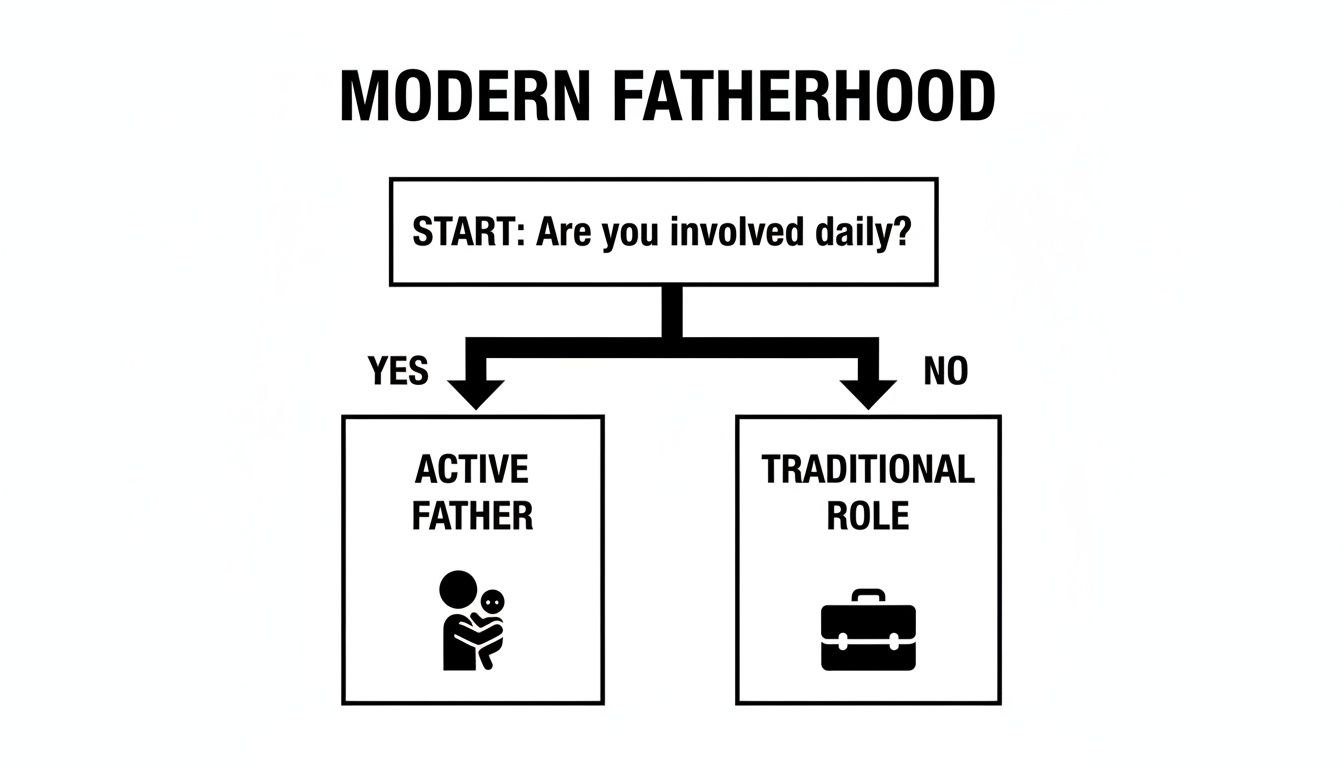
As you can see, what it means to be a father today often comes down to direct, hands-on engagement in a child's life.
Filing a Suit to Adjudicate Parentage
What happens when parents don't agree on paternity, or if the AOP process just wasn't an option? The next step is to go to court. A Suit to Adjudicate Parentage is a legal action filed to have a judge formally determine a child’s biological father. This lawsuit can be started by the mother, the alleged father, or even a state agency like the Office of the Attorney General.
The whole point of a paternity suit is to bring legal certainty to the parent-child relationship. It ensures children get the emotional and financial support they deserve from both parents, and it protects a father's right to be part of his child's life.
In a paternity suit, the judge will almost always order genetic testing—a DNA test—to confirm or rule out a biological link with scientific certainty. Once the results are back, the judge issues a final court order that officially names the legal father. This document, called an Order Adjudicating Parentage, will also establish the initial ground rules for:
- Conservatorship: Each parent's legal rights and duties.
- Possession and Access: The visitation schedule.
- Child Support: The financial obligation of the non-primary parent.
- Medical Support: The duty to provide health insurance.
This court order becomes the blueprint for the parent-child relationship from that day forward, giving both parents a clear and enforceable framework to follow.
What Is the Presumption of Paternity?
Texas law also has a powerful legal shortcut called the presumption of paternity. Under the Texas Family Code, if a man is married to the mother when a child is born, the law automatically presumes he is the child’s legal father. This presumption also kicks in if the child is born within 300 days after the marriage ends.
This means the husband is considered the father by default, with no need to sign an AOP or go to court to establish his rights. However, this presumption isn't set in stone. It can be challenged and overturned with solid proof, like a DNA test showing that another man is the biological father.
If you need help navigating a child custody or visitation case in Texas, our experienced attorneys can help you figure out the best path forward. Contact The Law Office of Bryan Fagan, PLLC today for a free consultation.
Understanding the Rights and Duties of a Legal Father
So, the court has officially recognized you as the legal father. Now what? That piece of paper does more than just state a fact—it fundamentally changes your relationship with your child in the eyes of Texas law. It’s the moment your role shifts from a personal one to a legally enforceable one, complete with a new set of rights and responsibilities.

Think of your new legal status as a coin. On one side, you have rights—the legal authority to be a parent. On the other, you have duties—the legal obligations that come with it. You can't have one without the other, and together they form the blueprint for how you'll co-parent from this point forward.
The Two Sides of Legal Fatherhood: Rights and Duties
In Texas, the court order that establishes your paternity will also spell out your specific rights and duties. These aren't just friendly suggestions; they are legally binding rules that both you and your child's mother are required to follow. Getting a handle on these terms is the first step toward confidently stepping into your role.
Here’s a breakdown of the key concepts you’ll find in that order:
- Conservatorship: This is the legal term for the bundle of rights and duties each parent holds. It covers your right to make major decisions about your child’s life, like where they go to school, what medical care they receive, and their religious upbringing.
- Possession and Access: This is simply the court-ordered visitation schedule. It’s the calendar that lays out exactly when your child will be with each parent—from weekends and holidays to summer break. It's the legal roadmap for your time together.
- Child Support: This is the financial obligation to provide for your child. Typically, the parent who doesn't have the child most of the time pays child support to the primary parent. It's designed to ensure both parents are contributing to the child's financial needs.
These three elements are the pillars of your court order, working together to define your role and make sure your child is consistently supported.
Demystifying Joint Managing Conservatorship
One of the most common points of confusion we see is the term Joint Managing Conservatorship (JMC). In Texas, JMC is the default arrangement because it's presumed to be in the child's best interest. But here’s a critical point: "joint" does not automatically mean a 50/50 split of parenting time.
Joint Managing Conservatorship means that you and the other parent share the rights and duties of raising your child. Even if one parent has the exclusive right to decide where the child lives, both of you typically have a say in the big decisions.
Under a JMC order, you are co-parents with shared authority. One parent is usually named the "primary" conservator, which gives them the right to receive child support and establish the child's residence (often within a certain geographic area). But both parents remain empowered. The specific details of who decides what will be clearly spelled out in your court order. Our attorneys can help you fully understand your rights as a father in Texas and what a JMC arrangement would actually look like for your family.
The Connection Between Attitudes and Action
Being a father today isn’t just about legal documents; it’s about showing up. Research confirms that a dad's mindset about his role directly impacts how involved he is. According to the State of America's Fathers 2023 report, fathers with more equitable views on gender roles are 1.6 times more likely to be highly involved in everything from daily chores to managing family schedules.
This data tells us that what defines a great father in practice often starts in his head. The report also pushes back on outdated stereotypes, finding that Black fathers are 2.8 times more likely than white fathers to be highly engaged caregivers. This suggests it’s often systemic barriers, not a lack of commitment, that limit a father's involvement. Courts pay attention to this kind of hands-on participation when deciding what’s in a child’s best interest.
Your legal rights give you the opportunity to be present. Fulfilling your duties—both financial and personal—shows your commitment, strengthens your bond with your child, and solidifies your place as an essential figure in their life.
What to Do When Paternity Is Challenged or Denied
Getting hit with a paternity challenge feels like the ground is crumbling beneath your feet. Whether you’re the one suddenly questioning if you’re the biological father or someone is trying to deny your role, it’s a gut-wrenching moment that puts your identity and your entire relationship with your child on the line.
These situations are legally complex, incredibly emotional, and—most importantly—time-sensitive. Texas law has very specific procedures and strict deadlines for handling paternity disputes, because the court’s main goal is to give the child certainty. You have to act fast to protect your rights.
When You Doubt Your Paternity After Signing an AOP
Let’s run through a common scenario. You signed an Acknowledgment of Paternity (AOP) at the hospital, but now you have good reason to believe you aren't the biological father. This is a legal crisis, and the clock is ticking.
Under the Texas Family Code, you have an extremely short window to undo that signature. You can either file a Rescission of Acknowledgment of Paternity to cancel the AOP or start a court case to challenge it. The deadline is just 60 days from the date the AOP was filed. Miss that window, and it becomes nearly impossible to overturn the AOP unless you can prove you were a victim of fraud, duress, or a major mistake of fact.
If you have any doubt whatsoever about your paternity, do not sign the Acknowledgment of Paternity. Once that ink is dry, it has the same power as a court order, and fighting it later is a brutal uphill battle. Waiting for a DNA test is always the smarter, safer move.
When the Mother Prevents You from Seeing Your Child
For many dads, the problem isn’t about biology—it’s about being denied access to their child. The mother might be actively preventing you from seeing them, trying to cut you out of their life completely. This is where your status as a legal father is your most critical asset.
If you’ve already established paternity with an AOP or a court order, you have a legal right to possession and access. If the mother is ignoring a court-ordered visitation schedule, you can file an enforcement action to hold her accountable. If you don’t have an order yet, you must file a Suit Affecting the Parent-Child Relationship (SAPCR). This lawsuit asks a judge to create a formal custody order that clearly lays out your rights and an enforceable schedule.
It's also worth noting that societal pressures can make it even harder for fathers to assert their parental role. For example, research shows 85% of fathers who didn't use their full parental leave felt immense pressure to stay at work, highlighting the lingering "provider" expectation. This is made worse by the fact that 57% of American adults believe society values a man's professional contributions more than his contributions at home. You can learn more about these cultural hurdles in the full report on modern fatherhood.
The Best Interest of the Child Is the Guiding Star
In any dispute over paternity, custody, or visitation, a Texas judge will make their final call based on one guiding principle: the best interest of the child. Every decision is filtered through that lens.
A judge will look at everything that affects a child's physical and emotional well-being—their need for stability, their relationship with each parent, and who has been actively involved in their life. Acting quickly and following the right legal steps doesn't just protect your rights; it also shows the court your unwavering commitment to being a stable, present force in your child's life.
Key Takeaways: Protecting Your Rights as a Father
Knowing what “father” means under Texas law is one thing. But taking action is what actually protects your relationship with your child. The road ahead is about turning your commitment as a dad into a clear, legally recognized plan that a court can enforce.
Going it alone in the family court system can be a minefield of confusing paperwork and missed deadlines. With the right preparation and guidance, however, you can walk in confidently and secure your role.
The big takeaways are simple but critical: Texas fatherhood is a legal status, establishing paternity is the non-negotiable first step, and your active, positive involvement is the bedrock of any strong custody case.
Next Steps to Take Legal Action
Getting organized is your single greatest advantage. Before you ever sit down with an attorney or step into a courtroom, gathering the right information makes the entire process smoother and far more effective.
A well-prepared case sends a powerful message to the court: you are serious, you are responsible, and you are focused on what’s best for your child.
Use this checklist to get your ducks in a row:
- Gather Key Documents: Pull together your child's birth certificate, any Acknowledgment of Paternity you signed, and records of any informal child support payments you’ve made (like canceled checks or app payment histories).
- Document Your Involvement: Start a simple journal or log. Note every school event you attend, every doctor's appointment you take them to, and the daily routines you share. Details matter.
- Outline Your Goals: What does success look like for you? Are you aiming for a standard possession schedule? Or are you seeking the right to be the primary decision-maker for your child's education? Having clear goals helps your attorney map out a winning strategy.
If you find yourself needing to take further legal action to secure your paternal rights, understanding how a dad can get full custody is crucial.
Securing your rights as a father isn't about "winning" a fight against the other parent. It’s about making sure your child wins by having two stable, loving, and legally recognized parents in their life. The proactive steps you take today build a secure future for them.
The most effective way to protect your relationship with your child is to get expert legal advice. An experienced family law attorney can walk you through your specific options, help you sidestep common pitfalls, and advocate for you every step of the way to make sure your voice is heard.
If you need help with a child custody or visitation case in Texas, our experienced attorneys can guide you every step of the way. Contact The Law Office of Bryan Fagan, PLLC today for a free consultation.
Frequently Asked Questions About Fatherhood in Texas
When you're dealing with a complex family law issue, your head is probably swimming with questions. It's completely normal. While the right answer for you will always depend on the specifics of your case, getting a handle on the basics can bring some much-needed peace of mind.
Here are a few of the most common questions we hear from fathers navigating paternity and custody in Texas.
Can I Be Put on Child Support if I Am Not on the Birth Certificate?
Yes, absolutely. A lot of people think the birth certificate is the final word on legal fatherhood, but it’s really just an administrative record. The real power lies with a court order.
The child's mother can file what’s known as a Suit to Adjudicate Parentage to get the court to legally determine who the father is. From there, a judge will almost certainly order a genetic (DNA) test. If those results confirm you're the biological father, the court will issue an order that officially makes you the legal father—and that comes with establishing your rights to custody and visitation, along with your responsibility to pay child support.
I Signed the Acknowledgment of Paternity but Now Have Doubts. What Can I Do?
You have to act fast. In Texas, a signed Acknowledgment of Paternity (AOP) is a powerful legal document, treated with the same weight as a formal court order. Once you sign it, the clock starts ticking.
You have a very narrow window—just 60 days from the day the AOP is filed—to either rescind it or launch a court challenge. After that deadline, your options are incredibly slim. To get an AOP overturned later, you'd have to prove you were a victim of fraud, duress, or a major mistake of fact, which is a very tough legal battle to win. If you have even the slightest doubt, you need to talk to an attorney right away.
Key Takeaway: The Acknowledgment of Paternity is a serious legal commitment with lifelong consequences. Never sign an AOP if you aren’t 100% sure you are the child’s biological father. Always, always wait for a DNA test.
Does the Mother Automatically Get Custody in Texas?
No. This is easily one of the most stubborn myths in Texas family law. The law is written to be gender-neutral; it doesn't give mothers an automatic advantage over fathers in custody fights.
Every single custody decision is guided by one principle: the "best interest of the child." A judge looks at a long list of factors to figure out which parent is best equipped to provide a safe, stable, and nurturing home. In fact, Texas law actively encourages judges to name parents as Joint Managing Conservators, meaning you both share the rights and duties of raising your child. The way you secure significant time with your child is by showing the court you are an involved, capable, and loving dad who is vital to your child’s life.
If you need help with a child custody or visitation case in Texas, our experienced attorneys can guide you every step of the way. Contact The Law Office of Bryan Fagan, PLLC today for a free consultation.