
When your child's future feels uncertain, the search for paternity lawyers near me usually starts in a moment of stress. A father may realize he has no enforceable right to visitation. A mother may be carrying the full financial load and wondering how to get support in place. A grandparent may be watching conflict grow and worrying about the child caught in the middle. A military parent may be trying to protect a bond with a child while deployment complicates every deadline.
In Texas, paternity is not just about biology. It is about legal rights, legal duties, and a child's stability. If you are trying to protect your relationship with a child, or secure support that child needs, the right legal guidance can make a confusing situation much clearer.
Why Securing Your Parental Rights Is the First Critical Step
A lot of parents think the main question is whether DNA will confirm who the father is. That matters, but it is rarely the whole legal problem. In Texas, the primary issue is whether paternity has been legally established so the court can make enforceable orders about custody, visitation, and support.

For fathers, this is often the hardest part to hear. You may be involved, loving, and present, but Texas law still requires a legal step before you can ask the court for a parenting order. For mothers, the challenge is different. If paternity is not established or enforced, child support can remain out of reach, and daily expenses still have to be paid.
According to the U.S. Census Bureau's 2022 report on fathers and mothers, only 19.6% of children in single-mother households receive formal child support, a gap often tied to unestablished or unenforced paternity. That number matters because it reflects a practical truth. When legal parentage is unclear, children often lose access to financial stability.
What legal paternity actually changes
Once paternity is properly established, the court can address several issues that affect a child's day-to-day life:
- Conservatorship rights. Texas uses the word conservatorship for custody. It covers decision-making authority about education, medical care, and other major issues.
- Possession and access. This is the Texas term for visitation and parenting time.
- Child support. A court can order support and create a structure for enforcement.
- Medical support and related obligations. Legal parentage affects more than one line item in a court order.
Practical rule: A DNA result alone doesn't give you a court-enforceable parenting plan. A legal order does.
Why delay creates problems
Waiting usually makes these cases harder, not easier. Parents keep informal schedules that later fall apart. Text messages become the only record of involvement. One parent moves. A new partner enters the picture. Sometimes the other side starts arguing that the existing arrangement should stay in place, even if it developed by accident.
That is why early legal advice matters. If you are trying to establish rights connected to custody, review a focused guide on establishing paternity for custody in Texas. It helps explain how paternity connects to the orders that shape a child's life.
The most effective first move is not emotional. It is procedural. Get clear on your legal status, then build from there.
How to Find a Paternity Lawyer in Your Texas Community
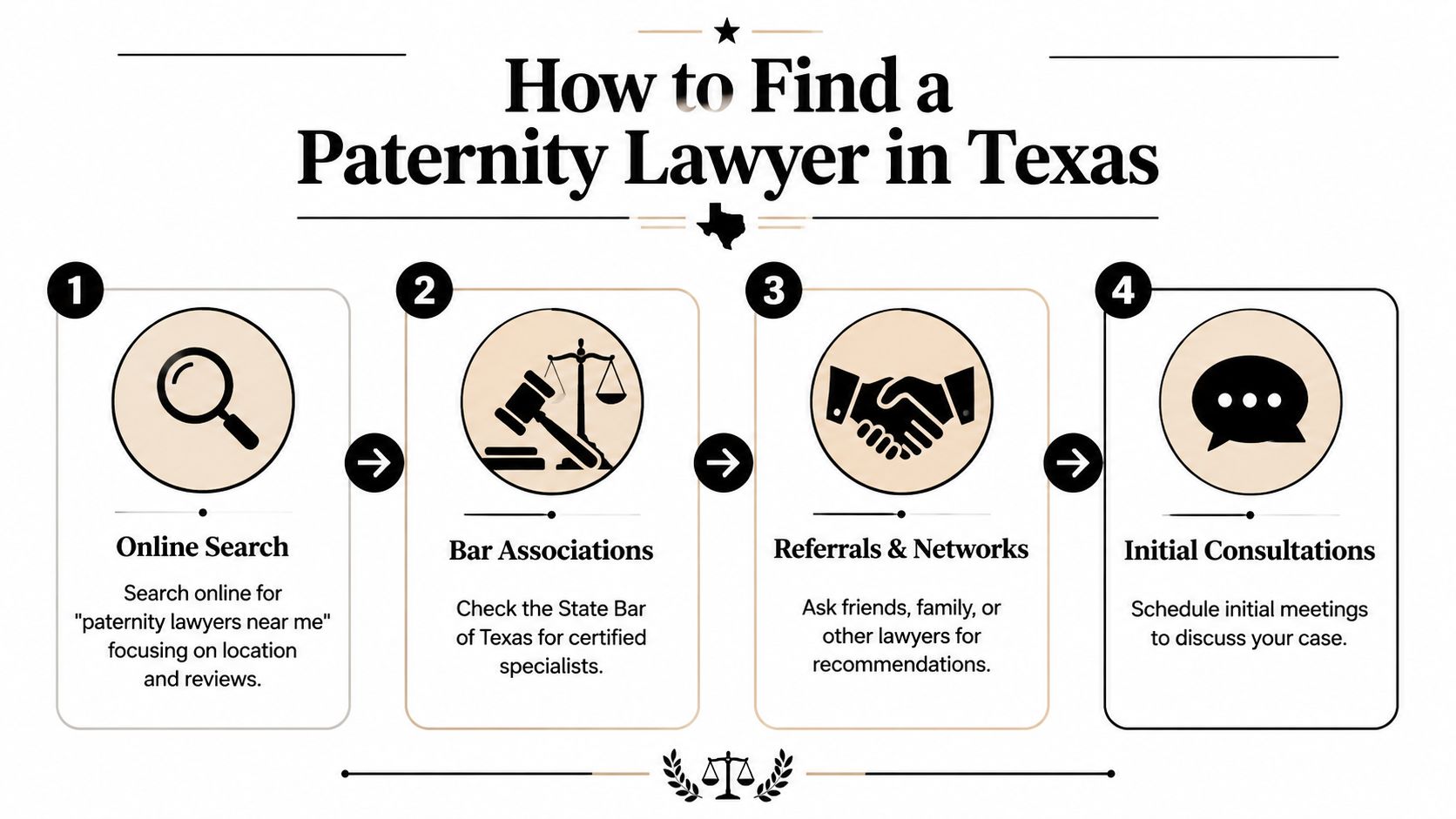
Searching online is a reasonable place to start, but it shouldn't be the only step. Many parents type paternity lawyers near me, click the first few results, and assume all family law firms handle these cases the same way. They don't.
A strong paternity case often overlaps with conservatorship, possession, support, and enforcement. In some families, it also involves military service, relocation, or a presumed father issue. You want a lawyer who handles those problems regularly, not one who treats paternity like a side issue.
Start with focused local research
A general search result tells you very little by itself. Look for signs that the attorney's work is centered on Texas family law, especially cases involving parent-child rights. Read practice area pages carefully. A short paternity page with no mention of custody or support can be a warning sign.
If you want a better sense of how law firms appear in local search and why some firms are easier to evaluate online, these resources on local SEO for lawyers can help you understand what you're seeing when you compare websites, map listings, and review patterns.
Build a shortlist, don't pick the first name
A practical approach is to identify at least three attorneys or firms and compare them. Use different sources so you're not relying on one marketing channel.
| Where to look | What to check |
|---|---|
| State Bar tools | Whether the lawyer focuses on family law in Texas |
| Firm website | Paternity, custody, support, and Chapter 153 content |
| Reviews | Whether clients mention communication, clarity, and follow-through |
| Professional referrals | Therapists, accountants, or other attorneys who know family law work |
One useful marker is whether the lawyer handles the custody side of the case, not just parentage testing. For example, a Texas Child Custody Lawyer handles representation in conservatorship, possession, and access matters under Chapter 153. That matters because most paternity cases do not end with a test result. They move into parenting orders.
A good local fit is not just someone near your home. It is someone who regularly works in the courts where your case may be heard.
What works and what usually does not
Some ways of choosing counsel tend to work better than others.
- Useful reviews. Look for comments about responsiveness, preparation, and whether the lawyer explained the process clearly.
- Less useful reviews. Be cautious with vague praise that says only “great lawyer” or “highly recommend” without any detail.
- Helpful referrals. A counselor, clergy member, or another lawyer may know who handles difficult family cases with steadiness.
- Weak shortcuts. Picking a lawyer only because the office is closest or the website is the flashiest often leads to a poor fit.
You are not just hiring someone to file papers. You are hiring someone to protect a parent-child relationship in a Texas court system that expects precision.
Key Questions to Ask a Paternity Lawyer Before Hiring
A consultation should help you evaluate the lawyer, not just the other way around. Good questions reveal whether the attorney understands both the law and the pressure your family is under. That is especially important in Texas paternity cases, where missed details can limit rights before a parent realizes what happened.
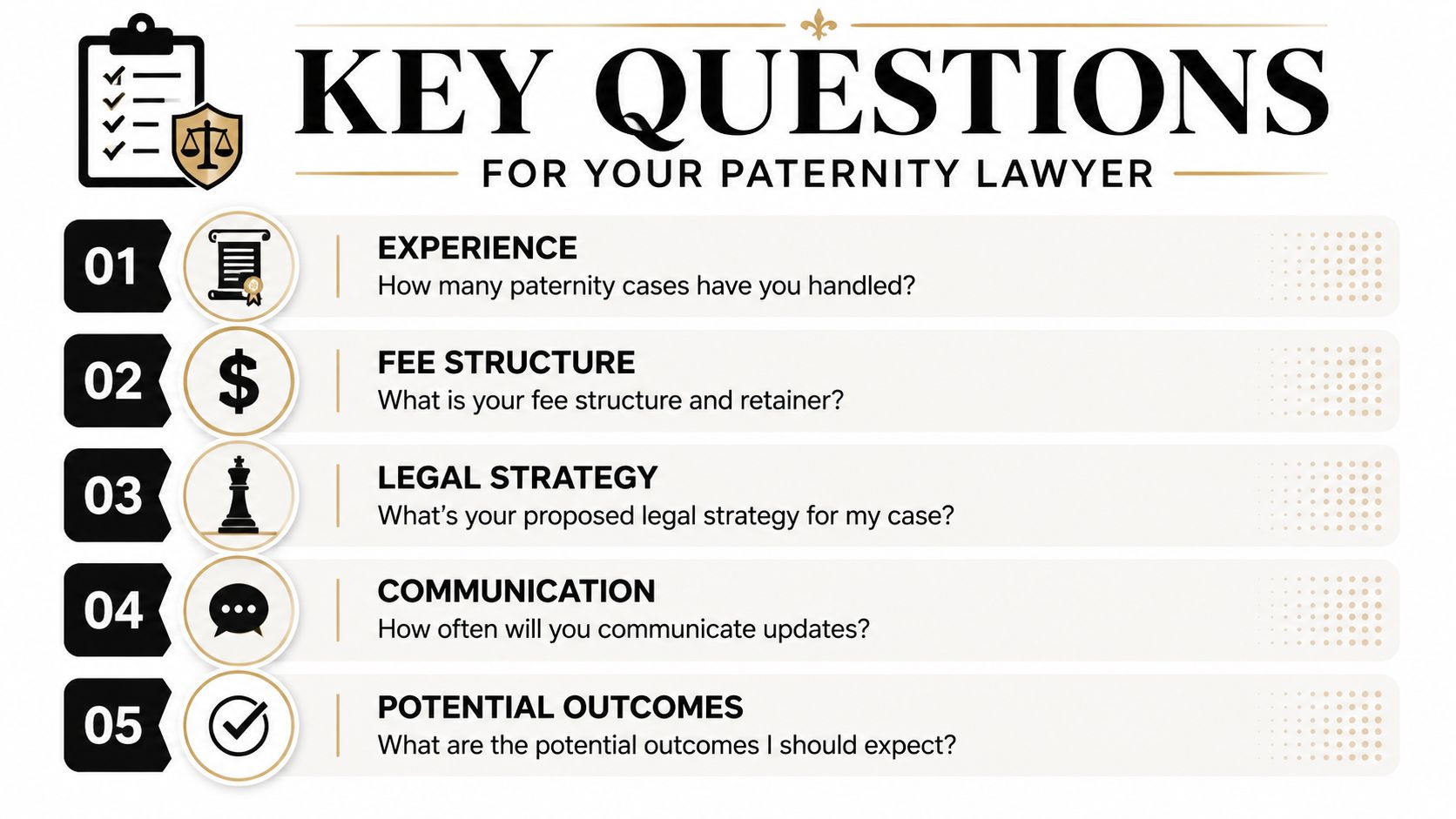
Some parents walk into a meeting ready to ask only about fees. Cost matters, but it should not be the only filter. A paternity case can affect conservatorship, possession, child support, and long-term decision-making. You need to know how the lawyer thinks.
Questions that reveal real experience
Ask direct questions that require more than a rehearsed answer:
- How do you handle cases where paternity and custody need to be addressed together?
- If the other parent denies access now, what immediate steps do you usually consider?
- How do you approach a case where the parents already have an informal schedule?
- What facts would make you push for temporary orders early?
- How do you define a good outcome in a paternity case involving a young child?
These questions matter because many cases turn less on dramatic courtroom moments and more on early strategy. A careful lawyer should explain what can be done now, what can wait, and what actions could make the case harder.
A short video can also help you think through what legal guidance should sound like in a family law setting.
Questions for complex Texas situations
Generic advice often fails families whose cases do not fit a simple pattern. If your facts are more complicated, your questions should be too.
Ask these if they apply:
- If the mother was married to someone else at conception or birth, how do you address the presumed father issue under Texas law?
- What is your approach if the biological father is not yet the legal father?
- How do you protect a deployed parent's position if court dates conflict with service obligations?
- What documents should I preserve right now if the other side may challenge paternity or parenting involvement?
One issue that deserves special attention is military service. Existing legal content often misses that 28% of military paternity cases in Texas stall due to deployment, a problem the Servicemembers Civil Relief Act can address by delaying proceedings. That figure comes from the 2025 DoD Family Advocacy Report, and it shows why military parents need a lawyer who understands more than ordinary scheduling problems.
If you are in the military, ask how the lawyer uses SCRA protections in real cases. If the answer is vague, keep looking.
Red flags during the consultation
The wrong fit often becomes obvious in the first conversation.
| Red flag | Why it matters |
|---|---|
| Promises of guaranteed results | Family courts do not work that way |
| No clear explanation of Texas procedure | Confusion early often means trouble later |
| Overly aggressive language | Escalation can hurt parents and children |
| Little interest in the child's routine | Good strategy starts with real family facts |
Another warning sign is a lawyer who treats your case as just a DNA issue. In practice, paternity cases often become parenting plan cases very quickly. The attorney should be thinking about school, medical care, exchanges, communication, and support, not only testing.
A strong consultation usually leaves you feeling more informed, not more intimidated. You should come away understanding your options, your risks, and the next decision you need to make.
Preparing for Your First Attorney Consultation
Parents often worry they need a perfect file before meeting a lawyer. You don't. What helps most is organization. A clear summary of what happened, who is involved, and what you want the court to do will make the consultation more useful than a stack of random papers.
Start by building a short timeline. Include the child's birth, when the relationship between the parents changed, whether anyone signed an acknowledgment of paternity, when support was provided, and when access to the child became disputed. Keep it factual. Dates matter, even if some are approximate.
What to bring if you have it
Bring copies, screenshots, or notes for the items that exist. Do not panic if some are missing.
- Basic records. Birth certificate, prior court orders, or any paperwork connected to paternity or support.
- Communication history. Texts, emails, or messages about the child, parenting time, support, or refusal of contact.
- Financial information. Proof of support paid or received, child-related expenses, and insurance information.
- Your timeline. A simple written summary helps the lawyer spot issues faster.
One important consultation topic gets overlooked often. In Texas, the timeline for challenging a presumed father can be critical. Data from the Texas Office of the Attorney General shows that 32% of Texas paternity disputes involve this scenario, which is why you should raise it immediately if the mother was married to someone else when the child was conceived or born. A useful starting point is this explanation of what an acknowledgment of paternity means in Texas.
What to write down before the meeting
Before you go, answer these questions for yourself:
- What do I want right now? Establish paternity, secure visitation, obtain child support, or clarify legal status.
- What am I worried the other parent will say?
- What schedule has the child been following?
- Is there urgency because of travel, deployment, a new relationship, or a move?
Bring the facts you know. Bring the questions you have. A consultation works best when both are on the table.
If family violence is part of the story, say so early. Custody and possession can change significantly in those cases. Texas parents dealing with that issue may also need information about custody when there is a history of family violence.
The goal is not to impress the lawyer. It is to give the lawyer enough clear information to help you protect your child and yourself.
The Texas Paternity Case Timeline and Key Legal Terms
After you hire counsel, most parents want to know the same thing. What happens now? The legal process feels less overwhelming when you can see the steps in order and understand the words the court uses.
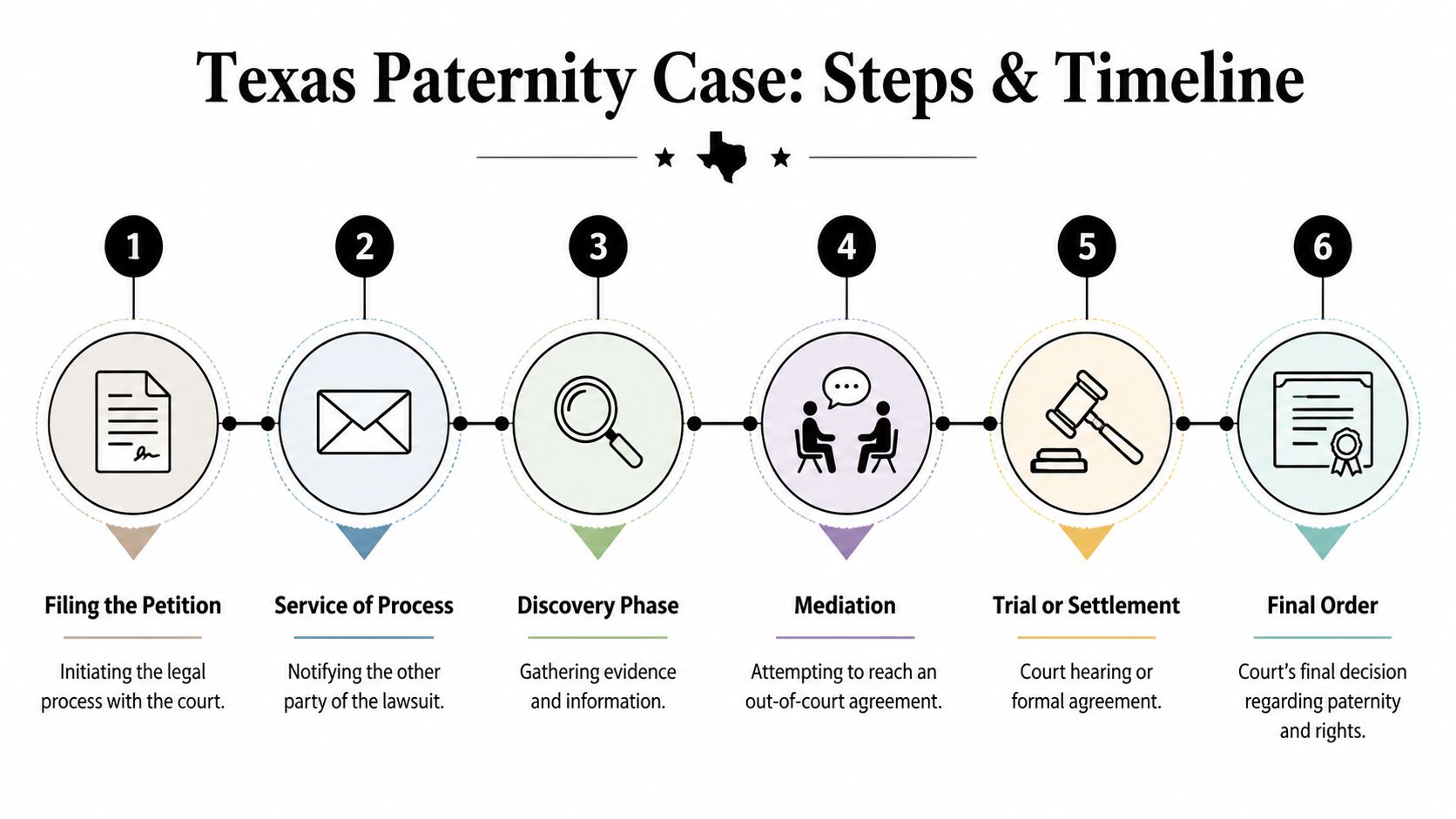
A Texas paternity case is usually not one single hearing where everything gets decided. It unfolds in stages. Some families resolve parts of the case by agreement. Others need court intervention at several points.
The first legal step
Under Texas Family Code Section 160.101, a father has no automatic right to seek a parenting order until legal paternity is established, either through a voluntary acknowledgment or a court-ordered genetic test. You can review the statute through Texas Family Code Section 160.101 guidance on court-ordered paternity testing.
That rule shapes the whole case. If legal fatherhood is not established, the court cannot move fully into conservatorship and possession issues the way many parents expect.
A common case path
Many paternity matters follow a sequence like this:
| Stage | What it usually means |
|---|---|
| Filing | One party asks the court to establish parentage and related orders |
| Service | The other party must be formally notified |
| Testing or acknowledgment | Parentage is confirmed by signed acknowledgment or testing |
| Temporary decisions | The court may address immediate concerns while the case continues |
| Negotiation or mediation | Parents try to reach workable terms |
| Final order | The judge signs enforceable orders on parentage and related issues |
Service matters more than people expect. If the other side is not properly served, the case can stall before the court reaches the actual dispute. Good preparation early often saves months of frustration later.
Courts move on procedure. Parents move on emotion. A good lawyer keeps both in view at the same time.
The terms parents need to understand
Texas family law uses words that sound technical, but the ideas are simpler than they seem.
Best interests of the child
This is the standard the court uses in custody-related decisions under Chapter 153. The court asks what arrangement serves the child's welfare, stability, safety, and development. Texas law also makes clear that courts cannot favor one parent over the other based on gender under Texas Family Code Section 153.001(a).
For mothers and fathers alike, that matters. The court is supposed to focus on the child, not old assumptions about which parent “usually” should win.
Joint managing conservatorship
Joint managing conservatorship is the default custody framework in many Texas cases under Texas Family Code Section 153.131(b). It means both parents may share important decision-making rights about the child, even if one parent has the right to determine the primary residence.
Many parents often get confused regarding this. Joint managing conservatorship does not always mean a perfectly equal time split. It is mainly about rights and duties.
Possession schedule
Texas uses possession and access to describe parenting time. A standard possession order often gives the non-primary parent time on the first, third, and fifth weekends of each month, plus summer and holiday periods, as described in Texas Family Code Section 153.254.
That schedule is a starting point, not a moral judgment. In some families it works well. In others, especially with very young children, unusual work schedules, or military demands, a more customized plan may make better sense.
What usually helps and what usually hurts
Parents often improve their position by staying organized and child-focused. They damage their position when they treat the case like a running argument with the other parent.
Helpful habits include:
- Keep a parenting record. Write down time spent with the child, missed visits, and major issues.
- Stay civil in writing. Judges may read what you send.
- Follow temporary arrangements carefully. Consistency matters.
- Think beyond the test result. The end goal is a workable court order.
Less helpful habits include withholding the child to gain an advantage, making informal deals without records, or waiting too long to address a legal problem that is already growing.
The legal terms can feel cold at first. Still, behind each one is a simple question. How will the court create a stable, enforceable structure for this child? Once you understand that, the process becomes easier to manage.
Your Next Steps to Protect Your Child and Your Rights
When seeking paternity lawyers near me, you are probably not looking for abstract legal theory. You want clarity, and you want to know what to do next.
Start with the basics. Confirm whether legal paternity has already been established. Gather the documents you have. Write down the accurate history of the child's schedule, support, and contact. Then speak with a lawyer who handles Texas family law issues tied to parentage, conservatorship, possession, and support.
Key takeaway
The strongest next steps are usually the simplest ones:
- Act early. Delay can limit options, especially in more complicated parentage cases.
- Ask better questions. The right consultation should give you strategy, not just general reassurance.
- Focus on the child's daily life. Courts care about stability, routine, and follow-through.
- Look for Texas-specific knowledge. Military issues, presumed father disputes, and Chapter 153 custody rules all matter.
No two families arrive at paternity issues the same way. Some parents are trying to build a relationship with a child. Some are trying to formalize a relationship that already exists. Some are trying to protect a child from prolonged uncertainty. Whatever brought you here, legal clarity can reduce conflict and create a more stable path forward.
If you need help sorting through your options, one factual resource is Law Office of Bryan Fagan, PLLC, a Texas family law firm that handles child custody, visitation, paternity, child support, modifications, and related family law matters.
The right legal step now can protect years of your child's future.
If you need help with a child custody or visitation case in Texas, our experienced attorneys can guide you every step of the way. Contact The Law Office of Bryan Fagan, PLLC today for a free consultation.