
When your child's future is on the line, understanding your rights matters most.
You got the call, the email, or the paper in hand. New orders. Maybe it's a deployment. Maybe a PCS move. Maybe a temporary assignment that suddenly turns your calendar upside down. Your first reaction may have nothing to do with the base, the flight, or the reporting date. It's often much more personal. What happens to my kids now?
That question is one Texas military parents ask in some of the hardest moments of family life. Mothers ask it. Fathers ask it. Grandparents helping hold a household together ask it too. In a Texas custody case, military orders are not just paperwork from the chain of command. They can become the document that helps a judge understand why your schedule changed, why your child needs a different routine, and why your parental rights need protection now, not later.
Your World Just Changed Now What About Your Kids
A parent can be steady under pressure and still feel shaken by orders that affect their children.
One common situation goes like this. A parent has a working visitation routine, school pickup is finally smooth, the child is adjusting, and then military orders arrive. Within minutes, that parent is trying to answer two very different sets of questions at once. One set comes from the military. The other comes from the family. Who will have the child on school nights? Will holidays change? Does the other parent have to agree? Will the court believe this is urgent?
Those questions are normal. They also need quick, careful answers.
Why this document matters more than most parents realize
Texas family courts make decisions based on evidence, and judges want specifics. A parent saying, “I may have to leave soon,” is very different from handing the court an official order that shows who issued it, where the service member must report, and when the duty begins.
That's why a good military orders example matters. It helps you see what the court sees.
Your orders can support a request for temporary changes, a modification, or a more detailed possession plan that keeps your child's life stable while your military duties change.
For many families, the emotional stress comes from not knowing whether the custody order they already have still works. Sometimes it does, with minor adjustments. Sometimes it does not, especially when distance, deployment, or changing duty status makes the old schedule impossible to follow.
The real goal is stability for your child
Texas courts focus on the best interests of the child. In plain English, that means the judge is trying to protect the child's safety, stability, and ongoing relationship with both parents whenever that's appropriate. Military service doesn't erase your role as a parent. But it does mean the court needs accurate information so it can make practical decisions.
If you're holding new orders right now, the right next move usually isn't panic. It's organization. Read the orders carefully, identify what they require, and connect those facts to your custody order before small problems turn into court problems.
What Military Orders Mean in a Texas Courtroom
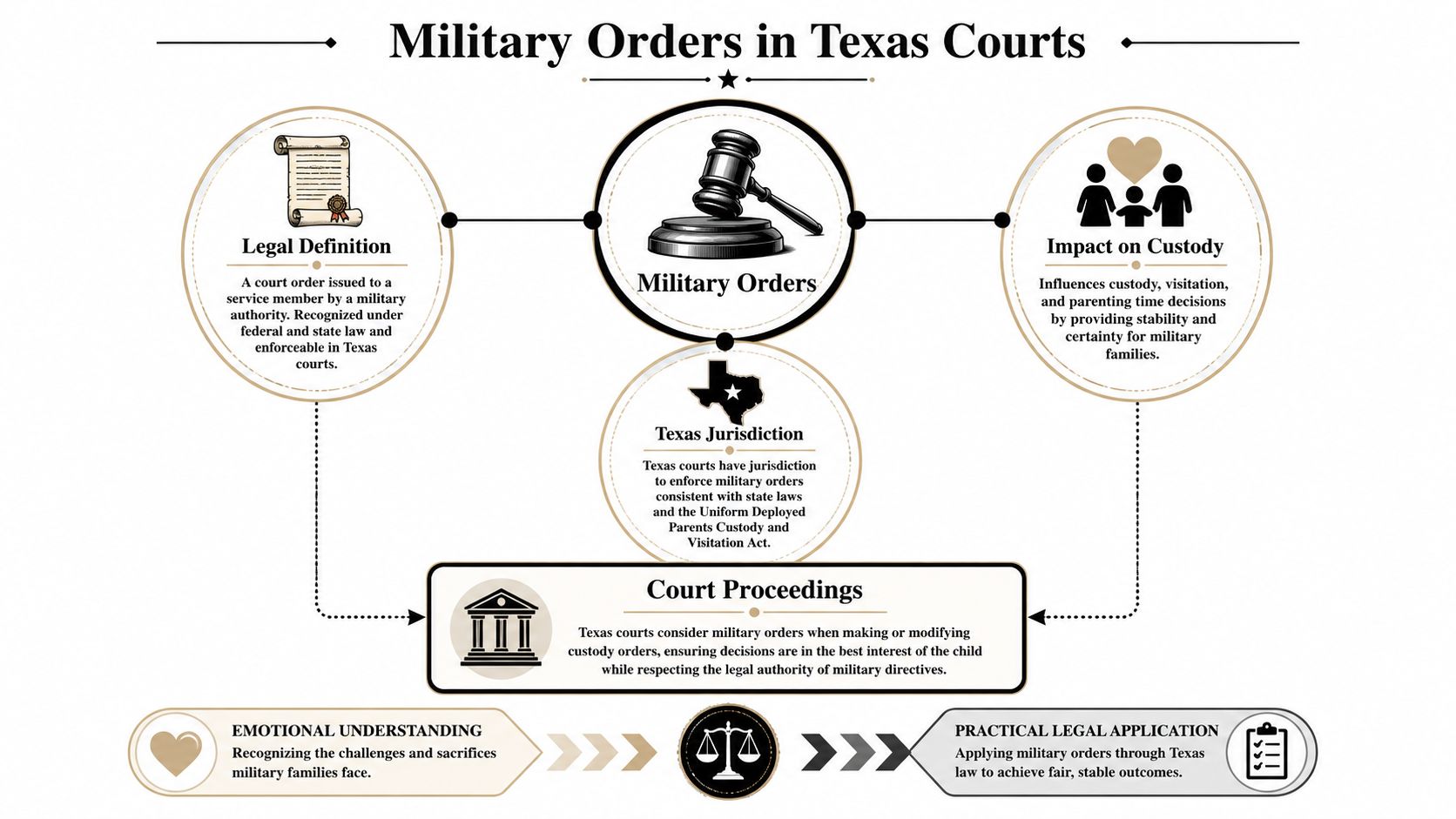
In a Texas courtroom, military orders function as legal proof. They verify military status and often become the starting point for any request involving custody, visitation, or a schedule change.
Military orders serve as the official legal documentation verifying a service member's active status and are a prerequisite for many family court actions. Benchmark data from the DoD Lock Program indicates that 92% of successful custody modification requests in military cases include verified order documentation as primary evidence, as noted in the MIL-STD-961E specification materials.
Conservatorship is Texas's word for custody
Texas usually uses the word conservatorship instead of custody. That matters because if you search military orders example online, you may find military forms but no explanation of how they connect to Texas legal terms.
The most common arrangement is joint managing conservatorship. Texas law generally favors both parents sharing major decision-making for the child. If you want a simple explanation of that presumption and what it means in practice, Joint Managing Conservatorship in Texas is a useful reference point.
A joint arrangement does not always mean equal time. One parent may still decide the child's primary residence, while both parents share rights involving education, health care, and other major issues.
Possession schedules are where orders often hit hardest
A possession schedule is the calendar in the court order that says when each parent has the child. In Texas, these schedules need to be specific enough to avoid confusion. That means military orders often matter because they provide hard dates, locations, and reporting requirements.
If your order says you must report out of state on a date that conflicts with weekend possession, school exchange, or a holiday period, the court needs to see that conflict in black and white. Vague testimony is weaker than documents.
Practical rule: Bring the actual orders, not just a summary from your memory. Judges make better decisions when the record includes exact dates and command information.
What judges usually look for
A Texas judge is often trying to answer a few direct questions:
- Is the military change real and documented
- How long will it affect the parent's availability
- Can the child keep a stable routine
- Can the parents preserve the child's relationship with both sides of the family
Parents dealing with divorce and military duty at the same time often need broader guidance too. The discussion in military divorce and child custody in Texas helps show how these cases overlap.
What does not work is waiting until after missed visits or last-minute cancellations pile up. Courts prefer planning over damage control.
The Different Types of Military Orders Explained
Not every order changes a custody case the same way. Two parents can both say, “I have military orders,” and still face very different legal problems.
The type of order matters because it affects location, duration, command authority, and sometimes benefits. It also changes whether a court should expect a short-term adjustment or a larger rewrite of the parenting plan.
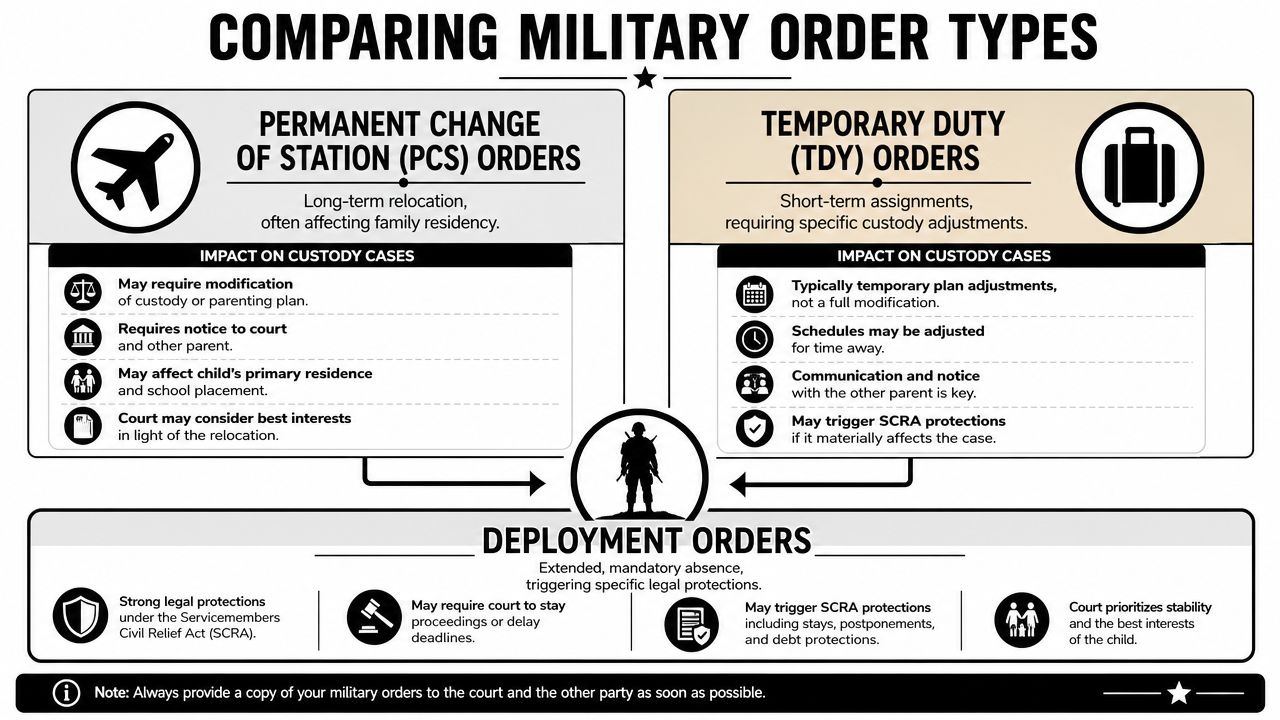
PCS, TDY, and deployment do not create the same custody issue
A PCS move usually raises the largest custody questions because it often changes where the parent will live for an extended period. That can affect school enrollment, transportation, exchange locations, and whether the current possession schedule still works at all.
A TDY assignment may be shorter, but that doesn't make it minor. If the current order depends on weekly exchanges, even a temporary absence can force the parents to address missed weekends, makeup time, or temporary caregiving.
A deployment often creates the clearest need for a temporary plan. The issue usually is not whether the parent wants time with the child. The issue is how to preserve that parent-child bond during a required absence and how to restart regular possession when the parent returns.
Title 10, Title 32, and State Active Duty
Military orders are also classified by legal authority. Military orders are classified into types like Title 10, Title 32, and State Active Duty, and National Guard members are unique because they can serve under all three, while active duty personnel and reservists are generally limited to Title 10, according to the Council of State Governments overview of military order classifications.
Here is the practical difference for families:
| Order classification | Why it matters in family court |
|---|---|
| Title 10 | Federal active duty may involve relocation or deployment under federal command |
| Title 32 | State-based duty under federal oversight can still disrupt parenting time, even if the parent remains in Texas |
| State Active Duty | State response duties may happen quickly and can require immediate schedule changes |
The key point is not just legal vocabulary. It is planning. A parent on state-related duty may not face the same long-distance problem as a parent on federal deployment, but both may still need court-approved adjustments.
What works and what does not
Some parents assume short orders do not need legal attention. That can be a mistake. If the order conflicts with exchanges, school events, or return dates, a “temporary” issue can create long-lasting conflict.
What usually works:
- Early notice to the other parent
- A proposed revised schedule tied to the actual duty dates
- Clear travel, call, and return provisions
What often fails:
- Verbal side agreements with no written follow-up
- Assuming the judge will fill in missing details
- Treating every type of military order the same
How to Read a Military Order An Example Breakdown
Parents often feel overwhelmed when they first look at orders because the document seems built for command, not for family court. A Texas judge, however, is usually looking for a small set of facts.
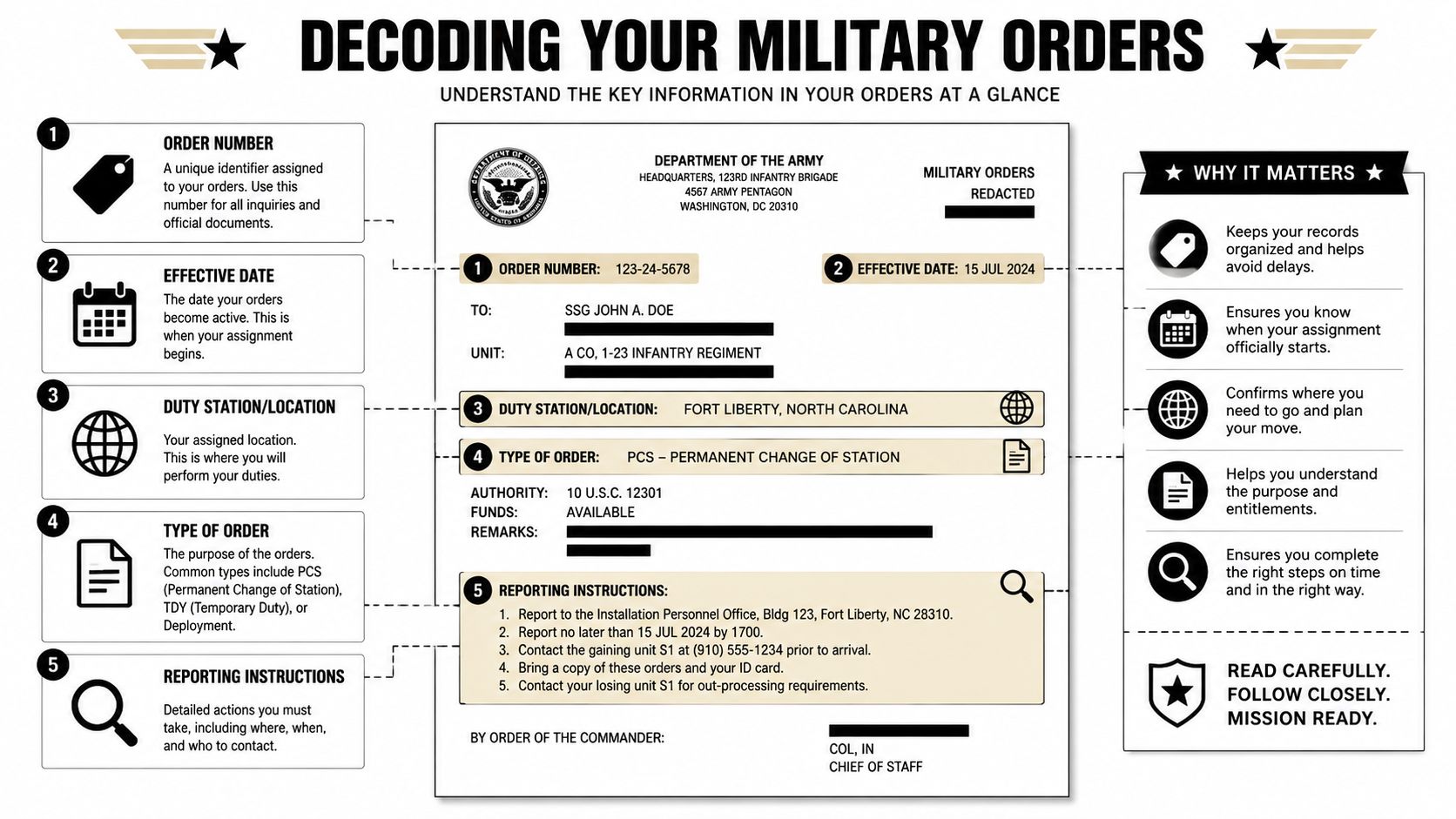
An example of military orders is useful. You do not need to master every abbreviation. You need to identify the parts that affect your child's schedule and your legal rights.
The parts of the order that matter most
Look first for the basics the court can verify quickly:
Service member name and rank
This confirms who the order applies to.Issuing authority
The court wants to know the order came from a legitimate command source.Order type
PCS, TDY, deployment, or another duty status can shape the judge's response.Effective date and duration
These dates often drive how long a temporary parenting plan should last.Duty station or reporting location
Distance affects transportation, school attendance, and feasibility of in-person visitation.
The structure matters because a Texas possession schedule must be detailed enough to avoid confusion. A possession schedule in Texas custody orders specifies the exact times a non-primary parent may have physical custody, with a standard order often granting possession on the 1st, 3rd, and 5th weekends of a month, and the requirement for detail makes the dates and locations on military orders critical evidence, as discussed in the Air Force training guide on order structure and clarity.
For readers who want a quick visual walk-through, this video helps show how to read an order form and identify the pieces that matter.
A redacted example in plain English
A court-ready reading of orders often sounds like this:
The parent received official orders directing reporting to a new duty location on a specific date, with duty continuing through a stated end date or until further orders. That information shows the current possession schedule cannot be followed as written.
That's the difference between military language and courtroom language. The judge does not need every acronym decoded. The judge needs the facts that affect the child.
What parents often miss
Parents commonly focus only on the departure date. That is not enough. Return language, temporary duty extensions, and reporting instructions can matter too. If an order leaves room for change, your proposed custody language should account for that possibility.
A strong court filing usually attaches the orders and then explains, in plain language, how those dates affect school routines, exchanges, holidays, and communication with the child.
Using Military Orders in Your Texas Custody Case
Orders become powerful only when they are matched with the right legal step.
In Texas, that often means filing to modify an existing order, requesting temporary orders, or asking the court to approve a revised parenting plan that fits the military schedule in front of you. The legal issue is usually a material and substantial change in circumstances. New military orders can be exactly that, but the court still needs a clear explanation of what should change and why.
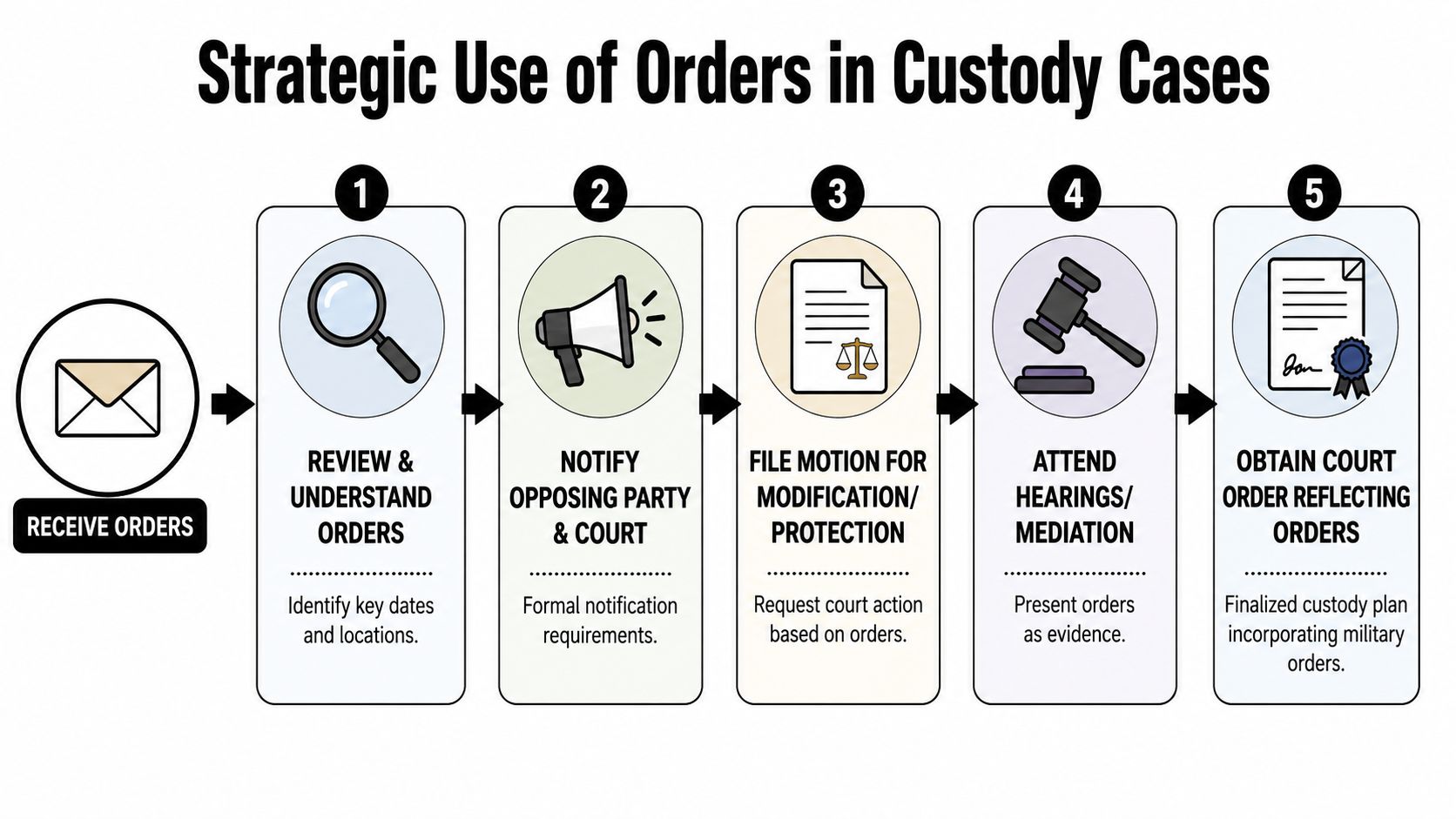
Step one is not filing first. It is planning first
Before rushing into court, line up the practical pieces:
Get a complete copy of the orders
Missing pages can create doubt or confusion.Compare the orders against your current custody order
Look at school exchanges, weekend possession, holiday periods, and travel requirements.Draft a workable alternative
Judges respond better when a parent presents a solution, not just a problem.
This is especially important in relocation cases. If the orders move you to another city or state, long-distance parenting details matter. The issues discussed in military relocation and child custody often become central fast.
The SCRA can help you, but it is not automatic cover
Many military parents hear about the Servicemembers Civil Relief Act, then assume the case must stop if they are on orders. That is too simplistic.
Many military parents in Texas are unaware of exceptions to the SCRA. The SCRA provides a 90-day protection window, but Texas judges can proceed with custody matters under certain circumstances, and that nuance contributes to 28% of military custody disputes in major Texas cities involving misinterpreted SCRA protections.
That means the SCRA can be useful, but it is not a substitute for a custody strategy. If a child needs a stable schedule now, the court may still act. Parents who rely on the SCRA without understanding the exception risk losing time and credibility.
Some of the hardest custody problems in military families are not caused by bad intent. They are caused by delay, unclear paperwork, and assumptions about what the law will do automatically.
Temporary orders often protect families better than informal deals
A temporary arrangement can address the period during deployment, TDY, or transition to a new duty station. It can cover:
- Virtual contact through calls or video at set times
- Holiday makeup periods when the service member returns
- Travel terms for exchanges, costs, and notice
- Emergency decision-making if the child needs immediate care while one parent is away
Informal side agreements sometimes work when co-parents communicate well. They often fail when travel changes, emotions rise, or memories differ. A signed court order gives everyone something concrete to follow.
When cooperation is possible, use it
Texas courts generally respond well when parents show they are trying to protect the child, not punish each other. That does not mean giving up your rights. It means proposing a child-focused plan with dates, exchange logistics, and realistic communication.
If you need help turning orders into a modification request, a temporary orders request, or an enforcement strategy, the Law Office of Bryan Fagan, PLLC handles Texas family law matters involving custody, visitation, military issues, support, and modifications.
Your Next Steps A Checklist for Protecting Parental Rights
When orders arrive, quick action matters. Calm action matters more.
The goal in most Texas custody cases is usually joint managing conservatorship, where both parents share rights and responsibilities. Texas courts generally favor that collaborative arrangement as being in the child's best interest, as reflected in this Texas military and custody reference discussing joint managing conservatorship.
A practical checklist you can start today
Get the final version of your orders
Use the complete document the court can verify, not a text message summary or verbal notice.Mark the dates that affect parenting time
Highlight reporting dates, expected duration, return timing, and any location details that affect exchanges.Compare those dates to your current possession schedule
If your weekends, summer time, or holiday periods no longer work, you likely need written changes.Build a child-focused proposal
Include transportation, video calls, makeup time, and how school routines will stay stable.Communicate carefully with the other parent
Be direct, respectful, and specific. Clear written communication can reduce conflict later.Review whether relocation changes the case
If your move affects residence or long-distance visitation, read about custody modification after relocation in Texas before the problem grows.
What mothers, fathers, and caregivers should remember
For mothers and fathers, the court usually wants to see the same thing. Can you support your child's stability while protecting that child's relationship with both parents when appropriate?
For grandparents and other caregivers, military orders can change who handles daily care, transportation, and communication. If you are helping hold things together during a deployment or relocation, accurate court orders matter because informal expectations often break down under stress.
A strong custody position is not built on emotion alone. It is built on clear documents, realistic planning, and a parenting proposal the judge can actually enforce.
Key takeaway
Your military orders do more than explain your duty assignment. In a Texas custody case, they can help prove why a change is needed and what schedule will best protect your child. Used well, they support stability, preserve parental rights, and reduce avoidable conflict.
If you need help with a child custody or visitation case in Texas, our experienced attorneys can guide you every step of the way. Contact The Law Office of Bryan Fagan, PLLC today for a free consultation.