
When your child’s future is on the line, understanding your rights matters most.
A supervised visit can feel painfully personal. You show up to see your child, but another adult is in the room, taking notes, watching your words, your tone, even how you handle a snack or a toy. Many parents hear “supervised visitation” and immediately think the court has already decided they’re a bad parent.
That isn’t always what it means.
In Texas, supervised visitation is often a safety tool, not a final judgment about your worth as a mother or father. Courts use it when they believe a child needs structure, oversight, or a slower path toward regular parenting time. For some families, it’s a short-term bridge. For others, it’s part of a longer rebuilding process.
If you’re dealing with supervised visitation texas issues right now, you probably need more than a definition. You need to know what the court is looking for, how these visits work, what they cost, and what you can do next. That’s especially true if you’re a father worried about losing connection with your child, a mother trying to keep a child safe while following court orders, or a grandparent helping hold things together.
Texas family courts decide custody and visitation under the best interests of the child standard. In plain English, that means the judge focuses first on what keeps the child safe, stable, and emotionally secure. You may also hear terms like joint managing conservatorship, which usually means both parents share certain parental rights and duties, and possession schedules, which are the court-ordered times each parent has with the child.
The details matter. So does your next move.
Understanding Supervised Visitation in Texas
A parent sits across from their child at a visitation center. They bring a coloring book, try to smile, and wonder whether every small mistake will end up in a report. The child is happy to see them. The parent is relieved, but tense. That mix of love, fear, and uncertainty is common.
That’s why it helps to start with a clear definition.
Supervised visitation means a parent spends time with a child while a court-approved third party is present. That third party might be a professional supervisor, a neutral adult, or sometimes a relative the court approves. The purpose is to allow contact while reducing risk.
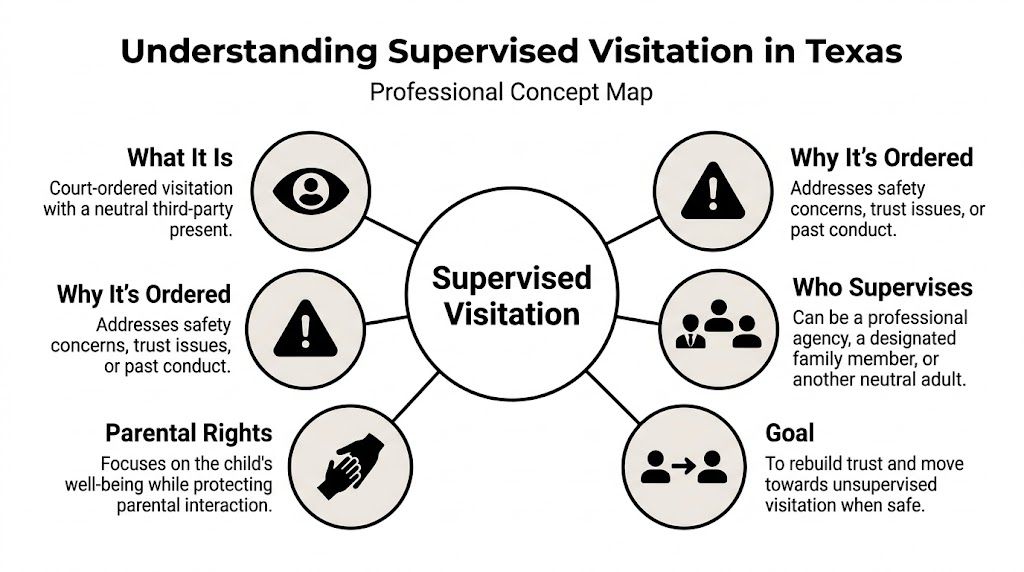
What the court is really trying to do
Texas courts don’t use supervised visitation just to make life harder for parents. They use it when they believe a child needs added protection while preserving the parent-child relationship.
That’s an important balance.
A judge may believe your child should still see you, but not yet without guardrails. It is like a temporary support rail on a staircase. The rail isn’t the destination. It’s there to help prevent harm while everyone moves more safely.
Practical rule: Supervised visitation usually means the court wants connection to continue, but under conditions that protect the child.
Why the words matter
Parents often hear legal terms and assume the worst. Here’s the simpler version:
- Best interests of the child means the judge asks, “What arrangement helps this child stay safe and healthy?”
- Conservatorship refers to parental rights and duties, such as making decisions about school or medical care.
- Possession and access means when and how a parent spends time with the child.
A supervised visitation order usually affects possession and access, not necessarily every parental right.
It’s serious, but it’s not always permanent
For many families, supervised visitation is a stage, not the final outcome. If the concern is tied to something that can be addressed, such as treatment, counseling, or rebuilding trust through consistent conduct, the order may later be changed.
That doesn’t make the process easy. It does mean you should view each visit as part of a larger record.
If you’re the parent under supervision, your actions matter every time. If you’re the parent requesting supervision, your accuracy and fairness matter too. In both situations, the court is watching for one thing above all else. Whether the child’s well-being comes first.
Why Texas Courts Order Supervised Visitation
A Texas judge won’t lightly limit a parent’s time with a child. When supervision is ordered, the court usually sees a specific concern that needs protection, structure, or proof of improvement.
Common reasons judges consider supervision
Some concerns are direct safety issues. Others are about instability or impaired judgment. Courts may look closely at situations involving:
- Family violence or threats between parents
- Substance misuse that affects safe parenting
- Neglect or unsafe living conditions
- Mental health concerns that are not being managed
- Parental behavior that harms the child emotionally
- Serious conflict during exchanges
Not every accusation leads to a supervised order. Judges compare claims to evidence, behavior patterns, and the child’s needs.
How the best-interest standard works in real life
The best interests of the child standard sounds broad because it is. Judges have room to weigh many facts at once.
A court may ask questions like these:
- Has this parent shown safe judgment around the child?
- Is there a pattern, or just one disputed incident?
- Can the child maintain contact without unnecessary risk?
- Is supervision the least restrictive way to protect the child?
That last question matters. Courts often try to protect children without cutting off contact completely.
Child safety drives these decisions
In child welfare matters handled by DFPS, supervised visitation is part of a broader safety system. Texas saw 286,314 reports to Statewide Intake in 2021 and 16,028 removals, and federal data showed 98.7% of children in foster care received monthly visits in 2020, reflecting how strongly the system emphasizes continued parent-child contact when it can be done safely, according to the DFPS visitation policy and related data.
That doesn’t mean every family court case is a DFPS case. It does show how Texas approaches the problem. Protect the child, but preserve connection where possible.
Substance use concerns often require proof, not promises
If alcohol or drug use is part of the concern, the judge may want more than a parent saying, “I’m doing better.” Courts often respond more favorably to concrete steps such as treatment records, clean testing, and consistent attendance in recovery support.
For parents looking for help close to home, some families explore resources like addiction treatment centers in Dallas, Dallas County, Texas when substance-related concerns are affecting custody or visitation.
Domestic violence changes the court’s lens
When there’s a history of abuse, intimidation, or coercive control, supervised visitation may become one part of a broader protection strategy. The court may focus not only on physical safety, but also on the emotional effect of conflict on the child.
If domestic violence is part of your case, this guide on custody modification when domestic violence is involved in Texas can help you understand how those facts may affect visitation orders.
A judge is not only asking whether a parent loves the child. The judge is asking whether the child is safe during the parent’s time.
What parents often misunderstand
Many parents think supervised visitation means the court believes they should never be alone with their child again. Usually, the court is making a narrower decision.
It may be saying:
- the child needs protection while facts are sorted out,
- the parent needs to show stability over time, or
- transitions must happen in a more controlled setting.
That distinction matters because it affects how you respond. Fear leads some parents to withdraw. A better response is focused action. Address the concern directly, follow the order carefully, and build a record the judge can trust.
The Different Types of Supervised Visitation
Supervised visitation can be formal, like a session at a professional center, or more informal, like a visit overseen by a trusted family member. That difference matters more than many parents expect, because the type of supervision affects how the visit feels, how much it costs, what gets documented, and how a parent later shows the court that more freedom is appropriate.

A court is not picking a label for its own sake. It is choosing a setting that matches the concern in the case. If the judge worries about safety, conflict, substance use, or a parent’s judgment during visits, the order may call for closer oversight. If the concern is narrower, the court may allow a less restrictive arrangement.
Professional supervision and family supervision
A professional visitation center works like a structured appointment. Staff members follow set rules, keep records, and usually control the timing and location of the visit. For some families, that setting feels stiff. For others, it brings relief because expectations are clear and there is less room for arguments about what happened.
A family-member supervisor or neutral third party usually feels less clinical. The child may be more relaxed in a familiar place, and scheduling can be easier. But that only works if the supervisor is reliable, calm, and able to put the child’s needs first. If one parent sees that person as biased, the arrangement can create new conflict instead of reducing it.
Here is the practical difference:
| Type | How it usually feels | Main advantage | Main concern |
|---|---|---|---|
| Professional agency | Structured and formal | Clear rules and reporting | Cost and scheduling |
| Neutral third party | Less clinical | Can be more flexible | Neutrality may be disputed |
| Approved relative | Familiar for the child | Often easier emotionally | Family conflict can complicate things |
Sometimes another professional may be involved in the broader case, even if that person is not the visit supervisor. If you are hearing terms that sound similar, this explanation of what a guardian ad litem does in a Texas custody case can help clarify who is evaluating the child’s best interests and who is monitoring a visit.
Different levels of supervision
It is common to confuse the type of supervisor with the level of supervision. They are related, but they are not the same.
A professional center can provide very close monitoring, where staff can see and hear everything. A relative supervisor may be told to stay in the same room and observe the full visit. In other cases, the supervisor only needs to remain nearby and manage the beginning and end of the parenting time.
Day to day, those levels often look like this:
- Lower oversight: The supervisor is present nearby and helps manage the visit.
- Moderate oversight: The supervisor stays throughout the visit and watches interactions.
- Higher oversight: The supervisor can see and hear the entire visit at all times.
- No supervision: The parent has regular possession under the order.
The practical rule is simple. The more unresolved the concern, the closer the monitoring.
Monitored exchanges are related, but different
It is common to confuse supervised visitation with a monitored exchange. A monitored exchange only covers the handoff. The parent’s actual time with the child may still be unsupervised.
That distinction matters in real life. If the problem is yelling during pickup, threats in the parking lot, or tension between parents during transitions, the court may focus on the exchange instead of the visit itself. That approach can lower conflict without restricting parent-child time more than necessary.
Why the type matters
The kind of supervision ordered shapes more than the hour you spend with your child. It can affect whether visits happen on weekends or only during business hours, whether you need to pay a center fee, whether missed visits are easier to reschedule, and whether there is a written record showing your progress.
For a parent trying to move toward unsupervised visitation, that paper trail can matter a great deal. A professional center may document punctuality, behavior, and interactions in a way that is easier to present later. A family supervisor may offer warmth and flexibility, but informal arrangements can lead to disputes if people remember events differently.
The best question to ask is not, “Which option feels less stressful today?” It is, “Which setup protects my child, follows the order, and gives me the clearest path to rebuild trust with the court?”
Navigating the Legal Process for Visitation Orders
When supervised visitation becomes part of a case, parents often feel lost because the order itself sounds simple, but the legal process behind it is not. Whether you’re asking for supervision, objecting to it, or trying to change an existing order, preparation matters.
What a strong order should include
A supervised possession order in Texas needs detail to work well. It should identify who supervises, where visits happen, what rules apply, and who pays. When those terms are vague, parents often end up back in court.
Texas guidance on supervised possession orders stresses that an enforceable order should clearly name the supervisor, define the location, set the rules of the visit, including prohibited conduct, and assign payment responsibility, as discussed in this explanation of supervised visitation orders in Texas.
That level of detail protects both the child and the parents. Everyone knows the expectations before the first visit happens.
Evidence that can help a judge
Family court runs on proof. Judges hear competing stories all the time. The parent who brings organized, credible evidence is usually in a stronger position.
Useful evidence may include:
- Messages and emails: Keep them complete and in context.
- Photos or videos: Only if lawfully obtained and relevant.
- Witness testimony: Teachers, counselors, relatives, or supervisors may matter.
- Medical or treatment records: These can show progress or concern.
- Visit logs: Dates, times, missed visits, and unusual events.
If a child’s interests need independent evaluation, the court may appoint a neutral professional. If that term is new to you, this article on what a guardian ad litem does in Texas cases explains that role in plain English.
If you want supervised visitation
The parent asking for supervision needs to do more than express fear. The court usually needs specific facts.
That means it helps to present:
- A clear description of the risk
- Dates or examples showing a pattern
- Any supporting records
- A proposed supervision plan that is realistic
A request is more persuasive when it sounds child-focused, not revenge-focused.
If you are contesting supervision
The instinct to defend yourself emotionally is understandable. But in court, calm proof works better than outrage.
Try to show:
- the allegation is false, exaggerated, or outdated,
- the concern has been addressed through treatment or counseling,
- you’ve exercised parenting time safely, or
- a less restrictive option would protect the child.
Modification requires changed circumstances
If supervision is already ordered and you want it lifted or reduced, Texas courts often look for a material and substantial change in circumstances. In simple terms, something important must be different now from when the order was entered.
That could involve meaningful treatment progress, sustained sobriety, improved mental health stability, or a strong record of safe visits.
Court orders work best when they read like a checklist, not a guess. If the order is unclear, enforcement becomes harder and conflict often grows.
Keep your records like a business file
Parents sometimes remember the big moments but forget the details that courts rely on. Build a file now.
Include court papers, supervisor notes, receipts, treatment records, and a clean timeline. If the case later turns on whether you complied, those records can speak louder than your memory.
The Practical Realities Costs and Logistics
A court order can say “supervised visitation,” but that doesn’t answer the hard questions. Who supervises? Where do visits happen? How do you fit them around work, school, and transportation? And for many parents, the most urgent question is simple. How much is this going to cost?

The financial side is real
In one Tarrant County program, parents face a $50 intake fee, a 30-day waitlist, and $15 one-hour center visits, while community-based supervision may cost $55 per hour, according to this review of Texas family law custody and visitation statistics.
For some families, that may sound manageable. For others, it can make compliance hard, especially when visits are recurring and transportation, missed work, and child-related expenses are already stretching the budget.
Why cost can change the whole case
The law can order access, but access still has to be practical.
If one parent can easily afford professional supervision and the other cannot, the arrangement may feel uneven before the first visit even starts. That doesn’t mean the order is invalid. It means the practical burden can shape whether the parent gets meaningful time with the child.
This issue often affects non-custodial parents sharply, including fathers already working with limited possession time.
Scheduling can be its own source of conflict
Even cooperative parents run into logistical stress. Professional centers may have limited hours. Community supervisors may need advance notice. Children have school, activities, and routines. Military families and long-distance parents face another layer of difficulty.
A few common trouble spots are easy to miss:
- Advance notice problems: If a provider needs notice and a parent responds late, the visit may be lost.
- Travel delays: Traffic or distance can shorten a visit and create conflict over blame.
- Intake requirements: Some providers require orientation before any visit begins.
- Rule misunderstandings: A parent may assume a sibling or grandparent can attend, then learn the provider forbids it.
If you want a practical sense of how possession can be structured around real family life, these Texas visitation schedule examples can help you think through options.
A simple way to compare common setups
| Issue | Visitation center | Community supervisor |
|---|---|---|
| Environment | Controlled and formal | More flexible |
| Cost pattern | Often fee-based | May also be fee-based |
| Scheduling | Fixed program hours | Depends on supervisor availability |
| Documentation | Usually stronger | Varies a lot |
What parents can do when the order feels unworkable
Start with honesty and documentation.
- Ask for clarity early: If the order doesn’t explain pickup, timing, or supervision terms, fix that before conflict builds.
- Document financial strain: Keep receipts, provider quotes, and communication.
- Propose workable alternatives: A different approved supervisor or location may solve the problem.
- Stay compliant while seeking changes: Self-help usually backfires.
The Law Office of Bryan Fagan, PLLC handles custody and visitation matters in Texas, including disputes about possession terms, enforcement, and modification when a supervision arrangement stops being workable for the family.
The hardest part for many parents isn’t understanding the order. It’s figuring out how to live it week after week without falling behind financially or emotionally.
Practical Tips for Parents During Supervised Visits
A supervised visit can feel stiff at first. Children notice tension quickly, even when adults think they’re hiding it. The best visits usually aren’t the fanciest ones. They’re the ones where the child feels calm, wanted, and free from adult conflict.
For the visiting parent
Start by treating the visit like an important appointment, because it is. Arrive on time, bring what the child enjoys if the rules allow it, and keep your attention on the child rather than on the supervisor.
A few habits help:
- Keep conversation child-centered: Talk about school, hobbies, pets, or favorite games.
- Follow the rules exactly: Even small pushback can look bigger in a report.
- Stay steady if emotions rise: Don’t argue with the supervisor or the other parent.
- Use simple affection appropriately: Warmth matters, but always stay within the order and provider rules.
If the child seems distant, don’t panic. Some children need time to settle in. Let the relationship breathe.
For the custodial parent
Your role matters before the visit even begins. Children do better when they aren’t asked to carry adult fears.
Try to prepare the child with calm, neutral language. You don’t need to oversell the visit or criticize it. A simple statement such as “You’re going to spend time with your parent today, and I’ll see you after” often works better than a long explanation.
Helpful approaches include:
- Keep routines steady: Meals, naps, and transitions matter.
- Avoid coaching the child: Children shouldn’t feel they must report back or take sides.
- Pack comfort items if allowed: A small familiar object can reduce stress.
- Respond to feelings without escalating them: “It’s okay to have big feelings” is often enough.
When safety concerns are part of the picture
Some families need supervised visitation because there has been violence, intimidation, or severe conflict. In those situations, emotional preparation and outside support can matter just as much as legal planning.
If someone in your family needs immediate support or safety planning, these domestic violence crisis lines may be a useful starting point.
What both parents should avoid
Children usually suffer most when supervised visits become another battlefield.
Avoid these traps:
- Talking about the court case in front of the child
- Asking the child to choose sides
- Sending messages through the child
- Criticizing the other parent during or after the visit
Children don’t need perfect parents during supervised visits. They need predictable adults who make the time feel safe.
Focus on what the child will remember
Most children won’t remember whether the room was formal or whether the supervisor took notes. They will remember whether they felt tension, warmth, fear, or relief.
That’s why the best strategy is often the simplest one. Show up, stay calm, and make the visit about your child rather than your frustration.
The Path Toward Unsupervised Visitation
The visit ends. Your child walks out with the supervisor, and you are left wondering what happens now. Many parents in that moment are asking the same question. What do I need to do to get back to regular, unsupervised time?
The answer is usually practical, not dramatic. Texas courts tend to look for a reliable pattern of safe parenting over time. A judge is not deciding whether you sound sincere. A judge is deciding whether the facts show your child can be safe with less restriction.

The court usually wants proof of change, not just a promise
Parents often feel pressure to explain why the original order was too harsh. That reaction is understandable. But modification requests are usually stronger when they stay focused on one question. What has changed, and how can you prove it?
A supervised visitation order often works like training wheels. The court put that structure in place because something raised concern about safety, judgment, stability, or conflict. To remove the restriction, you usually need to show that the original concern has been addressed in a measurable way.
That often means a steady record of safe visits, following every rule in the order, and completing any services the court expected.
Progress usually looks ordinary
Parents sometimes expect one big milestone to fix everything. In real cases, progress is more often built from small, repeatable steps.
A strong record may include:
- showing up for every scheduled visit
- arriving on time and prepared
- treating supervisors and the other parent respectfully
- finishing counseling, classes, or treatment that relates to the court’s concern
- complying with testing or sobriety requirements
- receiving positive or neutral reports from the supervisor
This can feel slow. It is also how trust is rebuilt in family court. One calm, appropriate visit rarely changes an order by itself. Months of calm, appropriate visits can.
Build your records like you are preparing a binder for court
Good intentions help your child. Good documentation helps your case.
Keep copies of anything that shows consistency and improvement, such as:
- program completion certificates
- therapy or counseling attendance records
- test results if the order requires them
- supervisor notes or summaries
- your own visit log with dates, times, and brief observations
Your log does not need to be emotional or lengthy. Keep it clear and simple. Write down the date, whether the visit happened, whether you were on time, what activities took place, and anything positive or unusual. If a problem comes up later, those notes can help your attorney present a clean timeline.
The original concern should shape your next step
This part is easy to miss.
If supervision was ordered because of substance use, the court will usually want to see sobriety and compliance. If the problem was angry outbursts, the court may want proof that you completed counseling and handled visits appropriately. If the issue involved unsafe decision-making or untreated mental health symptoms, your evidence should speak directly to that issue.
In other words, the path back is usually not generic. It needs to match the reason supervision was ordered in the first place.
Timing matters
Filing too early can set you back. If you ask for unsupervised visitation before your record shows real improvement, the judge may conclude that you still do not understand the seriousness of the order.
Before filing, ask yourself:
- Do I understand every condition in the current order?
- Have I addressed the concern that led to supervision?
- Can I prove that with records, reports, or certificates?
- Has enough time passed to show a stable pattern, not just a short burst of compliance?
- Would my supervisor’s notes support a change?
That last question matters more than many parents realize. A single angry exchange, missed visit, or rule violation near the time of filing can overshadow months of better conduct.
Here’s a helpful overview that many parents find useful before thinking about the next legal step:
Many parents regain unsupervised time one step at a time
A supervised order can feel personal. It can also feel humiliating, expensive, and exhausting. Those feelings are real. But the legal system usually responds best to calm persistence.
Parents often make the most progress when they stop trying to relitigate every past conflict and start creating a record the court can trust. Show up. Follow the rules. Finish what the order requires. Keep proof. Let your conduct tell the story.
For mothers, fathers, grandparents, and other caregivers, the same principle usually applies. Demonstrated change carries weight. If your circumstances are more stable, your visits are going well, and your records show that clearly, you may have a sound basis to ask for less restrictive possession.
Key takeaway
The road to unsupervised visitation is usually built visit by visit, document by document, and choice by choice.
- Know exactly what the order requires
- Address the reason supervision was ordered
- Create a steady record of safe, appropriate visits
- Save documents that show your progress
- Talk with a lawyer before filing to change the order
If you need help with a child custody or visitation case in Texas, the attorneys at The Law Office of Bryan Fagan, PLLC can explain your options and help you prepare for the next step.
If you need guidance with supervised visitation texas issues, custody orders, enforcement, or modification, Law Office of Bryan Fagan, PLLC can help you understand your options and prepare the next step that fits your family’s situation. Contact the firm today to schedule a free consultation.