Skip to content
When your child’s future is on the line, understanding your rights matters most. Deciding to move can feel like you're caught between a fresh start for yourself and your child's stability. You're probably asking: can a custodial parent move out of state from Texas? The short answer is yes, but it's almost never a simple personal decision. It requires legal permission from a Texas court or the written consent of the other parent.
Your Right to Move and Your Child's Future
Life happens—a great new job, a second marriage, or needing to be closer to family for support—and moving out of state can look like the best path forward for both you and your children. But Texas law places a heavy emphasis on your child's right to have a consistent, meaningful relationship with both parents. Balancing your dreams with your child's need for stability is the heart of every relocation case.

Why a Move Isn't Just a Personal Choice in Texas
Most Texas custody orders include a geographic restriction. Think of it as a legal boundary line—often a specific county and its neighbors—where the child must live. This provision isn't meant to punish you or tie you down. Its sole purpose is to keep the child close enough for both parents to stay actively involved in their life, which judges see as crucial for their well-being.
This legal boundary is a cornerstone of joint managing conservatorship, the standard arrangement in Texas where both parents share the rights and duties of raising their child. In plain English, this means the court presumes that having both parents nearby and involved is in the child's best interest. This "best interest of the child" standard is the legal guidepost for every single custody decision a judge makes.
The Reality of Post-Separation Moves
If you're considering a big move after a separation, you're not alone. Life is dynamic, and parents often need to seek new opportunities or find a stronger support system. Research shows that within just two years of separating, about 17% of custodial parents move at least an hour away. Fast forward to the four-year mark, and that number jumps to 25%. You can learn more about these relocation trends and their impact. These statistics show just how common relocation is, but they also highlight why it's so important to follow the correct legal steps to protect your rights and—most importantly—your child's well-being.
This guide will walk you through what the Texas Family Code requires, helping you understand how a judge will look at a request to move. We'll break it down into clear, manageable steps so you can make informed choices, whether you’re the parent hoping to move or the one hoping to keep your child close.
Decoding Geographic Restrictions in Your Custody Order
Life has a way of changing. A dream job offer, a new relationship, or the need to be closer to family can all pull you in a new direction. But if you're a parent in Texas, before you start packing, you must pull out your custody order and find one critical clause: the geographic restriction.
This single provision is the legal starting point for any conversation about moving with your child. Think of this restriction as a "home base" for your child, a legally defined area designed to make sure both parents can stay consistently and actively involved in their life. It isn’t meant to be a punishment; it’s a tool judges use to promote stability and protect your child’s right to have a meaningful relationship with both Mom and Dad.

Finding and Understanding the Restriction
So, where do you find this all-important clause? Grab your Final Decree of Divorce or your Suit Affecting the Parent-Child Relationship (SAPCR) order. You'll usually find it in the section that names the parent who has the exclusive right to decide where the child lives.
The language will look something like this:
"IT IS ORDERED that the parties are restricted to establishing the primary residence of the child within Harris County, Texas, and counties contiguous to Harris County, Texas."
This is what lawyers call a domicile restriction. "Domicile" is just the formal legal term for a person's permanent home. In Texas, it’s incredibly common for courts to limit a child's main residence to the county where the case was filed, plus any of the counties that border it.
Here’s a critical point many parents miss: the restriction applies to your child's primary residence, not necessarily your own. You are generally free to live wherever you want. What you can't do is move your child outside that designated area without getting either the other parent's written permission or a new court order.
Why This Clause Matters So Much
The geographic restriction is the foundation that makes a Standard Possession Order (SPO) work. A possession order is simply the court-ordered visitation schedule. The SPO is the default schedule in Texas, and it's built on the assumption that both parents live relatively close to each other—usually within 100 miles.
A standard schedule includes things like:
- Possession on the first, third, and fifth weekends of the month
- Splitting major holidays like Thanksgiving and Christmas
- A longer, uninterrupted stretch of time in the summer
When one parent wants to pack up and move out of state, this schedule falls apart. Weekend visits become impossible due to the cost and time of travel. This is why a move out of state requires more than just a permission slip; it means you have to modify the entire possession schedule, which forces you to modify the custody order itself.
The Texas court that issued your original custody order almost always keeps authority over your case. This legal principle is called exclusive, continuing jurisdiction, and it means you have to go back to that same court to ask for permission to change the geographic restriction. You can learn more by reading our guide on understanding Texas custody and exclusive, continuing jurisdiction.
Ignoring this part of your order is a huge mistake. A judge can order you to return the child to Texas immediately and could even consider changing who has primary custody. Your first, most important step is always to read your order carefully and understand the exact boundaries you’re working with.
What 'Best Interest of the Child' Really Means
If you’re a parent in a Texas family court, you’ll hear one phrase over and over: the best interest of the child. It’s the north star for every judge making a decision about your family. But what does it actually mean when you’re trying to move out of state with your child?
It’s not just a gut feeling. The Texas Family Code, guided by a landmark case called Holley v. Adams, gives judges a specific framework to work from. Think of it less as a single question and more like a detailed checklist the court uses to see the entire situation through your child’s eyes.
The Holley Factors Explained
When a judge weighs a relocation request, they aren't just looking at your reasons for wanting to move. They are balancing your hopes for a new life against the real-world impact on your child and their relationship with the other parent. The court digs deep, asking a series of questions to get a complete picture of what your child's life is like now versus what it would be after a move.
These questions, known as the Holley Factors, get into the details of family life:
- The Child's Needs: What does your child need to thrive—emotionally, physically, and developmentally? For instance, does one location offer better access to specialized medical care or a top-notch school program for their needs?
- Parental Abilities: The court looks hard at each parent’s ability to provide a stable, loving home. This isn’t just about who’s the “better” parent; it’s about who can best support the child’s needs, including the ability to co-parent effectively across hundreds of miles.
- Stability of the Home: Is the new home you're proposing a stable environment? What about the current one? Courts prize consistency for kids, and a move is a major disruption.
- Plans for the Child: A judge wants to see a concrete plan. Where will your child go to school? Who will their doctor be? What opportunities will they have for friends and activities? Vague ideas won't cut it.
- Acts or Omissions: The court will consider past actions by either parent that shed light on whether they genuinely act in their child's best interest.
The court's job is to create an order that protects the child's emotional well-being and, crucially, fosters a strong relationship with both parents. A move cannot be allowed if it undermines that fundamental right without a very compelling reason.
How a Move Impacts the Parent-Child Relationship
The real tug-of-war in any relocation case is the effect of distance on the parent-child bond. A move might open up amazing opportunities for you and your child, but there’s no getting around one hard fact: it makes frequent, casual contact with the other parent incredibly difficult.
This is where the judge’s analysis gets intensely practical. They must weigh the benefits of your proposed move—like a fantastic job offer or being closer to supportive family—against the loss of the other parent’s regular weekend visits, school play attendance, and soccer game cheering. Research backs this up. You can read more about how relocation affects child custody on our blog.
This is exactly why your ability to present a detailed, thoughtful long-distance possession schedule is a game-changer. You must show the judge you’ve got a realistic plan to keep the other parent deeply involved. Often, this means being generous with summer and holiday visitation to make up for the lost weekends. Ultimately, you must prove that the benefits of moving for your child are so significant that they outweigh the undeniable challenges the distance will create.
The Legal Pathways to Relocating With Your Child
Once you've decided a move is the right call for your family, the next question is a practical one: how do you make it happen legally? Figuring out if a custodial parent can move out of state involves a clear legal strategy, not just packing boxes. Texas law provides two distinct pathways to legally relocate with your child. Each one requires careful planning and a focus on your child’s well-being.
The journey always starts with your current custody order. Understanding the exact terms of your geographic restriction is your non-negotiable first step. Once you’re clear on the rules, you can choose the path that makes the most sense for your family.
Path 1: The Cooperative Approach Through a Written Agreement
The most straightforward and least stressful way to get permission to move is by reaching an agreement with the other parent. If you and your co-parent can communicate effectively, this should be your first option. A collaborative approach saves time, money, and the emotional toll of a court battle, which is always better for your child.
To make this work, you need more than a verbal "okay." Any agreement must be:
- In writing: A simple text message or handshake won't hold up in court.
- Specific and detailed: The agreement should clearly lay out the new terms, including the new geographic area and a revised possession schedule.
- Signed by a judge: The agreement must be formalized into a new court order to be legally enforceable.
Approaching this conversation with empathy and a solid plan is key. Come prepared with a proposed long-distance visitation schedule that shows you're committed to preserving your child's relationship with their other parent. This might include extended summer visits, alternating major holidays, and regular video calls. The more you can show that you’ve thought through the logistics of keeping the other parent involved, the more likely you are to get their support.
This flowchart outlines some of the core factors a court—and by extension, the other parent—will consider when evaluating a move.
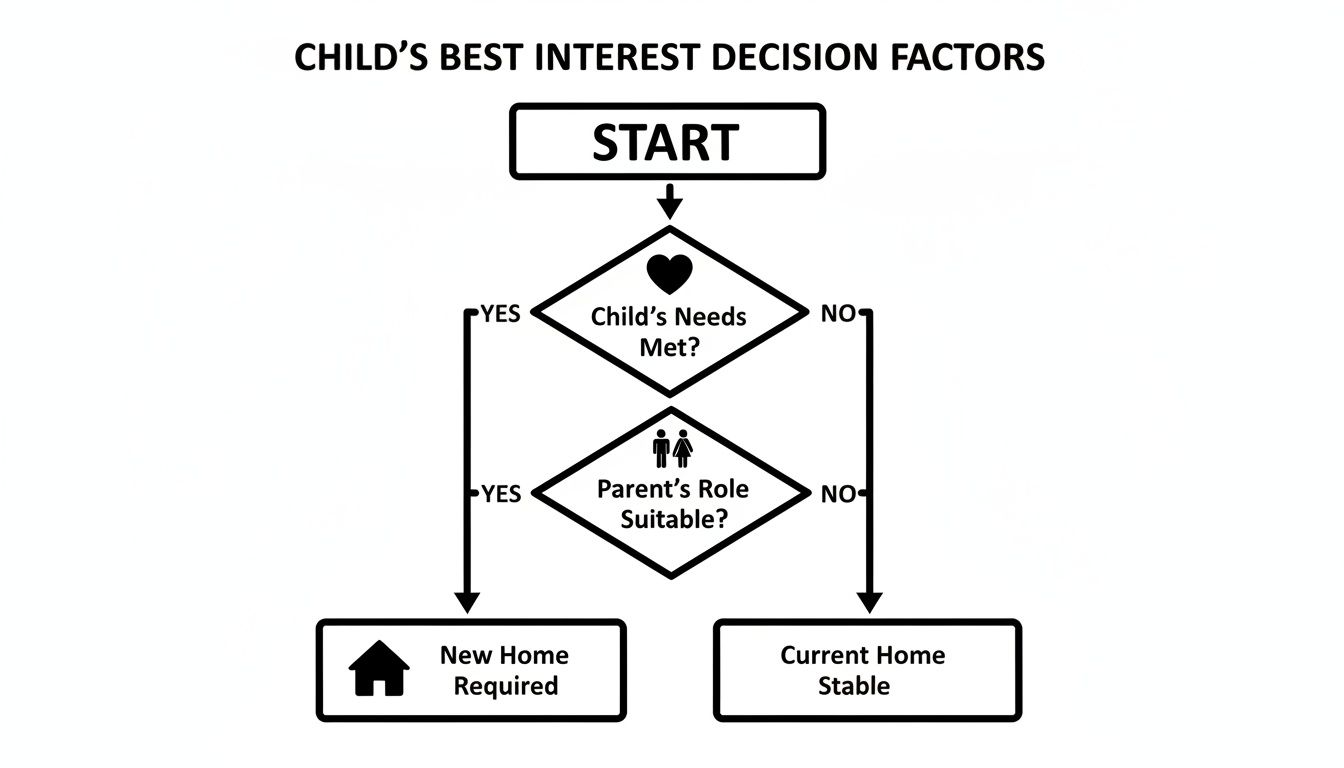
As you can see, the decision-making process is all about the child's needs, the stability of the proposed new home, and each parent's ability to support the child's well-being.
Path 2: The Formal Court Process Through a Petition to Modify
If an agreement isn't possible, your next step is to ask the court for permission. This is a formal legal process that begins when you file a Petition to Modify the Parent-Child Relationship. This document officially asks the judge to lift the geographic restriction and create a new possession schedule.
Here’s a simplified look at how the court process usually unfolds:
- File the Petition: Your attorney will draft and file the petition with the same court that issued your original custody order.
- Serve the Other Parent: The other parent must be formally notified of the lawsuit. This is called "service of process."
- Navigate Mediation: Before a final hearing, Texas courts almost always require parents to attend mediation. A neutral third-party mediator helps you try to reach a settlement. Many relocation cases are resolved at this stage.
- Prepare for a Hearing: If mediation fails, your case will be set for a hearing. Both sides will present evidence and testimony to the judge, who will then make a final decision based on the child's best interests.
This path is more complex and requires strong legal guidance. You’ll need to build a compelling case that proves your move is in your child's best interest. You can learn more in our detailed guide on child custody across state lines, which explores these challenges further.
Regardless of which path you take, never move your child without a signed court order or a written agreement filed with the court. Taking matters into your own hands can have severe legal consequences, including being ordered to return the child and even potentially losing custody.
Why Courts Approve or Deny Relocation Requests
Stepping into a courtroom to ask for permission to move your child out of state—or to fight to keep them here—means understanding how a judge thinks. It's not about what you want or what the other parent wants. It's about a judge looking into the future to decide which path is truly in your child's best interest. This is a massive balancing act, weighing the potential of a new life against the very real loss of frequent contact with the other parent.
Judges are trained to look past the surface and figure out the real reasons behind the move. Are they genuine, good-faith reasons that will benefit the child? Or is something else going on? This is a deeply human process where the specific facts of your family's story matter most.
Compelling Reasons Courts Often Say "Yes" to a Move
A judge is far more likely to approve a relocation when the moving parent can clearly show how the move will make the child's life better. The key is connecting the dots: it’s not about how the move improves your life, but how your improved life directly translates into a better, more stable world for your child.
Here are some of the strongest arguments we've seen work for both mothers and fathers in court:
- A Game-Changing Career Opportunity: This isn't just a small pay bump. It’s a major career move that offers a much higher income, better benefits, or a schedule that allows you to be more present as a parent. The financial security this provides for the child is what catches a judge's attention. When parents relocate for a job, courts want to see that the opportunity is real and substantial.
- A Stronger Family Support System: Moving to be near grandparents, aunts, uncles, and cousins who can offer a loving, helping hand is a powerful argument. This is especially persuasive if you’ve been handling most of the parenting on your own and need that village to help raise your child.
- Remarriage to a New Spouse: If your new spouse has a stable, established career in another state, a judge might see the move as a positive step toward creating a more secure, two-parent household for your child.
- Better Educational or Medical Opportunities: This is a big one. If the new city offers a specialized school, a unique program, or a top-tier medical facility that addresses a specific need your child has, it can be a very compelling reason for a judge to approve the move.
Common Reasons Courts Say "No" to a Move
On the flip side, judges are fierce protectors of the child’s relationship with both parents. A relocation request will almost certainly be denied if it looks like an attempt to interfere with that bond or if the promised benefits are just wishful thinking.
Here's what often leads to a denial:
- A Desire to Limit the Other Parent's Access: This is the kiss of death for a relocation case. If a judge suspects the move is a tactic to frustrate, punish, or minimize the other parent's time, the request is dead on arrival.
- Speculative or Unstable Plans: Vague plans like "I'll find a job when I get there" or moving for a new, unstable relationship won't cut it. A judge needs to see a concrete, well-thought-out plan that proves the move is a step up, not a gamble.
- Disrupting a Child's Deep Roots: If a child is thriving in their current school, has a tight-knit group of friends, is involved in the community, or has special needs being met by local doctors and therapists, a judge will be very hesitant to uproot them.
- The Co-Parenting Relationship Matters: This is especially true when it comes to relocating in Texas with joint custody. If the non-moving parent is highly involved in the day-to-day routine—school pickups, doctor visits, coaching soccer—the court will be extremely reluctant to break that active, hands-on connection.
In any relocation case, both parents will present their version of what's best for the child. Here's a look at how those arguments often stack up against each other.
Arguments for Moving vs. Arguments for Staying
| Argument for Approving the Move | Argument for Denying the Move |
|---|---|
| The move offers a significant financial upgrade for the child. | The move will sever the child's close bond with the other parent. |
| We'll be closer to family who can provide daily support. | The child is deeply rooted in their current school and community. |
| The new location has superior schools or medical care. | The proposed long-distance visitation plan is unrealistic and expensive. |
| The move allows the parent to remarry and form a stable home. | The moving parent's motives seem aimed at reducing the other parent's time. |
| The other parent can have extended summer/holiday visitation. | The child's relationship with siblings/friends will be damaged. |
| A new environment offers the child a fresh, positive start. | The non-moving parent is extremely active in the child's daily life. |
Ultimately, a judge's decision boils down to the story you tell with your evidence. A winning case paints a clear, compelling picture of a better future for your child—one with more stability and opportunity—while also presenting a realistic, good-faith plan to keep the other parent deeply and meaningfully involved in their life.
Key Takeaways & Next Steps for Your Family
Thinking about moving out of state with your child is one of the toughest, most emotionally tangled moments a parent can face. As you look toward the future, it's critical to ground every decision in a solid understanding of Texas law. This isn't just about your desire for a fresh start—it's about protecting your child and meeting your legal responsibilities.
Let’s quickly review the essentials for any parent asking, “Can I move out of state with my child?rdquo;
Your Journey Ahead
- Review Your Custody Order: Your current order is the legal roadmap. Before you do anything, find the geographic restriction. This clause dictates where your child can live and is the starting point for any relocation discussion.
- Focus on the "Best Interest of the Child": This is the only standard a judge cares about. Your reasons for wanting to move—a new job, a new partner—only matter if you can connect them directly to your child's well-being.
- Communicate First: The smartest first move is often the simplest: talk to the other parent. A collaborative solution through a written agreement is almost always less stressful, less expensive, and healthier for your child than a court battle.
- Get Permission Before You Move: This is the most important rule. Never move your child across state lines without either a signed agreement filed with the court or a new court order giving you explicit permission. Acting without court approval can have devastating legal consequences.
These situations are deeply personal and incredibly complex, and you shouldn't have to face them alone. Every family’s story is different, and the right path forward requires a smart strategy and compassionate advice.
If you need help with a child custody or visitation case in Texas, our experienced attorneys can guide you every step of the way. Contact The Law Office of Bryan Fagan, PLLC today for a free consultation.
Frequently Asked Questions About Moving States
When you’re thinking about a move, your head is likely swimming with questions. The legal process can feel overwhelming, but getting clear, straightforward answers is the first step toward feeling in control of your family's future.
Below, we've answered some of the most common questions we hear from parents just like you.
What Happens if I Move Without Permission?
This is the single biggest mistake a parent can make. Moving a child out of state without a court order or the other parent's written consent is a direct violation of your custody order. The other parent can immediately file an enforcement action, and a judge will almost certainly order you to immediately return the child to Texas.
The consequences can be severe. You could be held in contempt of court, forced to pay the other parent's attorney's fees, and in serious cases, a judge might even change the custody arrangement and make the other parent the one who establishes the child's residence. It’s a risk that is never worth taking.
How Does a Long-Distance Visitation Schedule Work?
A successful relocation hinges on creating a new possession schedule that preserves the child's bond with the other parent. Since weekend visits are no longer practical, these schedules look very different from a standard Texas plan.
You'll often see arrangements that include:
- Extended Summer Visits: The non-moving parent often gets the child for most of the summer break.
- Alternating Holidays: Parents typically alternate major holidays like Thanksgiving and Christmas each year.
- Spring Break: The non-moving parent usually gets the child for the entirety of spring break every year.
- Virtual Contact: The order will almost always include specific provisions for regular video calls and phone calls to maintain a strong connection between in-person visits.
What if the Other Parent Just Says No to Be Difficult?
It's incredibly frustrating if you feel the other parent is objecting simply to spite you. But in a courtroom, their personal feelings don't matter—only the child's best interests do. A parent's objection must be based on legitimate concerns about the child's well-being.
A judge is trained to see past personal animosity and evaluate the real-world impact of the move. If their objection is rooted in a genuine desire to protect their relationship with the child or maintain the child’s stability, the court will take it seriously. If it’s clear their objection is purely obstructive, it will hold very little weight.
The legal process is complex, but the logistics of the move itself also require careful planning. For a comprehensive understanding of the practical steps involved, consider reviewing an essential moving out of state checklist guide to help you prepare.
If you need help with a child custody or visitation case in Texas, our experienced attorneys can guide you every step of the way. Contact The Law Office of Bryan Fagan, PLLC today for a free consultation.