
When your child may be in danger, every minute feels heavy. A text from a neighbor. A missed pickup. A photo that shows unsafe conditions. A call that leaves you wondering whether your child is safe right now.
That panic is real. So is the urge to act fast.
Texas law does allow a parent or caregiver to ask for temporary custody without notice texas, but only in narrow emergency situations. This is not the same as a normal custody request. It is a short-term emergency remedy, usually sought through an ex parte request, meaning the judge may review it before the other parent is heard. Courts treat that power carefully because it affects both child safety and a parent’s due process rights.
If you’re in that position, the most important thing to understand is this: the court will want specific proof of immediate danger, not just fear, suspicion, or a difficult co-parenting conflict. Strong facts matter. The right filing matters. Timing matters.
Parents, grandparents, and military families often come to this issue under intense pressure. Mothers may be trying to stop contact after signs of abuse or neglect. Fathers may be trying to protect a child after the other parent disappears or exposes the child to drugs. Grandparents may be stepping in because neither parent is functioning safely. In each situation, Texas courts focus on one central question: what protects the child right now.
Texas family law also uses terms that can feel unfamiliar in a crisis. Conservatorship means the rights and duties of a parent or other caregiver. Joint managing conservatorship usually means both parents share major decision-making rights, even if one parent has the primary residence. Possession schedules are the parenting time rules that say when each parent has the child. And the best interests of the child standard guides custody decisions throughout the case.
An emergency filing is only one tool. Sometimes it’s the right one. Sometimes a noticed temporary orders hearing, a protective order, or an enforcement action is the better move. The key is knowing the difference before you spend precious time on the wrong remedy.
When Your Child’s Safety Can’t Wait
A parent gets a late-night message that the other parent is using drugs around the child. Another learns the child has been left with strangers for days. A grandparent sees a child returned hungry, bruised, and terrified to go back. Those are the moments when ordinary court timelines feel impossible.
That’s where temporary custody without notice texas enters the conversation. In Texas, ex parte emergency custody orders, which grant temporary custody without notice to the other parent, are authorized under Texas Family Code §§ 105.001 and following, but only in cases of immediate danger to the child’s physical health or emotional welfare, and they require a mandatory full hearing within 14 days to protect due process, as explained in this discussion of Texas emergency custody orders and the 14-day hearing rule.

What this remedy really is
An emergency no-notice request is not a shortcut around ordinary custody procedure. It’s a narrow legal response for situations where telling the other parent in advance could put the child at greater risk, or where waiting for a regular hearing could expose the child to serious harm.
In practice, courts expect the danger to be immediate and concrete. The legal system does have room to move quickly, but judges are trained to separate true emergencies from high-conflict parenting disputes.
Practical rule: If your facts would alarm a judge even before hearing from the other side, you may be in emergency-order territory. If your facts mainly show unfairness, disrespect, or bad co-parenting, you may need a different filing.
Why parents often hesitate too long
Some parents wait because they don’t want to seem dramatic. Others fear making things worse. Fathers sometimes worry they won’t be believed. Mothers often second-guess whether they have “enough” proof. Grandparents may assume they have no rights at all.
Those reactions are common. But when the facts point to immediate harm, delay can make a bad situation harder to fix.
If you’re trying to understand whether your situation may qualify, this overview of what emergency custody means in Texas is a helpful starting point. The key question is not whether the other parent is frustrating. It’s whether the child is unsafe now.
What Qualifies as an Immediate Danger in Texas Courts
Texas courts use emergency orders sparingly. The legal threshold is high because judges are being asked to act before the other parent gets notice. That means the court wants facts showing immediate danger, not just a serious disagreement.
Texas also separates emergency no-notice relief from ordinary temporary orders. Standard temporary custody orders require notice, can last 60 to 90 days or until final order, and focus on best-interest factors like parental fitness and home stability. Ex parte emergency orders are for immediate harm and are far shorter-term, as described in this review of temporary orders versus ex parte emergency orders in Texas.
Situations that often support emergency relief
Courts are more likely to take immediate action when the facts show a child is at risk of serious harm before a regular hearing can happen.
Examples often include:
- Recent physical abuse: Injuries, medical treatment, police involvement, or credible witness accounts can support emergency action.
- Sexual harm or exposure: If there is evidence of sexual abuse or unsafe sexual exposure, judges may act quickly.
- Severe neglect: Leaving a child without supervision, food, medication, or safe shelter can qualify.
- Dangerous substance abuse: A parent using drugs or abusing alcohol in a way that places the child in unsafe living conditions can support a filing.
- Abandonment or disappearance: If a parent leaves the child without proper care, the court may intervene.
- Credible flight risk: If a parent is about to hide the child or leave with the child in violation of court expectations, that may justify emergency restrictions.
The issue is not whether the other parent has flaws. The issue is whether the child faces a serious and immediate threat.
Situations that usually do not qualify
Many parents are surprised by what does not usually meet the emergency standard.
A judge will often deny an ex parte request if the facts look more like:
| Situation | Why it usually falls short |
|---|---|
| Different parenting styles | Courts expect parents to disagree on routines, discipline, and household rules |
| A new boyfriend or girlfriend you dislike | Discomfort alone is not proof of immediate harm |
| Missed visitation or late exchanges | That may support enforcement, but not necessarily emergency removal |
| Verbal conflict between parents | Hostility matters, but it is not automatically child endangerment |
| General claims with no details | Judges need dates, incidents, records, and corroboration |
That doesn’t mean the court won’t care. It means the remedy may be different.
The best-interest standard still matters
In Texas, custody cases always return to the best interests of the child. In plain English, that means the judge looks at what arrangement most protects the child’s safety, stability, health, and development. A parent doesn’t win because they are louder, angrier, or more offended. They win by showing that their request serves the child.
That standard applies to both mothers and fathers. Texas courts do not have one legal standard for moms and another for dads. If a father has the stronger facts, he can seek emergency relief. If a mother has the stronger facts, she can do the same.
For readers dealing with risk issues, this guide on child endangerment and custody in Texas helps connect the legal standard to real family situations.
A strong emergency case sounds specific. “He exposed our child to heroin use daily” is a legal allegation a judge can examine. “He’s a bad parent” is not.
When a standard temporary orders hearing makes more sense
If the problem is serious but not immediate, a standard temporary orders hearing may be the better path. That process gives notice to the other parent and lets the court put rules in place on conservatorship, child support, geographic restrictions, possession, and related issues while the case is pending.
Many families require urgent court assistance without meeting the no-notice standard. That is not a failure. It is often the correct legal route.
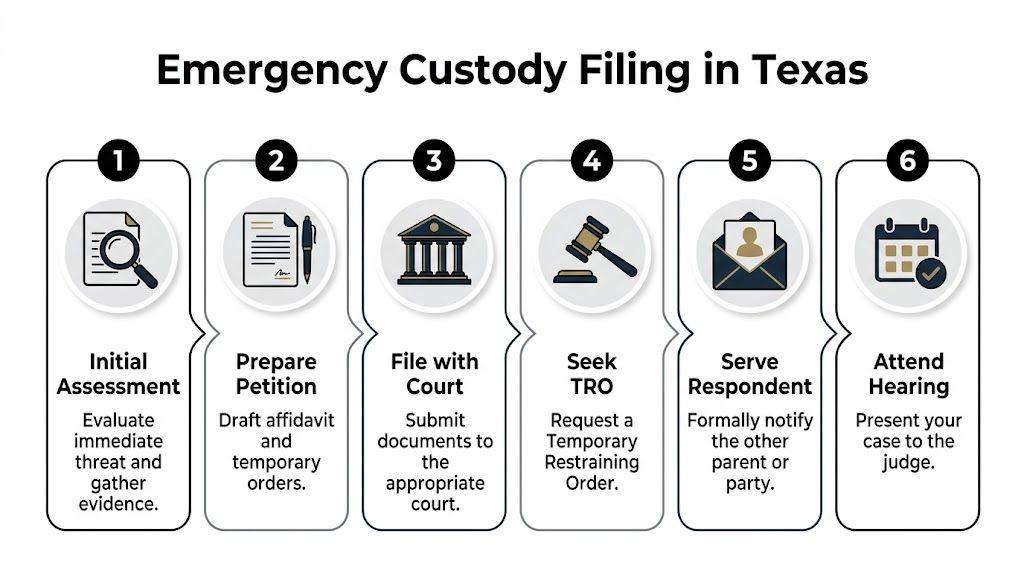
The Step-by-Step Process for Filing an Emergency Order
A parent usually calls my office after something concrete has happened. A child was left alone overnight. The other parent showed up intoxicated for pickup. A grandparent learned the child may be taken out of state before school starts the next morning. In those moments, the court is not looking for the longest story. The court is looking for sworn, specific facts and proof that the risk is immediate.
Texas emergency cases are won on detail, timing, and paperwork. If your filing does not show who did what, when it happened, how you know it happened, and why the child needs protection before the other side can be heard, the judge may deny ex parte relief and set a regular hearing instead.
Start with proof you can hand to a judge
Before filing, gather evidence that can be attached, verified, and explained quickly. Judges are far more likely to act on records, photos, screenshots, and witness statements than on general accusations.
Useful evidence often includes:
- Police records: offense reports, incident numbers, body-cam references, or dispatch records
- Medical records: emergency room paperwork, pediatric notes, discharge instructions, or treatment photos with dates
- CPS documents: intake information, safety plans, or records showing an active or recent investigation
- Witness affidavits: statements from teachers, neighbors, relatives, babysitters, or counselors with first-hand knowledge
- Texts, emails, and voicemails: threats, admissions, missed exchanges, or messages showing impairment or abandonment
- Photos and videos: unsafe living conditions, injuries, drug paraphernalia, or lack of supervision, with context about when and where they were taken
Details matter. “He is dangerous” usually goes nowhere. “On April 3, he sent a text saying he was too drunk to drive the child home, and the child was still with him” gives the court something it can evaluate.
The affidavit carries the case
The affidavit is the center of the emergency request. It must be signed under oath, and it should read like a timeline, not an argument.
A strong affidavit answers a judge’s first questions fast:
- What exactly happened?
- When did it happen?
- Who saw or documented it?
- What makes the danger immediate?
- Why would giving advance notice put the child at greater risk or defeat the purpose of the order?
For example, “At 9:15 p.m. on Friday, my son called from the apartment and said no adult was there. I arrived at 9:32 p.m. and found him alone with his four-year-old sister. I called police, and Officer Ramirez responded.” That is far stronger than “the other parent is neglectful.”
Parents often struggle here because they want to tell the whole history of the relationship. Save that for later if the court needs it. The emergency filing should stay tight, current, and supported.
Judges grant emergency relief when the sworn facts show a child may be harmed before a regular hearing can happen.
File in the correct court and under the correct case
Emergency custody relief usually has to be requested inside a SAPCR, which is the Texas case type for conservatorship, possession, and child support matters. If there is already a divorce, modification, or prior custody case, the request is usually filed there. If no case exists, a new one may need to be opened in the county with proper jurisdiction over the child.
That filing package often includes:
| Document | What it does |
|---|---|
| Petition | Starts the case or requests emergency relief in an existing case |
| Sworn affidavit | Lays out the immediate facts under oath |
| Proposed order | Shows the judge exactly what restrictions or possession terms you want entered now |
If you need a practical filing roadmap, this guide on how to file emergency custody in Texas covers the mechanics in more detail.
Military families and grandparents often run into extra procedural questions at this stage. A deployed parent may need to address notice, appearance, and possession logistics quickly. A grandparent may need to show standing before the court even reaches the emergency facts. Those issues do not prevent relief, but they do affect how the case must be prepared.
The ex parte review is usually brief and document-driven
At the first stage, the other parent is usually not present. The judge reviews the petition, affidavit, and attached proof and decides whether temporary action is justified without prior notice.
If the papers are strong, the court may sign a temporary restraining order that addresses possession of the child, contact restrictions, travel limits, or other short-term protections. Some judges ask a few focused questions. Some rule from the paperwork alone. Some deny the ex parte request and set the case for a noticed hearing because the facts do not support no-notice relief.
That is the practical trade-off. Filing too little can leave a child exposed. Filing an exaggerated or poorly supported request can damage your credibility when you return for the full hearing.
Service is a legal step, not a side task
If the judge signs a TRO, the other party still has to be formally served. Texting copies of the papers or asking a family member to pass them along is not a substitute for proper service.
Service mistakes can slow the case, force a reset, or weaken your position at the follow-up hearing. In practice, this is one of the most common points where an otherwise strong case loses time. Parents under stress often focus on getting the order signed and overlook what has to happen immediately after.
Families who want help reviewing evidence, preparing pleadings, and getting service done correctly often work with private counsel, legal aid if available, or firms such as Law Office of Bryan Fagan, PLLC for case-specific guidance.
From the TRO to the Full Hearing What Happens Next
Getting a TRO can bring immediate relief, but it is only the first round. The harder part often comes next, when both sides appear and the judge hears contested evidence.

The first proceeding is limited and one-sided. The full hearing is adversarial. That means the other parent can testify, explain, deny allegations, and present their own records and witnesses. A parent who was persuasive on paper can still lose if they arrive unprepared for live testimony and cross-examination.
What the full hearing is really about
At the follow-up hearing, the judge decides whether the emergency relief should end, continue in some form, or be reshaped into broader temporary orders.
Possible outcomes often include:
- The order is dissolved: The judge decides the emergency standard was not met or is no longer met.
- The order is modified: The court puts different restrictions or parenting terms in place.
- The order is extended or replaced by temporary orders: The judge keeps protections in place while the case continues.
Your presentation is essential. Bring organized exhibits. Bring witnesses who observed relevant facts. Be ready to explain why your requested restrictions are necessary for the child, not just helpful for your litigation position.
Prepare for proof, not storytelling
Parents often walk into these hearings prepared to tell the whole relationship story. Judges usually want something narrower. They want the facts connected to the current safety issue.
Useful hearing preparation often includes:
- Chronology: A short, clean timeline of incidents
- Exhibits: Texts, photos, records, and reports marked and organized
- Witness planning: Only people with firsthand knowledge should be central witnesses
- Requested relief: Be precise about what you want the judge to order
A mother seeking emergency custody should be ready to show more than fear. A father trying to stop unsafe contact should be ready to show more than frustration. The same standard applies to both.
If your evidence is strong, keep it simple. If your evidence is weak, talking longer won’t fix it.
Real-world delays can affect the hearing date
Texas Family Code §105.001 requires a hearing within 14 days after an ex parte order. In practice, some courts are running behind. In 2025, major county courts like Harris County reported average delays of 21 to 28 days because of judicial shortages and rising caseloads, and petitioners were advised to consider filing a motion to extend the order to prevent expiration, according to this discussion of Texas temporary custody hearing delays and extension practice.
That matters because an order is only useful if it stays enforceable. If the court cannot hear the matter on time, a party may need to ask for additional relief to avoid a gap in protection.
A short explainer can also help families understand how these hearing phases work in practice:
What judges often watch for
Parents are often surprised by what helps and what hurts at this stage.
| Helps your case | Hurts your case |
|---|---|
| Specific incidents with proof | Repeating accusations with no corroboration |
| Calm testimony focused on the child | Angry testimony focused on punishing the other parent |
| Reasonable requests | Overreaching demands that don’t match the evidence |
| Compliance with service and court rules | Procedural shortcuts |
Judges are also paying attention to whether one parent is trying to use an emergency filing to gain an advantage in a broader custody dispute. If the request feels tactical rather than protective, credibility can drop quickly.
Temporary orders after the emergency phase
If the case continues, the court may enter temporary orders that govern the family until a final trial or settlement. Those temporary orders can deal with conservatorship, possession schedules, support, communication rules, and geographic limits.
Plain-English custody terms are important. Joint managing conservatorship means both parents may share important decision-making rights. One parent may still have the right to determine the child’s primary residence. A possession schedule is the court-ordered calendar for parenting time. And all of it remains anchored in the child’s best interests.
Navigating Custody Emergencies for Military Families and Grandparents
Not every emergency case involves two parents living down the street from each other. Some of the hardest cases involve deployment, sudden relocation, or a grandparent trying to protect a child when the parents cannot.

These cases carry the same emergency standard, but the practical proof issues are different. The court still wants evidence of immediate danger. It also wants to know whether the person asking for relief has the legal ability to do so.
Military families face timing problems and notice issues
Military parents often deal with compressed timelines. A deployment order, training requirement, or PCS move can collide with an already unstable custody situation. If one parent fears the child will be exposed to danger during a relocation or left with an unsafe caregiver during deployment, emergency relief may be part of the strategy.
But military cases also require careful attention to procedure. A deployed parent may need remote access to hearings, fast communication with counsel, and a plan that addresses possession schedules in realistic terms. In some cases, a standard temporary orders hearing may be better than an ex parte filing because the court needs to hear fuller evidence about travel, residence, and substitute caregiving.
For military mothers and fathers alike, the strongest approach is usually practical and documented. Deployment papers, written communications, school records, and third-party observations often matter more than general anxiety about the move.
Grandparents have a steeper legal climb
Texas courts give significant weight to parental rights. That means a grandparent cannot step in because they believe they can provide a better home. They must clear both a procedural and an evidentiary hurdle.
A grandparent usually needs to show a legal basis to ask for custody relief at all, often called standing. Then they must present emergency facts strong enough to justify court action. That is a difficult combination.
According to this review of Texas emergency custody orders for grandparents and non-parents, anecdotal legal-forum data suggests grandparents succeed in under 30% of ex parte petitions without prior conservatorship history, and appellate cases have overturned nearly 40% of such orders for insufficient proof of irreparable harm.
What grandparents need to prove
A grandparent case often gets stronger when the evidence shows not just that a parent is struggling, but that the child is currently unsafe and there is objective support for that claim.
Evidence that often matters includes:
- CPS involvement: Reports or investigations can strongly support urgency
- Medical documentation: Especially when neglect, injury, or untreated conditions are involved
- School concerns: Attendance issues, behavioral changes, or reports from staff can help
- Prior caregiving history: If the grandparent has already been acting as a stable caregiver, that context may matter
- Specific incidents: Dates, names, and firsthand observations are critical
A common mistake is relying on family opinion. Statements like “she’s always been unstable” or “he’s never been a good father” rarely carry enough weight by themselves.
Grandparents usually need more than concern. They need records, witnesses, and facts that show the child cannot safely wait for an ordinary hearing.
The shared lesson for both groups
Military families and grandparents often face problems that are emotionally obvious but legally hard to package. The answer is not to dramatize the story. The answer is to narrow it.
What happened. When did it happen. Who can confirm it. Why does the child need immediate protection.
That disciplined approach helps military parents preserve credibility when distance and timing complicate notice. It also helps grandparents show the court they are not trying to override parental rights without cause. They are trying to protect a child with evidence the court can trust.
Your Questions About Temporary Custody Answered
Parents in emergency situations usually ask practical questions, not abstract ones. They want to know what happens if the other parent disappears, what to do if the judge says no, and whether support can be handled at the same time.
Can the court order child support in an emergency case
Yes, it can. When a judge grants an ex parte TRO, the court can also issue temporary financial orders. Under Texas Family Code guidelines, a judge may order temporary child support, including 20% of net resources for one child, and require health insurance coverage during the emergency period, as noted in this explanation of temporary orders for child support and health insurance in Texas custody cases.
That can matter a great deal when one parent suddenly becomes the child’s day-to-day caregiver because of an emergency. Safety and financial stability often need to be addressed together.
What if the other parent avoids service
Avoiding service doesn’t make the case disappear, but it can slow things down. The court expects proper notice and proof of service before a contested hearing moves forward in the usual way.
If you think the other parent may hide or evade service, tell your lawyer or the process server quickly. Dates, work schedule, vehicle information, and likely locations can help. Waiting too long to troubleshoot service problems can put the order at risk.
What if the judge denies the emergency request
A denied ex parte request does not always mean your underlying custody case is weak. It may mean the judge believes the facts do not justify no-notice action.
That often leaves several next steps:
- Set a noticed temporary orders hearing: This is common when the problem is serious but not immediate enough for ex parte relief.
- File for enforcement: If an existing order is being violated, enforcement may be the proper route.
- Consider a protective order: If family violence is involved, a protective order may offer stronger personal safety relief.
- Build the evidence file: Sometimes the court is signaling that the allegations need corroboration, not that the concern is unimportant.
Can fathers seek emergency custody too
Absolutely. Texas courts apply the same legal standard to fathers and mothers. If a father has strong evidence of immediate danger, he can ask for emergency custody. The same is true for a mother seeking to protect a child from a dangerous father or unsafe environment.
The labels in a prior order matter less than the current facts. Judges care about risk, evidence, and the child’s best interests.
How do possession schedules and joint managing conservatorship fit into this
These are core Texas custody concepts. A possession schedule is the calendar that sets out when each parent has time with the child. Joint managing conservatorship means both parents may share major parental rights and duties, though one may still have primary custody rights related to residence.
Emergency orders can temporarily interrupt the usual schedule if safety requires it. But longer-term changes usually happen through temporary orders, modification proceedings, or final orders after fuller evidence is heard.
Is an emergency order the only way to protect my child
No. It is one tool, and it is an important one, but it is not the only option. In some families, a negotiated safety plan works temporarily. In others, a standard temporary orders hearing, enforcement action, or protective order is the better legal fit.
That is one reason legal advice matters so much in these cases. The wrong filing can waste precious time. The right filing can stabilize the child’s situation quickly.
The strongest move is not always the most aggressive one. It is the one that fits the facts, the proof, and the urgency.
Key Takeaway: Temporary custody without notice in Texas is available for true emergencies, not ordinary custody conflict. The parents and caregivers who do best are the ones who act quickly, document carefully, follow service rules, and prepare for the full hearing, not just the first order.
If you need help with a child custody or visitation case in Texas, our experienced attorneys can guide you every step of the way. Contact The Law Office of Bryan Fagan, PLLC today for a free consultation.