
When your child’s safety is on the line, clear information matters more than ever.
You may be reading this after a phone call that shook you, a missed exchange, a frightening text, or a visit where your child came home and something was obviously wrong. In that moment, most parents aren’t thinking about legal terminology. They’re thinking, “How do I protect my child right now?”
In Texas, there is a legal path for true emergencies. If you’re searching for immediate custody order texas, you’re probably not looking for a long explanation of ordinary custody disputes. You need to know what counts as an emergency, what a judge will look for, and what you should do next. The process moves fast, but it also has rules. Knowing those rules can help you act with purpose instead of panic.
When Your Child's Safety is at Risk
A mother drops her son off for weekend possession and gets a late-night call from a relative saying there was fighting in the home. A father notices his daughter has unexplained bruises and is terrified to return. A grandparent learns a parent is spiraling, not sleeping, and threatening to leave with the child. These are the kinds of moments that make people search for emergency help in the middle of the night.
Texas law recognizes that some situations can’t wait for the normal pace of a custody case. Courts can issue emergency custody orders, often ex parte, meaning the judge may review the request without the other parent being present first. Texas courts use this process when there is immediate danger to a child’s physical health or emotional welfare, and these orders typically remain in place until a hearing within 14 days, when both sides can be heard under Texas Family Code §§ 105.001 et seq..

What an emergency order really does
In plain English, an emergency order temporarily changes who can make decisions for the child, who can have possession, or what contact is allowed. In Texas family law, this falls under conservatorship, which means the bundle of parental rights and duties tied to a child.
A judge may temporarily limit one parent’s access, stop removal of the child, or set immediate safety conditions. The court isn’t deciding the entire case forever in that first moment. The court is stabilizing a dangerous situation.
Practical rule: Emergency orders exist to prevent harm, not to punish a parent or win an argument.
That distinction matters. Many frightened parents believe that if the other parent has behaved badly, the court will automatically step in on an emergency basis. Courts don’t work that way. They look for urgent facts that show a child needs immediate protection.
How this differs from a regular custody case
A standard custody case often focuses on long-term questions such as who should be a joint managing conservator, what possession schedule will apply, and how the court will serve the best interests of the child. That standard means the judge tries to make decisions that support the child’s safety, stability, development, and relationships.
An emergency matter is narrower and faster. The court wants to know whether waiting would put the child at risk. If the answer is yes, the court can act quickly. If the answer is no, the judge may direct the parties into the ordinary custody process instead.
For a closer look at how short-term restrictions can work in these cases, this guide on a temporary restraining order in Texas custody cases is a useful companion.
What worried parents should hold onto right now
Panic often causes people to do one of two things. They either freeze and do nothing, or they rush into court with a vague story and no evidence. Neither approach helps much.
What does help is slowing down enough to answer three practical questions:
- What happened: Write down specific events, dates, statements, and observations.
- Why it’s dangerous now: Focus on what creates immediate risk, not the full history of the relationship.
- What proof exists: Think texts, photos, school reports, police involvement, medical records, or witnesses.
If your child is in immediate danger, Texas courts have a mechanism designed for exactly that crisis. The law can feel intimidating, but the basic purpose is simple. Protect the child first, then bring both sides in quickly so a judge can sort out what needs to happen next.
What Qualifies as an Emergency in Texas Courts
Not every painful custody dispute is a legal emergency. That’s hard to hear when emotions are high, but it’s one of the most important realities in these cases. Judges reserve emergency orders for situations involving immediate danger, not ordinary co-parenting conflict.
Texas courts are built to respond quickly when danger is real. From 2021 to 2023, courts across the state issued an estimated 162,497 protective orders, and in FY 2021, 71% of 49,942 protective orders were handled at the magistrate level for swift action in family violence and child endangerment matters, according to the Texas courts protective order report.

Situations that often support emergency action
Courts usually want facts showing a clear and present risk to the child’s physical safety or emotional welfare. Common examples include:
- Physical abuse: Injuries, threats, or violent discipline that goes beyond lawful parenting.
- Sexual abuse or exploitation: Any credible report of this kind of conduct is treated with urgency.
- Severe neglect: Lack of supervision, food, shelter, or medical care serious enough to place the child in danger.
- Dangerous substance abuse: A parent is impaired while caring for the child, driving with the child, or exposing the child to unsafe people or conditions.
- Domestic violence in the home: Children who are around repeated violence may face both physical and emotional harm.
- Mental health crisis: A parent’s condition has escalated to the point that the child’s safety is no longer reliable.
- Risk of parental kidnapping: Credible threats to hide the child, remove the child from the area, or disappear.
If your case may involve crossing state lines or urgent interstate issues, this article on when Texas can exercise emergency custody jurisdiction can help you understand that added layer.
Situations that usually do not qualify
A lot of custody fights feel urgent to the parent living through them. But “urgent to me” is not the same as “emergency to the court.”
These issues often do not support emergency relief by themselves:
- Different parenting styles: One parent is stricter, more relaxed, or has a different household routine.
- Arguments over school or activities: Important disputes, but usually not emergency-level without danger.
- Late pickups or schedule frustration: These may justify enforcement or modification, but not always emergency orders.
- Minor cleanliness complaints: A messy house is not the same thing as dangerous neglect.
- General distrust: Judges need facts, not a belief that the other parent is irresponsible.
The strongest emergency cases are specific. “My child is in danger because the other parent is unstable” is weak by itself. “The other parent threatened to drive away with the child after drinking, and I have the texts and photos” is very different.
How best interests fits into an emergency case
Texas courts always focus on the best interests of the child, but in an emergency hearing that principle gets very practical very fast. The judge is not trying to decide who is the better overall parent in one short hearing. The judge is asking whether immediate court intervention is necessary to keep the child safe.
That’s why a parent can be frustrated by behavior that feels unfair and still not meet the emergency standard. On the other hand, a parent with an imperfect history may still obtain emergency relief if the current facts show the child faces imminent harm. Courts look at the child’s safety first.
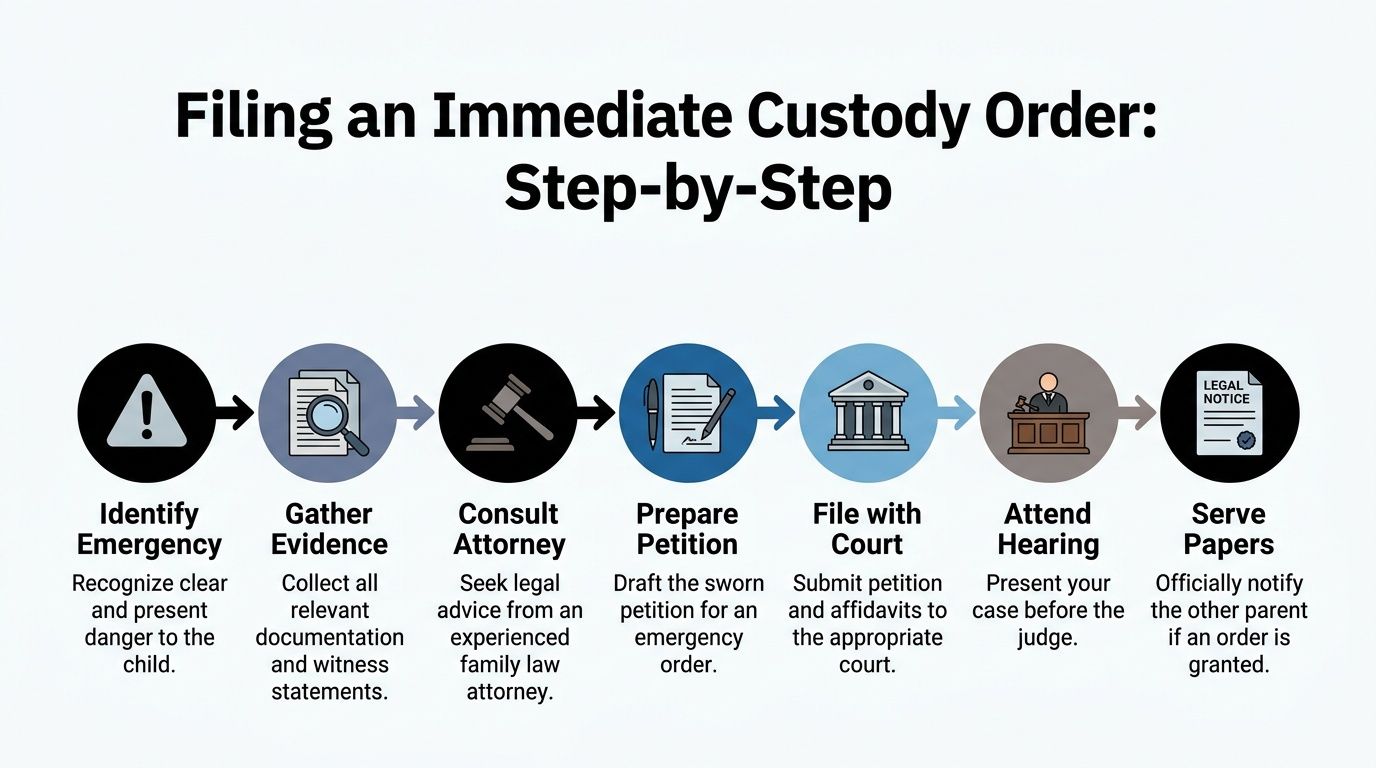
The Step-by-Step Process for Filing an Immediate Custody Order
Filing for an emergency order requires a formal legal process, not just a desperate call to the court. A judge can act quickly, but only after receiving the right case documents, a sworn statement, and facts that show the child needs protection now.
For many parents, the first practical question is whether there is already an open case. An emergency request usually has to be filed inside a custody-related matter, such as a divorce involving children, a SAPCR, a paternity case, or a suit to modify an existing order. If there is no active case, the filing often starts with the case itself and includes the emergency request at the same time.
The documents that usually matter most
A Texas emergency filing commonly includes:
A custody petition
This opens the case, or connects your request to an existing one. Depending on the family, that may mean a divorce petition, a Suit Affecting the Parent-Child Relationship, a paternity filing, or a modification.
A motion for temporary orders or emergency relief
This tells the court exactly what temporary action you are asking for. In some cases, that means suspending the other parent’s possession. In others, it means stopping a parent from removing the child, requiring supervised visitation, or granting one adult the temporary right to make decisions.
A sworn affidavit
This document often carries the most weight at the start. It is your factual statement under oath. It should describe what happened, when it happened, who saw it, and why waiting for a regular hearing would put the child at risk. If your concern involves abuse, neglect, intoxicated driving, or unsafe living conditions, facts tied to child endangerment in Texas custody cases need to be stated plainly and specifically.
After the filing is submitted, the judge may review it in an ex parte hearing. That means the court can consider immediate temporary relief before the other parent appears. If the judge signs emergency orders, the other parent must then be formally served, and the court sets a prompt follow-up hearing so both sides can be heard. As explained in this guide to Texas emergency modification procedures, that second hearing happens fast.
What the judge needs to see
Judges move quickly in these cases, but they do not guess. They look for a short, credible timeline supported by facts.
Strong affidavits usually include:
- Concrete dates and times: When did the conduct happen, and how recent was it?
- Direct observations: What did you personally see, hear, photograph, or receive by text or email?
- Other people involved: Did a teacher, neighbor, police officer, doctor, or relative witness part of the event?
- Immediate danger: Why would waiting even a few days create more risk?
- Specific requested relief: What order should the judge sign today?
A weak affidavit usually reads like a conclusion instead of a record. Statements such as “he is dangerous” or “she cannot parent safely” do not go far unless they are followed by facts the court can act on.
Courtroom reality: A parent may be telling the truth and still lose emergency relief if the affidavit is vague, missing dates, or unclear about the immediate danger.
A short educational video can also help you understand the pace and pressure of custody litigation:
What happens after the order is signed
The first order is only the beginning. Once emergency relief is granted, proper service on the other parent matters because that order affects possession, access, and the date of the next hearing.
That next hearing often comes up quickly. Parents who do well at the emergency stage sometimes get caught off guard here, especially if they assumed the signed order ended the fight. It does not. The court will soon hear from both sides, and the judge may keep, change, or dissolve the temporary relief based on fuller evidence.
Different families also face different pressure points. A father may need to address a court’s concern that his emergency request is really a response to conflict with the mother rather than a safety issue. A mother may need to explain why she did not report the danger sooner. Grandparents often have an added hurdle because they must show not only danger, but also why they have legal standing to step in. Military parents may need to act fast from outside the county or outside Texas and make sure filings, service, and hearing logistics are handled correctly.
The trade-off is real. Emergency filings can protect a child quickly, but they also push a family into immediate litigation and close judicial scrutiny. Some parents can gather records and prepare a clean affidavit on their own. Others need legal help with drafting, filing, service, and local court procedure. Options may include private counsel, legal aid if available, or a family law firm such as The Law Office of Bryan Fagan, PLLC, which handles Texas custody and emergency order matters.
Building a Compelling Case with Strong Evidence
Emergency custody cases are won or lost on proof. A worried parent’s testimony matters, but judges usually want more than a sincere fear. They want documents, records, images, messages, and witnesses that make the risk concrete.
The best evidence does two things at once. It shows what happened, and it shows why the child needs protection now. If your materials only prove that the co-parenting relationship is difficult, that usually won’t be enough.
What strong evidence looks like
Think in terms of outside verification. Judges tend to give significant weight to evidence that comes from neutral sources or that can be checked against other information.
Useful examples include:
- Police reports: Helpful when officers responded to violence, threats, or dangerous conduct.
- Medical records: Important if the child was treated for injuries, neglect, or concerning symptoms.
- Photographs or videos: These can show injuries, unsafe conditions, or property damage tied to violence.
- Texts, emails, and voicemails: Especially useful when they contain threats, admissions, intoxication, or plans to take the child.
- School or counselor communications: These may show attendance problems, alarming behavior, or disclosures made by the child.
- Witness statements: Teachers, relatives, neighbors, or caregivers may support what you observed.
- Prior court orders or violation records: These can show a recent pattern of ignoring legal boundaries.
If your concern centers on dangerous conditions or abusive conduct, this article on child endangerment and custody in Texas may help you think through what facts matter most.
Evidence Checklist for Your Emergency Custody Filing
| Evidence Type | What It Proves | Example |
|---|---|---|
| Police report | A third party documented a serious incident | Officers responded after a domestic disturbance while the child was present |
| Medical record | Physical injury, neglect, or urgent health concern | ER visit notes after a child returned with unexplained injuries |
| Text messages | Threats, admissions, or plans | A message saying the parent won’t return the child |
| Photos | Visible harm or unsafe conditions | Pictures of bruising or exposed hazards in the home |
| School communication | Changes affecting the child’s welfare | Teacher email about repeated absences or distress |
| Witness statement | Corroboration from someone else | Grandparent statement describing intoxication during pickup |
| Prior court paperwork | Context and pattern | Existing order showing possession limits that were ignored |
How to organize the file so a judge can follow it
Don’t hand the court a pile of screenshots and hope the truth will sort itself out. Organize the evidence in time order. Match each item to a specific statement in your affidavit.
A simple working method often helps:
- Start with a timeline: List incidents in date order.
- Match each event to proof: Attach the supporting text, photo, record, or witness statement.
- Label exhibits clearly: Make it easy for the court to follow.
- Keep your child at the center: Show risk to the child, not just anger between adults.
The most persuasive emergency filings usually read like a calm timeline backed by paper, not like an emotional argument backed by assumptions.
That can be difficult when you’re scared or exhausted. But it matters. Judges are more likely to act when your proof is disciplined, specific, and easy to verify.
Your Day in Court What to Expect at the Hearing
The hearing after an emergency order is often the most stressful part for parents. The first filing may have happened quickly. The follow-up hearing is where the judge takes a harder look at the facts with both sides present.
You should expect a more complete conversation about the child’s safety, temporary conservatorship, and short-term possession arrangements. This is still not the final trial, but it is a serious court setting with real consequences.
Who speaks and what the judge is looking for
At the hearing, the judge may hear from:
- You and the other parent
- Attorneys, if either side has counsel
- Witnesses with direct knowledge
- Sometimes professionals or records custodians, depending on the evidence
The judge is listening for consistency, credibility, and urgency. A parent who stays focused on the child’s current safety usually presents better than a parent who turns the hearing into a long complaint about the entire relationship.
If Texas custody language feels unfamiliar, keep these terms in mind:
- Best interests of the child: The judge’s guiding standard for child-related decisions.
- Joint managing conservatorship: A structure where both parents may share rights and duties, even if one parent has more day-to-day authority.
- Possession schedule: The court-ordered plan for when each parent has the child.
In an emergency setting, the judge may keep some version of shared rights in place while sharply limiting access, exchanges, or travel until the case settles down. In other cases, the court may impose supervised contact or a narrower temporary arrangement.
How to present yourself effectively
Parents often underestimate how much courtroom behavior affects credibility. You don’t need to sound polished. You do need to sound reliable.
A few practical habits help:
- Answer the question asked: Don’t wander into unrelated history.
- Use specific facts: Dates, places, statements, and observations matter.
- Stay calm when provoked: The other side may try to trigger an emotional reaction.
- Bring organized copies: Keep your papers neat and accessible.
- Dress with respect for the setting: It signals seriousness and preparation.
Speak to the judge as if you’re explaining the situation to someone who knows nothing about your family but has the power to protect your child.
That mindset usually leads to clearer testimony. It also keeps you from exaggerating. Exaggeration is one of the fastest ways to damage an otherwise strong case.
The possible outcomes
At the end of the hearing, the judge may choose among several paths.
One possibility is that the court extends or continues emergency protections in some form because the evidence supports ongoing risk. Another is that the court modifies the existing emergency terms and creates a more detailed temporary schedule. That might include exchange rules, communication limits, or temporary decision-making authority. The judge can also dissolve the emergency order if the proof doesn’t justify it.
Some parents are surprised when the court doesn’t give them everything they asked for. That doesn’t always mean the judge disbelieved them. It may mean the court is trying to use the least restrictive arrangement that still protects the child.
After the hearing, follow the temporary orders exactly. Keep records. Don’t freelance with exchanges, messages, or side agreements that contradict the signed order.
Life After the Order Guidance for Mothers Fathers and Grandparents
An emergency order can make life feel upside down overnight. School pickups change. Phone access changes. Sleep becomes hard. Even when the order brings relief, it can also bring grief, confusion, and a lot of practical stress.
The next phase is about more than surviving the hearing. It’s about building stability for the child while protecting your own legal position.
For mothers trying to protect day-to-day safety
If you’re the parent who sought emergency help, enforcement matters almost as much as obtaining the order. Keep a copy of the signed order with you. Follow it closely. If exchanges are tense, use written communication and stay brief.
Don’t assume the judge will remember every detail later. Save messages, missed exchanges, and any new incidents. If the child needs counseling, schooling support, or a safer routine, document those steps carefully.
For fathers protecting both safety and parental rights
Fathers often worry that asking for emergency relief will be viewed through an unfair lens. What matters in court is evidence and legal standing, not stereotypes. If you are the father and there are paternity issues, make sure you understand whether your legal rights are fully established.
This is also where the difference between immediate safety concerns and long-term rights becomes important. You may need emergency protection now, but you also need a plan for conservatorship, possession, and future decision-making once the crisis passes.
For grandparents and other caregivers
Grandparents are often the first safe harbor when a family is in crisis. Sometimes that means offering housing, transportation, or supervision. Sometimes it means serving as a credible witness because you saw troubling behavior firsthand.
Grandparents should also know the law gives them a more limited role than parents in many custody disputes. Even so, their testimony, records, and stable support can be very important in an emergency case. If you are a caregiver stepping in during a dangerous period, keep notes, preserve communications, and avoid coaching the child.
Children usually do best when the adults around them lower the temperature, follow the court order, and make the child’s routine feel steady again.
For military families and families under separation pressure
Military service can complicate an emergency case because deployment, training, and relocation affect notice, possession, and logistics. The core issue remains the same. The court still focuses on immediate danger and the child’s current needs. But military parents often need especially clear planning for communication, return dates, and who will care for the child in the short term.
Some families also face outside pressures that intensify separation, relocation, or sudden caregiving changes. In those situations, practical support resources can matter alongside legal help. Families dealing with broader disruption may find useful context in this discussion of family separations impacting parents and grandparents in Texas.
Key takeaway
An emergency order is not the finish line. It is the court’s short-term response to a serious risk. After that, the focus shifts to proof, compliance, and creating a safer structure that serves the child’s best interests.
If you’re overwhelmed, remember the basic path:
- Protect the child first
- Document facts, not guesses
- Follow every court order carefully
- Prepare for the next hearing, not just the first one
- Think beyond today toward a stable long-term arrangement
You do not have to face a crisis-level custody matter without guidance. Parents, grandparents, and caregivers can take concrete steps, and the law does provide emergency tools when the facts support them.
If you need help with a child custody or visitation case in Texas, our experienced attorneys can guide you every step of the way. Contact The Law Office of Bryan Fagan, PLLC today for a free consultation.