
When your child’s future is on the line, the thought of losing your parental rights is nothing short of terrifying. Termination of Parental Rights (TPR) in Texas is the legal process that permanently severs all legal ties between a parent and a child. It is, without a doubt, the most severe action a family court can take, reserved only for situations where it's proven to be in the child's absolute best interest.
The Most Serious Step a Texas Court Can Take

The first step in facing this challenge is understanding just how serious it is. The phrase "termination of parental rights" sounds cold and final for a reason—the court's decision is permanent. This isn't a temporary change in custody; it is a complete and irreversible end to the legal parent-child relationship.
Our goal is to replace that fear with knowledge, giving you a solid foundation to understand what might lie ahead. This process can happen in two very different ways: voluntarily or involuntarily. Each path has its own legal hurdles and emotional weight for everyone involved.
Voluntary vs. Involuntary Termination
Drawing a clear line between these two pathways is critical. Voluntary termination is when a parent agrees to give up their rights. This often happens in the context of a stepparent adoption, where a new, stable parental figure is ready and willing to step into that role. It’s a choice made, at least in theory, without the court forcing the parent's hand.
On the other side of the coin is involuntary termination, which is when the court orders the parent-child relationship to be severed against the parent's wishes. This is the scenario most people dread. It can only happen if another party—like the other parent or the Department of Family and Protective Services (DFPS)—proves specific legal grounds for termination and shows that it is in the child’s best interest.
The core principle guiding every decision in a termination case is the "best interest of the child." This is not just a phrase; it is the legal standard defined in the Texas Family Code that judges must use to evaluate every piece of evidence and testimony.
To give you a clearer picture, let's break down the key differences between these two scenarios.
Voluntary vs. Involuntary Termination at a Glance
This table compares the two primary pathways for terminating parental rights in Texas, highlighting key differences in initiation, consent, and common scenarios.
| Aspect | Voluntary Termination | Involuntary Termination |
|---|---|---|
| Initiation | The parent willingly signs an affidavit to relinquish their rights. | A lawsuit is filed against the parent by another party (e.g., DFPS, the other parent). |
| Consent | The parent agrees to the termination, usually for a specific purpose like adoption. | The parent contests the termination and fights to maintain their rights in court. |
| Common Scenarios | Stepparent adoptions or placing a newborn for adoption with a chosen family. | Cases involving allegations of child endangerment, neglect, abandonment, or abuse. |
Whether you're exploring your options or finding yourself forced to defend your rights, getting a firm grip on these fundamentals is absolutely essential.
Why a Court Might Terminate Parental Rights
In Texas, a judge can’t terminate your parental rights just because they feel like it, or because you and your ex have a major disagreement. The law sets an incredibly high bar, demanding specific, serious reasons—what the courts call "grounds"—before taking a step that can never be undone. If you're facing this, understanding these grounds is the first step to knowing what the court will be looking at.
This decision is never made lightly. The person trying to end your rights has to prove two critical things with "clear and convincing evidence," which is a much higher legal standard than in most other civil cases. First, they must show that at least one of the specific legal grounds for termination exists. Second, they have to convince the judge that ending your rights is truly in the “best interest of the child.” The court has to be left with a firm belief that the facts are true before it can even consider such a drastic measure.
Understanding the Grounds for Termination
Instead of getting bogged down in legal jargon, it's more useful to think about these grounds in terms of the real-world concerns for a child's safety and stability. The Texas Family Code lists out several situations that can lead to termination. Let's group them into themes to get a clearer picture of what they actually mean for a family.
A court is looking for patterns of behavior that make a child’s world unsafe or unstable. This isn't about being a "perfect parent"—no one is. It’s about whether a parent's choices or failures to act are actively harming a child or putting them in serious danger. The evidence brought against you must paint a clear picture of why a child simply cannot be safely cared for by you. If you're worried about what's being said, it’s critical to understand how to push back on claims that you're unfit. You can learn more about how to prove a parent is unfit in our related article.
Child Endangerment
This is one of the most serious and common reasons for termination. Endangerment is a broad term that goes way beyond just physical abuse. It means knowingly putting a child in situations or surroundings that threaten their physical or emotional health.
Real-world examples of endangerment often include:
- Exposing the child to substance abuse: This could be anything from using illegal drugs in the home to being so intoxicated you can’t safely watch your child.
- Allowing the child to be around domestic violence: Even if the child isn't hit, just witnessing family violence is considered deeply damaging and can be grounds for endangerment.
- Creating a hazardous home: This might look like severe neglect of the living space, letting dangerous people around your child, or not providing basic things like food and a safe place to sleep.
The legal definition of endangerment is broad. It covers any conduct related to the parent that creates a risk of harm, whether physical or emotional. The court looks at the environment the parent creates, not just isolated incidents.
Abandonment and Lack of Support
Another major category centers on a parent's absence from a child's life, whether that’s physical, emotional, or financial. The court sees consistent, active involvement as a fundamental part of being a parent.
- Abandonment: This can mean leaving a child with someone else without saying you plan to come back. It can also mean you've gone a long time without visiting or even calling, showing you've essentially walked away from the relationship.
- Failure to Support: If a parent who is able to provide financial support fails to do so for a full year (ending within six months of the date the lawsuit is filed), that can also be grounds.
The law is clear: parents are responsible for their children's emotional and financial well-being. A long, unexplained absence in either of these areas can be seen as a reason to make the separation permanent.
Serious Misconduct or Incarceration
Sometimes, a parent’s actions—even if they don't directly involve the child—are so severe they prove an inability to be a safe caregiver. Under Texas Family Code Section 161.001, there are nearly 20 specific grounds a court can look at. These range from causing a serious injury to a child to engaging in criminal conduct that leads to a long prison sentence.
This category includes situations like:
- Being the reason a child is born addicted to alcohol or a controlled substance.
- Having a medically documented mental or emotional illness that makes it impossible for the parent to provide proper care.
- Committing a crime that results in a prison sentence that will keep the parent away from the child for over two years.
No matter what, the court’s final decision must always come back to one guiding question: what is truly in this child’s best interest? Proving one of these legal grounds is just the first hurdle for the person suing you.
Who Can Start a Termination Case in Texas?
Receiving a legal notice that someone wants to terminate your parental rights can make your world feel like it's spinning off its axis. One of the very first questions that races through your mind is probably, “Who can even do this?” It’s a critical piece of the puzzle, and understanding who has the legal right—or standing—to start such a life-altering case is the first step.
In Texas, a lawsuit seeking the termination of parental rights isn’t something just anyone can walk into a courthouse and file. The law is very specific about who can bring this kind of case before a judge. This is to make sure that only people or agencies with a significant and legally recognized interest in a child’s well-being can initiate such a serious process.
The Most Common Initiator: The Department of Family and Protective Services (DFPS)
By far, the most common entity to file a termination petition is the Texas Department of Family and Protective Services (DFPS), which most people know as Child Protective Services or CPS. These cases almost always start after DFPS gets a report of child abuse or neglect.
If an investigation uncovers evidence that a child’s physical health or emotional well-being is at risk, DFPS can file a lawsuit. Their initial goal is twofold: protect the child first, then offer services to the parents to hopefully fix the underlying problems. But if the situation doesn't get better, DFPS will eventually ask the court to terminate parental rights, which opens the door for the child to be adopted.
Other Parents and Family Members
While DFPS is a major player, they aren't the only ones who can start a termination case. The law recognizes that family dynamics are complex and allows several other individuals to file a petition.
Other parties who might have standing include:
- The child's other parent: This often comes up when one parent feels the other has abandoned the child or engaged in dangerous behavior. It's frequently filed alongside a request for a stepparent to adopt the child.
- A court-appointed guardian or conservator: If the child already has a legal guardian, that person can petition the court for termination.
- A man alleging to be the father: A man trying to establish his legal fatherhood might also need to terminate the rights of another man who is legally presumed to be the father. Understanding the first steps in this process can be crucial, and you can learn more about how to establish paternity in our detailed guide.
- A prospective adoptive parent: Someone who has already had the child placed with them for adoption can file to terminate the biological parents' rights to finalize the adoption.
- A family member with substantial past contact: Grandparents, aunts, or uncles who have been a significant part of the child’s life may have standing, especially if they can prove the child's current living situation is harmful.
The legal term "standing" basically means you have a strong enough connection to and interest in the child to be a party in a lawsuit about them. Before a case can move forward, the court will confirm that the person who filed the lawsuit has the legal right to do so.
No matter who files the petition, the legal burden they have to meet is the same. They must prove with clear and convincing evidence that a legal reason for termination exists and that severing the parent-child relationship is in the child's best interest. The process officially kicks off when a petition is filed with the court and you are formally served with the lawsuit papers.
How the Legal Process Works Step-by-Step
Facing a lawsuit that could sever your parental rights can feel like trying to navigate a maze in the dark. The legal system has its own language, rhythm, and rules, making it incredibly intimidating. This section is designed to give you a clear, step-by-step roadmap of a typical involuntary termination of parental rights case in Texas.
Our goal here is to pull back the curtain on the timeline and make the legal process more predictable. When you understand what happens at each stage, you can feel more in control and better prepared to protect your rights and your family’s future.
This infographic shows the most common parties who can initiate a termination of parental rights case in Texas.
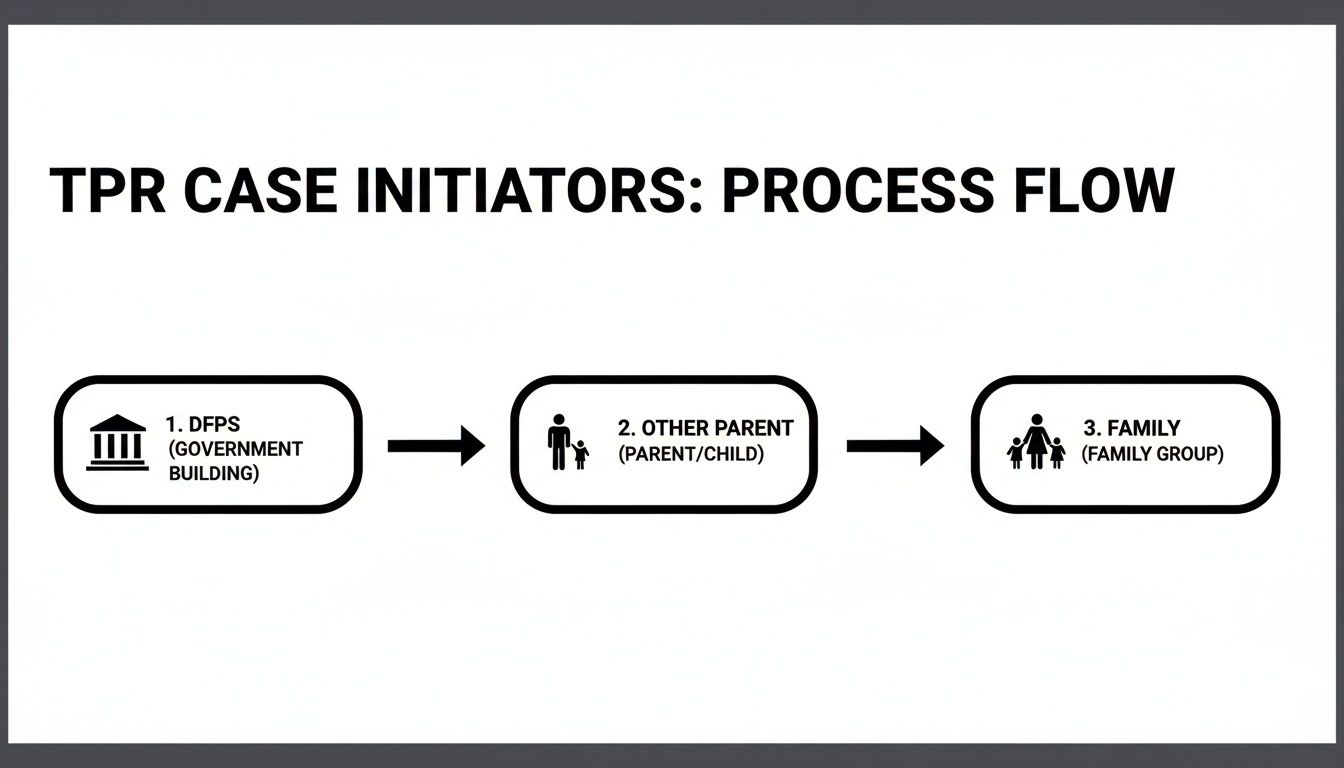
As the visual shows, while cases are often started by DFPS, the child's other parent or even another close family member may also have the legal standing to file a petition.
Initial Hearings and Key Appointments
The process usually kicks off with one or more initial hearings shortly after a petition is filed. One of the very first things the court does is appoint an attorney ad litem for your child.
This is a lawyer whose only job is to represent your child’s best interests. They will meet with your child, talk to you, the other parent, teachers, and anyone else involved to give the judge an independent perspective on what is best for the child.
You also have the right to an attorney. If you cannot afford one, the court must appoint one for you in a case brought by DFPS. It is absolutely critical to have experienced legal counsel on your side from the very beginning.
The Family Service Plan: A Roadmap to Reunification
If DFPS is involved, one of the most significant parts of the early process is the creation of a family service plan. This is a court-ordered plan that lays out specific tasks and goals you must achieve to address the concerns that led to the lawsuit in the first place.
Think of this service plan as a roadmap designed to guide you toward reunification with your child. It is your opportunity to show the court you are a committed and capable parent.
Common requirements in a service plan include:
- Attending parenting classes to learn new skills.
- Completing individual or family counseling.
- Undergoing substance abuse evaluation and treatment.
- Maintaining stable housing and employment.
Successfully completing this plan is arguably the most powerful evidence you can present in your defense. While these plans can feel demanding, the most empowering approach is to view them as a structured path back to your child.
Status Hearings and Mediation
As the case moves forward, the court will hold regular status hearings to monitor your progress on the service plan and check on the child's well-being. These hearings are your chance to show the judge all the positive steps you are taking.
Before a final trial, the court will almost always order the parties to attend mediation. This is a confidential meeting where a neutral third-party mediator helps you, the other parent, and any attorneys try to reach a resolution without a trial. As you move through the legal process, you'll be presented with numerous documents. Knowing how to approach and analyze them can significantly impact your understanding and strategy, and understanding document analysis can be a helpful skill.
Mediation gives you a voice in the outcome of your case. While not every case settles here, it is a valuable opportunity to find common ground and explore solutions that prioritize your child's needs.
The Final Trial: The Court's Decision
If mediation doesn't lead to an agreement, the case proceeds to a final trial. At trial, both sides present evidence, call witnesses, and make legal arguments before the judge or a jury. This is where the petitioner has to prove their case with "clear and convincing evidence."
The judge will hear testimony from you, caseworkers, counselors, and the attorney ad litem before making a final, life-altering decision. It is the culmination of the entire legal process. It is important to remember that this process is for involuntary termination. For those considering other options, you can explore our complete guide to voluntarily terminating parental rights in Texas.
Working with DFPS and a Family Service Plan
When the Texas Department of Family and Protective Services (DFPS) enters your life, it can feel like your every move is under a microscope. It’s an intimidating, often frightening experience, but understanding their role—and yours—is the key to navigating their involvement and getting your life back on track.
DFPS has two primary jobs: first, protect children from harm, and second, make reasonable efforts to reunify families whenever it’s safe. A central tool they use to accomplish this is the family service plan. Think of it as a court-ordered roadmap that lays out exactly what you need to do to fix the problems that brought DFPS to your door.
While it can feel like just another list of demands, the best way to look at your service plan is as a structured path back to your child. It's your single greatest opportunity to show a judge that you're committed to providing a safe and stable home.
What is a Family Service Plan?
A family service plan is a formal, written agreement between you and DFPS that gets approved by the court. It’s not a one-size-fits-all document; it’s tailored to your family’s specific situation and designed to correct the conditions that put your child at risk.
Successfully completing this plan is everything. It provides the judge with concrete proof that you’ve done the work, created a safe environment, and that the termination of parental rights isn’t in your child’s best interest.
Common requirements often include things like:
- Parenting Classes: To build skills in effective discipline, communication, and child development.
- Counseling or Therapy: To address personal challenges like anger management, past trauma, or mental health concerns.
- Substance Abuse Treatment: This could be anything from outpatient counseling to an inpatient program, depending on what's needed.
- Stable Housing and Employment: To prove you can provide a consistent and safe physical home.
- Regular Visitation: Attending every single scheduled visit with your child is non-negotiable for maintaining your bond.
The High Stakes of Non-Compliance
It is critical to follow your service plan to the letter. Since 2006, Texas has terminated parental rights for more children than any other state—a staggering 91,589 terminations have been reported. DFPS often starts these proceedings early in foster care cases, and a parent's failure to complete court-ordered services is a huge factor. In fact, around 90% of these cases are triggered by failing to follow the plan, not by direct abuse allegations. You can find more insights on these trends over at Imprint News.
Your service plan is more than just a checklist; it's your defense. Document every class you attend, every appointment you keep, and every goal you meet. This documentation becomes powerful evidence in court.
Tips for Successfully Working with DFPS
Your relationship with your DFPS caseworker is a professional one, and how you manage it can make a real difference in your case. Clear communication and diligent follow-through are absolutely essential.
Here are a few practical tips from our experience:
- Communicate Respectfully and Regularly: Keep your caseworker in the loop on your progress. If you don’t understand something in your plan, ask.
- Document Everything: Keep a binder. Fill it with certificates of completion, attendance sheets, and notes from meetings. Make copies of every single thing you give your caseworker.
- Be Proactive, Not Reactive: Don't make your caseworker chase you down. If you're hitting a wall with part of your plan, tell them and your attorney right away.
- Work Closely with Your Attorney: Your lawyer is your advocate. They can help you talk to DFPS, make sure your service plan is fair and reasonable, and present your progress to the judge in the best possible light.
Getting through a DFPS case is a marathon, not a sprint. By focusing on your service plan one step at a time and using the resources available to you, you can work toward the only goal that matters: being safely reunited with your child.
The Permanent Consequences of Losing Parental Rights
Let's be perfectly clear: a court order terminating your parental rights in Texas is permanent and final. This isn't a temporary change in custody or a visitation schedule that can be tweaked down the road. It is the complete and irreversible severing of the legal relationship between you and your child. Grasping the full weight of this finality is the first step in understanding why you need to build a strong legal defense from day one.

Once your rights are terminated, that legal connection is gone forever. You lose all legal standing to be involved in your child’s life, in any capacity.
What You Would Permanently Lose
The consequences ripple through every part of the parent-child bond, leaving no legal ties behind. When a judge signs that termination order, you lose the right to:
- Visit or Contact Your Child: You would no longer have any legal right to possession, visitation, or even communication.
- Make Important Decisions: Your authority to make choices about your child's education, healthcare, and religious upbringing is completely gone.
- Inherit From Your Child: The legal right for a parent and child to inherit from one another is severed.
To put it in perspective, think about the established legal protections and expectations often given to even the rights of non-custodial parents. A termination order erases every single one of those rights, and then some.
What Happens to Child Support
This is a critical question for many parents facing this situation. When parental rights are terminated, the obligation to pay future child support ends. The logic here is simple: you can't be held financially responsible for a child who is no longer legally yours.
But, and this is a big one, this does not wipe the slate clean.
Any past-due child support, known as "arrears," remains a legally enforceable debt. The state can and absolutely will continue to pursue collection for any unpaid support that built up before the termination order was finalized.
The Path to Adoption
Finally, a termination of parental rights makes the child legally free for adoption. This is often the ultimate goal of a TPR lawsuit, especially in cases brought by DFPS. The child can then be adopted by another family—whether it's their foster parents, a stepparent, or another relative—giving them a new, legally permanent family structure.
Key Takeaways and Next Steps
Going through a potential termination of your parental rights is one of the most stressful, heart-wrenching experiences a parent can face. It’s easy to feel overwhelmed and powerless, but you aren't. The key is to act fast, get a handle on the process, and start building a smart, proactive defense for your family.
Always keep in mind that the court's final decision comes down to one thing: the "best interest of the child." The person or agency trying to terminate your rights has a massive hill to climb. They have to prove, with clear and convincing evidence, not only that legal grounds exist but that ending your parental rights is the only workable option.
Your Most Important First Step
The single most critical step you can take right now is to connect with an experienced family law attorney. Don't delay. An attorney who lives and breathes Texas family law will be your best and staunchest advocate.
Here’s what a skilled attorney will do for you:
- Protect your legal rights at every single turn.
- Dig into the evidence being used against you and challenge it.
- Help you navigate your family service plan, making sure you document every bit of progress.
- Take on the negotiations with DFPS or the other party's lawyer, so you don't have to.
Don’t wait and hope things will sort themselves out. They won't. The moves you make today have a direct impact on the judge's final ruling and will define your family's future. The stakes in a termination of parental rights Texas case are just too high to go it alone.
When your relationship with your child is on the line, every moment matters. Get informed, and get the support of a legal team that’s ready to fight for you.
If you need help with a child custody or visitation case in Texas, our experienced attorneys can guide you every step of the way. Contact The Law Office of Bryan Fagan, PLLC today for a free consultation.