
When your child’s future is on the line, understanding your rights matters most. The bond you have with your child feels automatic and undeniable. But in the eyes of Texas law, your legal rights as an unmarried father are not. This is a tough reality to face, but it's the first, most critical fact you need to understand to protect your relationship with your child.
Many fathers we work with are shocked to learn that even if their name is on the birth certificate, it doesn't grant them legal custody or visitation rights. You must take specific legal steps to secure your place in your child’s life. This guide will walk you through that process, providing clarity and confidence every step of the way.
Why You Must Be Proactive: The Legal Status of Unmarried Fathers
For unmarried fathers in Texas, the starting point is a stark legal reality: until you legally establish paternity, you have zero rights to custody or visitation. This isn't meant to scare you; it’s the legal foundation from which you will build a secure, protected relationship with your child.
Under the Texas Family Code, when a child is born to unmarried parents, the mother is automatically named the sole managing conservator. By default, she holds all the legal cards—the rights and the responsibilities to make decisions for the child.
The Birth Certificate Is Important, But Not Enough
Let’s be clear: signing the birth certificate is a significant emotional step, but it is not a court order. It’s an acknowledgment of fatherhood, but it doesn't grant you the legal power to make decisions about your child’s school, their doctor, or where they live. It also doesn't give you a legal right to a possession schedule (what most people call visitation).
To get those fundamental rights, you must be proactive. This isn't about starting a fight; it's about formalizing your role as a dad so your relationship with your child is protected, no matter what twists and turns your relationship with the mother takes.
Your Two Paths to Legal Fatherhood
Fortunately, Texas law provides two clear pathways for unmarried fathers to establish legal rights. You must either sign an Acknowledgment of Paternity (AOP) or get a court order through a Suit Affecting the Parent-Child Relationship (SAPCR).
These aren't just bureaucratic boxes to check. They are the foundational legal actions that unlock your ability to get a custody and visitation order.
Acknowledgment of Paternity (AOP): This is a legal form, often presented at the hospital right after birth. When both parents voluntarily sign it, the AOP legally establishes you as the father with the same force as a court order.
Suit Affecting the Parent-Child Relationship (SAPCR): This is a formal lawsuit filed in court. You file it to have a judge establish paternity and then issue orders for custody, visitation, and child support. This is the route you'll need to take if the mother won't sign an AOP or if there are disagreements that only a judge can resolve.
The right path for you depends entirely on your situation, especially how well you and the child’s mother are cooperating.
Establishing Paternity in Texas: AOP vs. Court Order
| Method | What It Is | Best For | Key Consideration |
|---|---|---|---|
| Acknowledgment of Paternity (AOP) | A voluntary, signed legal document where both parents agree on the child's father. | Parents who are in complete agreement and cooperating fully. | It only establishes paternity. It does not create orders for custody, visitation, or child support. You still need a court order for that. |
| Court Order (via SAPCR) | A formal lawsuit filed to establish paternity and create comprehensive orders. | Parents who disagree, if the mother refuses to sign an AOP, or if you need to resolve custody, visitation, and support at the same time. | This process is more involved, but it results in a legally enforceable order covering all parental rights and duties. |
Choosing between an AOP and a SAPCR is a major decision. An AOP is faster and simpler, but it only solves half the problem. A SAPCR is a more complete solution that provides a clear, court-ordered framework for your co-parenting future. Every step you take is a move toward ensuring you can be the dedicated, involved father your child deserves. For a deeper dive into the specifics, you can check out our guide on how to establish paternity.
How to File a SAPCR and Secure Your Custody Rights
Let's be honest: the word "lawsuit" can sound intimidating. But for an unmarried father in Texas, filing a Suit Affecting the Parent-Child Relationship (SAPCR) isn't about starting a fight. It’s about building the legal framework that protects your relationship with your child.
When an Acknowledgment of Paternity (AOP) isn't an option or simply isn't enough to secure your rights, a SAPCR is the essential next move. This legal action asks a Texas court to create clear, enforceable orders that define your role. Without these court orders, you have no legal standing—no matter how much you love or provide for your child.
What Does a SAPCR Actually Do for You?
Filing a SAPCR is the only way to fully protect your rights as an unmarried dad in Texas. While an AOP establishes who the father is, a SAPCR establishes your rights and responsibilities as the father. It creates legally binding orders for every part of your co-parenting relationship.
A final SAPCR order will put everything in black and white, including:
- Paternity: If it isn't already established, the court can order DNA testing and legally declare you the father.
- Conservatorship: This is what most people mean by "custody." The order will outline your rights and duties, like making decisions about your child’s schooling and healthcare.
- Possession and Access: This is the "visitation" schedule. The order will set out exactly when you have the right to have your child with you.
- Child Support: The court will determine the amount of financial support, including who provides health insurance for the child.
These orders bring the clarity and predictability you both need to co-parent successfully. More importantly, they ensure your child gets the benefit of having two active, involved parents.
This chart illustrates the two paths an unmarried father can take to secure his legal rights.
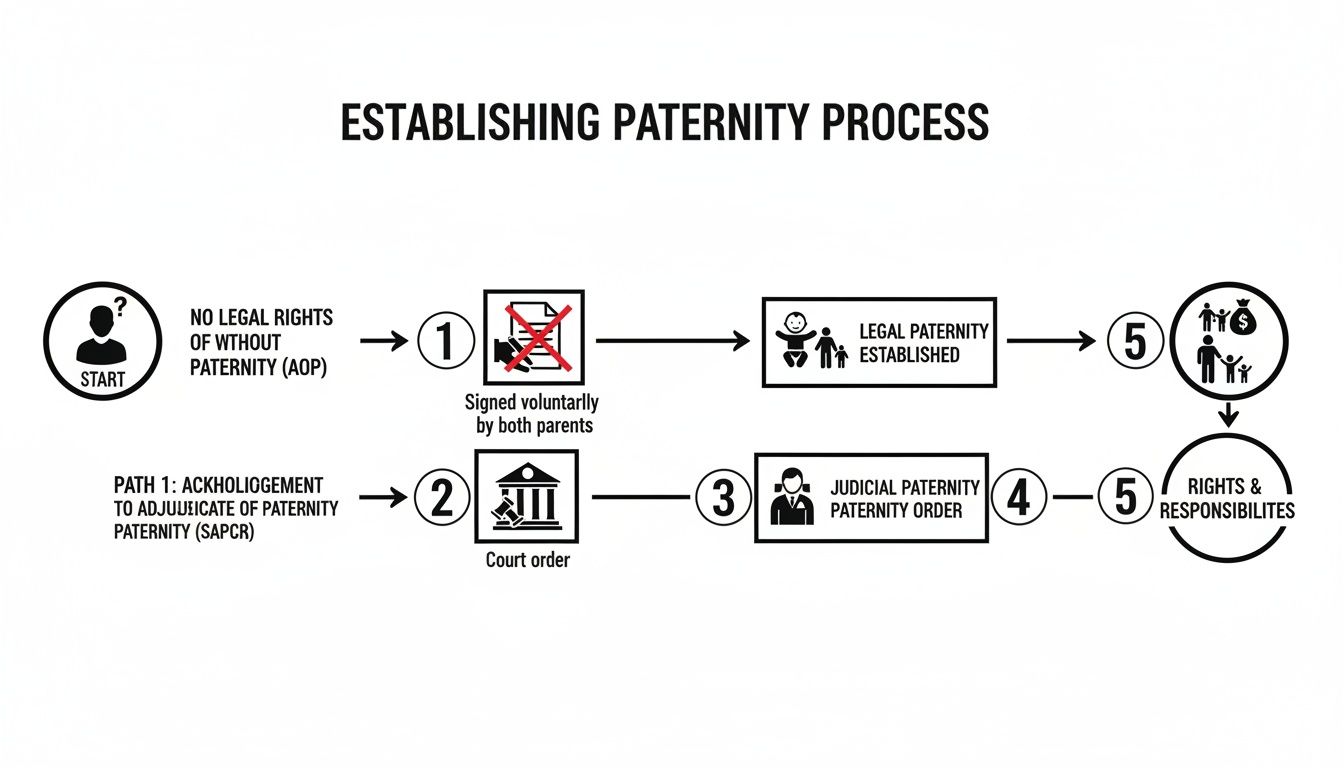
As you can see, both routes can establish you as the legal father, but only a SAPCR results in a complete court order covering custody, visitation, and support.
The First Steps in the SAPCR Process
The journey begins when you draft and file an Original Petition in a Suit Affecting the Parent-Child Relationship. This document officially opens your case. It tells the court who is involved (you, the mother, and the child) and what you are asking for—namely, to establish paternity and create orders for custody, visitation, and support.
Once the petition is filed with the district clerk in the county where the child lives, the next critical step is service. This means the child's mother must be formally notified that a lawsuit has been filed. You can't just hand her the papers yourself; it must be done legally by a constable, sheriff, or private process server. This proves to the court that she received official notice.
After she is served, the mother has a specific deadline to file her response, called an Answer. Once her Answer is filed, the case is officially underway. From there, many courts will require you and the mother to attend mediation to try and reach an agreement before going to a contested hearing.
Starting your case on strong footing is crucial. Begin gathering evidence that demonstrates your involvement and commitment, such as:
- Receipts for diapers, formula, and other supplies you've bought.
- Photos and videos of you spending quality time with your child.
- Text messages or emails with the mother discussing the child.
- A simple journal documenting when you see your child and what you do together.
This kind of documentation shows the judge you've been a consistent, dedicated father from the start. For a more detailed walkthrough, our guide on filling out the necessary SAPCR forms in Texas can provide more clarity on these critical first documents.
Understanding Custody: Conservatorship and Possession Schedules
When you start wading into Texas family law, you’ll run into a lot of new terms. Two you absolutely must understand are conservatorship and possession and access. As an unmarried father fighting for your rights, grasping what these words really mean is the first step to taking control of your case.
Think of conservatorship as the legal word for custody. It’s not just a title; it’s the set of legal rights and duties you have as a parent. These are the specific, court-ordered powers that let you make critical decisions about your child's life, from their schooling to their healthcare.

Joint Managing Conservatorship: The Texas Standard
Here in Texas, the law starts with a strong presumption: it is in the child’s best interest for both parents to be named Joint Managing Conservators (JMCs). When you are a JMC, you and the child’s mother share the rights and responsibilities of raising your child.
"Joint" doesn't necessarily mean a 50/50 split of time. It’s primarily about sharing the authority to make decisions. In most JMC arrangements, one parent is designated the "primary" conservator, giving them the exclusive right to decide where the child lives, usually within a certain geographic area. This idea of shared responsibility is a cornerstone of Texas family law, built on the principle that kids thrive when both parents are actively involved. For a deeper dive into the specific rights and duties, you can learn more about conservatorship in Texas in our article.
In rare situations, a judge might name one parent the Sole Managing Conservator (SMC). This is not the norm. It typically only happens when there's clear evidence that a joint arrangement would endanger the child, such as a history of family violence, substance abuse, or extreme conflict that harms the child. The other parent is then named a Possessory Conservator, and their rights are significantly limited.
Possession and Access: Your Parenting Schedule
While conservatorship defines your legal rights, possession and access is all about the time you actually spend with your child. This is what most people think of as the visitation schedule. Texas has a default schedule that courts frequently use as a starting point, known as the Standard Possession Order (SPO).
The SPO is designed to give both the parents and the child a predictable, stable routine. It usually gives the non-primary parent possession of the child on the first, third, and fifth weekends of a month, plus a split of holidays and a significant period of time in the summer.
It's crucial to remember that the SPO is not rigid. A judge can, and often will, customize the schedule based on the unique needs of your family and what is in the best interest of your child.
How Distance Affects Your Schedule
The Standard Possession Order looks different if the parents live more than 100 miles apart. The court recognizes the logistical challenges of long-distance travel and adjusts the schedule accordingly.
For long-distance parenting plans, you might see:
- Fewer, but longer, visits: Instead of every other weekend, the non-primary parent might get to choose one weekend a month to have the child.
- All of spring break: The non-primary parent often gets the child for the entire spring break every single year.
- More summer time: Summer possession is usually extended, giving that parent a much longer block of uninterrupted time with the child.
Understanding these two frameworks—conservatorship for your rights and possession for your time—is key. It demystifies the court process and lets you focus on what really matters: building a stable, loving, and consistent presence in your child’s life.
How Texas Determines Custody: The "Best Interest of the Child"
When it comes to your child's future, everything boils down to a single guiding principle in a Texas courtroom: the best interest of the child. This isn't just a legal catchphrase; it's the absolute standard that every judge uses to decide on conservatorship (custody) and possession.
For an unmarried father, this is where you build your case. Your entire focus should be on proving that your consistent, stable, and loving presence is essential for your child's well-being. It’s not about who has the better argument, but who can provide the better life.

The Holley Factors: A Plain-English Explanation
So how does a judge decide what's "best"? They don't just guess. They rely on a specific set of criteria established by the Texas Supreme Court in a landmark case, Holley v. Adams. These "Holley Factors" are the roadmap the court will follow to evaluate you, the mother, and your individual circumstances.
Here are some of the key points a judge will look at:
- The child’s current and future emotional and physical needs.
- Any immediate or potential emotional and physical danger to the child.
- The parenting abilities of each person seeking custody.
- The stability of the home you can provide.
- The plans each of you has for the child's upbringing.
- Any actions or failures to act that suggest the current parent-child relationship isn't healthy.
This list isn't exhaustive, but it's the core of the court's analysis. As a father, your job is to gather and present clear evidence showing that you are the parent who can best meet these needs.
Proving Your Stability and Parental Abilities
In court, actions always speak louder than words. You have to show the judge, not just tell them, that you are the stable, capable parent your child deserves. This is where facts and evidence push aside any outdated stereotypes about fathers' roles.
Texas courts evaluate custody for unmarried fathers based solely on the 'best interest of the child' standard. This means dads have an equal opportunity to gain custody, as there is no built-in maternal preference. Outdated notions like the 'tender years' doctrine are gone. Instead, Texas courts focus on tangible factors: a history of parental involvement, a stable home, a clean record free from family violence or substance abuse, mental stability, and a history of being present for the child. To learn more about your chances, you can read about how fathers can get full custody in Texas.
Demonstrating Your Commitment to Co-Parenting
A judge will also pay very close attention to how you speak about and interact with your child's mother. In our experience, a parent who actively supports the child's relationship with the other parent is almost always seen in a more positive light.
Showing that you can put your child’s needs above any personal conflict is a massive advantage.
Here’s how to prove you are a responsible co-parent:
- Communicate with respect: Keep your texts and emails focused on the child. Avoid hostility, name-calling, or dredging up old arguments.
- Encourage contact: Unless there is a legitimate safety risk backed by a court order, never prevent your child from seeing or talking to their mother.
- Share information openly: Proactively share updates from school, doctor's appointments, and other key events in your child's life.
By being the parent who fosters a healthy connection with the other parent, you send a powerful message to the court: you are the one who is truly focused on your child's best interest.
Understanding Child Support and Parental Responsibilities
When you fight for your rights as a father, you’re also embracing your responsibilities. In Texas, once you secure your legal role as a parent through a SAPCR, certain duties follow—and the most significant is often child support. It's completely normal to have questions and concerns about this.
Let's reframe how we look at it. Child support isn't a penalty for one parent or a prize for the other. It is your direct, personal investment in your child’s life—the money that helps provide their food, clothing, home, and future.
How Child Support Is Calculated in Texas
Texas family law keeps child support calculations as straightforward as possible. Courts rely on a specific formula that takes a percentage of the non-primary parent’s net monthly resources.
The process looks something like this:
First, determine gross income. The court totals up all your income streams—your salary, wages, overtime, bonuses, self-employment income, and more.
Next, calculate net resources. From that gross total, the court subtracts specific, allowed deductions. This typically includes federal income taxes (using the rate for a single person with one exemption), Social Security and Medicare taxes, and the cost of the child's health insurance.
Finally, apply the guidelines. A set percentage is then applied to your net monthly resources. For one child, it's 20%. For two children, it's 25%, and the percentage increases with more children.
So, if your net monthly resources are calculated to be $4,000, your guideline child support for one child would be $800 per month (20% of $4,000). While these guidelines provide a predictable starting point, a judge always has the authority to deviate from them if it’s in the child's best interest.
Responsibilities Beyond the Monthly Check
Your duties as a legal parent, as defined in the SAPCR order, extend beyond the monthly child support payment. These other responsibilities are just as crucial for ensuring your child is fully cared for.
Providing Health Insurance: The court will order one parent to provide and maintain health insurance for the child. The monthly premium for the child's policy is factored directly into the child support calculation.
Splitting Uninsured Medical Costs: Even with great insurance, you’ll have deductibles, co-pays, and other out-of-pocket expenses. Courts typically order parents to split these costs 50/50, though a different arrangement can be ordered if the situation warrants it.
Legally establishing paternity not only creates child support obligations but also opens the door to essential protections for your child, including medical benefits, inheritance rights, and even Social Security or veterans' benefits. As you can discover in more detail from legal experts, this legal step is what prevents a father from being shut out of his child's life during a dispute. By understanding and preparing for these responsibilities, you show the court and the child's mother that you are a serious, committed father ready to provide for every aspect of your child's well-being.
Key Takeaway: Your Next Steps to Protect Your Relationship with Your Child
This journey can feel overwhelming, but taking decisive action is the most powerful thing you can do for your child and your future together. We've walked through the complex legal landscape facing unmarried fathers in Texas, from understanding why a name on a birth certificate isn't enough to the details of filing a SAPCR.
The path from feeling powerless to becoming a legally recognized father is now clear.
If you remember just one thing, let it be this: you must be proactive. The simple truth is that Texas law doesn't automatically grant you rights or protect your relationship with your child. The law provides the tools, but it's entirely up to you to use them.
Establishing your legal parentage through a court order from a Suit Affecting the Parent-Child Relationship (SAPCR) is the only way to secure your rights to custody and visitation. Without this legal step, your ability to see your child is left completely to the mother's goodwill, which can change in an instant.
Once paternity is legally established, your focus has to shift to the next crucial step: showing the court that your consistent and loving presence is in your child's best interest. You are not starting from behind. Courts in Texas are increasingly recognizing the vital role fathers play, moving away from outdated biases. Your bond with your child is real and undeniable. Our legal system simply requires you to formalize it to protect it. Taking that first step—whether it's filing a petition or calling an attorney—is an act of love and commitment that will safeguard your relationship for years to come.
Your relationship is worth protecting. You have the right to be a consistent, guiding presence in your child’s life, to help make decisions about their future, and to share in the everyday moments that build a lifelong bond. Don't leave your rights as a father to chance.
If you need help with a child custody or visitation case in Texas, our experienced attorneys can guide you every step of the way. Contact The Law Office of Bryan Fagan, PLLC today for a free consultation.
Frequently Asked Questions from Unmarried Fathers
Of all the questions we get from unmarried fathers in Texas, a few pop up again and again. These are the issues that cause the most confusion and stress, so let's clear the air with some straight answers.
Does My Name on the Birth Certificate Give Me Custody Rights?
No. This is easily the biggest misconception, and it's a critical one. While putting your name on the birth certificate is an important first step, it gives you zero legal rights to custody (conservatorship) or visitation (possession and access) in Texas. To get those rights, you need a court order from a Suit Affecting the Parent-Child Relationship (SAPCR) that legally establishes you as the father and spells out your specific rights and responsibilities.
Can My Child's Mother Move Away with Our Child?
This depends entirely on whether a court order is in place. If there's no order, then yes, she can legally move anywhere she wants with the child. This is why acting quickly is so important. Once you file a SAPCR, the court will almost always put a geographic restriction in the final order. This restriction typically limits the child's main home to a specific county and its surrounding counties, preventing one parent from moving far away without permission from you or the court.
What if the Mother Denies I Am the Father?
If you file a SAPCR and she contests that you're the dad, your attorney will simply ask the court to order genetic testing. You have an absolute right to request a DNA test to prove your biological link to your child. Once the results confirm your paternity, the judge will issue an order making it official, and the case will proceed to determine conservatorship, possession, and support.
If you are an unmarried father ready to establish your rights, you don't have to navigate this complicated process alone. If you need help with a child custody or visitation case in Texas, our experienced attorneys can guide you every step of the way. Contact The Law Office of Bryan Fagan, PLLC today for a free consultation.