
When your child’s future is on the line, understanding your rights as a father matters most. For unmarried fathers in Texas, the path to securing a protected relationship with your child begins with one critical step: establishing legal paternity. Until a court recognizes you as the legal father, you have no automatic rights to custody or visitation, no matter how involved you are in your child's life. This guide will walk you through exactly what you need to do to protect your fatherhood.
Understanding Your Legal Standing as an Unmarried Father
For unmarried fathers in Texas, the journey starts with a crucial realization: without a court order, you have no automatic legal rights to your child. This can be a painful truth, especially for a devoted, hands-on dad who has been there since day one.
Many fathers believe that signing the birth certificate or providing financial support gives them legal standing. In Texas, that is not the case. Without a court order or a properly filed Acknowledgement of Paternity, you legally have no authority to make major decisions for your child or guarantee your time with them. This isn't meant to be unfair; it's simply how the law is structured to create clarity and stability for the child.
The Sobering Reality Before Paternity is Established
Under the Texas Family Code, from the moment a child is born to unmarried parents, the mother is automatically granted sole legal and physical custody. This means she has the exclusive right to make every critical decision in your child’s life, including:
- Where your child lives.
- All decisions about medical and dental care.
- Choices about your child's education and religious upbringing.
Even if you are an active and loving parent, without that legal recognition, you have no guaranteed right to see your child and no legal say in these life-altering decisions. You can learn more about the specific legal hurdles unmarried fathers face.
This means that until you take formal legal action, your ability to see your child is completely insecure. The mother could decide to move away or simply stop letting you see the child, and because no court order exists, she wouldn't be breaking any laws.
To help you see just how dramatically things change, we've put together a simple comparison.
Legal Status Before vs After Establishing Paternity
The table below breaks down the night-and-day difference in a father's legal standing once paternity is officially established in Texas.
| Parental Right | Status Before Paternity is Established | Status After Paternity is Established |
|---|---|---|
| Custody (Conservatorship) | None. The mother has sole legal and physical custody. | Equal footing. You can be named a Joint Managing Conservator. |
| Possession & Visitation | None. Visitation is at the mother's discretion. | Legally enforceable. You can get a court-ordered possession schedule. |
| Decision-Making | None. The mother makes all decisions (medical, school, etc.). | Shared rights. You can have the right to participate in major decisions. |
| Child Support | No obligation until a court order is in place. | Legal obligation based on Texas guidelines. |
| Preventing Relocation | No power to stop the mother from moving with the child. | Can seek court orders to establish geographic restrictions. |
| Access to Records | No legal right to school or medical records. | Legally entitled to access all of your child's records. |
As you can see, establishing paternity isn't just a piece of paper—it's the key that unlocks your legal ability to be the father you want to be.
The Power of Establishing Legal Fatherhood
The good news is that this situation is entirely fixable. By taking the right legal steps, you transform your status from a biological father to a legal parent with rights a court can enforce.
Once paternity is established, Texas law views you and the mother as two parents. From that point on, a judge must make decisions based on the “best interest of the child,” a legal standard that prioritizes your child's emotional and physical well-being above all else. This change opens the door for you to seek custody, secure a visitation schedule, and build a protected, meaningful relationship with your child.
How to Establish Paternity in Texas
For an unmarried father, the entire journey to securing your rights as a parent boils down to one foundational action: establishing legal paternity. This is the single most critical step you can take to protect your relationship with your child. Without it, your ability to see your child, make decisions for them, and be a part of their life is left entirely to the mother’s goodwill.
Fortunately, Texas law provides two clear pathways to legally establish yourself as your child’s father. The right path for you will depend on your specific situation and your relationship with the child's mother.
This decision tree gives you a quick visual of how it works for fathers in Texas, depending on whether you're married and if paternity is already legally recognized.
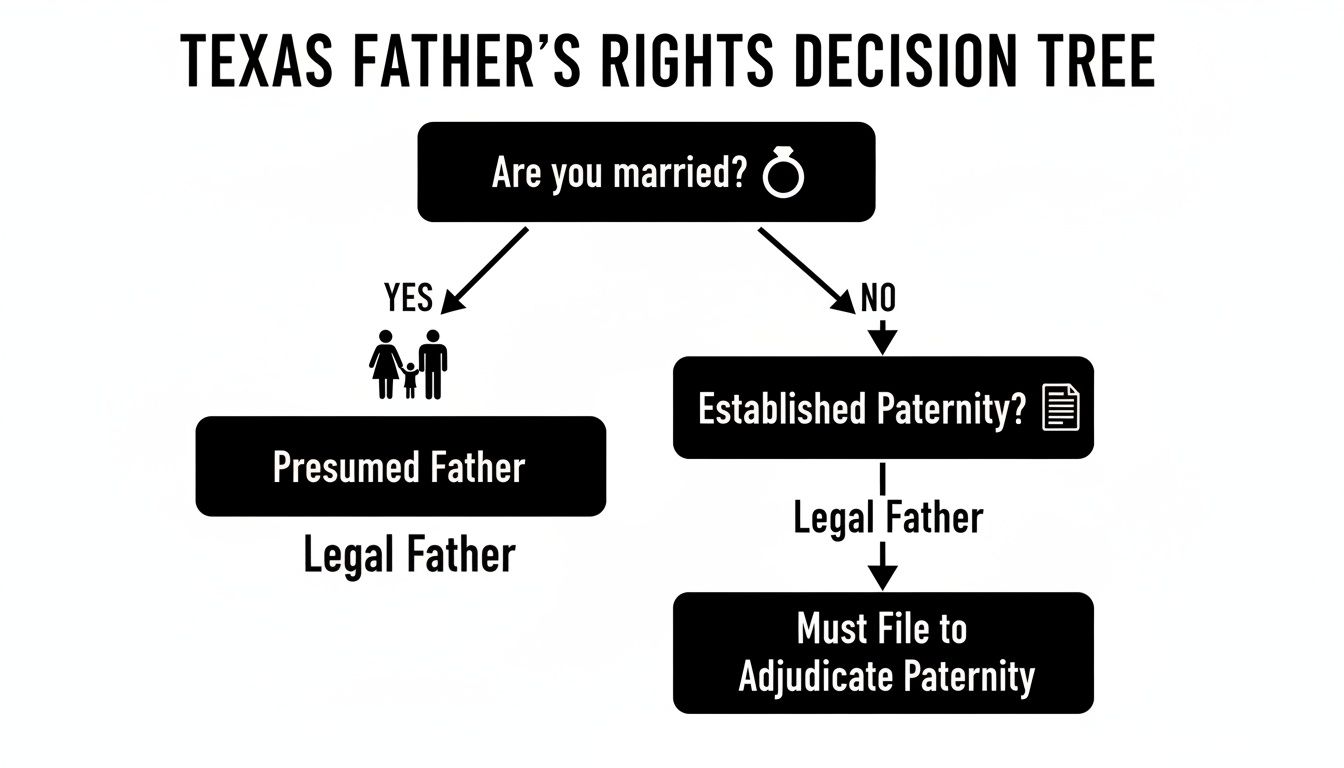
As you can see, being unmarried puts you on a track where establishing paternity isn't just a good idea—it's a non-negotiable requirement for getting any legal rights.
The Cooperative Path: The Acknowledgement of Paternity
If you and your child's mother agree that you are the father, the most straightforward route is signing a legal document called an Acknowledgement of Paternity (AOP). This is a sworn, voluntary statement signed by both of you that, once filed with the Texas Vital Statistics Unit, carries the same legal weight as a court order establishing you as the father.
Most parents sign the AOP form at the hospital when their child is born, but it can be completed and filed later.
Here’s what you absolutely need to know about the AOP:
- It’s a Two-Way Street: Both parents must sign it willingly, without being pressured or forced.
- This is Legally Binding: Once an AOP is signed and filed, it is very difficult to reverse. You are accepting all the rights and responsibilities of fatherhood, including the legal duty to pay child support.
- It Does Not Create a Custody Order: This is a crucial distinction. The AOP makes you the legal father, but it does not automatically create orders for custody (conservatorship), a visitation schedule, or child support. You still need a separate court order for those specifics.
For parents who can work together, the AOP is an excellent, low-cost way to make your child’s parentage official.
The Court-Ordered Path: Adjudicating Parentage
If the mother won't sign an AOP, or if there is any doubt about paternity, your path forward is to go to court and file a Suit to Adjudicate Parentage. This is a lawsuit under the Texas Family Code designed to legally determine a child's father.
Often, this process is part of a larger case called a Suit Affecting the Parent-Child Relationship (SAPCR), which allows you to resolve all critical issues at once. A SAPCR results in a comprehensive court order covering:
- Conservatorship: Your rights and duties to make decisions for your child.
- Possession and Access: A legally enforceable visitation schedule.
- Child Support: The amount of financial support one parent will pay.
- Medical Support: Who is responsible for providing health insurance.
If paternity is in question, a judge will almost always order genetic testing (a simple DNA test) to get a definitive answer. The results are typically over 99% accurate, giving the court the proof it needs to issue a final, binding order. For a deeper look, we have a detailed guide on how to establish paternity in Texas.
A court order is the most powerful tool an unmarried father can have. It is legally binding and enforceable, meaning if the other parent violates the possession schedule or other terms, you can ask the court to step in and enforce your rights.
Whether you use an AOP or a court order, taking this step is the legal bedrock upon which all your future rights—custody, visitation, and having a real say in your child’s life—will be built.
How Texas Determines Custody and Visitation
Once you’ve legally established paternity, you are no longer on the outside looking in. You are a legal parent with the right to ask a Texas court for specific orders regarding your child. This is where you can secure your role in your child's life and ensure you have a lasting relationship with them.

The most important principle guiding every decision a Texas judge makes is the “best interest of the child.” This is the legal standard from Texas Family Code Chapter 153. It requires the court to prioritize a child’s physical and emotional well-being, ensuring they have a safe, stable, and loving environment.
Crucially, Texas law is gender-neutral. A judge cannot legally favor a mother over a father simply because of gender. Your rights are equal, and your case will be decided based on the facts and what is truly best for your child.
What is Conservatorship in Texas?
In Texas, we use the term “conservatorship” instead of "custody." It refers to the bundle of legal rights and responsibilities each parent has, such as making decisions about your child’s health, education, and general welfare.
There are two main types of conservatorship:
- Joint Managing Conservatorship (JMC): This is the default in Texas. The law presumes it's in a child’s best interest for both parents to share the rights and duties of raising them.
- Sole Managing Conservatorship (SMC): This is much less common and is usually ordered only when one parent has a history of family violence, substance abuse, or extreme conflict that makes co-parenting impossible.
Under a JMC, one parent is typically named the "primary" conservator, which gives them the right to determine the child's residence, usually within a specific geographic area.
Understanding Possession Schedules
While conservatorship covers your decision-making rights, the “possession order” is the detailed schedule of when your child is physically with you. For an unmarried father, a court-ordered schedule is essential—it makes your time with your child legally enforceable.
Texas has a default schedule called the Standard Possession Order (SPO), which is presumed to be in the child’s best interest. For parents living within 100 miles of each other, the SPO typically grants the non-primary parent:
- Possession on the first, third, and fifth weekends of a month.
- Alternating major holidays, such as Thanksgiving and Christmas.
- An extended period of possession in the summer, usually 30 days.
This schedule provides consistency for you and your child. For a more detailed breakdown, you can read our guide on child visitation rights for fathers. Navigating these legal proceedings can be complex, and understanding how legal experts reach families in need, as explored in articles on Modern Family Law Marketing Strategies, highlights the importance of accessible guidance.
Navigating Child Support Rights and Responsibilities
Becoming a legal parent comes with both precious rights and significant responsibilities. For unmarried fathers, establishing paternity brings the issue of child support into focus. Understanding how this financial obligation works is critical for your child's well-being and your own financial stability.
The moment you are legally recognized as the father, you become legally responsible for financially supporting your child. This is a tangible reflection of your commitment to their welfare.
How Texas Calculates Child Support
In Texas, child support is calculated using specific guidelines from the Texas Family Code to ensure fairness and consistency. The amount is typically a percentage of the paying parent’s net monthly resources.
Here’s a simplified look at the process:
- Determine Gross Income: This includes all sources of income, such as wages, salary, commissions, and self-employment earnings.
- Calculate Net Resources: The court subtracts social security taxes, federal income tax (for a single person with one exemption), union dues, and the cost of the child's health insurance.
- Apply Percentage Guidelines: The final amount is based on the number of children. For one child, the guideline is 20% of net resources. For two children, it is 25%, and so on.
Remember, this works both ways. If you are the primary parent (the child lives with you most of the time), you have the right to receive child support from the mother. This money helps cover the day-to-day costs of raising your child. For more details, you can learn about how to get child support in Texas.
The Separation of Visitation and Support
This is one of the most important rules for unmarried parents: child support and visitation are two completely separate legal duties.
A mother cannot legally deny you your court-ordered possession time just because you are behind on child support payments. Conversely, a father cannot legally stop paying child support just because the mother is not following the possession schedule.
Withholding one because you are frustrated with the other is a violation of a court order and can lead to serious legal consequences. If you have problems with either visitation or support, the only correct solution is to seek enforcement through the court.
This legal framework is especially critical given the realities many Texas families face. With 35.2% of babies born to unwed mothers by 2020, the landscape for unmarried fathers' rights is complex. The stakes are incredibly high, as 35.8% of children in Texas single-parent families live in poverty, compared to just 7.7% in two-parent households. While many cooperative parents formalize paternity, conflicts often leave fathers legally shut out and unable to contribute. You can discover more insights about the challenges facing Texas families on ifstudies.org.
Finally, the court will also order one or both parents to provide health and dental insurance for the child, ensuring a complete financial plan is in place for their future.
Handling Common Challenges for Unmarried Fathers
You've gone through the court system and now have an order that defines your rights and your time with your child. But life is unpredictable, and co-parenting can present new challenges. Knowing how to respond when issues arise is key to protecting the bond you fought so hard to secure.

Whether you're being denied your court-ordered time or facing a potential relocation, your court order is your most powerful tool. Here's how to use it.
What to Do When Visitation is Denied
It is one of the most painful experiences a father can face: you arrive to pick up your child for your weekend, only to be turned away. Your first instinct might be anger, but your next steps are critical.
Whatever you do, do not stop paying child support. In a Texas court, visitation and child support are two completely separate legal duties. Withholding support will not get your visitation back; it will only put you in legal trouble and weaken your case.
The correct action is to file a Motion for Enforcement with the court that issued your order. This formal motion tells the judge that the other parent is violating the order and asks for the court's intervention.
An enforcement action can result in serious consequences for the non-compliant parent, including:
- Make-Up Visitation Time: The court can order extra time for you to make up for the visits you were denied.
- Fines and Attorney's Fees: The other parent may be ordered to pay financial penalties and reimburse your legal fees.
- Jail Time: For repeated or severe violations, a judge can sentence the other parent to jail.
Start documenting everything immediately. Keep a log of every denied visit with dates, times, and screenshots of any relevant text messages or emails. This evidence will be invaluable in court.
Responding to a Proposed Relocation
Another common challenge is when the child's mother wants to move away. Most Texas custody orders include a geographic restriction, which establishes a boundary—usually the current county and its neighbors—where the child must live. This is designed to ensure both parents can remain actively involved in the child's life.
If the other parent wants to move outside this area, she needs either your written permission or a judge's approval. If you do not agree, she must go to court and prove the move is in the child's best interest. This gives you the right to present your case for why your child should remain in the current location.
Special Protections for Military Fathers
Military service adds another layer of complexity. Thankfully, Texas law provides special protections for service members to secure their parental rights during deployment.
The Texas Family Code allows a deploying parent to designate another person—such as a grandparent or new spouse—to exercise their possession time while they are away.
This is a crucial provision. It ensures your child maintains a strong connection with your side of the family during deployment, and it holds your spot in the possession schedule so it’s waiting for you when you return home.
Facing these situations can feel overwhelming, but you are not powerless. The law provides clear pathways for you to stand up for your rights and protect your relationship with your child.
Key Takeaways: Your Next Steps to Protect Your Fatherhood
Knowing your rights is the first step; taking action is the next. For unmarried fathers in Texas, the greatest risk is inaction. The path forward is clear, and the time to start is now. This journey from biological father to legal parent boils down to a few critical moves that will create a solid legal foundation for your relationship with your child.
Your Action Plan Checklist
Here is a straightforward checklist of your essential next steps:
- Step 1: Prioritize Paternity. If you haven't already, make establishing legal paternity your top priority. Decide if a voluntary Acknowledgement of Paternity is an option or if you need to file a Suit to Adjudicate Parentage.
- Step 2: Get a Formal Court Order. Never rely on informal agreements. File a Suit Affecting the Parent-Child Relationship (SAPCR) to get an enforceable order that defines conservatorship, possession, and support. This document is your ultimate protection.
- Step 3: Document Everything. Keep detailed records of your involvement in your child’s life. Log financial support, save communications with the mother, and track your time with your child. This documentation is powerful evidence.
- Step 4: Talk to an Experienced Family Law Attorney. You don’t have to do this alone. A knowledgeable attorney can explain how the law applies to your unique situation, help you build a smart legal strategy, and advocate for you in court. This is the most effective way to protect your unmarried fathers rights in Texas.
Remember, the Texas Family Code is designed to support a child’s relationship with both loving parents. The law is on your side, but you have to take the initiative and use it.
Your child deserves a father who is consistent, present, and legally protected. Following these steps is how you become that person for them, not just today but for all the years to come.
If you need help with a child custody or visitation case in Texas, our experienced attorneys can guide you every step of the way. Contact The Law Office of Bryan Fagan, PLLC today for a free consultation.
Frequently Asked Questions About Fathers' Rights
Navigating a custody case can leave you with many questions. You need clear, direct answers to make informed decisions for your family. Here are some of the most common questions we hear from unmarried fathers in Texas.
Does Signing the Birth Certificate Give Me Rights?
No. This is one of the most common and dangerous myths for Texas fathers. While signing the birth certificate shows you are acknowledging your child, it gives you zero legal rights to custody (conservatorship) or visitation (possession). To get enforceable rights, you must either have a filed Acknowledgement of Paternity (AOP) or a court order establishing you as the legal father.
What if the Mother Won't Let Me See My Child?
If you do not have a court order, the mother has sole legal custody, and she is not breaking any law by denying you visitation. Your only remedy is to go to court, establish paternity, and get a formal possession order that sets a clear visitation schedule. If you do have a court order and she is violating it, you can file a Motion for Enforcement to ask a judge to force her to comply.
Can I Stop Paying Child Support if She Denies Visitation?
Absolutely not. In Texas, child support and visitation are two separate legal duties. Withholding support because you are being denied visitation is a violation of a court order and will damage your credibility with the judge. It can lead to severe penalties, including wage garnishment, license suspension, and even jail time. The correct response to denied visitation is to file an enforcement action with the court.
Is It True That Texas Courts Favor Mothers?
No, this is a misconception. The Texas Family Code is gender-neutral. Judges are prohibited from discriminating against a parent based on their gender or marital status. Every decision about conservatorship and possession must be based solely on the “best interest of the child.” Once you establish paternity, you stand on equal legal footing with the mother and have the same right to be named a Joint Managing Conservator and receive a standard possession schedule.
If you need help with a child custody or visitation case in Texas, our experienced attorneys can guide you every step of the way. Contact The Law Office of Bryan Fagan, PLLC today for a free consultation.