
When your family's safety is on the line, understanding your rights is the first critical step. It can be confusing to hear the terms "protective order" and "restraining order" used in Texas family law, especially because people often use them interchangeably. But in the eyes of the law, they are worlds apart, and choosing the right one is crucial for your family's well-being.
Here’s the bottom line: a Protective Order is a legal shield against family violence and has serious criminal penalties if violated. A Restraining Order is a civil tool used during a lawsuit to simply keep things stable and only carries civil consequences.
Navigating Your Legal Options in Texas
When tensions are high and you’re worried about your family’s future, the legal jargon can feel overwhelming. We understand the stress and fear that Texas parents, grandparents, and caregivers face during intense family conflicts. Getting the right legal tool is crucial for protecting your children and your rights.
Think of it this way: a Protective Order is designed specifically to stop family violence and comes with the full weight of criminal law. A Temporary Restraining Order (TRO), on the other hand, is a civil order used in cases like a divorce to stop actions that could disrupt the legal process. A TRO is about preserving stability for your children and your property.
For instance, a TRO can be used to:
- Prevent one parent from pulling a child out of their school and moving them to another county or state.
- Stop a spouse from suddenly draining a joint bank account.
- Prohibit someone from selling shared property, like the family home, while the case is ongoing.
Understanding this core difference is everything. One is about ensuring physical safety from harm. The other is about ensuring fairness and stability during a lawsuit.
Here’s a quick breakdown of the fundamental differences:
| Feature | Protective Order | Restraining Order (TRO) |
|---|---|---|
| Primary Purpose | To prevent future family violence | To maintain the status quo during a lawsuit |
| Governing Law | Texas Family Code | Texas Rules of Civil Procedure |
| Violation Penalty | Criminal charges (potential jail time & fines) | Civil penalties (contempt of court, fines) |
| Who Can Get One | A victim of family violence | A party in an active lawsuit (e.g., divorce) |
| Impact on Firearms | Prohibits firearm possession | Typically does not affect firearm rights |
What Is A Protective Order In Texas Family Law?
When your child's safety is on the line, you need more than just a piece of paper—you need a legal shield with real power behind it. In Texas, that shield is a Protective Order. It’s a specific type of court order designed with one critical goal: to stop family violence from ever happening again.
This isn't just a simple court instruction; it's a serious directive grounded in the Texas Family Code. To get one, you have to prove to a judge not only that family violence has happened, but also that it's likely to happen again in the future without the court stepping in.
The Power Behind a Protective Order
Here’s the single most important thing to understand: violating a Protective Order is a criminal offense. This is what separates it from other court orders and makes it such a powerful tool for families in danger. It's the key difference when you're weighing a protective order vs a restraining order in Texas.
If someone violates a Protective Order, they can be arrested on the spot and face criminal charges under the Texas Penal Code § 25.07. This immediately elevates the matter from a civil family dispute to a criminal case, creating a much stronger deterrent against future abuse.
This potential for immediate law enforcement action is what gives a Protective Order its teeth. It provides a vital layer of security for parents and children trying to break free from a cycle of abuse, harassment, or threats.
What Protections Can It Provide?
A Texas judge has significant flexibility to customize a Protective Order to the specific circumstances of your family. The main objective is always to create a safe distance and cut off all avenues of contact between the abuser and the victims.
Some of the most common protections included are:
- No Contact: The abuser is legally forbidden from all forms of communication—no phone calls, texts, emails, social media messages, or even messages passed through friends or family.
- Stay-Away Provisions: The order will name specific places the abuser is barred from approaching. This nearly always includes your home, your children’s school or daycare, and your place of work.
- Prohibition of Harassment: It makes it explicitly illegal for the abuser to harass, threaten, or engage in any abusive behavior toward you or your children.
- Firearm Restrictions: Once a final Protective Order is issued, the subject is prohibited by law from possessing a firearm or ammunition.
Impact on Child Custody and Visitation
When a Protective Order is issued in the middle of a child custody case, its impact is immediate and significant. The court's primary duty is always to protect the "best interests of the child," and a finding of family violence is one of the most serious factors a judge considers. "Best interests of the child" is the guiding standard in Texas that requires judges to prioritize a child's emotional and physical well-being above all else.
A judge will almost certainly determine that it's not in a child's best interest to be left alone with a parent who has committed family violence. You might also want to look into how a Texas emergency protective order can offer immediate protection. This often leads to court-ordered supervised visitation, where a neutral third party must be present during the parent's time with the child. In more extreme cases, a judge can deny visitation rights altogether.
A protective order, under Texas Family Code § 81.001, is a powerful legal tool designed to prevent further family violence. It comes with criminal penalties for violations and strictly limits an abuser’s ability to contact the victim, their children, or go near their home, school, or work. These orders can be temporary (lasting up to 20 days) or final (lasting up to two years, and sometimes longer). You can find more data on this topic in the 2023 Domestic Violence High-Risk Team Report.
How Restraining Orders Work In Texas Custody Cases
While a Protective Order is a legal shield against family violence, a Restraining Order has a completely different—but equally critical—job: it creates stability during a time of chaos in a divorce or custody case.
A Restraining Order is a civil court order that falls under the Texas Rules of Civil Procedure. Its main purpose is to maintain the "status quo," which is legal-speak for keeping things exactly as they are while your case moves forward. This stops either parent from making sudden, disruptive decisions that could unfairly tip the scales in the case.
Preserving Stability for Your Children and Assets
Let's say you're in the early stages of a divorce, and you find out your spouse is about to drain the joint savings account. A judge can issue a Restraining Order to put an immediate stop to that.
In the world of child custody, these orders are absolutely essential. A Temporary Restraining Order (TRO) can prevent the other parent from doing things like:
- Pulling your child out of their current school without your consent.
- Moving with your child outside your county or even the state of Texas.
- Disrupting the established possession schedule (the court-ordered calendar that details when each parent has the child).
- Making nasty or disparaging comments about you in front of the children.
- Taking on new debt on a shared credit card.
Think of it as the court hitting a legal "pause button." It ensures a level playing field until a judge can hear from both sides and make more permanent rulings on custody, visitation, and property division.
A Restraining Order isn't about punishment; it's about preservation. The court’s primary goal is to make sure that when it's time to make final decisions about your children and property, neither of you has been put at an unfair disadvantage by the other's impulsive actions.
The Civil Nature of Restraining Orders
Here’s where the protective order vs. restraining order Texas debate gets really clear: the consequences for violating them are worlds apart. If someone breaks the rules of a Protective Order, they can be arrested and face criminal charges.
Violating a Restraining Order, however, is a civil issue. It won't land someone with a criminal record. Instead, the person who ignored the order can be held in contempt of court. This can lead to hefty fines or, in more serious cases, jail time until they decide to follow the judge's order. The whole process is handled in family court, not the criminal justice system.
A restraining order is a common tool in civil cases like divorce, governed by Texas Rules of Civil Procedure Rule 680, and it's all about keeping things stable—like stopping a parent from moving a child out of state during a custody fight. These TROs last no more than 14 days unless they are extended. You can find more details on these procedural differences in the 2023 DVHRT Report.
At the end of the day, a TRO is a procedural tool meant to protect your parental rights and your marital property while your case is being sorted out. It provides the kind of stability and predictability needed to reach a final resolution that is truly in the best interests of your child.
Comparing Protective Orders And Restraining Orders Side By Side
When you’re trying to tell the difference between a protective order and a restraining order in Texas, putting them side-by-side is the quickest way to cut through the legal jargon. While both are court orders, they come from entirely different places in the law, are used for completely different reasons, and carry vastly different penalties.
This decision tree gives you a visual shortcut. It zeroes in on the one question that usually separates these two legal tools: is there already an active lawsuit, like a divorce or custody case, in progress?
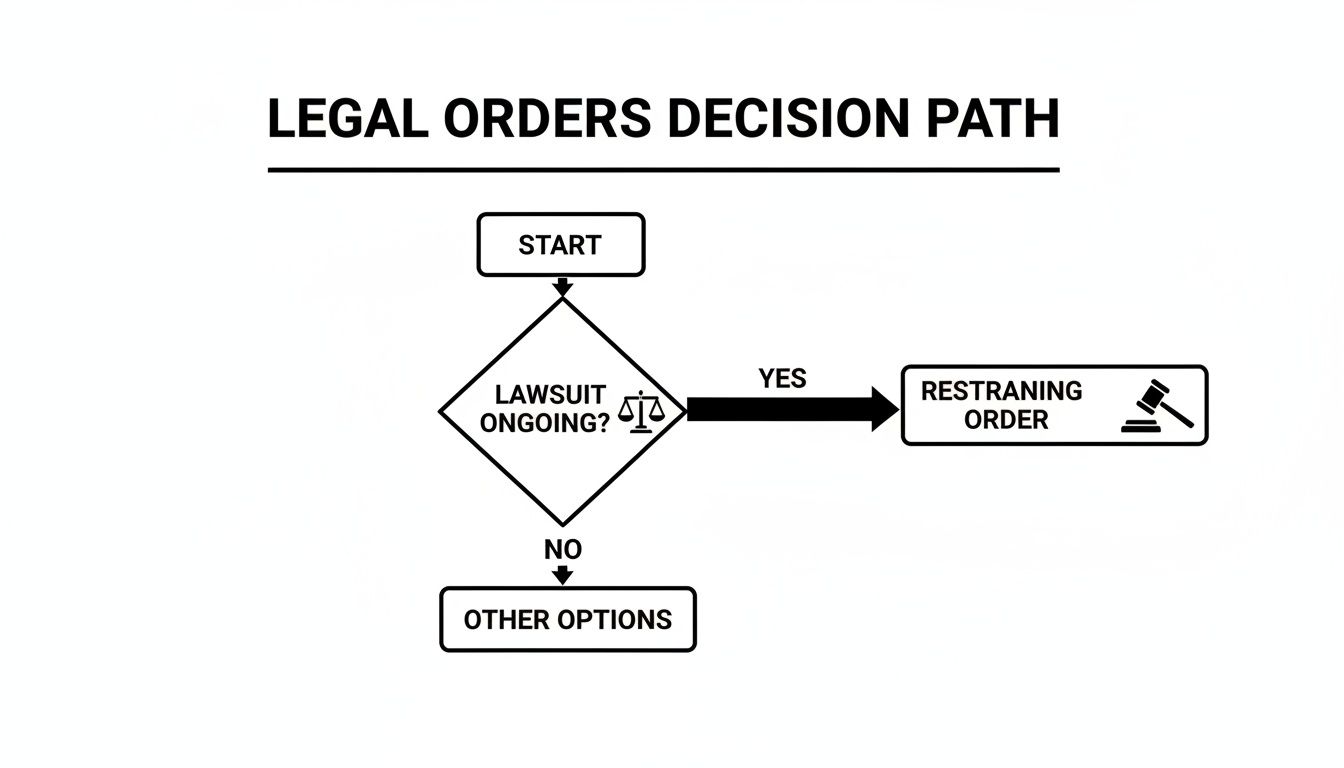
As you can see, Restraining Orders are almost always tied to an ongoing case. Their job is to manage everyone's behavior until the case is finalized. Protective Orders, on the other hand, are standalone actions focused entirely on stopping family violence, whether a lawsuit exists or not.
Different Legal Foundations
The legal authority behind each order tells you everything you need to know about its purpose. A Protective Order is a product of the Texas Family Code, created specifically to prevent family violence. Its entire reason for existing is to keep a victim and their children safe from harm.
A Restraining Order, including a Temporary Restraining Order (TRO), is governed by the Texas Rules of Civil Procedure. That detail alone tells you it’s a procedural tool, not a personal safety shield. It’s designed to manage the conduct of people involved in a lawsuit so the case can move forward fairly.
Purpose: Preventing Physical Harm vs. Preserving Stability
The "why" behind each order is probably the most critical distinction for any parent to understand.
- The "Why" of a Protective Order: Its only goal is to stop family violence from happening again. It’s requested by someone who has already experienced violence and has a real fear it will continue.
- The "Why" of a Restraining Order: Its purpose is to maintain the "status quo" while a lawsuit is pending. It’s about preventing one person from doing something that could harm the other's legal rights, like draining the bank account or moving a child out of state before a judge can rule on the issues.
Understanding this difference is key: a Protective Order is about protecting a person from physical harm, while a Restraining Order is about protecting the legal process and the assets or children involved in a case.
Evidence Required: Proof of Violence vs. Proof of Harm
To get a judge to sign either of these orders, you have to bring proof. But the kind of evidence you need—and how strong it has to be—is worlds apart.
To get a Protective Order, you must show the court that "family violence has occurred" and is likely to happen again. This isn't a low bar. It often requires concrete evidence like:
- Police reports or testimony from officers
- Photos of injuries or damaged property
- Threatening text messages, emails, or voicemails
For a Restraining Order, the standard is different. You need to convince a judge that you will suffer "irreparable harm" if the court doesn’t step in immediately. This means showing the other person is about to do something that can't be easily undone later, like selling the house from under you or taking the kids to another country.
Protective Order vs Restraining Order in Texas Key Differences
To make these distinctions crystal clear, here is a simple breakdown of the most important differences between a Protective Order and a Restraining Order in Texas. This table helps you quickly see which legal tool might fit your specific situation.
| Feature | Protective Order | Restraining Order (including TRO) |
|---|---|---|
| Primary Goal | To stop family violence and protect victims from physical harm. | To maintain stability and preserve assets/rights during a lawsuit. |
| Legal Basis | Texas Family Code | Texas Rules of Civil Procedure |
| Evidence Needed | Proof that family violence has occurred and is likely to occur again. | Proof of imminent, irreparable harm to your legal case. |
| Consequence of Violation | Criminal charges. Immediate arrest is possible. | Civil penalties (contempt of court, fines). |
| Firearm Rights | Automatically prohibits the abuser from possessing or buying a firearm. | Typically does not impact firearm rights. |
| Who Can Get One | A victim of family violence. | A party involved in an active civil lawsuit (like a divorce). |
This table highlights the core functions of each order. A Protective Order is a shield with criminal enforcement, while a Restraining Order is a rulebook for a civil case. Knowing which one you need is the first step toward protecting yourself and your family effectively.
Consequences: Criminal vs. Civil
The most powerful difference between these orders is what happens when someone breaks the rules.
Violating a Protective Order is a criminal offense under the Texas Penal Code. The police can arrest the person on the spot for violating the order, and that person will face a new criminal charge completely separate from any family court case. This is what gives a Protective Order its real teeth.
Violating a Restraining Order, however, is a civil matter. While the judge will take it seriously, it won't lead to a criminal record. The consequence is being held in "contempt of court," which can result in fines or even jail time, but it’s all handled by the family court judge, not the criminal justice system.
Understanding these key differences is crucial. It empowers you to choose the right legal tool to protect what matters most—your children, your rights, and your future.
How to Choose the Right Order for Your Situation
Knowing the legal definitions is one thing, but figuring out which tool to use in the middle of a family crisis is what really matters. The decision comes down to the kind of threat you’re facing. Are we talking about a threat to your physical safety, or a threat to your legal rights and family stability while a lawsuit is going on?
Let's look at some real-world situations that Texas parents run into all the time. Seeing these examples will help you figure out which path is the right one for protecting your family.
Scenarios Calling for a Protective Order
A Protective Order is your legal shield when the core issue is family violence. This isn't the tool for stopping someone from selling a car; it's the tool for preventing physical harm, harassment, and credible threats. If you find yourself in any of the situations below, a Protective Order is the powerful and appropriate solution.
You should consider seeking a Protective Order if the other parent has:
- Physically harmed you or your child, even if it was just once.
- Made believable threats of violence against you or your family.
- Started stalking or harassing you in a way that makes you genuinely fear for your safety.
- Engaged in behavior that constitutes sexual assault or abuse.
The question you need to ask is simple: Do I fear for my physical safety or the safety of my child? If the answer is yes because of threats, harassment, or past violence, then a Protective Order under the Texas Family Code is the specific remedy designed to keep you safe.
Scenarios Requiring a Restraining Order
A Temporary Restraining Order (TRO) is a different kind of tool altogether. It's used to keep things stable and fair after a lawsuit has already been filed. Its whole purpose is to stop one person from doing something that could sabotage the legal process or cause irreversible damage to your parental rights or the marital estate. Think of it as preserving the status quo.
A Temporary Restraining Order is the right move if you find out the other parent is:
- About to take your child out of the county or state without your permission while a divorce is pending.
- Planning to drain a joint bank account or sell off shared investments.
- Trying to sell the family home or another major piece of shared property before a judge can divide it.
- Threatening to drop your child from their health insurance policy.
In these cases, the harm isn't physical violence, but it's immediate and can't be easily fixed later. A TRO basically hits the legal "pause button," protecting your rights until the court has a chance to make a final decision.
When Both Orders Might Be Necessary
Life is rarely neat and tidy, and some situations are messy enough to need both legal tools at once. A parent might need a Protective Order to ensure their safety and, at the same time, a Restraining Order to manage the practical side of a divorce or custody case.
For instance, imagine a parent commits an act of family violence (which calls for a Protective Order). At the same time, they're threatening to empty the joint savings account and leave the state with the kids (which calls for a Temporary Restraining Order). In a high-conflict case like this, we would go after both orders to build a complete legal shield. The Protective Order tackles the immediate threat of violence, while the TRO locks down the finances and keeps the children in Texas, ensuring the "best interests of the child" standard can be properly applied by the court.
Key Takeaways: Your Next Steps To Protect Your Family
When you're under this much stress, trying to figure out the difference between a protective order and a restraining order in Texas can feel impossible. Let’s cut through the noise. Here’s the fundamental difference to remember: Protective Orders are your shield against family violence, while Restraining Orders are a procedural tool for stability during a lawsuit.
Getting that distinction straight is the first real step toward taking the right action to protect your children and yourself. You are not powerless here. The Texas legal system has specific, powerful tools designed for exactly what you're facing.
Next Steps to Consider
As you figure out what to do next, hold onto these key points. They are the foundation for making smart, confident decisions for your family's future.
- Your Goal Determines the Tool: If you are afraid for your physical safety because of threats or actual violence, a Protective Order is what you need. If you need to stop the other parent from draining the bank account or taking the kids out of state during a divorce, a Restraining Order is the right move.
- Evidence is Everything: The proof you need is completely different for each. For a Protective Order, you have to show that family violence has actually happened. For a Restraining Order, the goal is to show the court you'll suffer immediate and irreparable harm if it doesn't step in.
- Consequences Matter: Breaking a Protective Order is a criminal offense that can lead to arrest and jail time. Violating a Restraining Order is a civil matter, handled in family court with fines or other penalties.
Your feelings of fear and uncertainty are valid, but they don't have to control what happens next. By understanding these legal options, you are already taking back control and moving toward a safer, more stable life for you and your kids.
Beyond the courtroom, it can be incredibly helpful to explore resources like family therapy services, which can offer a path to address the underlying conflicts and build healthier ways of communicating. In some urgent situations, you might also need to learn more about how an emergency custody order in Texas can offer immediate protection for your children.
Common Questions About Texas Court Orders
When you're dealing with a high-stress family situation, getting straight answers is the first step toward making smart decisions for your family's future. We've pulled together some of the most common questions our attorneys hear from parents just like you to provide the clarity you need.
Can I Get a Protective Order and a Restraining Order at the Same Time?
Yes, absolutely. In fact, it's a common and often necessary strategy in high-conflict cases where you need to protect both your physical safety and your legal standing. For example, a parent might file for a Protective Order to stop threats and harassment while also getting a Temporary Restraining Order (TRO) as part of their divorce to stop the other parent from draining the bank account or taking the kids out of state. One order shields you and your children from harm, while the other puts a legal fence around your property and rights while the case is sorted out.
How Will a Protective Order Affect My Child Custody Case?
A Protective Order can completely change the landscape of a child custody case. The judge’s number one job is to protect the "best interests of the child," and a finding of family violence is one of the heaviest factors a court will ever consider.
If a judge issues a Protective Order against one parent, the court is legally required to presume that it's not in the child’s best interest for that parent to have joint managing conservatorship (the standard Texas arrangement where both parents share major decision-making rights). This often leads to the court ordering things like:
- Sole Managing Conservatorship: The non-violent parent gets the exclusive right to make big decisions for the child (school, medical, etc.).
- Supervised Visitation: The parent who committed violence might only be allowed to see the children with a neutral third party watching.
- No Visitation at All: In the most severe cases, the court can cut off all contact to ensure the child’s safety.
What Kind of Proof Do I Need for Each Order?
The evidence needed for each order is fundamentally different. It's a critical distinction to understand.
For a Protective Order, you have to bring credible proof that "family violence has occurred" and is likely to occur again. This is where things like police reports, threatening texts or voicemails, photos of injuries, or testimony from a witness become vital. For a Restraining Order, the proof is different—you have to show the judge you'll suffer "irreparable harm" if the order isn't granted. For example, you might show bank statements proving the other parent is trying to empty a joint account.
How Long Do These Orders Actually Last?
Their timelines are built for completely different purposes. A Temporary Restraining Order (TRO) is a short-term fix, designed to keep things stable until the court can hold a proper hearing. It typically only lasts for 14 days.
A final Protective Order, on the other hand, is built for long-term safety. A judge can issue a final order that lasts for up to two years. In some very serious situations, it can even be ordered for longer than two years.
If you need help with a child custody or visitation case in Texas, our experienced attorneys can guide you every step of the way. Contact The Law Office of Bryan Fagan, PLLC today for a free consultation.