
When your child’s future is on the line, understanding your rights matters most. Considering the idea of voluntarily giving up your parental rights is one of the most difficult and emotional roads a person can walk. This isn't like a simple change in custody; it's a permanent legal action that completely severs the parent-child relationship. This guide is here to offer clear, compassionate information to help you understand what this process truly means for you and your child here in Texas.
The Hardest Choice a Parent Can Make

The thought of severing legal ties with your child is one of the heaviest burdens a parent can face. It’s a path filled with emotional complexity, and it’s okay to feel overwhelmed, sad, or uncertain. Our goal is to provide a supportive space where you can find clarity without judgment.
We will walk you through the legal realities under the Texas Family Code, making sure you understand the gravity and permanence of this decision. For those navigating the often-overwhelming journey of parenthood, finding foundational support can be crucial. Sometimes, going back to basics with resources offering essential tips for new dads and mothers alike can help build a strong foundation.
Focusing on Your Child's Best Interests
In Texas, every single decision a family court makes comes down to one guiding principle: the “best interest of the child.” This is the legal standard judges use to ensure a child's safety and well-being are the top priority. Voluntarily giving up your parental rights is no different. A judge won’t approve this life-altering request unless it’s crystal clear that doing so gives the child a more stable, secure, and positive future.
This usually happens in very specific situations, such as:
- Stepparent Adoption: A biological parent agrees to terminate their rights so a stepparent, who has become a primary caregiver, can legally adopt the child and make their family whole.
- Family Adoption: Another family member, like a grandparent or an aunt, is ready and willing to adopt the child, providing a permanent and loving home.
The court’s focus is always on making sure the child lands in a solid, reliable support system. Relinquishment is not a tool to dodge responsibility, but a legal process designed to secure a child’s well-being for the long haul.
What Relinquishing Parental Rights Actually Means in Texas
When your child’s future is at stake, some legal terms can be intimidating. In Texas, “voluntarily relinquishing parental rights” isn’t just jargon—it’s the legal equivalent of a final goodbye. It signifies a complete and permanent end to the parent-child relationship, an action known formally as the “Termination of the Parent-Child Relationship.”
This isn't a temporary break, like modifying your visitation schedule. It's an irreversible step finalized by a court order. Grasping that finality from the start is absolutely critical.
The Finality of the Decision
Once a judge signs that termination order, every legal thread connecting you to your child is cut. All the rights and responsibilities that come with being a parent—gone. It’s a profound decision that rewrites your legal relationship.
The process usually begins when a parent signs a formal document called an Affidavit of Relinquishment of Parental Rights. But just signing the paper doesn’t seal the deal. A judge must review the entire situation and agree that terminating your rights is truly in the “best interest of the child.” Courts won’t leave a child without a legal parent, which is why this step is almost always tied to an adoption by another loving adult.
Custody Modifications vs. Relinquishment
It’s easy to confuse relinquishing parental rights with simply changing a custody arrangement, but they are worlds apart. Modifying custody is like adjusting the rules; relinquishment is ending your role in the game entirely.
For example, in a typical joint managing conservatorship, both parents share the power to make decisions about their child’s school, doctor, and general well-being. Even if one parent has the child most of the time, the other parent is still legally a parent with rights. If you want to dive deeper into how parental status is established, our article on acknowledgment of paternity is a great resource.
A court order modifying your possession schedule changes when you see your child. An order terminating your rights means you legally have no right to see your child ever again.
To make this crystal clear, let's break down the differences between these two very different legal paths.
Key Differences: Custody vs. Parental Rights
The table below highlights the crucial distinctions between temporarily changing a custody schedule and permanently ending your legal role as a parent.
| Legal Aspect | Modifying Custody (Joint Managing Conservatorship) | Voluntarily Relinquishing Parental Rights |
|---|---|---|
| Permanence | Temporary & Modifiable. Orders can be changed later if circumstances change. | Permanent & Irreversible. This is a final legal action with very rare, specific exceptions. |
| Parental Rights | Retained. You keep your rights to make decisions, receive information, and see your child. | Terminated. All rights, including visitation and decision-making, are completely lost. |
| Future Contact | Legally Protected. You have a court-ordered possession schedule outlining visitation. | No Legal Right. Any future contact depends entirely on the goodwill of the child's new legal parents. |
| Financial Duty | Continues. The obligation to pay child support remains in effect. | Ends (Mostly). Future support ends, but past-due amounts may still be owed unless waived by the court. |
Understanding these differences is the first step. One path allows for future changes as life evolves, while the other is a one-way street with no turning back.
The Step-By-Step Legal Process in Texas
Navigating the Texas court system can feel overwhelming, especially when your child’s future is on the line. But when it comes to voluntarily relinquishing parental rights, the legal process follows a clear path designed to protect the child. Knowing what to expect can help you feel more prepared.
The entire process hinges on one powerful legal document: the Affidavit of Relinquishment of Parental Rights. This isn't just a simple form; it's a sworn statement that must meet strict legal standards to be valid. In Texas, a mother can't sign this affidavit until at least 48 hours after the child is born. This waiting period ensures the decision is made with a clear head, not under the immediate physical and emotional stress of childbirth.
Signing the Affidavit of Relinquishment
This affidavit must be signed in front of two credible witnesses and a notary public. This formality highlights just how serious the document is. By signing it, you are stating under oath that you are voluntarily and knowingly giving up all your legal rights and duties as a parent.
Once signed, the affidavit is generally considered irrevocable. This finality is a crucial protection for the child, especially when an adoption is pending, as it prevents a child's future from being left in limbo.
The Court's Crucial Role
Simply signing a paper doesn't end the process. The next step is a court proceeding where a judge reviews the entire case. A petition must be filed with the family court asking a judge to legally terminate the parent-child relationship.
In Texas, a judge will only grant a termination of parental rights if they are convinced by "clear and convincing evidence" that it is in the best interest of the child. This is the highest standard of proof in family law, and it is the court's absolute top priority.
The judge doesn’t just rubber-stamp these requests. They will look at many factors, including the child's emotional and physical well-being, their stability, and the plans for their future care. For a deeper dive into this, you can find more details in our guide to parental termination of rights in Texas.
Common Scenarios in Court
So, when will a judge actually approve a voluntary relinquishment? The most common situation is when it's part of an adoption. The court won’t leave a child without a solid, secure plan for their future.
- Stepparent Adoption: This is a classic example. A biological parent agrees to terminate their rights so their child's stepparent can legally adopt them, creating a unified legal family.
- Adoption by a Relative: Sometimes, a grandparent, aunt, or another family member steps up to adopt the child, making sure they stay within a loving family network.
In these cases, the relinquishment and the adoption are handled together in the same legal proceeding. This creates a seamless transition and guarantees the child will have two legal parents responsible for their care. The infographic below lays out this basic legal flow.
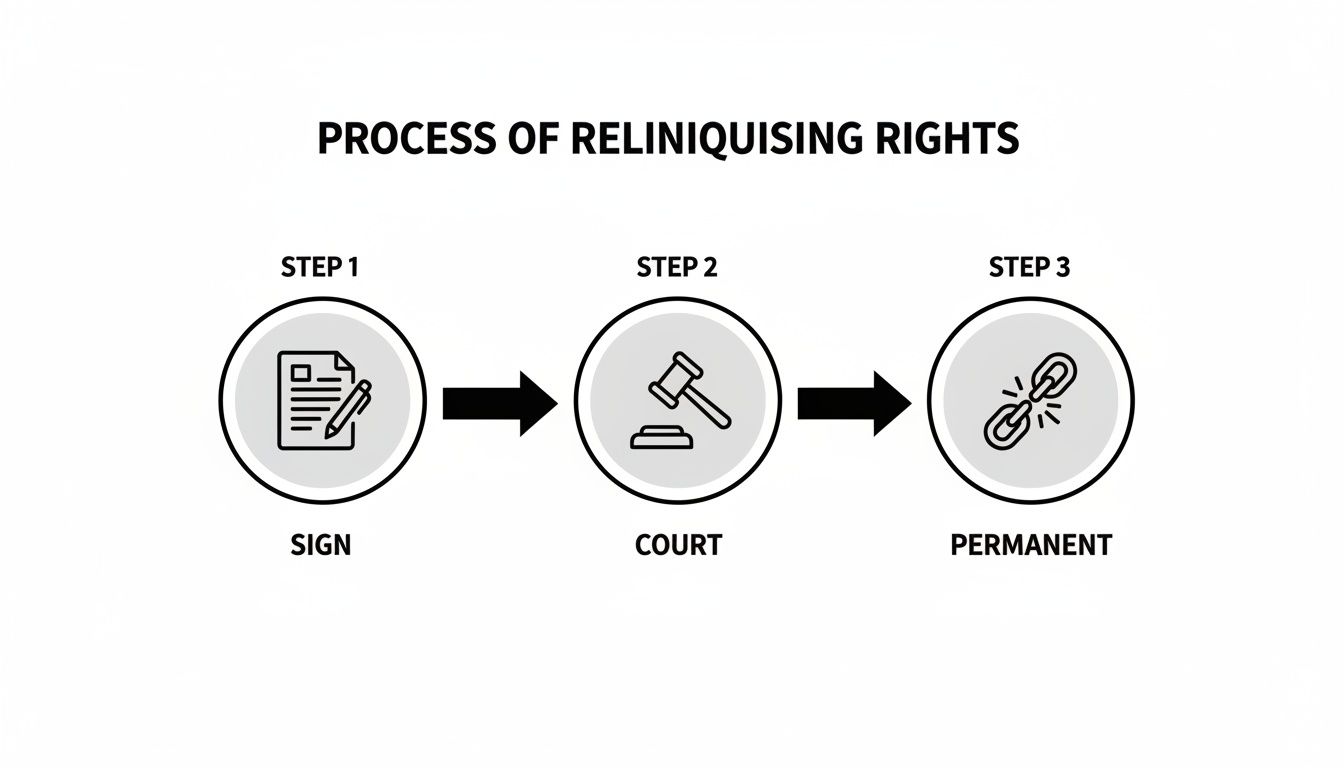
This process has become more common than many people realize. Sadly, the rate of parental rights termination has been climbing nationwide. Based on 2016 data, 1 in 100 children is expected to experience this permanent severance by age 18. That represents a nearly 60% increase in risk from the year 2000, a trend often linked to heartbreaking societal issues like poverty and substance abuse. The Texas legal process is designed to make sure that every single one of these life-altering decisions is made with the utmost care for the child at the center.
Understanding the Permanent Consequences

The decision to voluntarily give up your parental rights isn't just a legal change; it’s a permanent one that reshapes your family’s future forever. This isn't like a temporary custody adjustment that you can revisit down the road. Once a judge finalizes the termination, there is no turning back.
It’s absolutely critical to understand the full weight of this finality. We're talking about a choice with profound, lifelong consequences that reach far beyond whatever circumstances you’re facing today. Let’s paint a realistic picture of what life looks like after relinquishment.
What Is Permanently Lost
When parental rights are terminated, the entire legal relationship between you and your child is erased. This means you lose every single right and privilege that comes with being a parent.
Specifically, you will lose the right to:
- Possession and Access: You’ll no longer have a legal right to see or spend time with your child. Any future contact would be entirely up to the child's new legal parents.
- Make Decisions: Your authority to make choices about your child's education, healthcare, and religious upbringing is completely gone.
- Inheritance: Your child will no longer have a legal right to inherit from you, and you will have no right to inherit from them.
This is a complete and total severance. In the eyes of the law, you and your child become legal strangers. It's a tough reality to face, but it’s one you must fully absorb before taking this step.
A Common Misconception About Child Support
Many parents believe that voluntarily signing away their rights automatically wipes their financial slate clean. This is a dangerous and common misunderstanding. While a termination order will end your obligation to pay future child support, it does not erase any past-due amounts you already owe.
Your responsibility for any child support arrears—that’s the legal term for past-due payments—remains even after your rights are terminated. Only a separate court order can waive that debt, which is extremely rare.
A Texas court will not approve a relinquishment if the main motivation appears to be avoiding child support. The court's single focus is the best interest of the child, and financial support is a huge part of that analysis. Never assume that signing a form is a quick fix for financial problems.
The Broader Impact of Termination
The legal finality of termination is felt far beyond the courtroom. The number of families affected by parental rights termination has grown significantly. By 2021, a staggering 65,000 children in the U.S. foster care system had their parental rights fully terminated. You can learn more about the factors driving these trends, and it becomes clear that these decisions are part of a much larger, complex picture.
For a parent, the emotional consequences can be just as permanent as the legal ones. The loss of that legal connection to your child often brings a profound and lasting grief. It is absolutely vital to consider not just the immediate legal outcome but also the long-term emotional impact this decision will have on you and your child.
Exploring Alternatives to Relinquishing Rights
Thinking about voluntarily giving up your parental rights is an unbelievably heavy burden. It can feel like you’re trapped, with no other way forward. But Texas law is built to be flexible, and its primary goal is to protect the bond between a parent and child whenever possible. Before you make a decision that can't be undone, it's critical to look at other, less permanent legal options that can give your child stability while keeping your family legally whole.
These alternatives are designed to solve immediate problems without the finality of termination. They offer solutions that can change as your life changes, always leaving the door open for your future relationship with your child.
Modifying Your Custody Order
One of the most powerful alternatives is to simply modify your existing custody order. A custody order isn't carved in stone; it can be updated to reflect new realities. If you're struggling to keep up with your parental responsibilities, you can ask the court to make adjustments.
This could look like:
- Naming the Other Parent as Sole Managing Conservator: This gives the other parent the exclusive right to make major decisions in your child’s life. You would then become the possessory conservator, which means you still have the right to see your child under a clear possession schedule.
- Adjusting the Possession Schedule: Your visitation time can be changed to fit what you can handle right now. This might mean moving to a more limited or even supervised visitation plan until you can get back on your feet.
This approach gives your child stability by putting the primary responsibility on the other parent, but it protects your legal status as a parent and your right to be in your child’s life.
Establishing a Formal Guardianship
What if both parents are unable to care for the child, or if you're a single parent facing a temporary crisis? In these situations, establishing a legal guardianship can be a lifesaver. A trusted family member, like a grandparent, can be appointed by the court as the child’s legal guardian.
This gives them the authority to make decisions and provide day-to-day care, but it does not terminate your parental rights. Guardianship is usually temporary and can be ended once you're able to resume your parenting duties. It’s a legal safety net, making sure your child is cared for without permanently breaking your family ties.
Choosing an alternative like a custody modification or guardianship preserves your legal relationship with your child. It's like building a bridge over a difficult time, rather than creating a permanent divide.
For parents whose struggles are leading them to consider relinquishment, exploring options like mental health and substance abuse treatment can offer another way forward, helping them address root issues and work toward keeping their parental role.
In some heartbreaking cases, parents feel they have no choice but to give up custody to get their child access to necessary services. In fact, custody relinquishment for behavioral health needs accounted for thousands of foster care entries in the U.S. in recent years. You can see by reviewing the federal report on this issue, this problem highlights why it's so important to explore every available alternative before taking a step you can't take back.
Comparing Legal Options for Your Child's Care
| Legal Option | Permanence | Parental Rights Retained | Best For Situations Involving… |
|---|---|---|---|
| Custody Modification | Not Permanent. Can be modified again in the future. | Yes. You remain a legal parent with rights to visitation. | A co-parent who is able and willing to take on more responsibility. |
| Guardianship | Temporary. Designed to end when the parent is stable. | Yes. Your parental rights are fully preserved. | A temporary crisis where a trusted relative can step in to help. |
| Voluntary Relinquishment | Permanent and Irreversible. | No. All parental rights are legally severed forever. | An adoption where another person is ready to become the legal parent. |
Looking at this table, you can see that both custody modifications and guardianships are powerful tools for getting through tough times without making a permanent choice. They prioritize your child's immediate stability while protecting your legal connection for the long run.
Next Steps: Why Legal Guidance is Essential
This is a heavy decision, and it’s not one you should ever make alone—especially if you’re feeling pressured or overwhelmed. The first step is understanding the gravity of it all: voluntarily giving up your parental rights is permanent, it absolutely must be in your child's best interests, and there may be better alternatives available.
Your next step is the most important one. You need to talk to a compassionate family law attorney who can look at your specific situation and give you honest, personalized advice. A family law attorney isn't there to judge you; they are your advocate, making sure you understand your options and that your rights are protected every step of the way.
Why You Must Speak with an Attorney
An experienced lawyer offers a confidential space to explore the reality of your circumstances. They’ll help you truly understand:
- The lifelong consequences of termination versus less permanent solutions like modifying custody.
- Whether your situation actually meets the strict legal standard of the “best interest of the child.”
- How to handle the court process and all the required legal paperwork, like the Affidavit of Relinquishment.
This conversation is about getting the clarity you need to make the best possible choice for your child's future with confidence. Before you sign anything or agree to anything, pause and talk to an expert. Learning how to choose the right family law attorney is a critical first move to protect your family.
Key Takeaway: The decision to relinquish parental rights is too significant to make without personalized legal counsel. An attorney can validate your emotions while clarifying your legal options, ensuring any action taken truly protects your child’s well-being and your own rights.
If you need help with a child custody or parental rights case in Texas, our experienced attorneys can guide you every step of the way. Contact The Law Office of Bryan Fagan, PLLC today for a free consultation.
Frequently Asked Questions About Relinquishing Rights in Texas
When your child’s future is on the line, the last thing you need is confusing legal jargon. You need straight answers. This process is emotionally heavy and legally complicated, so we’ve tackled some of the most common questions Texas parents ask when they’re thinking about voluntarily giving up their parental rights.
Can I Change My Mind After Signing the Affidavit?
In almost every case, the answer is no. The Affidavit of Relinquishment of Parental Rights is a legally binding document designed to be final and irreversible. This isn't just a technicality; it’s a critical protection for the child. It provides the stability they need, especially when an adoption is pending, and prevents them from being trapped in legal limbo.
While there are incredibly rare exceptions—like proving you were forced to sign under extreme duress or were a victim of fraud—you should go into this assuming the decision is permanent. Once that affidavit is signed and witnessed, the door is effectively closed. The entire legal system is built to prioritize a child’s need for a stable, predictable future.
Will I Still Owe Back Child Support After Relinquishment?
Yes, you will almost certainly still owe any past-due child support. This unpaid support is legally called arrears, and voluntarily giving up your parental rights doesn’t make it disappear. The court order terminates your obligation for future child support payments, but the debt that has already accumulated is still yours to pay.
The only way to get out of arrears is through a separate and specific court order that waives the debt. This is extremely rare, as judges are focused on a child's financial security and are very unlikely to forgive a parent’s past financial responsibilities.
Does the Other Parent Have to Agree to the Relinquishment?
While the other parent's formal consent isn't always legally required for you to file, their position on the matter is hugely important to the court. A judge’s guiding principle is the best interest of the child, which almost always means ensuring the child has a stable home with legal parents to care for them.
Voluntary relinquishment cases are approved most often when there’s another person ready and willing to step in and adopt the child, like a stepparent. A court will not sign off on a termination that would leave a child with just one legal parent and no solid plan for their future. If the other parent objects, the judge will listen carefully to their reasons and weigh how the termination would impact the child’s stability.
What Happens if There Is No One to Adopt My Child?
A Texas court will not terminate a parent's rights if it means leaving the child with no legal parent or only one legal parent without a secure plan. The whole point of the "best interest of the child" standard is to guarantee the child’s safety, stability, and well-being.
If you don’t have a stepparent, grandparent, or another qualified adult who is ready to file for adoption immediately, a judge will not approve the voluntary relinquishment. This process isn't a loophole for a parent to walk away from their responsibilities. It’s a legal mechanism designed to help a child transition to a new, permanent family structure that serves their needs.
If you need help with a child custody or visitation case in Texas, our experienced attorneys can guide you every step of the way. Contact The Law Office of Bryan Fagan, PLLC today for a free consultation at https://texascustodylawyer.net.