
When your child’s future is on the line, understanding your rights matters most. Here in Texas, the law is clear: dads' rights are equal to mothers' rights. A judge won't favor one parent over the other based on gender. Instead, every single decision comes down to one guiding principle: what is in the best interest of the child. For Texas fathers, this is where your journey to securing your rights and protecting your relationship with your child begins.
Your Role as a Father and Your Rights in Texas
The bond between a dad and his child is irreplaceable, but the Texas legal system can feel like a maze. Many fathers worry that the courts automatically side with mothers. It's a common myth, but it's just that: a myth.

The foundational truth of Texas family law is that it is completely gender-neutral. The Texas Family Code, Chapter 153, which lays out all the rules for custody, is built around determining the best interest of the child. This means a judge looks at the facts of your specific situation to decide what living arrangement and parenting plan will best support your child's emotional and physical well-being.
What Does "Best Interest of the Child" Actually Mean?
So, what are the courts really looking for? Your gender isn't on the list. Instead, a judge will evaluate things like:
- Which parent can provide a safe, stable, and loving home.
- The child’s emotional and physical needs, both now and down the road.
- Any history of family violence or substance abuse from either parent.
- The actual relationship the child has with each parent.
- Each parent's track record of being involved in the child’s life—things like showing up to school functions or taking them to the doctor.
This legal standard is great news for fathers who are hands-on, capable, and committed. It gives you a strong foundation for securing your rights.
A Roadmap for Texas Fathers
Feeling overwhelmed is completely normal, but you're not in this alone. This guide is designed to replace that uncertainty with confidence by giving you a clear, practical roadmap. We’ll walk you through the essential steps every Texas father needs to understand.
Your active involvement in your child’s life is the most powerful evidence you can present. The law is designed to support, not hinder, the relationship between a loving father and his child.
We're going to break down the key legal concepts you'll face, from establishing your legal rights as a dad to understanding how parenting time gets divided. We’ll explain the complex jargon in plain English, empowering you to advocate for yourself and your child effectively. By the time you're done reading, you will have a solid grasp of your legal standing and the actions you can take to protect your vital role in your child's life.
Establishing Paternity is Your First Critical Step
For unmarried fathers in Texas, this is the single most important thing to understand: your legal rights as a dad don’t just happen. Before a court will even consider granting you custody or visitation, you have to be legally recognized as the child’s father.
Think of it like this: establishing paternity is the key that unlocks the door to your rights as a dad.

This step is what transforms you from a biological father into a legal father with enforceable rights and responsibilities. Even if your name is on the birth certificate, without legally establishing paternity, you can’t walk into a courtroom and ask for a possession schedule or fight for the right to make decisions for your child.
Two Paths to Legal Fatherhood
So how do you do it? In Texas, there are two main ways to establish your legal parentage. The path you end up taking usually comes down to your relationship with the child's mother and the specific circumstances of your child's birth.
The first and most straightforward method is voluntary. The second is a more formal court process that becomes necessary when there's a disagreement or any uncertainty.
The Acknowledgement of Paternity (AOP)
The simplest way to get this done is for both you and the mother to sign a form called an Acknowledgement of Paternity (AOP). This is a sworn legal document where you both agree, under penalty of perjury, that you are the child’s biological father. More often than not, this form is presented to new parents at the hospital right after the child is born.
Signing an AOP is a serious legal act. It carries the same weight and legal effect as a court order, and the consequences are significant. Once it's signed and filed with the Texas Vital Statistics Unit, you are legally established as the father. This gives you the standing you need to then go to court and seek custody and visitation rights. To learn more, check out our detailed guide on the legal implications of an Acknowledgement of Paternity.
A word of caution: it is absolutely vital to be 100% certain you are the biological father before you put your name on that form. Trying to undo a signed AOP is an incredibly difficult, expensive, and time-sensitive legal battle.
By signing the AOP, you are not just adding your name to a form; you are legally binding yourself to the rights and duties of fatherhood, including the obligation to provide financial support for your child.
The Suit to Adjudicate Parentage
What if the AOP was never signed? Or what if there’s some doubt about who the biological father really is? In these situations, either parent can file a Suit to Adjudicate Parentage. This is a formal lawsuit that asks a family court to step in and legally determine the child’s father.
This process is all about creating clarity and legal certainty for everyone involved—you, the mother, and most importantly, the child. Here’s what it usually involves:
- Filing a Petition: One parent kicks off the process by filing a petition with the court.
- Genetic Testing: The court will almost always order DNA testing to confirm the biological relationship. This removes all doubt and makes sure the final decision is based on hard science, not just someone's word.
- Court Order: Once the DNA results come back and confirm you are the father, the judge will issue a final order that legally names you as the dad.
This court order achieves the same thing as an AOP—it makes you the legal father. But here's the real power of this approach: it can be combined with a custody, visitation, and child support case. This allows the court to sort out all the critical issues about your child in a single, efficient proceeding, making it a powerful tool for fathers ready to secure their rights and build a stable future.
How Texas Determines Custody: Understanding Conservatorship
When you’re fighting for your kids, the last thing you need is a bunch of confusing legal jargon. In Texas, you'll hear the term conservatorship instead of "custody." It’s less about who the child lives with and more about a much bigger question: who has the legal right to make the important decisions in their life?
The good news for fathers is that Texas law starts with a powerful, built-in belief: it’s in a child’s best interest for both parents to be deeply involved. This isn’t just a nice idea; it’s the legal starting point for every custody case and the foundation of a father's rights in this state.
The Default is Joint Managing Conservatorship
Because the law presumes shared parenting is best, the most common outcome is for both parents to be named Joint Managing Conservators (JMC). Think of this as a legal recognition that both you and the child's mother are essential partners in raising your child. It’s the court’s way of saying you both have a vital role to play.
Being a Joint Managing Conservator means you get a legal say in the big-picture decisions that will shape your child's future. These shared rights almost always include decisions about:
- Education: Where your child goes to school and how you’re involved in their learning.
- Medical Care: The right to consent to non-emergency medical, dental, and psychological treatment.
- Moral and Religious Upbringing: The ability to help guide your child’s spiritual and ethical development.
The final court order will lay out exactly how these decisions get made. Sometimes, one parent might be given the exclusive right to make a specific call (like deciding where the child lives), while all other major decisions have to be made together. We cover exactly what Texas conservatorship means for your family and how these rights are divided in more detail.
Sole Managing Conservatorship Is the Exception, Not the Rule
While JMC is the standard, there are rare and serious situations where a judge decides it’s just not in the child’s best interest. In these cases, one parent may be named the Sole Managing Conservator (SMC).
This arrangement gives one parent the exclusive right to make most of the major decisions without needing the other parent's input or consent. A court will only go this route if there’s clear evidence of serious problems that could put the child at risk, like:
- A history of family violence or child abuse.
- Documented substance or alcohol abuse problems.
- Such extreme conflict that making decisions together is impossible.
- One parent has voluntarily given up their rights.
It’s important to understand that judges don’t take this step lightly. The evidence has to be compelling and show that appointing a Sole Managing Conservator is the only way to protect the child's physical or emotional health.
To help you see the differences more clearly, here’s a breakdown of how these two arrangements stack up.
Joint vs Sole Managing Conservatorship in Texas
| Feature | Joint Managing Conservatorship (JMC) | Sole Managing Conservatorship (SMC) |
|---|---|---|
| Decision-Making | Rights and duties are shared between both parents, either jointly or allocated by the court. | One parent has the exclusive right to make most major decisions. |
| When It's Used | The standard in Texas, presumed to be in the child's best interest. | Reserved for cases with family violence, substance abuse, or extreme conflict. |
| Parental Roles | Both parents are active, legally recognized decision-makers. | One parent is the primary decision-maker; the other is a Possessory Conservator with visitation rights. |
| Communication | Requires co-parenting and cooperation on key issues like health and education. | Minimal cooperation is required from the Possessory Conservator on major decisions. |
| Child's Residence | One parent is typically designated to establish the child's primary residence. | The Sole Managing Conservator establishes the child's residence. |
Ultimately, this table shows that Texas law is designed to keep both parents involved. Unless there are serious safety concerns, the courts will work to create a JMC arrangement that protects your rights as a father.
As a dad, that legal presumption of Joint Managing Conservatorship is your single strongest asset. Texas family courts begin with the belief that you should be a co-pilot in your child’s life, which gives you a solid foundation to advocate for your role.
The point of conservatorship isn't to declare a “winner” and a “loser.” It's about building a stable framework that allows both parents to be a positive force in their child's life.
By understanding the key differences between joint and sole conservatorship, you’re in a much better position to fight for the arrangement that ensures you remain a central, guiding presence in your child’s upbringing.
How Possession Orders Define Your Parenting Time
If conservatorship is about your right to make decisions for your child, the Possession Order is the nuts and bolts of your parenting life. Think of it as the official, court-ordered calendar that spells out exactly when your child is with you and when they're with their other parent. For most dads, this is where the rubber meets the road—it’s the document that legally protects your physical time with your kid.
Texas law doesn't leave this up to chance. It provides a default schedule designed to give both parents predictable, consistent time with their children. This framework is called the Standard Possession Order (SPO), and it serves as the starting point for the vast majority of custody arrangements in the state.
The timeline below gives you a bird's-eye view of how Texas courts approach custody, beginning with the assumption that both parents should be involved and ending with a specific possession schedule tailored to the family.
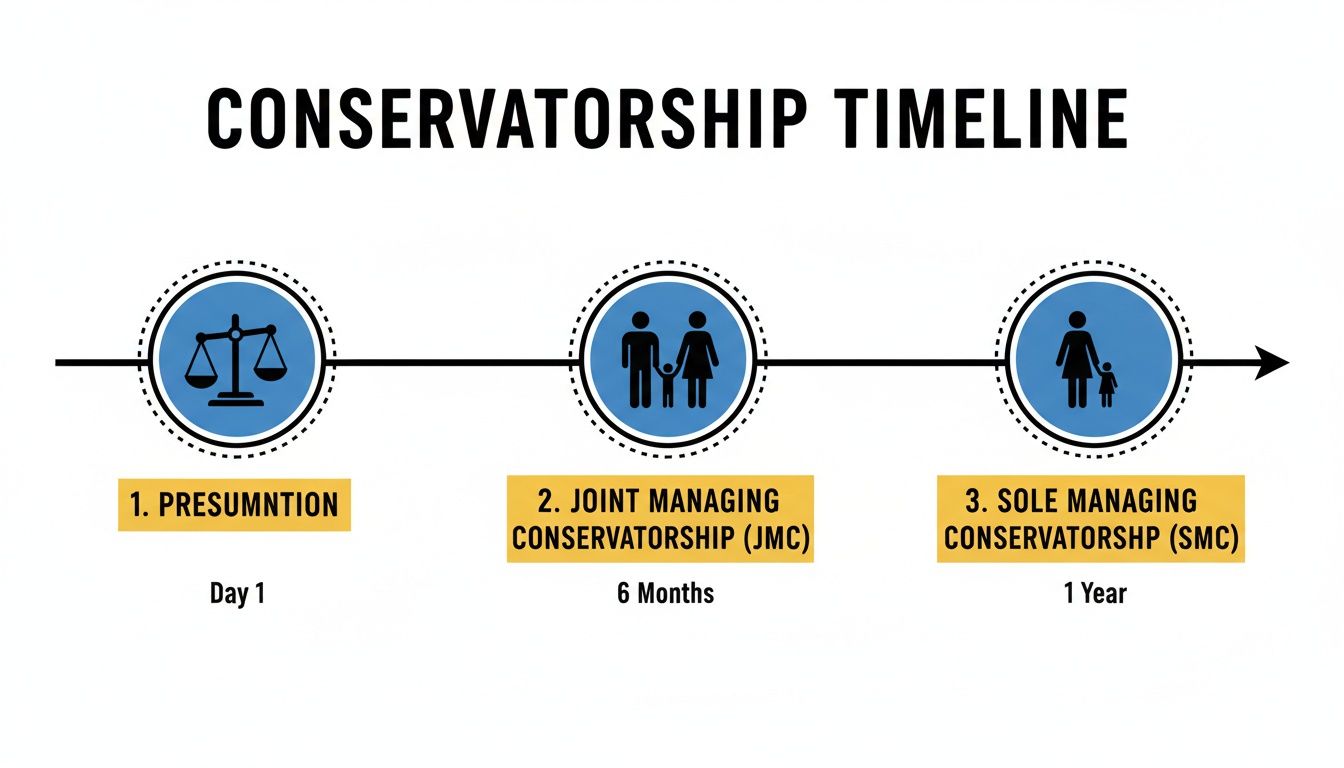
As you can see, the court's preference is Joint Managing Conservatorship (JMC), which is the most common outcome. This ensures both parents hang on to their decision-making rights.
The Rhythm of the Standard Possession Order
The SPO is designed to create a predictable rhythm for your child's life. It might look a little complicated on paper, but once you're living it, the pattern becomes second nature. It's important to know that the parent who doesn't establish the child's primary home is called the Possessory Conservator, and the SPO lays out their specific time.
Here’s the typical breakdown when parents live within 100 miles of each other:
- Weekends: The Possessory Conservator has the child on the first, third, and fifth weekends of any given month.
- Holidays: Major holidays like Thanksgiving and Christmas are split and usually alternate between parents each year. This is to make sure both parents get to build those special memories.
- Summer Vacation: The Possessory Conservator typically gets 30 days of possession in the summer, which can be taken as one block or split into smaller chunks.
While the SPO is the default, the devil is in the details. For a much deeper dive into the specifics—like pickup times, holiday schedules, and summer possession rules—you can check out our detailed guide to child visitation and Standard Possession Orders in Texas.
What if We Live Far Apart?
The law gets it—the standard schedule just doesn't work when parents live more than 100 miles apart. In those cases, the SPO is adjusted to cut down on the travel burden while maximizing parenting time.
A common tweak for long-distance parents gives the Possessory Conservator every spring break and bumps their summer possession up to 42 days. It’s a trade-off: fewer visits, but for longer stretches, which helps maintain a strong bond despite the miles.
The SPO Is a Starting Point, Not a Final Destination
This is crucial for fathers to understand: the SPO is just a baseline. You have every right to negotiate a different schedule that actually works for your family's life. If you and the other parent can agree on a custom plan, a judge will almost always sign off on it, as long as it serves the child's best interest.
Many dads we work with successfully negotiate for a 50/50 possession schedule, sometimes called an expanded possession order. This can look like adding Thursday overnights to the standard weekends or shifting to a week-on, week-off calendar.
Getting to a 50/50 schedule usually comes down to showing a judge that it’s both practical and beneficial for your child.
At the end of the day, a possession order is more than a calendar—it's the legal guarantee of your time with your child. Knowing how the SPO works is the first step in fighting effectively for the schedule that best protects your relationship.
Navigating Child Support and Your Financial Duties
When it comes to your child's future, few things are as important—or as misunderstood—as child support. Let’s clear the air: child support isn't a penalty. It’s a shared commitment to giving your child the financial stability they deserve. In Texas, the law views this as a core part of parenting, and both parents are expected to contribute.
Getting a handle on how it all works will replace that anxiety of the unknown with the confidence you need to plan for your child's future.
How Texas Calculates Child Support
Unlike other states that can feel like they require a math degree to figure out, Texas keeps its child support calculations pretty straightforward. The system is based on a set percentage of the non-primary parent's net monthly resources. The "non-primary parent" is just legal-speak for the parent who doesn't have the exclusive right to decide where the child lives—often called the Possessory Conservator.
The calculation starts with your gross income. From there, specific items like federal income taxes, Social Security taxes, and the cost of the child's health insurance are subtracted to get to your net monthly resources. Then, a simple percentage is applied based on how many kids are part of the court case.
The Texas Family Code lays out specific guideline percentages to keep support orders consistent and fair. This simple approach takes a lot of the guesswork out of the equation and helps parents know what to expect.
Here’s how those guideline percentages break down:
- 1 Child: 20% of net monthly resources
- 2 Children: 25% of net monthly resources
- 3 Children: 30% of net monthly resources
- 4 Children: 35% of net monthly resources
- 5 or more Children: 40% of net monthly resources
These are the standard starting points. A judge can move off these numbers, but only if they find that sticking to the guidelines would be unfair or inappropriate for the child or the parents in that specific situation.
A Father's Right to Receive Child Support
This is a big one, and it’s an aspect of a dad's rights that gets overlooked all the time. If you are the primary parent—the one who has the right to determine the child's residence—you have the right to receive child support from the mother. The law here is completely gender-neutral. Child support follows the child, not the parent’s gender.
This ensures your child benefits from both parents' financial resources, no matter which parent they live with most of the time. If you're the one providing the primary home, you are entitled to this financial help to cover the everyday costs of raising your child. It's that simple.
Beyond the Monthly Payment
Your financial duties as a Texas dad don't stop with the monthly support payment. The court order will almost always require both parents to pitch in on other essential expenses to make sure your child is fully covered.
These additional responsibilities nearly always include:
- Providing Health Insurance: One parent will be ordered to maintain health and dental insurance for the child. This is usually the parent who has better or more affordable access to a good plan through their job.
- Sharing Uninsured Medical Costs: Even with insurance, there are always extra costs. Parents are typically ordered to split expenses not covered by insurance, like co-pays, deductibles, and prescriptions. Most of the time, this is a 50/50 split.
Having a clear picture of these financial responsibilities from the start allows you to build a realistic budget and make sure your child has everything they need to thrive.
Steps to Modify or Enforce Your Court Orders
A court order is supposed to bring predictability and stability to your life as a dad. But let's be honest—life rarely stays the same for long. Jobs change, kids get older and have new needs, and what worked last year might feel completely unworkable today.
The good news for Texas fathers is that your custody and support orders aren't carved in stone. Think of them as living documents. They can—and should—be adapted to meet your family’s real-world needs. And when an order is being ignored, you have powerful tools to make sure it's followed. You don't have to feel powerless.
Taking Action When an Order Is Violated
There’s nothing more frustrating for a dad than being denied court-ordered time with his child. If the other parent is consistently blowing off the possession schedule, you have a potent legal remedy: filing a Petition for Enforcement.
This isn't just a formal complaint; it's you asking a judge to step in and force the other parent to follow the rules. An enforcement action can lead to several serious outcomes:
- Make-Up Parenting Time: The court can order the other parent to give you extra time to make up for the visits you were denied.
- Fines and Penalties: A judge can hit the non-compliant parent with fines for ignoring a court order.
- Attorney's Fees: The court can order the parent who violated the order to pay for your legal costs for having to drag them to court.
To make this work, you have to document everything. Meticulously track every single violation—dates, times, and any texts or emails about it. That documentation is your best ammunition.
Modifying an Order When Life Changes
Sometimes, the issue isn't that the order is being ignored. It’s that the order itself no longer makes sense for your family. A job loss, a big promotion with a totally new schedule, a move, or a major shift in your child's needs are all legitimate reasons to ask the court to change the order by filing a Petition to Modify.
To get an order modified, you have to prove to the court that there has been a "material and substantial change" in the circumstances of the child or one of the parents. This is a high legal bar, and it's there to stop people from running to court for every minor disagreement.
For instance, a dad who can prove he provides a more stable and involved home life has a very strong case for becoming the primary parent. The law cares about stability and who is actually doing the parenting—not gender stereotypes. You can discover more insights about how dads can win primary custody in Texas.
Whether you need to enforce the rights you already have or adapt your order for a new chapter in your life, the Texas legal system provides clear pathways to protect your relationship with your child.
Common Questions from Texas Fathers
Trying to figure out your rights as a dad can feel like learning a new language, and it’s completely normal to have a ton of questions. We talk to fathers across Texas every single day, and honestly, a lot of them share the same worries and uncertainties. This section cuts right to the chase with clear, direct answers to the questions we hear most often.
Can I Really Get 50/50 Custody of My Child in Texas?
Yes, absolutely. While the Standard Possession Order (SPO) is often the default starting point, Texas courts are very open to approving 50/50 schedules when it's proven to be what’s best for the child. The key is showing the judge that an equal possession plan is practical, stable, and truly benefits your child.
To build a rock-solid case for 50/50, you'll need to demonstrate a few things:
- You and the other parent live reasonably close to one another.
- You have a track record of being actively involved and sharing parenting duties.
- You can maintain a civil, cooperative co-parenting relationship.
A 50/50 schedule isn't handed out automatically, but it is a very achievable goal for dedicated, involved fathers.
What if My Child's Mother Is Keeping Them from Me?
If you have a court order for possession and she’s ignoring it, you can't afford to sit back and wait. Your next move is to file a Petition for Enforcement. This is a formal legal action that asks a judge to step in and force her to follow the order.
A judge can order make-up visitation time, hit her with fines, and even make her pay your attorney's fees. It is absolutely crucial to document every single time she denies you a visit—write down the dates, times, and save any texts or emails. The court order is your tool, and an enforcement action is how you use it.
Do I Still Have to Pay Child Support if I Lose My Job?
Yes. Your legal duty to pay child support doesn't stop just because your paychecks do. The court order stays in effect until a judge officially changes it. However, losing your job is the textbook definition of a "material and substantial change" in circumstances, which is exactly what you need to modify the support amount.
You have to file a Petition to Modify with the court immediately. A judge can only adjust your child support obligation from the date you file your petition, not retroactively for the months you were unemployed before filing. Acting fast is critical to keep unpaid support from piling up into a mountain of debt.
Does It Matter if My Name Is on the Birth Certificate?
It’s an important first step, but for unmarried fathers in Texas, having your name on the birth certificate does not automatically give you legal rights. To get enforceable rights to custody (conservatorship) and visitation (possession), you need one of two things: a signed Acknowledgement of Paternity (AOP) that has been filed with the state, or a court order that establishes you as the legal father. The birth certificate alone isn't enough to get you into a courtroom to enforce your rights.
Key Takeaways and Next Steps
Navigating Texas family law can be challenging, but understanding your rights is the first step toward protecting your role in your child's life. Remember these key points:
- Texas Law is Gender-Neutral: All decisions are based on the "best interest of the child," not the parent's gender.
- Establish Paternity: For unmarried fathers, this is the non-negotiable first step to securing any legal rights.
- Joint Conservatorship is the Norm: Texas courts presume that both parents should be involved in making major decisions for their child.
- Your Orders Can Be Changed: Life evolves, and your possession and support orders can be modified to reflect significant changes in circumstances.
The most important thing you can do is be an active, involved, and loving parent. Your dedication is the strongest asset you have. When you need to protect that relationship legally, taking informed action is critical.
If you need help with a child custody or visitation case in Texas, our experienced attorneys can guide you every step of the way. Contact The Law Office of Bryan Fagan, PLLC today for a free consultation.