
The most important evidence in a Texas custody case is usually not one dramatic document. It's a collection of dated, objective proof showing consistent, stable, loving parenting that fits the child's best interest, the standard Texas codified in 1995 and courts still analyze through the 1976 Holley v. Adams factors.
If you're reading this while staring at old text messages, school papers, or a calendar full of missed exchanges, you're not alone. Many parents walk into a custody dispute worried that the judge will decide everything based on who sounds more convincing in court. In reality, judges usually want something much more grounded. They want proof of what your child's daily life is like and which parent is meeting that child's needs in a reliable, healthy way.
That shift matters. A custody case isn't usually won by the parent with the angriest story. It's often shaped by the parent who can calmly show, day by day, "Here's how I care for my child. Here's how I keep life stable. Here's how I support school, health, routines, and the relationship with the other parent."
For mothers, fathers, grandparents, and other caregivers, that can feel both overwhelming and reassuring. Overwhelming, because details matter. Reassuring, because the strongest evidence is often already part of your real life. School pickups. Doctor visits. Homework help. Bedtime routines. Messages where you tried to solve problems instead of create them.
In plain English, when people ask what evidence matters most in a Texas custody case, the answer is this: evidence that shows who is acting in the child's best interest, not who is making the loudest accusation.
Your Child's Future Is on the Line What Do You Show the Judge
A parent often comes into a consultation with the same fear: "What if the other side says terrible things about me?quot; That fear is understandable. Custody disputes can feel intensely personal, and it's hard not to worry that the court will reduce your relationship with your child to a few tense moments or a stack of allegations.
Texas courts generally look for something steadier than that. They want to understand your child's real life. Who gets the child to school. Who notices when the child is sick. Who keeps routines stable. Who supports the child's emotional needs. Who encourages healthy co-parenting instead of pulling the child into adult conflict.
What the judge is usually looking for
Think of your evidence like a family photo album with timestamps. A single picture doesn't tell the whole story. But many dated, consistent snapshots start to reveal a pattern. In custody court, that pattern matters more than one isolated event unless safety is involved.
Useful proof often includes things like:
- Daily involvement records: calendars, parenting logs, exchange notes, and appointment reminders
- School-related proof: attendance information, report cards, teacher emails, and records showing who participates
- Health-related records: doctor, dental, counseling, or therapy records showing follow-through
- Communication history: texts and emails that show cooperation, planning, and child-focused decisions
- Home stability evidence: proof that the child has a safe, steady place to live and predictable routines
A judge usually isn't asking, "Which parent is perfect?quot; The real question is, "Which arrangement best supports this child?quot;
Why worried parents often focus on the wrong thing
Parents under stress tend to collect evidence like they're building a case against the other parent. Sometimes that's necessary, especially when safety is an issue. But many people miss the stronger point. You also need to build a picture of your own parenting.
That means showing more than complaints. Show habits. Show follow-through. Show your child's ordinary life in your care.
If you're a father worried that your role has been overlooked, documentation can help show the court your actual involvement. If you're a mother carrying most of the daily responsibilities, records can help make that invisible labor visible. If you're a grandparent or caregiver stepping in during instability, your records may help explain the child's routine and support system.
Custody language in plain English
A few Texas terms help to know early:
- Best interest of the child: the guiding rule the court uses to decide what arrangement helps the child most
- Joint managing conservatorship: a legal term that often means both parents share important rights and duties, even if one parent has greater authority in certain areas
- Possession schedule: the court-ordered schedule for when each parent has time with the child
Those words can sound formal, but the underlying issue is simple. The court wants a practical plan that protects the child and supports healthy development.
The Guiding Principle Best Interest of the Child in Texas
Texas custody decisions are guided by the child's best interest, a standard codified in 1995 in Texas Family Code § 153.002, and courts commonly evaluate evidence through the 1976 Holley v. Adams factors, which remain foundational in custody cases, as discussed in the Texas Bar's explanation of the best-interest standard.
That legal phrase can sound vague at first. Parents often ask, "What does best interest mean?quot; In plain language, it means the court is trying to decide what living arrangement, decision-making structure, and possession schedule will most protect the child's emotional, physical, and developmental needs.
A helpful way to think about it is this: the judge is not grading your personality. The judge is reviewing whether the evidence shows a stable, safe, child-focused home life.
For a closer look at how courts frame that issue, this guide on how to prove best interest of child can help connect the legal standard to practical evidence.
Here is the big picture many parents need to see visually:
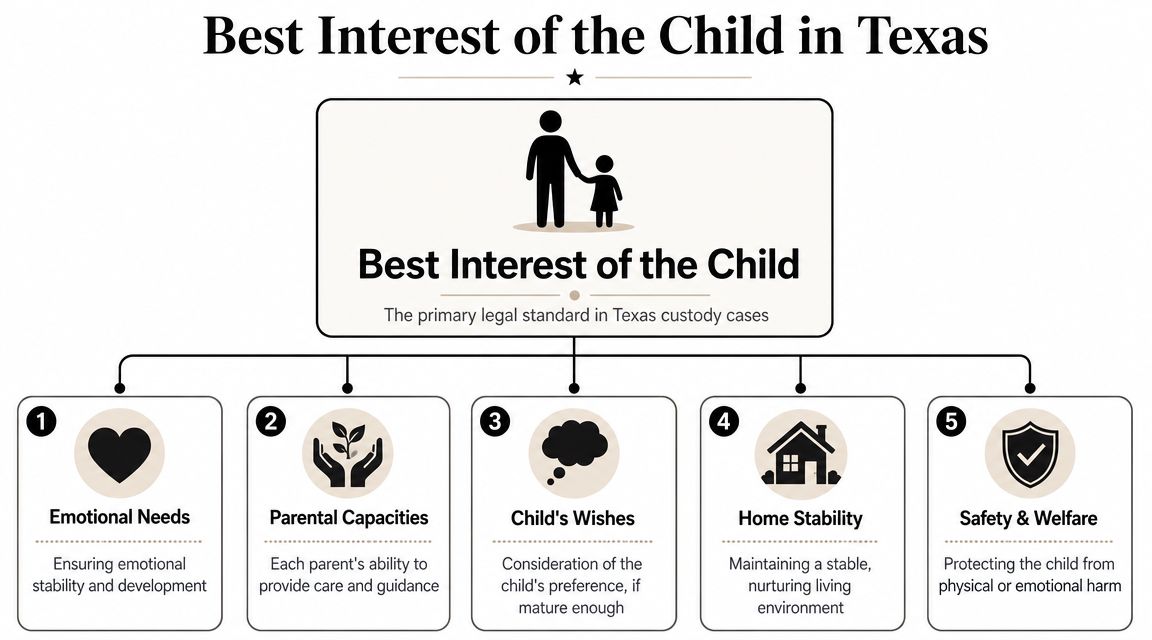
The Holley factors in plain English
The Holley factors are not a rigid checklist where every box must be filled. They are more like lenses the court uses to view the facts. They often include concerns such as:
- Emotional needs: Does the child have support, comfort, attention, and healthy guidance?
- Physical needs: Is the child fed, supervised, taken to appointments, and cared for consistently?
- Parental abilities: Which parent shows sound judgment, follow-through, and day-to-day parenting skill?
- Home stability: Is the home steady, safe, and predictable?
- Safety concerns: Is there documented violence, substance abuse, dangerous behavior, or serious conflict affecting the child?
A related question may involve the child's preferences if the child is mature enough, but that is only one part of the larger picture.
Why the "why" behind each document matters
Many parents gather papers without knowing how those papers help the case. That creates stress and wasted effort. A better approach is to ask one question about every item: What best-interest factor does this prove?
For example:
- A school attendance record may help show routine and stability
- A medical record may show follow-through with healthcare
- A string of respectful co-parenting texts may show parental judgment and cooperation
- Photos of a tidy bedroom alone may mean little, unless they help prove a safe and prepared home
Practical rule: Don't just collect documents. Match each document to a custody issue the judge cares about.
This short video gives another accessible overview of how Texas courts think about custody:
What this means for joint managing conservatorship and possession schedules
Parents often hear that Texas favors joint managing conservatorship and assume that means everything is split evenly. Not necessarily. In many families, both parents may share rights and duties, but the court can still assign one parent the right to decide the child's primary residence or shape a possession schedule differently based on the evidence.
That's why the best-interest standard matters so much. It influences not only who gets what authority, but also how the child's schedule is structured and how the court evaluates future modifications.
Proving Your Stability and Parental Fitness
In Texas custody litigation, the strongest evidence is often contemporaneous, behavior-based documentation tied to the child's best-interest analysis, and preserved texts and emails can be more persuasive than later summaries because they show frequency, consistency, and who handled specific parenting tasks, as explained in this discussion of gathering evidence for a Texas custody case.
That matters because a judge is usually trying to see patterns, not polished speeches. If one parent says, "I always help with school," and the other says, "No, you don't," a dated record is much more useful than a memory offered months later in court.
The evidence you can start building today
Some of the most persuasive proof is in your control. You don't need to wait for a court date to start organizing it.
A strong parenting record often includes:
- A parenting log: note exchanges, pickups, bedtime routines, homework help, appointments, and major child-related events
- A calendar: mark school functions, extracurricular activities, doctor visits, and which parent attended
- Saved messages: preserve texts, emails, and co-parenting app messages that show requests, confirmations, and problem-solving
- Expense records: keep receipts for child-related needs when they help show ongoing involvement
- Routine notes: record things like tutoring, medication reminders, and efforts to keep consistency during your parenting time
The key is timing. Records made close to the event carry more weight than a notebook you try to recreate all at once later.
What good documentation sounds like
Parents sometimes turn their records into arguments. That usually weakens them. Judges tend to trust neutral descriptions more than emotional commentary.
Compare these two examples:
- "Other parent was selfish and irresponsible again."
- "Pickup was scheduled for 6:00 p.m. Child was not picked up. I sent a follow-up text at 6:20 p.m. asking whether there was a delay."
The second version is stronger because it gives facts the court can evaluate.
Keep your records like a nurse charting symptoms, not like a friend venting after a bad day.
Communication can prove more than people realize
Texts and emails are not just evidence of conflict. They can also show maturity. If your messages stay focused on school, health, scheduling, and the child's needs, they may help prove that you're acting like a parent the court can trust.
That includes messages where you:
- Offer practical solutions: proposing makeup time or schedule adjustments
- Share important updates: sending school or medical information promptly
- Stay calm under pressure: refusing to escalate arguments in writing
- Encourage the child's relationship with the other parent: when safe and appropriate
This is especially important for both mothers and fathers in contested cases. Sometimes one parent has done a great deal of daily work but never documented it. Sometimes a very involved parent gets unfairly painted as absent because there is no organized record. A detailed, steady file can correct both problems.
Small habits that build a strong picture
You don't need perfect records. You need believable ones. A simple digital folder system, a paper binder, or a co-parenting app can work if you use it consistently.
If you're trying to answer what evidence matters most in a Texas custody case, this category belongs near the top. It shows your own conduct. It turns your daily parenting into proof the court can use.
Using Official Records to Corroborate Your Case
Objective third-party records from schools, healthcare providers, and police often carry serious weight because they reduce the court's need to choose between competing stories, and school reports can reflect stability while medical records can show whether a parent consistently meets healthcare needs, as described in this overview of what evidence to bring to Texas family court.
That's why official records often feel less emotional in court. They aren't usually created for litigation. They exist because a school tracked attendance, a dentist charted treatment, or a provider documented care. That neutrality can make them powerful.
Why judges often trust third-party records
If you tell the court, "My child was constantly late when the other parent had school mornings," that may or may not be true. But if attendance records, tardy notices, and teacher communications line up with that concern, the issue becomes much clearer.
The same logic applies to health and safety. A parent's claim that a child missed appointments or wasn't receiving care becomes more persuasive when a provider's records back it up.
Here's a simple way to think about it: your own log tells the story from your seat. Third-party records show what the outside world saw.
Mapping evidence to best interest factors
| Evidence Type | Holley Factor It Supports |
|---|---|
| Child's report card | Emotional and developmental needs, parental involvement |
| School attendance record | Stability, routine, day-to-day supervision |
| Teacher emails | Parental abilities, communication, school engagement |
| Medical records | Physical needs, follow-through with healthcare |
| Dental records | Basic care, consistency, parental responsibility |
| Police report or protective order | Safety and welfare |
| Employment schedule or employer letter | Ability to provide consistent caregiving arrangements |
| Photos tied to a specific event | Corroboration of a custody-relevant issue |
Which records are often worth requesting
Different families need different records, but these are commonly useful:
- School records: attendance, report cards, behavior notes, teacher communication
- Healthcare records: pediatric, dental, counseling, therapy, medication records
- Safety documents: police reports, protective orders, incident reports
- Work-related proof: schedules or letters that help explain availability and caregiving arrangements
A practical example helps. If your child struggled after frequent schedule disruptions, school attendance and teacher notes may help connect those disruptions to the child's daily functioning. If your child has a medical condition, provider records may help show which parent regularly managed treatment.
A caution about photos and videos
Photos and videos can help, but they usually work best when they support a specific point. A video of a child happily eating dinner at your house may not prove much by itself. A date-specific photo showing the child's sleeping area, medication setup, or condition after a missed exchange may be more relevant if it ties directly to a best-interest issue.
What makes evidence stronger is not drama. It's connection. The closer the record is to a real parenting question, the more useful it becomes.
The Role of Witnesses and Expert Testimony
People can be evidence too. In some custody cases, a witness helps confirm what the documents already show. In others, an expert helps the court understand a child's needs, family dynamics, or safety concerns in a more structured way.

Fact witnesses and what makes them useful
A fact witness testifies about what that person directly saw, heard, or observed. Good examples may include a teacher, coach, neighbor, family friend, relative, daycare worker, or healthcare provider.
The strongest fact witnesses usually have three qualities:
- Personal knowledge: they saw the events themselves
- Neutral tone: they don't sound coached or overly invested in attacking one parent
- Specific examples: they can describe actual incidents, routines, or concerns
A witness who says, "She's a wonderful mother" may not help much. A witness who says, "I saw her at parent conferences, school pickups, and medical follow-ups over the school year" is more useful because the testimony is concrete.
Expert witnesses and when they matter
An expert witness offers professional opinion, not just personal observation. In higher-conflict cases, psychological evaluations, custody evaluations, or therapist input may become important. If you're trying to understand how professional assessment fits into a family case, PPA's expert evaluations provide a helpful overview of how expert testimony can be used in legal settings.
Some families also encounter a guardian ad litem, a person appointed in some cases to represent the child's best interests. If that term is new to you, this article on what is a guardian ad litem explains the role in plain language.
A credible witness doesn't need to be dramatic. The best testimony is often calm, specific, and easy to verify.
How to prepare without over-preparing
Parents sometimes make the mistake of trying to script a witness. That can backfire. A better approach is to make sure the witness understands the issues, reviews relevant dates if needed, and stays within what they know.
Helpful witness preparation usually means:
- Clarifying the timeline: so the witness remembers when events happened
- Sticking to firsthand knowledge: no guessing, no repeating rumors
- Keeping the child central: testimony should relate to caregiving, safety, routine, or development
- Avoiding exaggeration: overstatement hurts credibility fast
Witnesses are often most effective when they support, rather than replace, your documents. If the records show school involvement and the teacher confirms your participation, your case becomes more coherent. If the records raise safety concerns and a neutral witness observed the same issue, the court has less reason to see the case as just one parent's accusation against the other.
How to Gather and Preserve Your Evidence
Strong evidence can lose value if it's disorganized, incomplete, or mishandled. Parents sometimes have useful proof but can't find it, can't show when it was created, or accidentally damage their credibility by editing screenshots, mixing dates, or posting too much on social media.
A good system doesn't need to be fancy. It needs to be clear, consistent, and easy to explain.
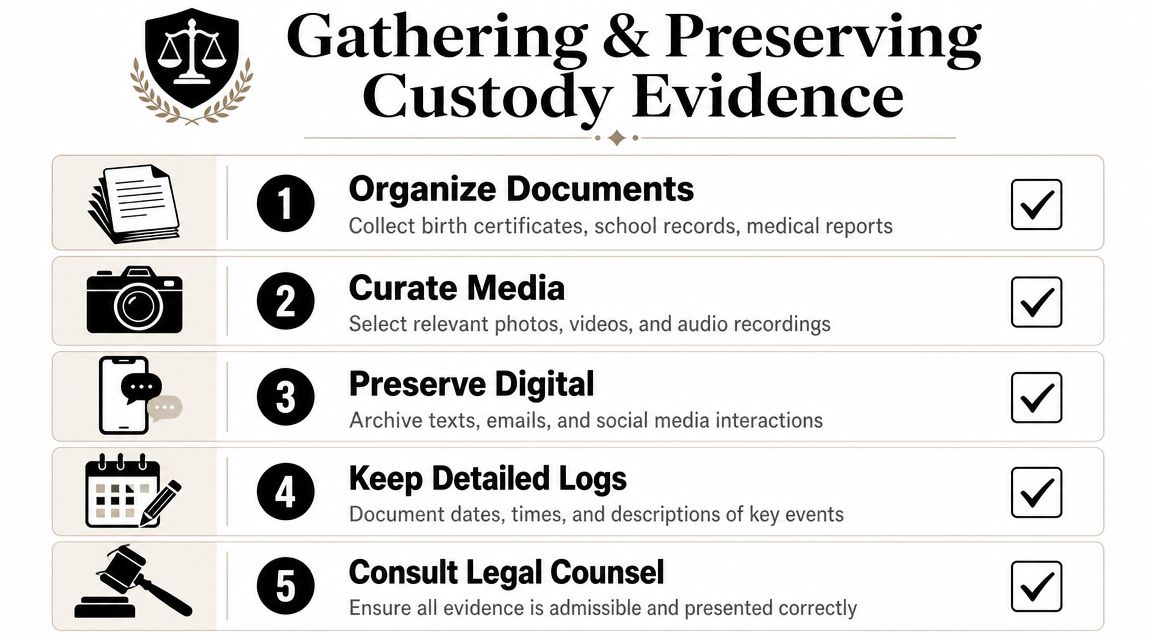
A practical way to organize your file
Start by separating evidence into categories instead of storing everything in one place.
A simple structure may look like this:
- Communications folder for texts, emails, co-parenting app exports, and written notices
- Child records folder for school, medical, dental, therapy, and activity documents
- Parenting log folder for calendars, exchange notes, and daily care records
- Incident folder for missed visits, denied access, safety concerns, or major disruptions
- Court prep folder for the most important documents you may use at a hearing
Many parents use cloud storage plus a paper binder for the most important records. Others work with counsel to build a hearing notebook. One practical option for case preparation is working with a Texas family law firm such as The Law Office of Bryan Fagan, PLLC, which handles custody, visitation, enforcement, and modification matters.
What to preserve and how
Digital evidence is often where important details live, so preservation matters. Save full screenshots when needed. Keep emails in their original format. Export app conversations when possible. Record dates carefully in your own logs.
If you're preparing for court, this guide on how to prepare for a custody hearing can help you think through presentation and organization.
A useful comparison comes from outside family law. In other fields, people use research methods to locate and verify hard-to-find information. For example, this explanation of how real estate investors use skip tracing shows how organized data gathering can help locate people and confirm details. In custody cases, the lesson is similar. Accuracy and documentation matter.
Mistakes that can hurt your case
Some errors create much bigger problems than parents expect:
- Editing or rewriting old evidence: if a screenshot looks altered, the court may question all of it
- Recording without legal advice: privacy issues can be serious, especially if a recording involves people who didn't consent or conversations you weren't part of
- Posting online: angry social media posts can undermine the calm, child-focused image you need to present
- Saving only the bad moments: courts often want a broader pattern, not a pile of isolated attacks
- Ignoring backup copies: phones break, accounts lock, and files disappear
Preserve first, interpret later. Save the original version before you summarize or discuss it with anyone.
A neat file won't win your case by itself. But a scattered file can make a strong case harder to prove.
Next Steps and When You Need an Attorney
If you take one idea from this article, let it be this: the court is usually looking for patterns of parenting, not isolated claims. The evidence that matters most is the proof that connects your child's real daily life to the best-interest factors Texas courts care about.
That means focusing on three things:
- Consistent documentation: records made close in time to the events
- Objective support: school, medical, and other third-party documents
- Clear connection to the child: evidence should show why the fact matters for stability, safety, or development
When handling it alone becomes risky
Some custody disputes are manageable with careful preparation. Others become too high-stakes to handle without legal help.
You should strongly consider speaking with an attorney if:
- Abuse or family violence is alleged
- Substance abuse or serious mental health concerns are part of the case
- The other parent already has a lawyer
- You are facing a modification request
- There are relocation or interstate issues
- A guardian ad litem, evaluator, or expert is involved
- You are accused of interfering with possession or violating court orders
In those cases, evidence isn't just about collecting records. It's about knowing what to request, how to present it, how to respond to accusations, and how to avoid mistakes that can change the outcome.
Key takeaway
The best evidence usually tells a simple, believable story: this child is cared for, this parent is involved, and this plan serves the child's needs.
If you're feeling overwhelmed, that's normal. Most parents don't walk into family court with a legal background. But you can take the next right step. Start preserving records. Stay child-focused. Get advice early when the situation is complicated.
If you need help with a child custody or visitation case in Texas, our experienced attorneys can guide you every step of the way. Contact The Law Office of Bryan Fagan, PLLC today for a free consultation.