
When your child's future is on the line, understanding your rights matters most.
If you're waiting for a final custody hearing in Texas, you may be carrying a mix of fear, frustration, and exhaustion. Most parents I talk to aren't just worried about the courtroom. They're worried about school mornings, bedtime routines, holidays, doctor visits, and whether the judge will really understand what their child needs.
That concern is completely normal. A final hearing matters because it is where the court can issue the final order that decides conservatorship, possession and access, child support, and other long-term issues that shape daily family life. In plain English, this is often the hearing where the judge turns months of conflict, paperwork, and temporary arrangements into a binding set of rules for the future.
For many parents, the hardest part is not knowing what happens at a final custody hearing in Texas. They know it's important, but they don't know what the judge will ask, when witnesses speak, how evidence gets used, or whether the hearing will be quick or feel like a trial.
That uncertainty can make everything feel worse.
The good news is that a final hearing follows a structure. Once you understand the process, the legal standard, and your role in the room, the hearing becomes less mysterious and more manageable. You can prepare with purpose instead of panic.
Your Final Custody Hearing A Guide for Texas Parents
It is 8:43 a.m. You are sitting on a hard bench outside a Texas courtroom, holding a folder that suddenly feels too thin or too full. Your child is at school, the other parent is down the hall, and in a few minutes the judge may decide where your child lives, who makes major decisions, and what your family's routine looks like from here on out.
That is what makes a final custody hearing feel so heavy. It takes the temporary structure your family has been living under and turns it into a binding order the court expects everyone to follow.
For many parents, the biggest fear is not only the outcome. It is the mystery of the process. They do not know whether the hearing will move quickly, who speaks first, what the judge pays attention to, or how much those earlier temporary orders already shaped the road ahead.
A final hearing works a lot like the closing chapter of a long story. The judge is not walking in cold. By this point, the court has often seen temporary orders, heard prior disputes, and watched how each parent handled the case under stress. That is one reason temporary orders matter more than many parents realize. They often create the day-to-day pattern the court will measure against when deciding what should continue and what should change.
Texas courts decide conservatorship and possession issues under the best interest of the child standard in Texas Family Code §153.002. In plain English, the judge is asking a practical question: what arrangement gives this child the strongest chance at stability, safety, and healthy development?
What the hearing is really designed to decide
Parents often use the word custody, but Texas courts break that idea into separate parts. That distinction matters because two parents can both love their child and still disagree about very different legal issues.
A final order often covers:
- Conservatorship, meaning each parent's rights and duties, including who can make major decisions
- Possession and access, meaning the parenting-time schedule
- Child support, meaning financial support for the child
- Specific ground rules, such as exchange locations, school enrollment, counseling, travel, or limits on decision-making authority
The judge is building a legal framework for ordinary life. School pick-ups. Summer vacations. Doctor appointments. Bedtime on a Thursday.
That is why evidence about daily parenting usually matters more than dramatic accusations standing alone.
Why the process feels harder than it should
Texas family law has its own vocabulary, and that can make a stressful day feel even more confusing. A parent may hear terms like joint managing conservatorship or possession and access and wonder whether they mean something different from the word custody. Usually, they are more precise labels for the pieces of custody the court is deciding.
Here is a plain-English guide:
| Texas term | What it usually means |
|---|---|
| Joint managing conservatorship | Both parents share certain rights and duties |
| Sole managing conservatorship | One parent has more exclusive decision-making authority |
| Possession and access | When the child spends time with each parent |
| Final order | The binding court order that controls after the case ends |
If you are feeling unsure, that is normal.
The good news is that final hearings follow a courtroom structure, and that structure can be learned. If you want a stronger foundation before hearing day, this guide on how to prepare for a Texas custody hearing can help you understand what to gather and how to present your concerns clearly.
How to Prepare for Your Final Hearing
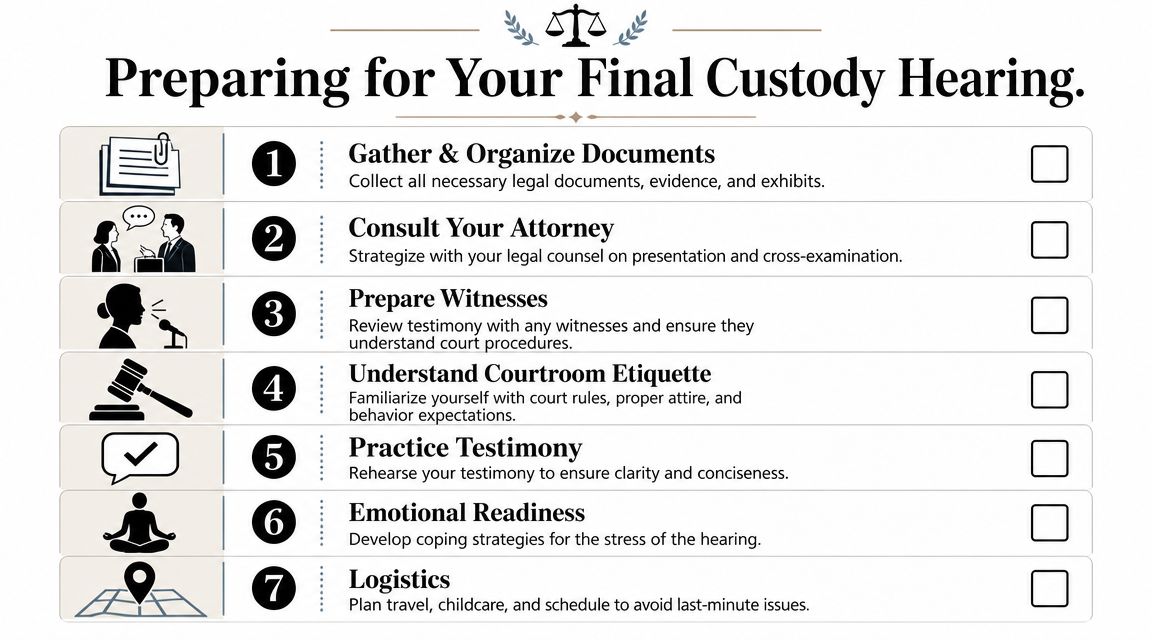
Preparation for a final hearing starts long before you walk into the courthouse. It begins with how you've handled the case from the moment temporary orders were entered, or from the moment conflict over the child became serious.
One of the biggest misunderstandings in Texas custody cases is thinking the final hearing is where the case begins. In reality, many important issues are shaped much earlier. Texas family law practitioners report that only 5% to 10% of custody cases go to final trial, which means the status quo created by temporary orders often carries enormous weight, as explained in this discussion of final trials in Texas custody cases.
What to gather before the hearing
Good preparation is less about creating a dramatic story and more about building a reliable record. Judges tend to trust specific, organized proof over general complaints.
Bring your lawyer the material that helps show your day-to-day parenting:
- School records: report cards, attendance notes, teacher communications
- Medical information: appointment records, prescriptions, therapy recommendations if relevant
- Parenting communications: texts, emails, co-parenting app messages
- Your parenting log: a calendar of exchanges, missed visits, school events, and care duties
- Photos or documents with context: not random screenshots, but items tied to a clear issue
- Proposed schedule details: a workable plan for school weeks, weekends, holidays, and transportation
If you want more practical planning ideas, this Texas custody hearing preparation guide can help you organize the basics.
Choosing witnesses carefully
Not every supportive person should testify. The best witness is usually someone who has direct, specific knowledge of your parenting or your child's needs.
That may include:
- Teachers who can describe attendance, homework support, or communication
- Family members if they've personally observed regular care, not just heard about it
- Doctors or counselors when their testimony is relevant and admissible
- Child-related professionals who can speak to routine, needs, or observed behavior
A witness who says “she's a great mom” or “he loves his kid” is less helpful than one who says, “I saw him handle school pickup, speech appointments, and homework every week.”
Your conduct during the case matters
Parents often focus on the hearing date and overlook the months before it. But courts notice patterns. Are you following temporary orders? Are you supporting the child's routine? Are you communicating reasonably? Are you showing up?
The strongest custody case usually looks steady, child-focused, and consistent long before the judge takes the bench.
If you're a father, don't assume the court will discount your role. If you're a mother, don't assume past caregiving automatically decides the future. Texas judges look for proof, stability, and follow-through from both parents.
The Best Interest of the Child Standard in Texas
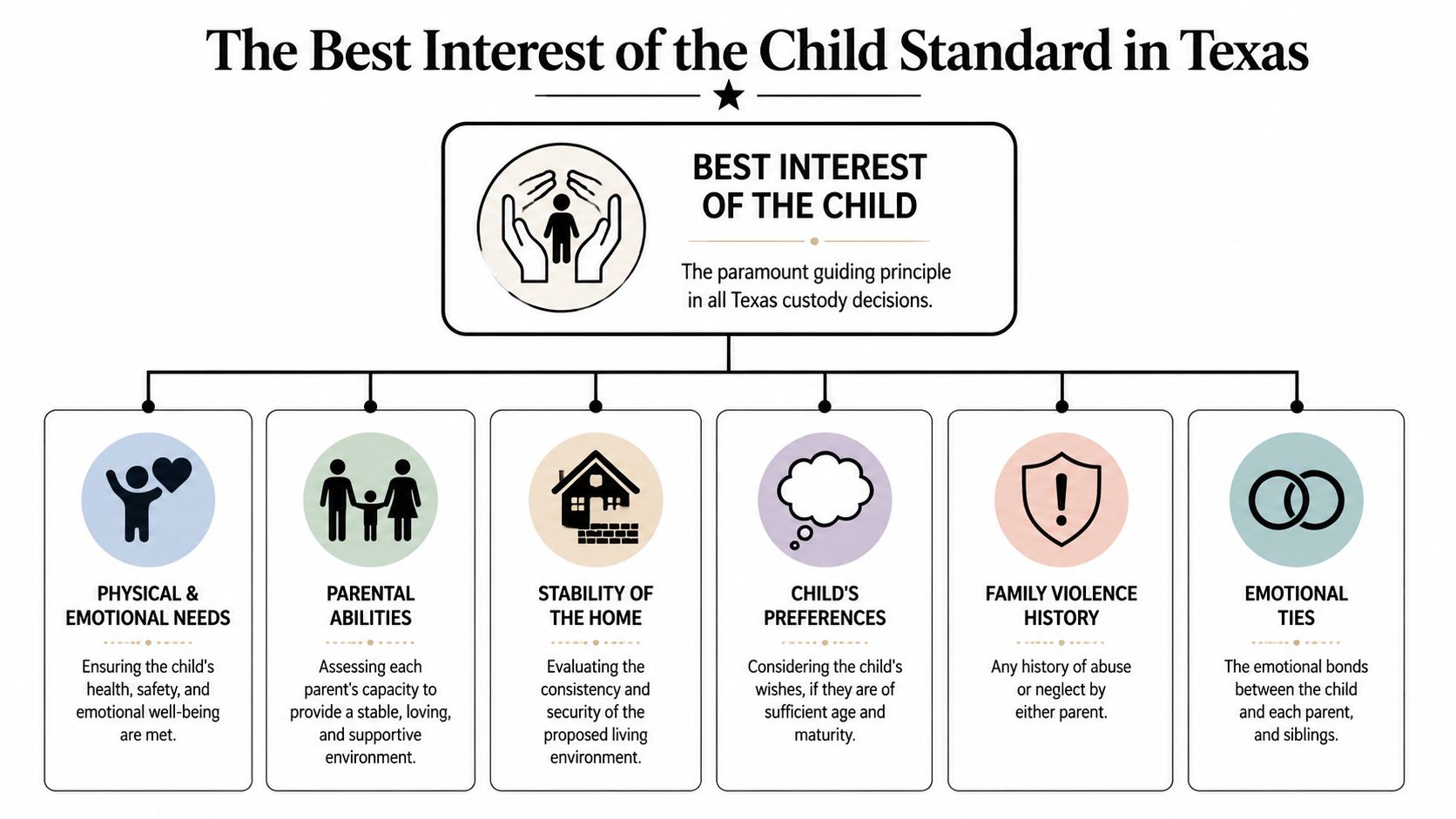
The phrase best interest of the child sounds broad because it is broad. But in practice, it gives the judge a framework. The court is asking one central question: what arrangement is most likely to protect this child's well-being, stability, and healthy development?
Texas law makes that standard the guiding rule in custody decisions. Judges also often look to the Holley factors, which are practical considerations such as the child's needs, each parent's abilities, the stability of each home, and any danger, misconduct, or poor judgment affecting the child.
Questions a judge may be answering
The judge may not ask these questions out loud, but they often sit underneath the evidence:
- Who has been meeting the child's daily needs?
- Which home offers more consistency?
- How well does each parent make decisions for the child?
- Is either parent creating unnecessary conflict or risk?
- What arrangement helps the child stay safe, supported, and connected?
This is why small details can matter. School attendance. Medical follow-up. Homework. Transportation. Communication. Reliability.
Best interest is not about gender
Texas custody law does not use an automatic rule favoring mothers or fathers. Recent data shows Texas fathers receive about 33% of custody time, or about 120.5 days per year, while the national average for fathers is about 35%. The same source notes that Texas courts may consider a child's preference once the child is 12 or older, which can influence conservatorship decisions. Those figures appear in this Texas family law statistics overview.
That matters for both parents.
A father should come prepared to show involvement, caregiving history, and a realistic parenting plan. A mother should come prepared to show those same things. The court is looking for substance, not assumptions.
For a closer look at how judges evaluate these issues, review these best-interest considerations in Texas custody cases.
A plain-English way to think about it
If you feel overwhelmed by legal terms, use this simpler lens:
| Factor | Plain-English meaning |
|---|---|
| Child's needs | What does this child need emotionally, physically, and educationally right now? |
| Parental abilities | Which parent has shown sound judgment and dependable care? |
| Home stability | Which home is more predictable and secure? |
| Danger or misconduct | Is there violence, neglect, substance abuse, or serious instability? |
| Child's preference | If the child is old enough, does the child have a view the court should hear? |
A judge isn't trying to reward the better argument. The judge is trying to make the safest and most workable decision for the child.
Inside the Courtroom A Step-by-Step Walkthrough
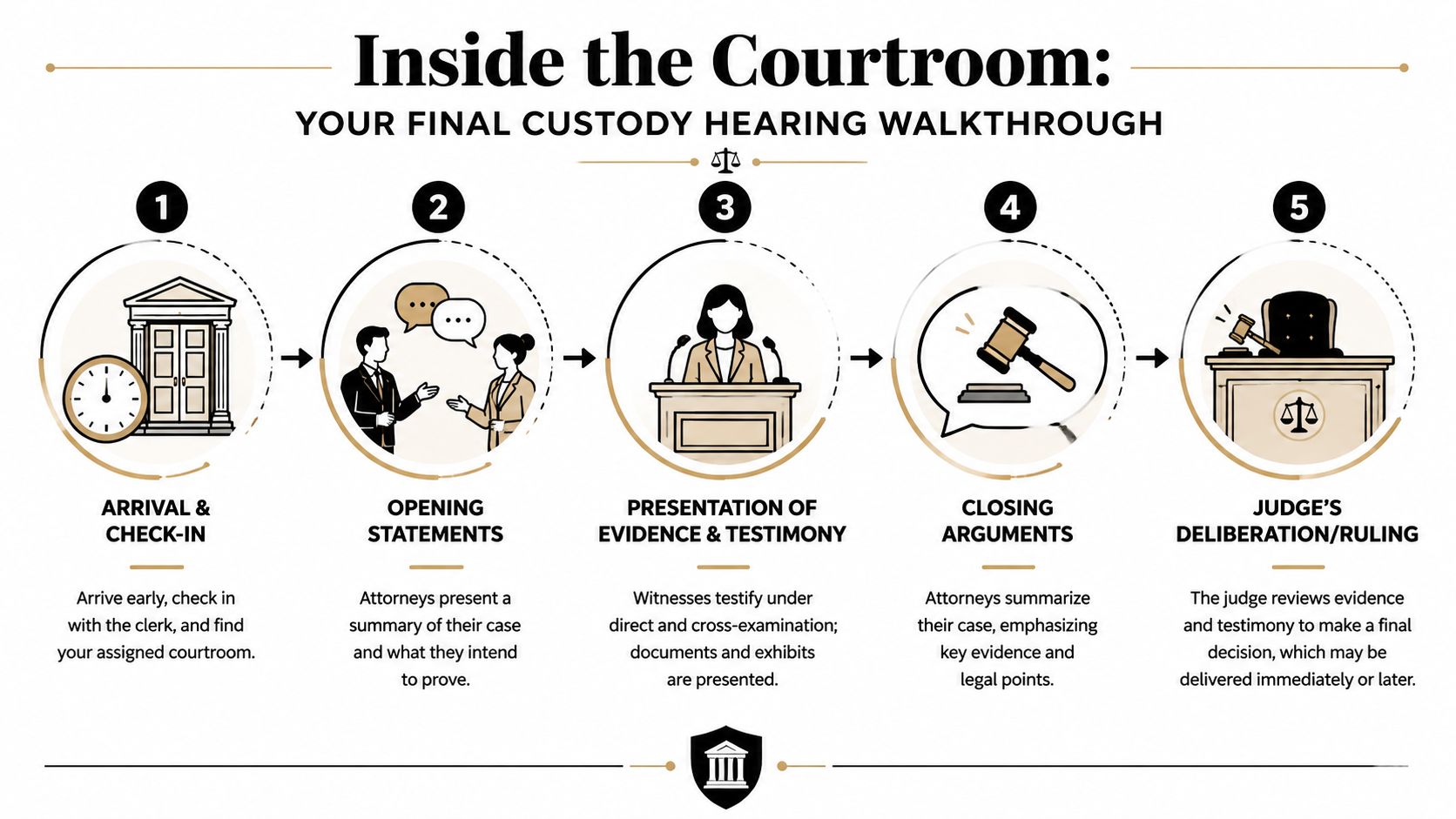
A contested final hearing in Texas usually works like a simplified bench trial. The judge listens to testimony, reviews documents, and evaluates credibility before making a decision. Both parents can be cross-examined, and witnesses may include teachers, doctors, family members, or other people with firsthand knowledge. Parties must receive at least 45 days' notice before the final hearing, according to this overview of final custody hearing procedure.
When your case is called
You and your lawyer will usually wait in or near the courtroom until the judge calls the case. The bailiff helps maintain order. The court reporter creates the record. The judge controls the hearing, rules on objections, and decides what evidence comes in.
At the beginning, the judge may confirm who is present, whether the case is contested, and how much time each side has. If there are agreed issues and disputed issues, the court may identify them early.
Opening statements
Some judges allow brief opening statements. These aren't evidence. They are short summaries of what each side expects the testimony and documents to show.
A simple opening might sound like this: one parent asks the court to keep a stable school routine, preserve the child's medical care, and enter a possession schedule that reflects the parent's actual involvement.
Testimony and exhibits
The parent who goes first presents testimony through direct examination. That usually means their lawyer asks questions first. Then the other lawyer cross-examines.
The pattern often looks like this:
- Parent testifies on direct examination
- Other side cross-examines
- Additional witnesses testify
- Documents or exhibits are offered into evidence
- The other side presents its own case
- Rebuttal may happen if needed
The courtroom can feel intense during cross-examination because the lawyer is testing details, memory, and consistency. If you want to understand that process better, this guide to effective questioning offers a useful plain-language overview of how cross-examination is designed to probe credibility.
Here's a short video that can help you picture the hearing environment before your court date:
What the judge is watching
Judges listen to words, but they also watch how facts hold together. They often notice whether testimony is specific, whether exhibits support the claim being made, and whether a witness appears evasive or calm under pressure.
Common courtroom roles include:
- Judge: decides legal issues and final orders
- Attorneys: question witnesses, offer exhibits, make objections
- Court reporter: records the testimony
- Bailiff: handles courtroom order and logistics
- Witnesses: provide firsthand information
Credibility often turns on details. A parent who can calmly explain dates, routines, and decisions usually comes across as more reliable than one who speaks in accusations and generalities.
Closing argument and ruling
At the end, each lawyer may give a closing argument. During this, the evidence gets tied back to the legal standard. The lawyer explains why the facts support a certain order.
Sometimes the judge rules from the bench. In other cases, the judge takes the matter under advisement and signs the final order later. Either way, this is the point where months of preparation come into focus.
Your Role in the Courtroom on Hearing Day
On hearing day, you can't control every question, every objection, or the other parent's testimony. You can control how you present yourself. That matters more than many people realize.
Start with the basics. Dress neatly and conservatively, like you're going to an important job interview. Arrive early. Bring your documents, a notepad, and anything your lawyer told you to have ready. Silence your phone before you step into the courtroom.
How to act in the room
Courtroom etiquette is simple but important.
- Stand when appropriate: if the judge enters and the courtroom stands, stand too
- Address the judge respectfully: “Your Honor” is the safe choice
- Don't interrupt: not the judge, not the lawyers, not the other parent
- Don't react visibly: eye-rolling, scoffing, or head-shaking can hurt you
- Speak clearly: answer the question asked, then stop
If you're asked a hard question, pause before you answer. That short pause can help you stay calm and avoid saying more than necessary.
How to answer questions well
The best testimony is usually truthful, direct, and concise. Parents get into trouble when they try to argue with the question, add unnecessary speeches, or guess when they don't know.
A few habits help:
| Situation | Better response |
|---|---|
| You don't know | “I don't know” |
| You don't remember exactly | “I don't recall” |
| The question is misleading | Answer the truthful part, then stop and let your lawyer object if needed |
| You feel attacked | Stay calm and answer only what was asked |
Setting realistic expectations
The length of the hearing depends a lot on whether the case is agreed or disputed. In Texas, an uncontested final hearing can take about five minutes, while contested hearings may be allotted 20 to 90 minutes per side, as described in this Texas final hearing timing guide.
That difference matters emotionally. A short agreed hearing usually focuses on paperwork and the judge's basic questions. A contested hearing demands patience, focus, and trial-level preparation.
If you become emotional, that doesn't mean you've failed. Custody cases are personal. What helps is returning to the same steady message: your child's needs, your parenting history, and the practical order you're asking the court to enter.
Potential Outcomes and Your Final Custody Order
When the hearing ends, many parents expect the hard part to be over. In reality, one of the most important parts is the written order itself. The judge's ruling has to be turned into precise legal language, and that language becomes the rulebook for everyday parenting.
This catches parents off guard. They remember what the judge said in court, but later run into problems because the signed order says something more specific, or leaves out a detail they assumed was included. In Texas custody cases, wording matters.
What the final order usually decides
A final Texas custody order usually answers three big questions: who makes major decisions, when the child is with each parent, and how the child's financial support will be handled.
Conservatorship
Conservatorship covers parental rights and duties. It answers who can make decisions about medical care, schooling, counseling, and, in many cases, who has the right to decide the child's primary residence.
Many parents are appointed joint managing conservators. That means both parents keep important legal rights, but it does not guarantee equal parenting time. One parent may still have the exclusive right to make certain decisions.
In some cases, the court appoints one parent as sole managing conservator. That gives one parent broader decision-making authority. Judges usually reserve that outcome for cases where the evidence shows shared decision-making would not protect the child's welfare.
Possession and access
Possession and access is the schedule. It spells out weekends, weekdays, holidays, summer periods, pickup times, drop-off times, and sometimes transportation rules.
The order may use a Standard Possession Order, an expanded version of that schedule, or a custom plan built around the child's age, school routine, distance between homes, and the parents' ability to cooperate. A schedule on paper can look simple. Living by it is another matter. That is why judges often give serious weight to the routine already working under temporary orders. If a temporary schedule has been stable, practical, and good for the child, that history can shape the final result more than many parents expect.
Child support
The final order often addresses child support, medical support, and health insurance. These terms are part of the same case because the court is trying to create a workable long-term structure for the child, not just decide where the child sleeps.
Temporary orders often shape the final outcome
Parents sometimes treat temporary orders as a placeholder. Courts often see them as a live test run.
If a temporary arrangement has been in place for months, the judge has a real-world example of how the family functions under that structure. Who got the child to school on time? Who followed the exchange schedule? Who kept conflict low? Those facts can carry more weight than a last-minute promise that things will be different after trial.
That does not mean temporary orders always become final orders. It does mean they matter. A lot.
What this means in daily life
Your final order reaches into ordinary moments. It decides whose house the child wakes up in on school mornings, who can authorize counseling, how Christmas is divided, and what happens if one parent wants to move.
That is why careful review matters before the order is signed. If a term sounds vague, ask for clarification. If pickup times, holiday language, or decision-making rights are missing, the problem can follow you long after the hearing ends.
If you need help understanding the paperwork after court, this step-by-step guide to obtaining a copy of your final custody order in Texas can help.
If your case involved legal counsel, that may include private firms, legal aid, or a family law practice such as the Law Office of Bryan Fagan, PLLC, which handles Texas custody, visitation, support, and modification matters. The important point is simple. Do not rely on memory. Rely on the signed order and its exact wording.
What Happens After the Judge Makes a Ruling
The hearing may be over in a matter of minutes, but the judge's ruling keeps working long after everyone leaves the courtroom. Once the final order is signed, it becomes the written set of rules for your family. It controls daily life, school-year routines, holidays, decision-making, support, and exchanges until a court changes it.
That last part often surprises parents. A final order is not easy to change just because one parent is unhappy with the result. Courts usually require proof that circumstances have materially and substantially changed before they will revisit custody terms. That is one reason temporary orders matter so much. If a temporary arrangement has been in place for months, and the final order largely follows it, the court has already seen that schedule in real life.
So after the ruling, your focus shifts from proving your case to living under the order as written.
Your next practical steps
Start with the paper, not your memory. What people remember from the courtroom is often incomplete, especially after a stressful hearing. Read every section carefully, including the parts that seem routine. Small wording differences can affect pickup times, holiday exchanges, notice requirements, and who can make certain decisions.
After you have the signed order:
- Get a full copy and save it in more than one place. Keep a paper copy and a digital copy you can pull up quickly.
- Read the deadlines and details. Some orders require action right away, such as setting up child support payments, turning over documents, or following a new exchange schedule.
- Follow the order exactly. That matters even if you disagree with part of the ruling.
- Keep a calm, organized record of problems. Save messages, note missed exchanges, and track unpaid support or repeated violations.
- Ask for legal advice early if something goes wrong. Delay can make enforcement harder and can also create confusion about what happened.
If you need the paperwork itself, this step-by-step guide to obtaining a copy of your final custody order in Texas walks through the process.
If the other parent does not follow the order
Texas courts expect parents to obey the signed order, not their own version of it. If the other parent refuses exchanges, ignores support obligations, withholds the child, or breaks other clear terms, you may need to file an enforcement action. The judge can only enforce language that is specific enough to be enforced, which is another reason careful wording matters before the order is signed.
A different problem calls for a different tool. If life later changes in a serious way, such as a major relocation, a change in the child's needs, or a significant shift in a parent's circumstances, the issue may be modification rather than enforcement. In a small number of cases, a parent may also consider an appeal, but an appeal is a review of legal error, not a new trial with new testimony.
One practical point matters here. The weeks right after the hearing often set the tone for what happens next. Parents who follow the order, stay organized, and respond promptly to violations usually put themselves in a stronger position if they need to return to court later.
Key Takeaway
A final custody hearing in Texas is where the judge turns evidence into a binding order for your child's future. The court looks at your child's best interests, hears testimony, evaluates credibility, and decides the structure that will guide parenting time, decision-making, and support.
If you're preparing for court, focus on what judges find persuasive. Consistency. Specific evidence. Child-centered decisions. Respect for the process. Those things often matter more than anger, assumptions, or dramatic accusations.
If you need help with a child custody or visitation case in Texas, our experienced attorneys can guide you every step of the way. Contact The Law Office of Bryan Fagan, PLLC today for a free consultation.