
When your child's future is on the line, understanding your rights matters most.
If a Texas judge has told you to attend custody mediation, you may be feeling tense, skeptical, or exhausted already. Many parents walk into this part of a case thinking it's one more hearing they have to survive. It isn't. In most situations, mediation is a private settlement process where you and the other parent get a chance to make decisions yourselves instead of waiting for a judge to do it for you.
That difference matters. A courtroom is built for rulings. Mediation is built for problem-solving.
If you're wondering what happens during custody mediation in texas, the short answer is this: a neutral mediator helps parents work through custody, visitation, support, and parenting-plan issues in a structured setting, usually through back-and-forth negotiation rather than face-to-face argument. For many families, that structure makes a hard situation feel more manageable.
When Your Child's Future Is at Stake Understanding Mediation Matters
You open a court notice, see the word “mediation,” and your mind jumps straight to the hard questions. What if the other parent dominates the discussion? What if bringing up a safety concern makes things worse? What if your work schedule, military orders, or your child's special needs do not fit a standard custody plan?
Those reactions are common, and they make sense.
Mediation matters because this part of a Texas custody case often shapes the details your family will live with. Court orders may look formal on paper, but your child experiences them in ordinary moments. Monday school drop-offs. Holiday exchanges. Soccer practice pickups. Bedtime calls. Mediation is often where those daily pieces get discussed with enough detail to make a plan workable.
Many parents feel less anxious once they understand what mediation is designed to do. It gives parents a structured setting to discuss solutions before a judge makes those choices for them. That structure can lower the temperature in a case, especially when direct conversations at home or by text have gone badly.
A courtroom works like a place for decisions. Mediation works more like a guided work session. The focus is usually practical. What schedule fits your child's routine? How will parents communicate? What happens if one parent lives far away, deploys, works overnight shifts, or has concerns about violence, intimidation, or substance use?
Why many parents feel better after they understand the process
Mediation centers on your child's day-to-day life, not on who gives the most polished performance. Parents often come in worried they will be judged for every emotion or every imperfect moment. In a well-managed mediation, the goal is to sort through problems and turn them into specific decisions.
That often includes questions such as:
- Where your child will live most of the time
- When each parent will have parenting time
- How school, medical, and extracurricular decisions will be handled
- How parents will manage holidays, transportation, exchanges, and communication
Some families need more than a standard conversation about possession schedules. If there has been family violence, coercive control, or serious fear between the parents, the mediation process may need safety measures such as separate rooms, staggered arrival times, or attorney involvement. If a parent serves in the military, a parenting plan may need to address deployment, training, long-distance contact, and temporary schedule changes. Generic advice often skips these realities. Good preparation does not.
Texas courts decide custody issues based on the best interests of the child. Mediation can support that goal because it gives families room to build a plan around real life instead of relying only on broad legal language. A judge may hear a short summary of your family's situation. You are the one living the routine, handling the exchanges, and helping your child adjust.
That is why understanding mediation matters before you walk in. The more clearly you understand the process, the easier it becomes to speak up, protect your child's needs, and recognize when a proposed agreement will work well in practice.
What Is Custody Mediation and Who Is Involved
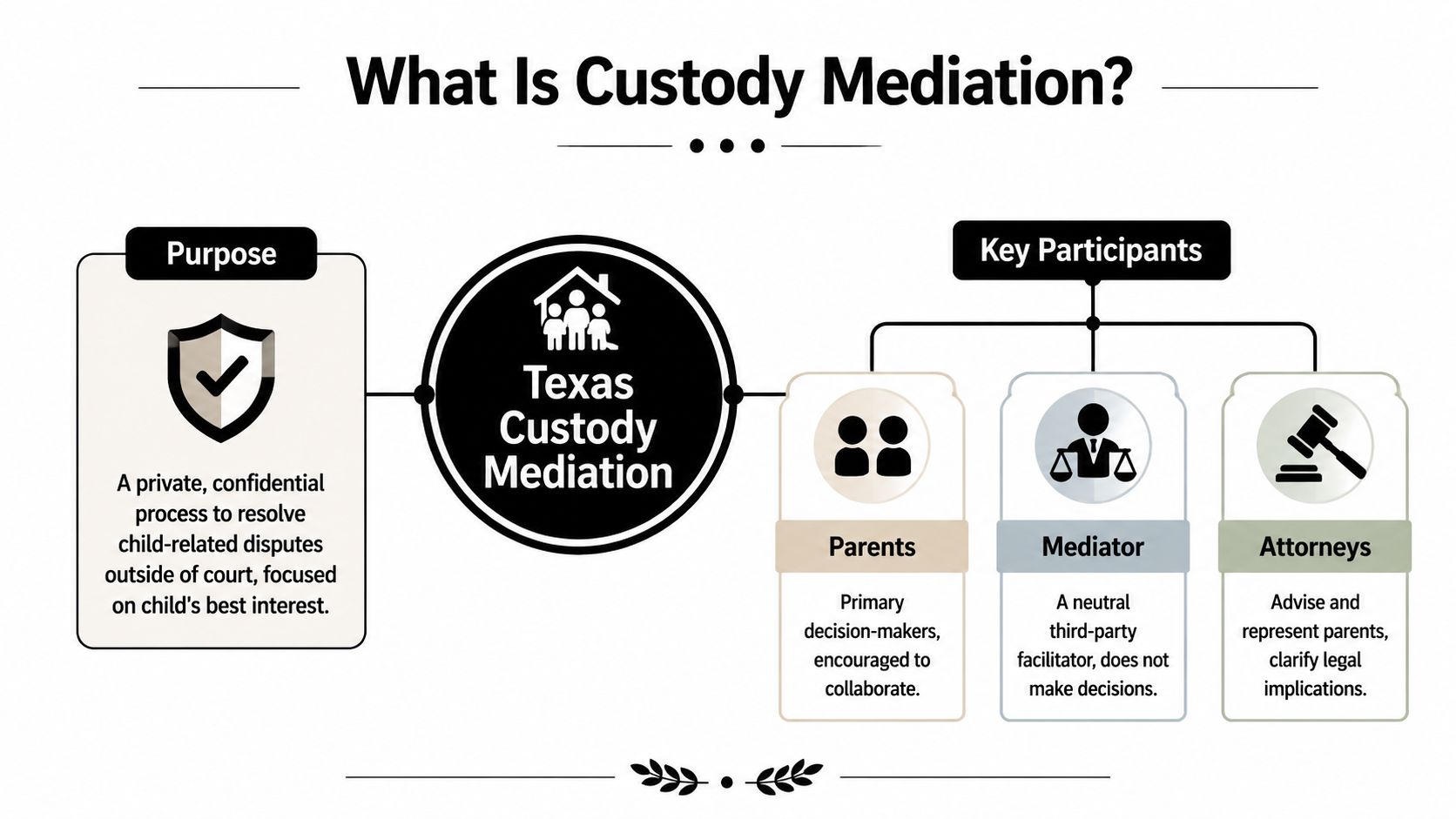
Custody mediation is a confidential, problem-solving process led by a neutral third party called a mediator. The mediator does not act like a judge. The mediator does not decide custody. The mediator helps the people involved work toward a voluntary agreement.
In Texas child-related cases, Texas Family Code § 153.0071 governs mediation. Family-law guidance explains that a mediated settlement agreement can become binding once it is properly signed and contains the required finality language, and these agreements are commonly used for custody, visitation, child support, and parenting plans through Texas Access mediation guidance.
The mediator's role
The mediator is neutral. That means the mediator isn't your lawyer, isn't the other parent's lawyer, and isn't there to pick sides.
A good mediator usually helps by:
- Clarifying issues: narrowing broad conflict into specific decisions
- Testing proposals: asking whether a schedule or arrangement is realistic
- Managing tone: lowering tension so negotiations stay productive
- Drafting terms: helping turn an agreement into writing if the case settles
The mediator can ask hard questions. That doesn't mean the mediator is against you. It usually means the mediator is checking whether a proposal will work.
The parents' role
Parents remain the decision-makers. That's one of the most important things to understand.
If you are a mother worried about losing time with your child, or a father worried no one is hearing your side, mediation gives you a setting where your proposed parenting plan can be discussed in detail. In Texas, many parents are appointed joint managing conservators, which usually means they share certain rights and duties relating to the child. That does not always mean equal time. It means both parents may continue to have a significant legal role.
What attorneys do in mediation
Attorneys don't replace the mediator. They serve a different function.
Your attorney helps you understand:
- Your legal position
- How Texas courts usually view a disputed issue
- Whether a proposed term is safe or workable
- What should be included in the written agreement
Practical rule: If a term matters to your child's routine, it should be discussed clearly enough that it can be written into the final agreement.
Why confidentiality matters
Mediation is private by design. That privacy encourages honest discussion and practical compromise. It also helps many parents speak more freely than they would in open court.
That privacy can make mediation feel safer emotionally, but it doesn't make it casual. Once a proper mediated settlement agreement is signed, it can carry serious legal force.
The Typical Timeline and Structure of a Mediation Session
The day usually feels more organized than people expect.
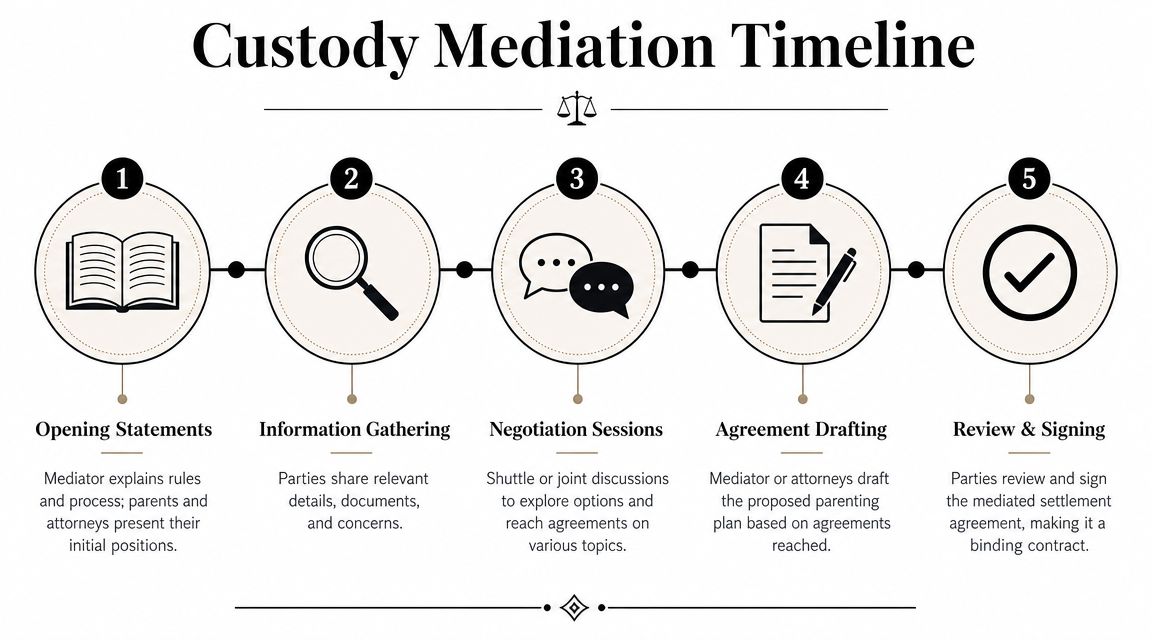
In Texas custody cases, mediation is often handled in a shuttle-style format. That means the parents are commonly placed in separate rooms while the mediator moves back and forth between them to discuss offers, concerns, and possible solutions. According to Custody X Change's overview of Texas mediation, sessions can run from about two hours to a full day, and if an agreement is reached, it becomes a draft order for the court.
How the day usually begins
At the start, the mediator explains the rules. You'll usually hear that the mediator is neutral, that the process is confidential, and that the goal is settlement if possible.
Some mediations begin with everyone together. Others start with parents already separated into different rooms. If the relationship is tense, separate rooms are often more productive from the beginning.
A typical opening stage may include:
- Basic introductions
- An explanation of how the mediator will communicate
- A short statement from each side about the main issues
- A plan for which topics will be tackled first
What happens during private caucuses
Most of the substantive work happens in private meetings, often called caucuses. The mediator may sit with you, ask what matters most, and then carry proposals to the other room.
The focus of the day shifts from blame to tradeoffs. One parent may want a certain weekend schedule. The other may care more about school pickup rights or holiday rotation. The mediator looks for movement.
Separate-room negotiation often helps parents focus on the child's routine instead of reacting to each other's tone or body language.
If your case involves temporary orders, a modification, or a contested final order, the pace of mediation can still vary. For a broader look at how this fits into the overall process, this step-by-step custody case timeline in Texas helps place mediation in context.
How the session ends
If the parties reach agreement, the terms are reduced to writing. That written document is commonly called the Mediated Settlement Agreement, or MSA.
If the parents only agree on some issues, those points may still be written down while other disputed matters are left for court. If no agreement is reached, the mediator reports that mediation occurred and the case proceeds in litigation.
Key Topics Discussed in Texas Custody Mediation
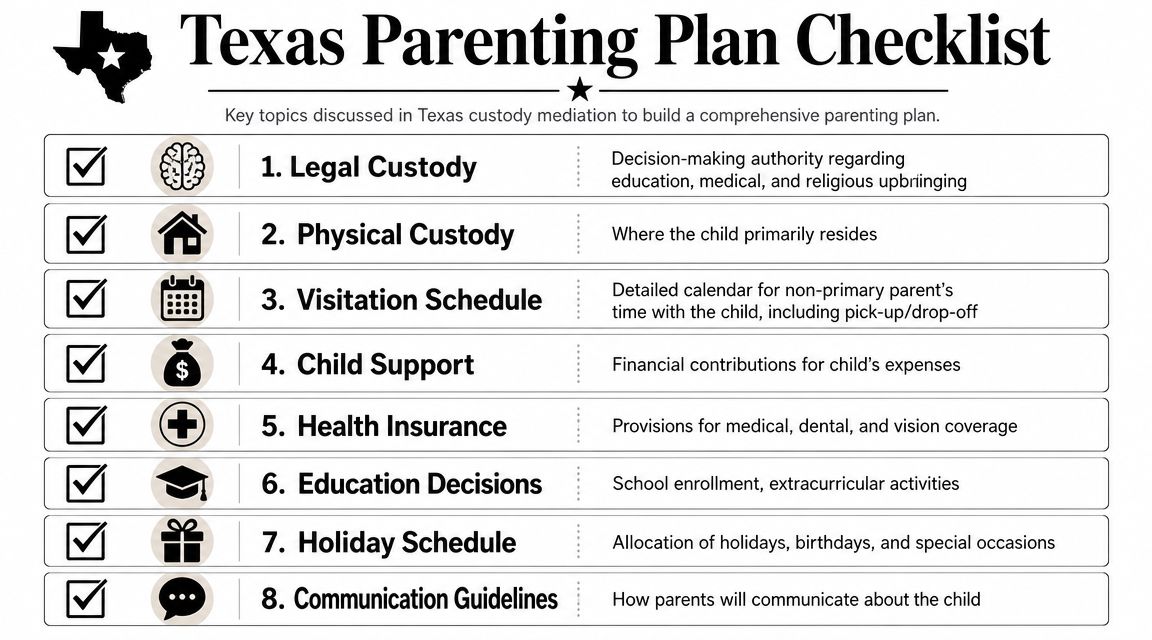
Parents are often surprised by how detailed mediation gets. This is not just about who “wins custody.” It's about building a parenting plan your family is able to follow.
Conservatorship and decision-making
In Texas, “custody” is often discussed under the term conservatorship. This refers to the parents' legal rights and duties. If parents are named joint managing conservators, they may share important rights relating to education, medical care, and other major decisions.
But joint managing conservatorship doesn't automatically answer every practical question. Mediation may still need to address:
- Who decides about non-emergency medical care
- Who can consent to counseling
- Who has the right to make educational choices
- Whether certain rights are shared, independent, or exclusive
Possession schedules and parenting time
Texas also uses the term possession and access for what many people call visitation. The possession schedule covers when the child is with each parent.
This part of mediation often includes:
| Topic | What parents usually work out |
|---|---|
| Weekday and weekend time | Regular school-week routine |
| Holiday schedule | Thanksgiving, winter break, birthdays, Mother's Day, Father's Day |
| Summer possession | Extended summer periods and notice deadlines |
| Exchanges | Pick-up times, locations, and who transports the child |
A possession schedule should be clear enough that neither parent has to guess. Ambiguity creates future conflict.
Support and everyday expenses
Child-related mediation often also addresses child support and medical support. Parents may discuss who provides health insurance, how uninsured costs are handled, and how reimbursement will work.
That discussion can be especially important when one parent's work schedule changes often or when the child has recurring medical or therapy needs.
A strong parenting plan doesn't just divide time. It assigns responsibility in a way both parents can follow.
Special issues in military, relocation, and emergency cases
Some of the most stressful mediation sessions involve unusual facts. A parent may be in the military and facing deployment. Another may want to move for work or family support. Sometimes a case starts under emergency orders and needs fast, temporary decisions.
Family-law guidance notes that Texas mediation content often overlooks how these cases differ, even though the mechanics may be similar. In these situations, strategy and timing matter because parents need customized solutions for deployment, proposed relocation, or urgent custody concerns, as discussed in this overview of Texas custody mediation issues.
A relocation discussion may involve geographic restrictions, school continuity, travel responsibility, and long-distance communication. A military case may need terms for deployment notice, make-up parenting time, and communication during active service.
How to Prepare for Your Mediation Session
Preparation changes everything. Parents who walk in with a plan usually feel steadier than parents who hope the day goes well.

Family-law guidance explains that parents should enter mediation with a proposed parenting plan, financial documents, and a list of essential conditions. It also notes that the session is often the last efficient chance to define terms before trial costs rise, and that a properly executed MSA is generally binding through this mediation preparation resource.
What to gather before the session
Don't bring every paper you've ever saved. Bring the documents that help make decisions.
A useful preparation file may include:
- A draft parenting plan: your preferred schedule and a backup option
- School information: calendars, attendance concerns, activity schedules
- Medical information: insurance details, therapy appointments, prescriptions if relevant
- Financial records: income information and child-related expense details
- Communication history: only if it helps explain a recurring parenting issue
If you want a more detailed checklist, this guide on how to prepare for mediation can help you organize your approach.
Know your goals and your limits
Some parents enter mediation focused only on what they don't want. That's understandable, but it isn't enough. You should know what outcome you are asking for and why it supports your child.
Try separating your thinking into three categories:
- Must-have terms
- Preferred terms
- Points where you can be flexible
This is also the point where legal advice matters. A family-law attorney can help you tell the difference between a strong negotiating point and a position that may not hold up well before a judge. The Law Office of Bryan Fagan, PLLC is one Texas option that assists parents with custody mediation, parenting-plan issues, and related family-law disputes.
Here's a helpful overview before mediation day:
Practical behavior that helps during mediation
The most persuasive parent in mediation is often not the angriest one. It's the one who stays focused.
Bring your child's routine into the room. Sleep schedules, school transportation, medical needs, and homework logistics often matter more than old arguments.
You don't need to sound perfect. You do need to sound prepared.
Understanding the Possible Outcomes of Mediation
You may walk out of mediation with relief, mixed feelings, or unfinished business. All three are normal. The goal is not to force a perfect ending in one day. The goal is to see clearly where you stand and, if possible, turn conflict into a written plan the court can use.
Many Texas family cases do settle in mediation, at least in part. Even when parents do not agree on every issue, mediation often narrows the fight. That matters. A smaller dispute usually means less time in court, lower cost, and fewer decisions left for a judge who does not know your child the way you do.
The three main outcomes
Mediation usually ends in one of three ways:
| Outcome | What It Means | What Usually Happens Next |
|---|---|---|
| Full agreement | You and the other parent reach agreement on all major custody and parenting terms | The terms are written into a mediated settlement agreement, then used to prepare court orders |
| Partial agreement | You settle some issues but leave others unresolved | The agreed terms are preserved, and the remaining disputes go on to a hearing or trial |
| Impasse | No agreement is reached | The case returns to litigation, and the judge may decide the unresolved issues |
A partial agreement is often more valuable than parents expect.
If you settle the weekly schedule, holiday exchange times, and pickup responsibilities, but still disagree about one medical decision-making issue, you have still removed a large part of the conflict from the case. That can make court much more focused. It can also make co-parenting easier because you are no longer arguing about everything at once.
Why the written agreement matters so much
The written agreement is where mediation becomes real. In Texas, a properly prepared and signed mediated settlement agreement can carry serious legal weight. It is not a rough draft or a handshake on paper.
That is why details matter so much. A parenting plan works like a set of instructions. If the instructions are vague, people fill in the blanks differently, and that is where future conflict starts. Terms about holidays, summer possession, travel notice, school pickup, phone contact, counseling, and who makes which decisions should be clear enough that a third person could read them and understand what happens next.
This is especially important in special-circumstance cases. A military parent may need terms that address deployment, long-distance visitation, and virtual contact. A parent with family violence concerns may need exchange terms that reduce direct contact and leave no room for pressure or surprise changes. Generic language often fails families with real-world complications.
What if only part of the case settles
Partial settlement can still be a strong result. It gives you a foundation. It also tells you what is left for the judge to decide.
For example, if both parents agree on where the child will go to school and how weekdays will work, but cannot agree on geographic restrictions, your attorney can prepare for court around that one issue instead of relitigating the entire parenting plan. That usually saves energy and helps you make better decisions under stress.
If you want a practical sense of how parents handle that kind of negotiation, these Texas child custody mediation tips can help you assess whether to keep working toward a partial deal or prepare for court on the remaining disputes.
When no agreement is reached
An impasse does not mean mediation was pointless. Sometimes the session exposes what the underlying disagreement is. Sometimes it shows that one parent needs more documents, more legal advice, or stronger court protections before any fair negotiation can happen.
That is often true in harder cases involving intimidation, untreated mental health concerns, substance abuse allegations, or unstable work schedules. In those situations, ending mediation without an agreement may be the safer and more realistic outcome.
The key is this. You do not measure success only by whether everyone signed. You also measure it by whether the process clarified the issues, protected your position, and helped you avoid agreeing to terms that would not work for your child.
FAQs About Custody Mediation in Texas
Parents usually have a few practical worries that don't fit neatly into legal explanations. These are some of the biggest ones.
What if I'm afraid of the other parent
Mediation is not always appropriate when family violence or intimidation is involved. Texas Law Help explains that parents can object to mediation on those grounds, and if mediation does proceed, they can request safety measures like separate rooms so they can participate without fear or pressure through Texas Law Help's family violence and mediation guidance.
If you feel unsafe, tell your attorney immediately. Don't assume you have to “just get through it.”
Can the mediator force me to agree
No. The mediator facilitates negotiation. The mediator does not have the power to impose a custody result on you.
The pressure you may feel in mediation usually comes from the reality of litigation. A judge can decide unresolved issues later. That is different from a mediator forcing a settlement.
What if the other parent refuses to negotiate fairly
That happens. Sometimes one parent delays, grandstands, or tests whether the other side will give up.
If that occurs, your attorney can help you decide whether to keep negotiating, narrow issues, or end the session and prepare for court. This set of child custody mediation tips can help you think through how to respond productively.
How much does mediation cost and who pays
The answer varies by court, county, mediator, and the terms of your case. Some parents split the cost. In other cases, the court may allocate responsibility differently or the issue may be addressed by agreement.
That's a good question to ask your lawyer before the mediation date is set.
Key takeaway
If you remember only one thing, remember this: mediation is usually your chance to shape the parenting plan before a judge has to. Preparation, clear priorities, and good legal advice can make that chance count.
If you need help with a child custody or visitation case in Texas, our experienced attorneys can guide you every step of the way. Contact The Law Office of Bryan Fagan, PLLC today for a free consultation.