Skip to content
When your court-ordered time with your child is blocked, the frustration is immediate. You may have taken off work, driven to the exchange point, and cleared your whole weekend, only to get a message saying the visit isn't happening.
That moment can leave you angry, confused, and worried about what comes next. The good news is that Texas law gives you a path forward. If you're asking what happens if a parent refuses visitation in Texas, the answer isn't just about penalties. It's also about whether you can prove the denial in a way the court can enforce.
That Sinking Feeling When a Visit Is Denied
You pull into the parking lot a few minutes early. Maybe it's a school pickup, a police substation exchange, or the other parent's driveway. Then your phone lights up. "They're not coming." Or worse: "The child doesn't want to go today."
That message hits hard because it does more than ruin a visit. It disrupts your routine with your child and chips away at the trust that a court order was supposed to create. Many parents in this position feel powerless for a few reasons at once. They don't want to escalate the conflict. They don't want to upset the child. They also don't want to make a legal mistake.

The first thing to understand is this. A denied visit is not just a co-parenting problem. It can become a legal enforcement issue very quickly when there is an existing court order for possession and access.
What parents usually get wrong in this moment
A lot of parents make one of two mistakes.
- They leave immediately: They assume the text message settles it and drive away.
- They retaliate: They answer with threats, stop cooperating, or decide they will withhold the child next time.
Both reactions are understandable. Neither usually helps your case.
Practical rule: Stay calm, follow the order exactly, and start thinking like someone who may need to prove this denial to a judge.
Texas courts care about facts, timing, and proof. They want to know what the order said, whether you complied, where you were supposed to be, whether you showed up, and what happened next. That means the strongest response is usually a disciplined one, not an emotional one.
The path forward starts with control
You can't control the other parent's choices. You can control your own record, your own conduct, and your own legal strategy.
That matters for mothers and fathers alike. It also matters for grandparents and caregivers who are trying to protect a child relationship under a standing order. The court's focus stays on the best interests of the child, which means the judge will look for stability, compliance, and a parent who acts responsibly under pressure.
If this has happened once, take it seriously. If it's becoming a pattern, treat it like a case you may need to enforce.
Why a Texas Custody Order Is Not a Suggestion
In Texas family law, the court order controls. It doesn't matter whether one parent likes the schedule, thinks it is inconvenient, or believes the child should decide from week to week. If the judge signed an order, the parents are expected to follow it until the order is changed.
What possession and access means
Texas often uses the phrase possession and access instead of everyday words like visitation. In plain English, that means the schedule that says when each parent has time with the child and how exchanges happen.
You may also see the term conservatorship. That refers to the legal rights and duties of a parent. A joint managing conservatorship usually means both parents share certain rights and responsibilities, even if one parent has the right to determine the child's primary residence or one parent has most of the day-to-day possession time.
A possession schedule is the practical part of the order. It tells each parent when the child goes where. If your order includes weekends, holidays, summer periods, pickup times, or return locations, those terms are enforceable.
The custodial parent still has a duty
One of the most important rules in these cases is that a child's refusal does not wipe out the parent's legal obligation to comply. Texas Law Help explains that the parent who has the child must still make the child available for each scheduled period of possession, and if that doesn't happen, the other parent can pursue enforcement through the court in Texas guidance on court-ordered visitation and child safety.
That rule matters because many denied visits are framed as if nobody is responsible. "I didn't stop it. The child just refused." Texas courts don't usually treat that as the end of the story.
A possession order creates duties for adults. A child may have feelings about the visit, but the parents are still responsible for following the order unless a judge changes it.
Why judges take this seriously
Judges don't issue parenting orders as suggestions for good days only. They issue them to create consistency for the child and predictability for the parents. If one parent can ignore the schedule whenever conflict arises, the order loses its value.
That's also why the phrase best interests of the child matters here. In plain English, it means the court tries to protect the child's well-being, stability, and relationship with both parents when appropriate. A parent who consistently follows the order usually stands in a stronger position than a parent who treats the order as optional.
If the schedule no longer works, the legal answer is usually a modification case, not self-help. Until then, the signed order remains the rulebook.
The Legal Consequences for Withholding a Child
A parent who refuses visitation in Texas can face more than a stern warning. Courts have several tools available, and the consequences can become more serious when the interference keeps happening.
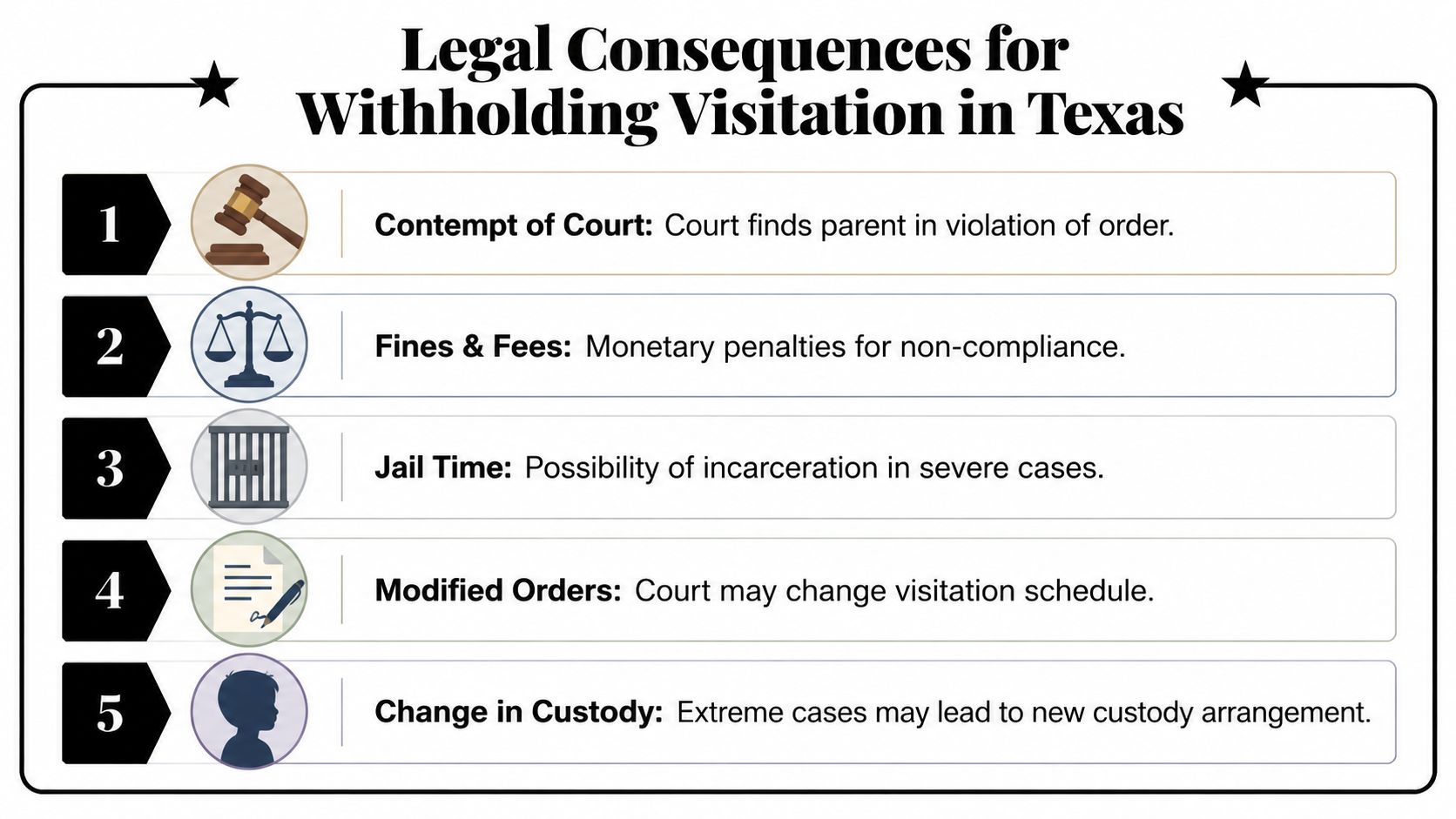
What a judge may do
At the lower end, the court may order make-up visitation so the parent who lost time can regain it. That's often the first practical remedy because it addresses the missed possession directly.
If the violations are proven and serious enough, the judge may also use contempt of court. Contempt means the court found that a parent violated a clear court order. If you want a plain-English look at that process, this article on how contempt of court works in Texas custody cases is a helpful companion.
Texas sources also describe possible fines, jail time, and remedial orders in enforcement cases. In some situations, a court may issue a writ of habeas corpus to return a child to the person legally entitled to possession. That remedy is less about punishing a parent and more about restoring the child to the proper legal arrangement.
When the risk gets much bigger
Repeated interference can create more than civil exposure. One Texas family-law source states that under certain statutes, a third offense of intentionally preventing possession can be treated as a state jail felony, with a potential sentence of up to two years in jail, as discussed in this Texas custody-order violation overview.
That doesn't mean every missed exchange becomes a criminal case. It does mean a parent should never assume repeated interference is just a private family disagreement with no larger consequences.
| Consequence | What It Means |
|---|---|
| Contempt of court | The judge finds a parent violated a clear possession order |
| Make-up visitation | Extra time may be awarded to replace missed periods |
| Fines or other sanctions | The court may impose penalties for noncompliance |
| Jail exposure | Serious contempt findings can lead to incarceration |
| Criminal escalation | Repeated intentional interference may carry felony risk in some situations |
What works and what doesn't
What works is building a clean record and asking for relief the court can grant.
What doesn't work is assuming the judge will act because the situation feels unfair. Judges act on evidence tied to the exact language of the order. If your proof is weak or your own compliance is unclear, even a very frustrating pattern may be harder to enforce than you expect.
The Step-by-Step Process to Enforce Visitation
Knowing the other parent may face consequences is useful. Knowing how to get in front of a judge is what protects your rights.

Step one through step three
Start with the order itself. Read the possession terms carefully. You need to know the exact dates, times, and exchange location before you claim a denial.
Then document every missed period. Save messages, note the time you arrived, and record what happened. If the issue might still be resolved without court, keep your communication brief and respectful.
For a practical look at the filing itself, review this guide to a motion to enforce custody in Texas.
What a Motion to Enforce does
A Motion to Enforce Possession or Access asks the court to enforce the order already in place. It is not the same thing as asking for a new custody arrangement from scratch. Instead, you are telling the court that the other parent failed to follow a specific order and asking for relief.
Texas enforcement is very detail-driven. The motion needs to identify each violation with enough specificity for the court to evaluate it. That usually means the exact date, time, and place involved in the missed possession period.
The more exact your record is, the more usable it becomes in court.
Texas Law Help also notes that enforcement can be order-specific, which is why these cases are often won or lost on details rather than broad complaints.
What the process usually looks like
A typical enforcement path often includes these stages:
- Review the order and confirm the exchange terms.
- Document each denial with dates, times, and communications.
- File the motion in the correct court.
- Serve the other parent so they have legal notice.
- Prepare for hearing with exhibits, testimony, and a clean timeline.
- Attend the hearing and ask for clear relief, such as make-up time or contempt.
Later in the process, the court may issue an enforcement order that tells the parents exactly what must happen next.
If you want a visual summary before diving into paperwork, this video gives a helpful overview of the topic:
When emergency relief may matter
In more urgent situations, a parent may need to discuss emergency remedies with counsel, including a writ of habeas corpus when a child is being wrongfully withheld from the legally entitled caregiver. Those cases move differently than a standard disagreement over one late exchange, so the facts matter.
This is one place where many parents decide to involve counsel early. Options can include self-help forms in limited situations, a private attorney, or a firm such as the Law Office of Bryan Fagan, PLLC for case-specific enforcement strategy and filing support.
How to Prove Visitation Was Denied
Many parents often face difficulties. They know the visit was denied, but they don't have the kind of proof a Texas court needs.
Texas Law Help states that a parent is not technically denied visitation unless that parent appears at the exchange location at the correct time, and it also warns that text messages alone may be insufficient evidence for contempt, as explained in Texas Law Help's enforcement guidance.

The mistake that hurts parents most
If the other parent texts, "Don't come, the child refuses," many parents turn around and go home. That feels reasonable. It can also weaken an enforcement case.
The court wants proof that you were ready, willing, and able to exercise your court-ordered possession. Showing up matters because it turns a disputed story into a documented event.
What evidence helps most
Build your file like you expect a judge to read it line by line.
- A copy of the signed order with the possession terms highlighted.
- A denial log that lists each missed date, exchange time, and location.
- Screenshots of texts and emails showing what was said before and after the exchange.
- Call records showing attempted communication.
- Photos, receipts, or location records that support your presence at the exchange point.
- Witness information if someone came with you and observed the denial.
- Police report details if law enforcement was called, even if the officer didn't force the exchange.
If you're thinking about recording conversations, learn the rules first. A practical starting point is SpeakNotes' guide on recording consent, which helps explain why recording laws can matter before you press record.
Present evidence in a way a judge can use
Messy proof is almost as bad as missing proof. Organize everything by date. Use one folder for each denied visit. Put the order first, then your notes, then the messages, then any supporting records.
For a courtroom-focused approach, this article on how to present evidence in a custody case in Texas can help you think through what a judge needs to see.
Bring facts, not speeches. Judges usually respond better to a clean timeline than to a long summary of every frustration in the co-parenting relationship.
Common Excuses for Refusing Visitation and Why They Fail in Court
Parents hear the same explanations over and over. Some reflect real concerns that need legal attention. Many do not excuse violating a court order.
The child said no
This is the most common excuse, and it causes the most confusion.
Texas law does not set a legal age at which a child can refuse court-ordered visitation. A child remains a child under Texas law until 18, and while a judge may interview a child who is 12 or older about the child's wishes under Section 153.009, the judge is not bound by that preference, as discussed in this Texas visitation refusal article.
That means a parent can't decide on their own that the child gets the final vote. The court may listen. The court still decides.
The child is sick
A genuine health issue can change what is reasonable in the moment. But a vague claim like "not feeling well" usually doesn't justify repeated denials without communication, documentation, or efforts to reschedule.
Courts tend to look at pattern and credibility. One true illness is one thing. A string of conveniently timed illnesses is another.
The other parent is strict, annoying, or has a different household
Texas courts don't expect separated parents to agree on every rule. Different bedtimes, food choices, homework routines, or screen-time policies usually do not justify ignoring a possession order.
A family court order is not built around which parent is more popular with the child that week. It is built around legal rights, duties, and the child's overall welfare.
There are safety concerns
Safety concerns are different. If a child is in immediate danger, a parent should act to protect the child and get legal guidance quickly. But even then, the long-term answer is usually to seek emergency relief or a modification, not to create a permanent self-directed suspension of visits.
If your concern is real, bring it to court with facts. If the concern is being used as a shield for interference, judges often recognize that too.
Your Next Steps to Protect Your Time with Your Child
When visitation is denied, don't guess your way through it. Follow a disciplined plan.
What to do next
- Follow the order exactly: Be at the right place at the right time, even if the other parent says the visit won't happen.
- Document every denial: Keep a calendar, save messages, and make notes while the details are fresh.
- Stay measured in communication: Short, polite messages help more than emotional arguments.
- Avoid retaliation: Don't answer one violation with another.
- Get legal advice early: Especially if denials are becoming a pattern or the other parent is testing the edges of the order.
Keep the court's focus where it belongs
The strongest position is usually the parent who stays child-focused, respects the order, and brings organized proof. That applies whether you're a mother trying to protect your scheduled time, a father fighting to preserve a meaningful relationship, or a grandparent or caregiver trying to understand what the order allows.
Key Takeaway
If you're dealing with what happens if a parent refuses visitation in Texas, the biggest issue isn't just whether the other parent is wrong. It's whether you can prove the denial in a way the court can enforce. Good records, calm conduct, and prompt legal action can make the difference between frustration and a workable court remedy.
You don't have to solve this by yourself. A clear strategy now can protect your time with your child and prevent a bad pattern from becoming the new normal.
If you need help with a child custody or visitation case in Texas, our experienced attorneys can guide you every step of the way. Contact The Law Office of Bryan Fagan, PLLC today for a free consultation.