Skip to content
When your child is supposed to be at the exchange spot and the other parent doesn't show up, the clock feels louder than usual. You may be angry, embarrassed, and worried all at once. Most parents in that moment aren't thinking about legal terminology. They're thinking, “What do I do now, and how do I stop this from happening again?rdquo;
That's where contempt becomes important. In Texas custody cases, contempt isn't just about punishing a parent who ignored the rules. It can be a tool to restore routine, protect your parenting time, and give your child the stability that court orders are supposed to create in the first place.
Texas custody law also uses terms that can feel cold when your family life is anything but. Best interests of the child means the judge's main focus is the child's safety, emotional well-being, and long-term stability. Joint managing conservatorship usually means both parents share important rights and duties about raising the child, even if the child doesn't spend equal time with each parent. Possession schedules are the court-ordered calendars that say when each parent has time with the child. When one parent keeps ignoring that schedule, the problem is not just inconvenience. It's disruption in the child's life.
When Your Custody Order Is Ignored
You drive to the school parking lot for pickup. You arrive on time. You wait. You text. You call. Nothing. Then a message comes through saying the child “doesn't want to go” or “we made other plans.”
That moment is more than frustrating. It can make you feel powerless, especially if it keeps happening. Many parents start second-guessing themselves. They wonder whether they should keep showing up, whether the court will care, or whether enforcing the order will make things worse for the child.

The better way to think about it is this. A custody order is like the family's traffic light. It tells everyone when to stop, when to go, and how to avoid chaos. If one parent keeps running the red light, the court has to decide whether to step in and enforce the rules. If you're dealing with repeated violations, this guide on what to do if the other parent won't follow the custody order can help you start organizing your next steps.
Why enforcement matters for the child
Children usually do better when their routines are predictable. They need to know where they'll be, who will pick them up, and that the adults in their lives mean what they say. When a parent ignores a possession schedule, the child often feels that instability too.
Practical rule: Enforcing a custody order is not the same as escalating conflict. In many cases, it's the step that puts structure back into the child's life.
Both mothers and fathers run into this problem. So do grandparents and other caregivers who have court-ordered rights. Texas courts don't treat these cases as a popularity contest. They look at the order, the facts, and whether someone failed to do what the order required.
What usually does not work
Parents often try the same things first. Some are understandable, but they usually don't solve the problem:
- Endless arguing by text: Long emotional exchanges may feel necessary in the moment, but they rarely fix repeated noncompliance.
- Self-help retaliation: Keeping the child later next time or denying the other parent access usually creates a second legal problem.
- Assuming one violation is enough by itself: Sometimes it is, but judges often want clear proof of a pattern or a precise, documented incident.
Texas Access notes that a record of at least three denials within a brief time span can be helpful evidence in court, and the Texas judiciary's FY 2024 annual statistical report shows more than 7.9 million filings statewide and 8 million cases disposed, which helps explain why courts rely on organized, specific proof rather than general complaints (Texas Access enforcement guidance).
What Contempt of Court Means in a Custody Case
Contempt of court means a person failed to obey a court order. In a custody case, that often involves possession, access, child support, or another family court requirement that was already spelled out in a signed order.
The key idea is that courts must be able to enforce their own rulings. If a judge signs an order and one parent can ignore it without consequences, the order stops protecting the child and the family. That's why contempt exists.
Civil contempt and criminal contempt
Texas custody enforcement is built around the distinction between civil contempt and criminal contempt. Civil contempt is designed to coerce compliance with an existing order, while criminal contempt punishes past disobedience. Texas Government Code § 21.002 defines criminal contempt as punishable by a fine of up to $500, confinement for up to 6 months, or both (Texas contempt framework in family-law cases).
A simple way to remember the difference is this. Civil contempt is a tool to fix the problem. Criminal contempt is a penalty for already breaking the rule.
| Aspect | Civil Contempt | Criminal Contempt |
|---|---|---|
| Main purpose | Force compliance with the order | Punish past disobedience |
| Focus | Getting the parent to do what the order requires | Responding to a completed violation |
| How it feels in practice | Pressure to comply | Consequences for what already happened |
| Why the court uses it | Restore order and stability | Uphold the authority of the court |
Why most custody contempt is constructive contempt
Most custody violations happen outside the courtroom. The missed exchange happens in a parking lot, at a home, or at a school. The unpaid reimbursement happens after messages are ignored. The blocked communication happens on a phone.
That matters because this kind of case is usually handled as constructive contempt, meaning the judge did not personally witness the violation. As a result, the case turns on proof. The parent asking for enforcement must usually show the exact language of the order and the exact conduct that violated it.
Courts don't punish general unfairness. They enforce specific orders against specific conduct.
Where parents get tripped up
Many parents know something is wrong but don't yet have a contempt case. The order may be too vague. The facts may be incomplete. Or the parent may have excellent suspicions but poor evidence.
That's why precise wording in the order matters so much. If the order says who picks up, where, and when, enforcement becomes much more workable. If it says only that the parties will “agree later,” contempt becomes much harder.
Common Actions That Violate a Custody Order
Not every bad co-parenting decision is contempt. But many everyday custody disputes do cross the line when they violate a written order.
The easiest way to spot the difference is to ask one question. Did the other parent break a clear instruction in the signed order? If the answer is yes, you may be looking at an enforcement case.
The violations parents see most often
A common example is denied possession. One parent arrives for a scheduled weekend, but the child is never brought out. Another is the late return that becomes a pattern. One late drop-off after a flat tire may be an isolated problem. Returning the child late again and again can turn into a serious issue.
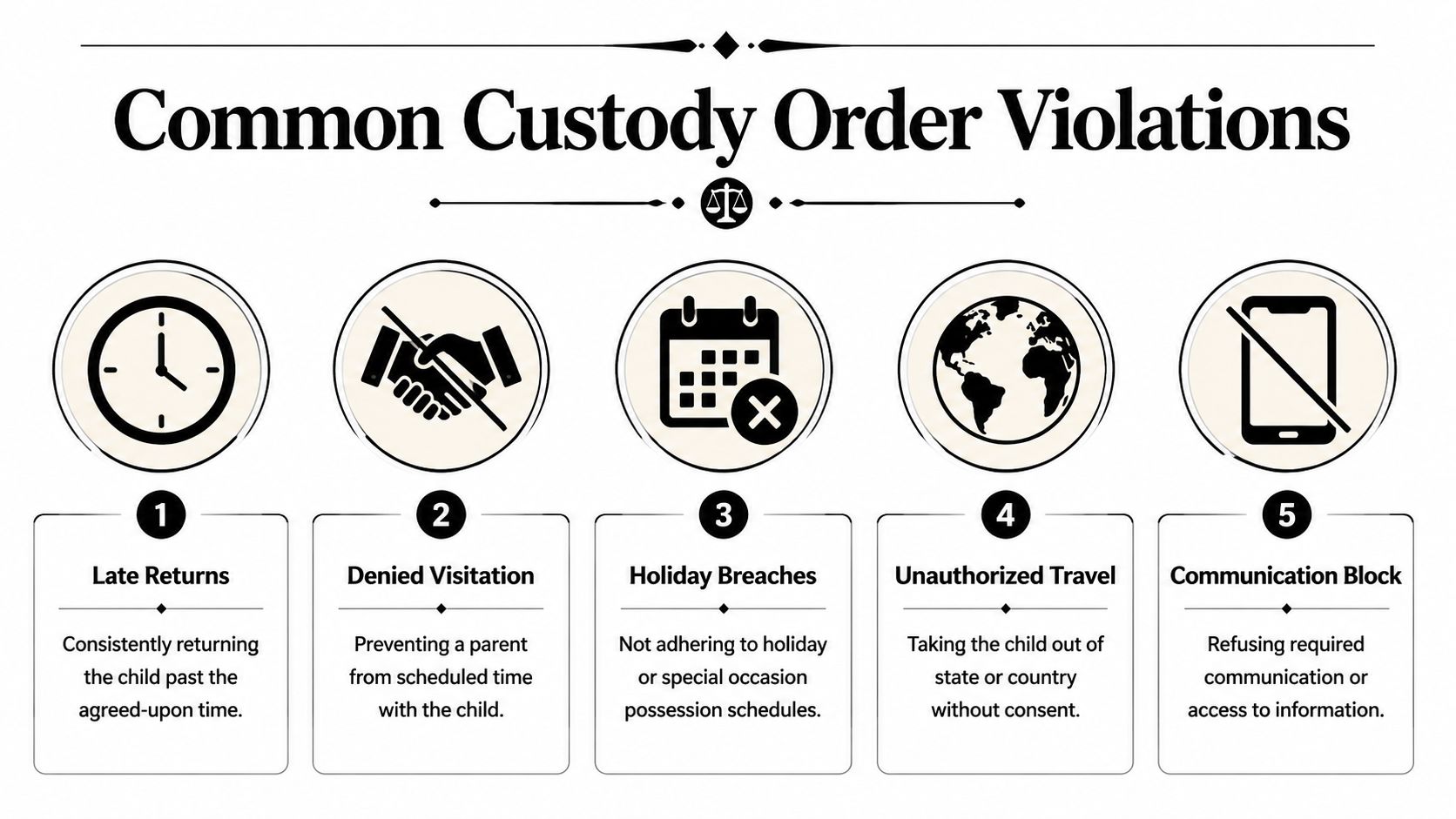
Parents also run into trouble with decision-making rights. If the order requires shared input on school or medical issues under a joint managing conservatorship, one parent cannot unilaterally make major choices alone because it feels easier. And if there is a geographic restriction, moving without court approval or the required consent can create major enforcement problems. If repeated violations have become the norm, this article on what happens if a parent violates a custody order repeatedly is a useful follow-up.
Real-world patterns that often lead to court
- Blocked exchanges: The other parent says the child is sick, busy, grounded, or “doesn't want to go,” but offers no lawful basis to deny possession.
- Holiday interference: The regular schedule is ignored during Thanksgiving, winter break, birthdays, or Mother's Day and Father's Day.
- Communication restrictions: A parent blocks required phone or video contact or refuses to share basic school and medical information required by the order.
- Support-related violations: Some enforcement cases also involve unpaid child support or missed medical reimbursement duties.
A custody order is not a set of suggestions. If the language is clear, the court expects parents to follow it even when they're upset with each other.
What may feel unfair but needs closer review
Some situations are more complicated. A child's refusal to go may not automatically excuse a parent. At the same time, a true medical emergency can change what was possible in that moment. Those cases often depend on details, timing, and whether the parent acted reasonably.
That's why practical legal review matters. The same set of texts can look very different once matched against the exact order language.
The Process for Enforcing Your Custody Order
Contempt cases are won or lost on detail. The parent filing the case has to do more than say, “The other parent keeps violating the order.” The court wants the who, what, when, where, and how.
Texas Law Help explains that, in Texas custody enforcement, the movant must plead the exact order provision, the specific act of noncompliance, and for visitation enforcement the date, place, and time of each missed exchange. It also explains that the enforcing parent must be able to testify that they were present at the ordered exchange location and time, which is why these cases are so evidence-driven (Texas Law Help on enforcing a visitation order).
Start with your proof
Before you file anything, build a clean record. Save texts, emails, call logs, screenshots, school messages, and any photos that help show what happened. Keep a written timeline that matches the order.
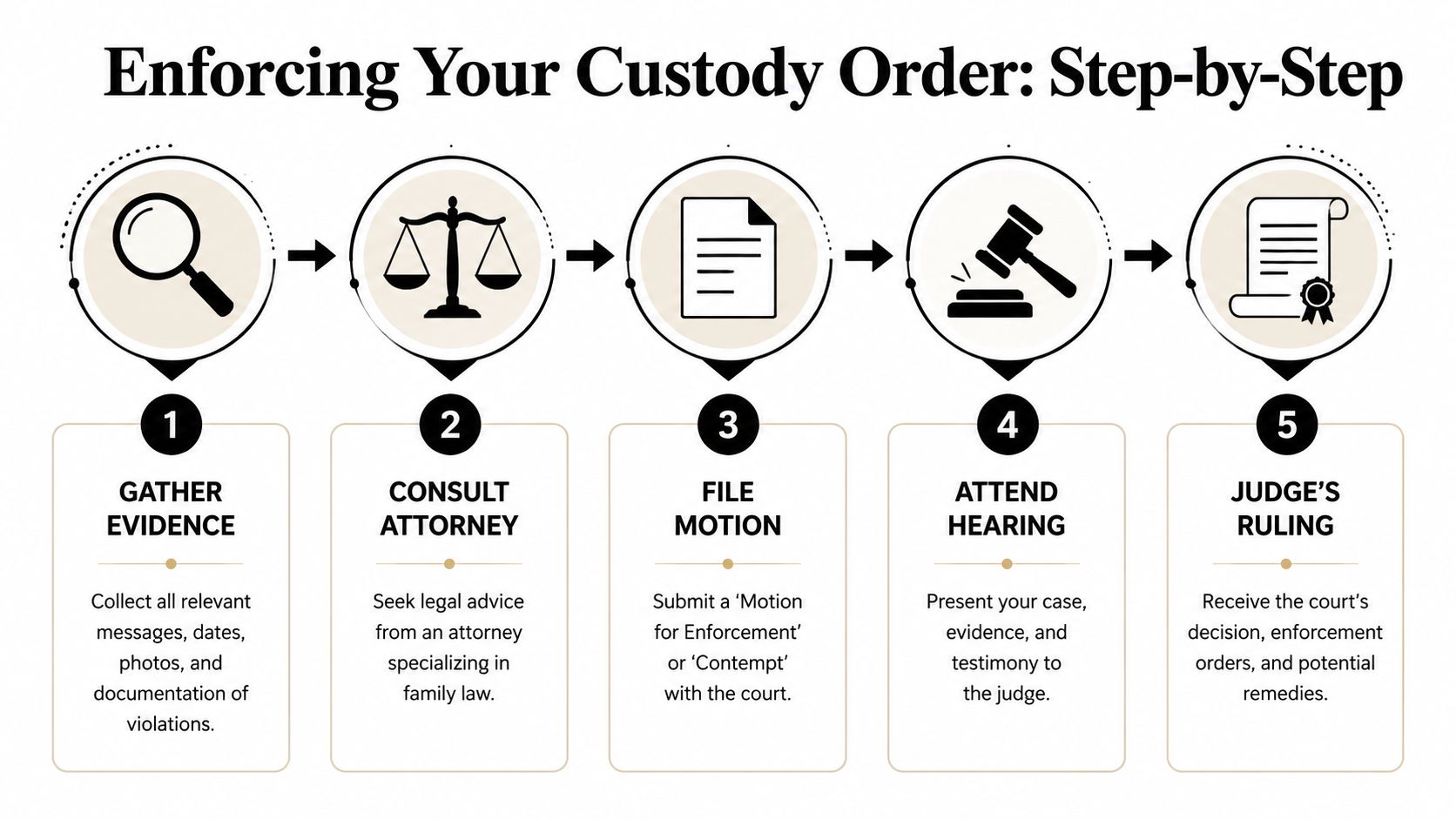
That record should answer these questions:
- Which paragraph of the order was violated
- What exactly happened
- Where the exchange was supposed to occur
- When it was supposed to happen
- What you did to comply on your side
For many parents, the hardest part is consistency. They document the first denial, then get discouraged. Judges usually trust records that were kept carefully and in real time more than memories reconstructed months later.
File a motion for enforcement
The usual vehicle is a Motion for Enforcement. That document tells the court what part of the order was violated and what relief you are asking for.
A lawyer can help make sure the motion is specific enough to support contempt. If you are preparing paperwork, practical guides on filing court documents correctly can help you avoid basic filing mistakes, though they don't replace legal advice in a contempt case where liberty may be at stake. Families looking for a Texas-specific overview of this process can also review how a motion to enforce custody works in Texas.
Make sure service is done properly
After filing, the other parent has to be legally served. This is not just courtesy notice. It is a due process requirement. If service is defective, the hearing can be delayed or the case can fail for procedural reasons.
That's one reason contempt cases can be frustrating. Parents often come in focused on the emotional wrong. Court procedure focuses on whether the legal steps were followed with precision.
Prepare for the hearing
A hearing is where the judge decides what happened and what remedy makes sense. The strongest preparation usually includes:
- Your order packet: Bring the signed order with the relevant provisions clearly marked.
- A violation chart: List each missed exchange or violation in date order.
- Your testimony: Be ready to say where you were, when you arrived, and what happened next.
- Witnesses when available: A grandparent, spouse, or friend who attended an exchange may help confirm events.
Later in the process, some parents consult private counsel for strategy. The Law Office of Bryan Fagan, PLLC handles custody enforcement matters in Texas, including contempt-related issues tied to possession and access orders.
A short overview may also help before you step into court:
Bring facts, not speeches. Judges hear frustration every day. They act on organized proof.
Potential Penalties and Remedies for Contempt
Parents often assume contempt is only about fines or jail. Those are part of the picture, but they aren't the whole picture. In custody cases, judges often use contempt and related remedies to restore order for the child and make future violations less likely.
The court's response depends on the wording of the order, the evidence, the number of proven violations, and whether the judge believes the parent's conduct was intentional.
What the court can do
Texas contempt in family cases can result in a fine, jail, or both. Criminal contempt carries a maximum $500 fine and up to six months' confinement per violation. Because each violation can be treated separately, repeated missed exchanges can substantially increase a parent's legal exposure (State Law Library explanation of contempt consequences).
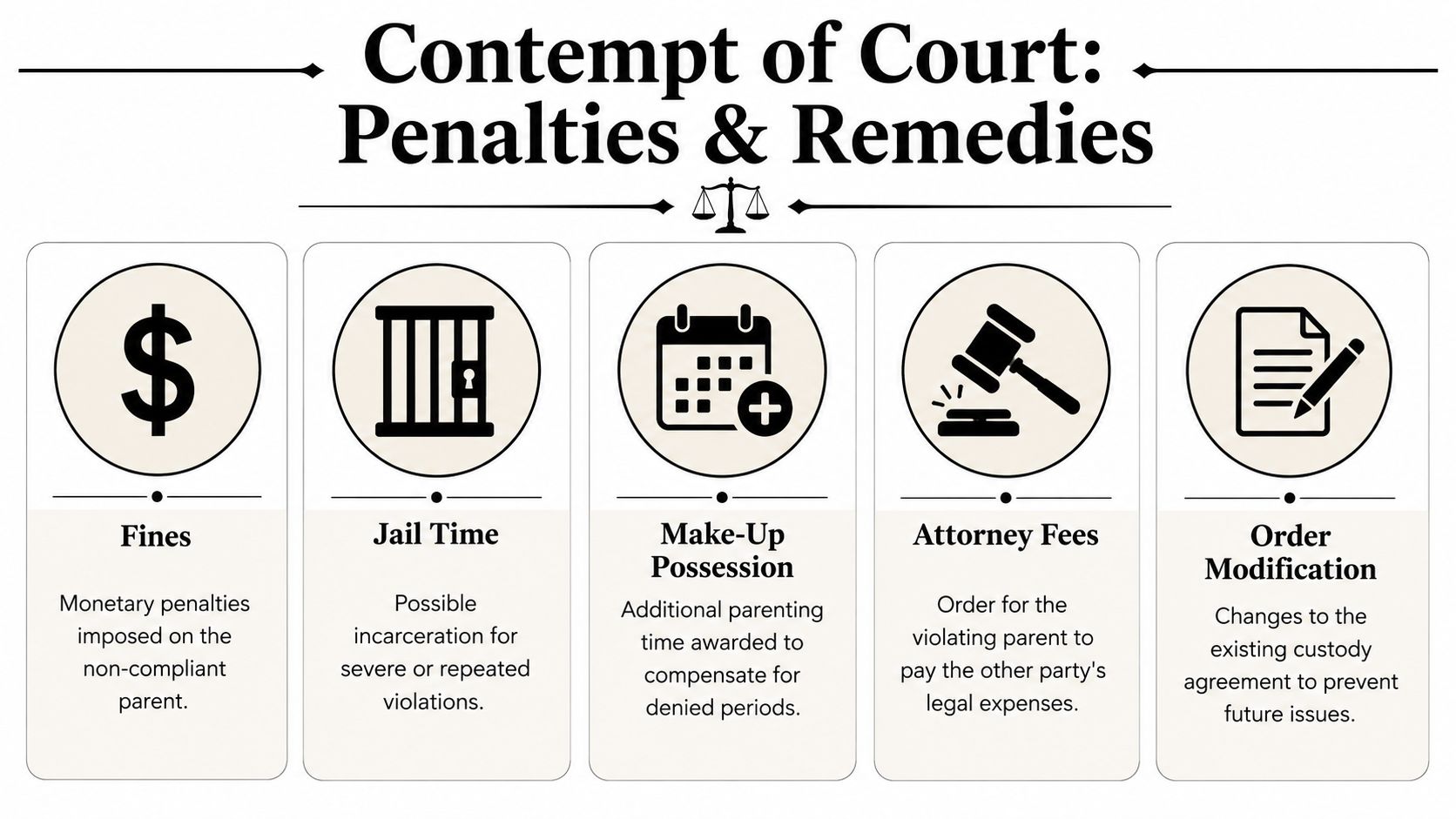
Some remedies are aimed more directly at the child's routine and the wronged parent's lost time. These may include:
- Make-up possession: Extra parenting time to replace visits that were wrongfully denied.
- Attorney's fees and costs: In some enforcement settings, the court may require the violating parent to bear financial consequences tied to the litigation.
- Further orders for compliance: The judge may spell out exchange logistics with more detail to reduce future conflict.
Why the court uses different remedies
Think of these remedies as different tools in the same toolbox. Jail and fines punish serious disobedience. Make-up time repairs the child-parent relationship that was interrupted. Fee shifting can keep one parent from absorbing all the cost of fixing a problem they didn't create.
The most effective remedy is often the one that makes the next exchange happen on time and without drama.
That practical reality matters. Some parents want the harshest punishment possible. Judges often focus instead on whether the remedy will improve compliance and protect the child going forward.
What doesn't always happen
Parents sometimes expect a custody reversal after one strong enforcement hearing. That can happen in the right case through the proper procedure, but contempt by itself is not an automatic transfer of custody. Judges usually separate two questions. First, was the order violated? Second, what response fits the evidence and the child's needs?
That's why strategy matters. In some situations, an enforcement action is the right immediate move. In others, enforcement and modification may need to be considered together.
How to Defend Against a Contempt Allegation
If you've been served with a motion for enforcement, take it seriously right away. Don't assume the judge will “understand your side” if you merely show up and explain. Contempt can involve severe consequences, and ignoring the case is one of the worst decisions you can make.
A contempt allegation is not the same as a finding of contempt. The other side still has to prove the violation. You still have the right to defend yourself.
Defenses that may matter
Some defenses are factual. Others are legal. The key is whether the defense fits the order and the events.
- You could not comply: A genuine inability to comply may matter, especially if something outside your control prevented performance.
- The order is too vague: If the order did not clearly say what had to happen, contempt may be harder to support.
- There was a legitimate emergency: If there was a real safety or medical issue involving the child, the court may view the event differently.
A parent should be careful here. “The child didn't want to go” is often not enough by itself. Neither is “we agreed informally to switch weekends” if the written order says otherwise and the facts are disputed.
What to do after service
Your best next moves are practical:
- Read the motion closely: Find out exactly which provisions and dates are being alleged.
- Gather your documents: Pull texts, emails, calendars, medical records, receipts, and anything else tied to those dates.
- Avoid reactive messages: Angry texts after service can become exhibits.
- Talk to counsel quickly: A contempt hearing is not a good place to improvise.
If jail is a possible outcome, treat the case with the same seriousness you would give any matter affecting your freedom.
This is true for mothers and fathers alike. It's also true for grandparents or caregivers subject to enforceable court orders. A calm, documented defense is always stronger than a rushed explanation at the courthouse door.
Frequently Asked Questions About Custody Enforcement
What if the other parent lives in another state
You may still be able to enforce the Texas order, but interstate cases add procedural issues. The original Texas order, the current residence of the child, and which court still has authority all matter. Get case-specific advice before filing.
What happens if my child refuses to go on a scheduled visit
A child's resistance does not automatically excuse a parent from following the order. Courts often look at the parent's efforts. Did the parent encourage compliance, have the child ready, and avoid undermining the visit? Those facts matter.
Can I be held in contempt if I lose my job and can't pay child support
Job loss can be highly relevant, but it does not erase a court order on its own. The safer move is to seek legal advice quickly about modification or enforcement exposure rather than waiting for arrears to build.
How does contempt work for military parents
Military service can complicate schedules, travel, and notice issues, but service members are still dealing with enforceable court orders. If deployment or relocation affects compliance, address it early through the court rather than relying on informal side agreements.
Where can I find more local legal guidance
If your situation overlaps with regional court practices, family law FAQs, or related concerns, resources offering guidance on San Antonio legal issues may help you frame questions for your own attorney.
If you need help understanding how contempt of court works in Texas custody cases, or you're dealing with a parent who keeps ignoring a possession or support order, legal guidance can make the process clearer and more effective. The right strategy often begins with reviewing the exact wording of your current order, your documentation, and whether enforcement, modification, or both make sense for your family. If you need help with a child custody or visitation case in Texas, our experienced attorneys can guide you every step of the way. Contact The Law Office of Bryan Fagan, PLLC today for a free consultation.