Skip to content
When your child is supposed to be dropped off at 6:00 and 6:45 comes and goes, the stress hits fast. You check your phone. You reread the order. You wonder whether this is another excuse, another broken promise, or something more serious. After enough missed exchanges, late returns, blocked calls, and last-minute cancellations, the question changes from “Is this fair?rdquo; to “What can I do now?rdquo;
In Texas, a custody order is not a suggestion. It is a court order. If a parent keeps violating it, the problem can move from co-parenting conflict into court enforcement, contempt, and in some cases a real change in custody. That matters not only for your parenting time, but for your child's stability, routines, and sense of safety.
There is also a harder gray area that many articles ignore. Sometimes a parent breaks the order out of defiance. Sometimes a parent withholds a child because they believe the child is in danger. Texas courts don't treat those situations the same way, and the difference often comes down to proof, timing, and whether the parent used the right legal tools.
Your Co-Parent Is Ignoring the Custody Order What Now
A lot of parents arrive at this point slowly.
It starts with “I'm running late.” Then it becomes “We already made other plans.” Then your child isn't brought to the exchange location at all. Maybe your calls go unanswered. Maybe your child tells you they were told not to come. Maybe the other parent acts like the court order only matters when it helps them.
That pattern can leave even a calm parent feeling powerless. You may be worried about your child, angry about the disrespect, and exhausted from trying to keep things civil. Those feelings are normal. They also shouldn't stop you from acting carefully and strategically.
Texas judges expect parents to follow the written order until the court changes it. The court's main focus is the best interests of the child, which means the arrangement should support the child's safety, stability, emotional health, and ongoing relationship with both parents when appropriate. If one parent keeps undermining that structure, the court can step in.
The biggest mistake I see is waiting too long while hoping repeated violations will fix themselves.
What works is a calm, organized response. What usually doesn't work is a string of angry texts, self-help retaliation, or refusing your own obligations because the other parent refused theirs. If you're dealing with what happens if a parent violates a custody order repeatedly, the practical answer is this: preserve evidence, follow your order as closely as possible, and get legal advice before the pattern gets worse.
Understanding Your Texas Custody Order
Texas uses terms that can sound more complicated than they are. Once you translate them into plain English, the order becomes much easier to understand and enforce.

Conservatorship means custody in Texas
In Texas, conservatorship is the legal term commonly understood as custody. A parent may be a Joint Managing Conservator or, in some cases, one parent may be a Sole Managing Conservator.
In plain terms, this part of the order deals with decision-making. It can cover school, medical care, counseling, and other major issues in your child's life. Joint managing conservatorship usually means parents share many of those rights and duties, though not always equally. Sole managing conservatorship means one parent has a greater share of major decision-making authority.
Possession and access means when the child is with each parent
The part parents fight about most often is usually the possession schedule. That is the calendar portion of the order. It says when each parent has the child, where exchanges happen, what time pickup and return occur, and how holidays are handled.
Think of it as the rulebook for co-parenting. If the order says pickup is Friday at a certain time, that's the rule. If it says one parent has spring break in alternating years, that's the rule too. Judges act like referees when one parent stops following that rulebook.
Here are the core pieces most Texas parents should identify in their order:
- Rights and duties: Who can consent to medical treatment, talk to teachers, or make school decisions.
- Primary residence terms: Whether one parent decides where the child lives and whether there is a geographic restriction.
- Possession schedule: The regular weekends, weekdays, summer periods, and holiday rotations.
- Exchange details: The exact place, time, and conditions for pickup and return.
Key point: You can't enforce a vague memory of what you thought was agreed. You enforce the signed order.
If you're a mother, father, grandparent, or caregiver trying to protect your time with a child, start by reading the exact language. Many disputes come down to one overlooked sentence.
Documenting Every Violation The Foundation of Your Case
Judges don't rule on frustration. They rule on evidence.
If the other parent repeatedly ignores the order, your documentation becomes the foundation of any enforcement case. A good record turns “this keeps happening” into a timeline for the court to use.

What to record every single time
Keep a dedicated log. That can be a notebook, a spreadsheet, a parenting app, or a digital folder with dated entries. What matters most is consistency and detail.
For each violation, write down:
- Date and time: The exact exchange time or missed call window.
- Location: Where the exchange should have happened.
- What the order required: Quote or summarize the relevant part of the order.
- What happened: Missed pickup, late return, denial of visitation, blocked communication, or refusal to share information.
- Communications: Save text messages, emails, app messages, and voicemails.
- Witnesses: Anyone who saw the exchange fail or heard what was said.
- Effect on the child: Changes in mood, missed school events, confusion, or distress.
What counts as a violation
Some violations are obvious. The child is not delivered for your weekend. The other parent keeps the child beyond the return time. You are denied a scheduled holiday.
Other violations are less obvious but still serious, depending on the wording of your order. They may include repeated refusal to allow scheduled calls, interfering with exchange logistics, or making unilateral decisions where joint rights apply.
A strong log is factual, not emotional. “Respondent failed to appear at 6:00 p.m. at the school parking lot” helps you. “She is impossible and always ruins everything” does not.
What works better than angry texting
Screenshots matter. So do calendars, school attendance records, travel confirmations, and neutral third-party notes when available. Preserve the original messages if possible. Don't edit screenshots. Don't crop out context if the missing context could become an issue later.
If you're preparing for court, this guide on how to present evidence in a custody case in Texas can help you organize records in a way a judge can follow.
Bring order to chaos. A judge should be able to flip through your evidence and see the pattern without guessing what happened.
What usually fails is selective record-keeping. Parents often document only the worst incidents and forget the rest. But repeated violations are about pattern, and patterns are proven one dated event at a time.
Legal Consequences for Repeated Violations
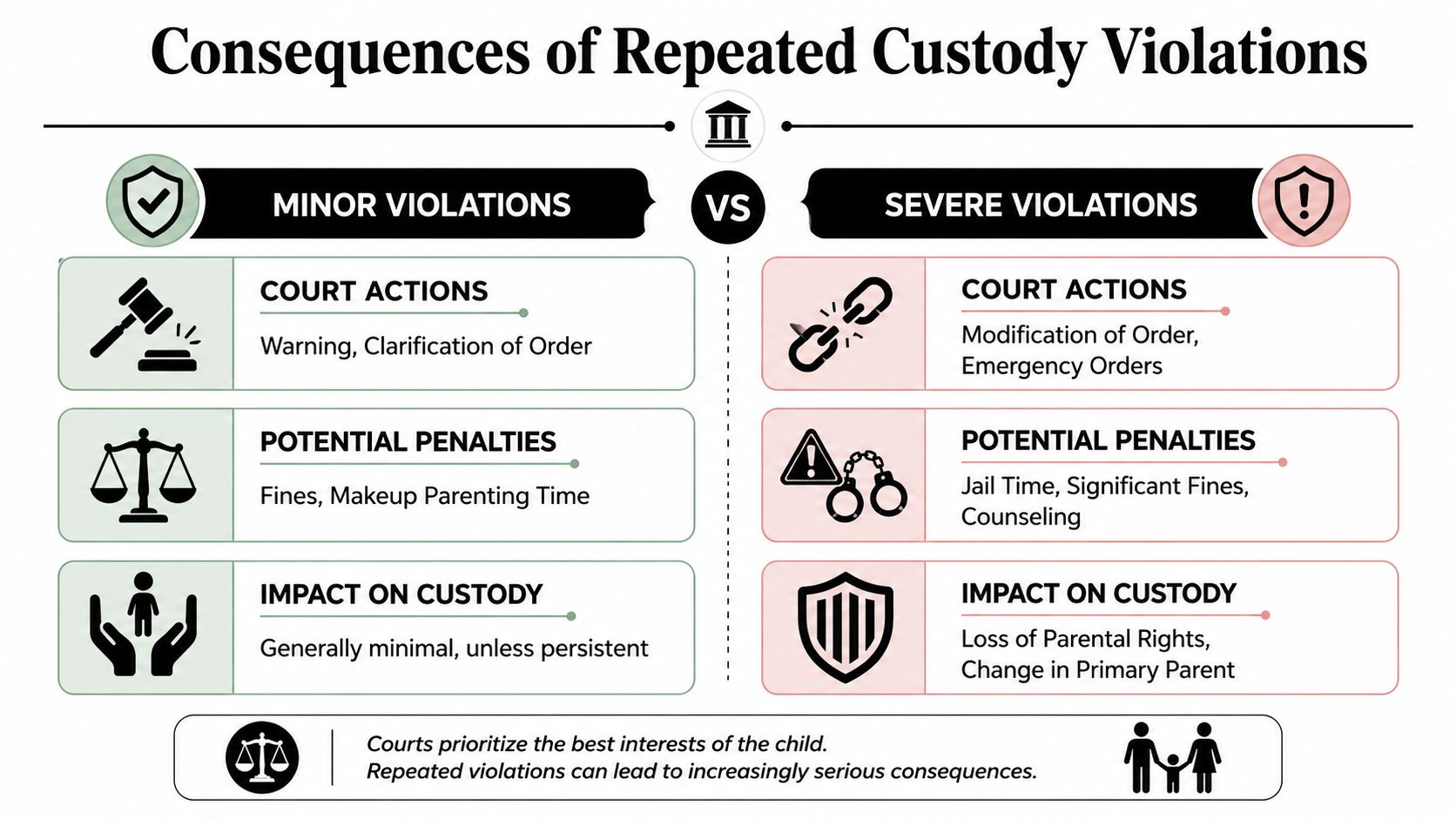
Repeated violations can carry real legal consequences. Courts don't view ongoing disobedience as a private disagreement forever. Legal overviews note that repeated violations can move a case into contempt of court, where courts may impose fines, probation, jail time, custody modification, or even termination of parental rights in severe cases, and judges look closely at the parent's track record of compliance and the nature of the violation when deciding punishment. The same overview notes that 10% to 20% of U.S. custody disputes are high-conflict, and about 15% continue into long-term conflict with repeated filings and enforcement actions becoming a defining feature (LawInfo overview of custody order violations).
Contempt is the court's enforcement power
In Texas, contempt generally means the court is responding to a willful failure to obey its order. Repeated denial of possession, refusal to return a child, or a pattern of interference can push the court toward stronger remedies.
Common outcomes in enforcement cases may include:
- Make-up parenting time: Extra time to restore what was wrongly denied.
- Fines or court sanctions: Financial consequences for noncompliance.
- Probation-like conditions: Requirements to follow stricter terms going forward.
- Attorney's fees: In some cases, the violating parent may be ordered to pay.
- Jail time: Possible in serious contempt findings.
- Custody changes: If the pattern shows the current arrangement no longer works for the child.
The court is asking two main questions. Was the order clear enough to be followed? And did the parent choose not to follow it?
A short explanation of enforcement issues can help before you watch this video.
Civil and criminal contempt are not the same
Both terms can appear in family court discussions, but they serve different purposes.
| Feature | Civil Contempt | Criminal Contempt |
|---|---|---|
| Primary purpose | To force compliance with the order | To punish past disobedience |
| Focus | Fixing the problem going forward | Responding to willful defiance |
| Typical use in custody cases | Encouraging future compliance, make-up time, related remedies | Punishment for serious or repeated violations |
| Possible consequences | Court-ordered action, sanctions, other coercive remedies | Fines, jail, other punitive measures |
| Why it matters | Gives the parent a path to comply | Signals the court sees the conduct as a serious offense |
Why repeated violations hit harder than isolated mistakes
One missed exchange with a documented emergency is not the same as a recurring pattern. Repetition changes how judges view the case. It can suggest unreliability, poor judgment, or an unwillingness to support the child's relationship with the other parent.
That's why what happens if a parent violates a custody order repeatedly often goes beyond a warning. Courts may decide enforcement alone isn't enough and that the structure itself needs to change.
How to File a Motion for Enforcement in Texas
When the order has been broken more than once, many parents need more than informal complaints. They need a Motion to Enforce.
That filing asks the court to enforce the existing order and, when appropriate, hold the other parent accountable for specific violations. Texas courts expect precision here. General statements like “he never follows the order” won't carry much weight.
Specificity matters
Each alleged violation should be listed clearly. That usually means identifying:
- The date of the violation
- The time the violation occurred
- The place involved
- The exact provision of the order that was violated
- What the other parent did or failed to do
Think of the motion as a timeline, not a rant. The court needs enough detail to know exactly what conduct is being challenged.
What the process usually looks like
After the motion is filed, the other parent must be formally served. Then the case is set for hearing. At the hearing, both sides present evidence, testimony, and documents.
A typical enforcement path includes:
- Reviewing the current order carefully so you only allege violations the order covers.
- Drafting the motion with exact details from your records.
- Serving the other parent properly so the court can proceed.
- Preparing exhibits and witnesses for the hearing.
- Asking for specific relief such as make-up time, contempt findings, fees, or other remedies supported by the facts.
If you want a closer look at the process, this article on a motion to enforce in Texas custody cases is a helpful starting point.
Court enforcement is strongest when each violation is tied to a sentence in the order and backed by a document, message, or witness.
Parents sometimes ask whether they can file on their own. Sometimes they can. But repeated violations often involve enough complexity that legal guidance matters, especially when contempt is requested. The Law Office of Bryan Fagan, PLLC handles custody enforcement matters for Texas parents who need help turning a messy pattern into a court-ready case.
When Violations Justify Modifying Custody or Emergency Orders
Sometimes enforcing the current order isn't enough.
If one parent keeps violating the order in a way that harms the child's stability or undermines the parent-child relationship, the better remedy may be a modification. In Texas, that usually means asking the court to change the existing conservatorship, possession schedule, or exchange terms because circumstances have materially changed and the new arrangement would better serve the child.

When a pattern points to modification
A judge may take a long pattern of noncompliance seriously because it can show more than poor scheduling. It can show that the current structure isn't protecting the child's routine, emotional well-being, or relationship with the other parent.
Modification may be worth discussing when the violations involve:
- Chronic denial of parenting time
- Repeated refusal to communicate about major issues
- Conduct that places the child in ongoing instability
- A pattern that shows one parent won't support the existing order
If that sounds familiar, this resource on when you should modify a custody order in Texas can help you think through whether enforcement alone is enough.
The safety concern gray area
This is the part many parents struggle with most.
A parent may technically violate the order because they believe the child is in danger. Maybe the other parent appears intoxicated at pickup. Maybe there are allegations of abuse. Maybe there is an immediate threat that doesn't fit neatly into the weekend schedule. In those moments, parents often feel trapped between obeying the order and protecting their child.
A key legal concern is that courts can punish defiance, but they also have discretion to consider whether a violation had good cause, such as protecting a child from immediate risk, and whether the parent sought emergency relief with evidence of danger rather than acting on fear alone (discussion of emergency relief and good cause in custody violations).
What to do if you withheld the child for safety
If safety is the reason you did not comply, your next steps matter as much as the reason itself.
Take practical action right away:
- Preserve evidence immediately: Photos, messages, medical records, witness statements, or any other proof tied to the risk.
- Seek emergency relief fast: Don't sit on the issue and hope the court understands later.
- Ask for targeted protection: Temporary orders, supervised exchanges, or supervised visitation may fit the facts better than merely refusing future visits.
- Stay focused on the child's safety: Avoid inflammatory accusations you cannot support.
Fear without proof puts a parent in a dangerous legal position. Evidence of immediate risk gives the court something it can act on.
What usually does not work is unilaterally withholding the child for an extended period without filing anything. Even a sincere parent can lose credibility if they do not move quickly to involve the court.
Your Next Steps Protecting Your Rights and Your Child
When a parent keeps violating a custody order, delay usually makes the case harder. Records get lost. Memories fade. The child gets pulled deeper into the conflict.
Your next steps should be practical and steady.
A workable action plan
Start here:
- Read the order word for word: Make sure the conduct really violates the signed terms.
- Keep a clean violation log: Dates, times, messages, witnesses, and effects on the child.
- Stay compliant yourself: Don't hand the other side a counterclaim.
- Decide whether you need enforcement, modification, or emergency relief: The right filing depends on the pattern and the risk.
- Get legal advice early: Especially if the violations are repeated, serious, or tied to safety concerns.
Some cases move quickly. Others take time, especially when evidence must be gathered and hearings must be scheduled. The important thing is to move with purpose, not panic.
Why strategy matters so much
Family courts pay close attention to which parent supports the child's relationship with the other parent and which parent interferes with it. In research on custody outcomes involving abuse and alienation allegations, courts took custody from mothers 44% of the time in cases where fathers alleged alienation, and the same body of research found other troubling shifts in outcomes when alienation claims were raised (GWU research on custody outcomes and alienation allegations). The lesson for Texas parents is not to panic. It is to understand that interference claims can become central fast, and evidence matters.
That is why repeated violations should never be treated like a side issue. They can affect how a judge views reliability, cooperation, parental judgment, and what arrangement serves the child's best interests.
Key takeaway
If you're dealing with what happens if a parent violates a custody order repeatedly, the answer is usually bigger than one missed weekend. Repeated violations can lead to contempt, sanctions, make-up time, and even custody changes. If the issue involves safety, the court may consider good cause, but only if you can show evidence and seek the right relief promptly.
You do not have to solve this by yourself. A careful legal response can protect your rights and reduce the chaos your child is living with.
If you need help with a child custody or visitation case in Texas, our experienced attorneys can guide you every step of the way. Contact The Law Office of Bryan Fagan, PLLC today for a free consultation.