
Lying in a Texas custody case usually doesn't lead to automatic jail time, but it can badly damage the lying parent's credibility with the judge and directly affect custody, visitation, and decision-making orders. In one study involving abuse and alienation claims, a mother's rate of losing custody rose from 26% to 50% when alienation became part of the dispute, showing how seriously manipulative claims can affect outcomes.
When your child's future is on the line, that kind of lie doesn't feel like a technical issue. It feels personal, unfair, and frightening. You may be staring at a sworn statement, a false CPS report, or courtroom testimony and thinking, “How can this even happen?”
Texas family courts know that custody disputes can bring out exaggeration, blame, and sometimes outright dishonesty. The good news is that judges aren't limited to taking each parent at face value. They look at evidence, patterns, third-party records, and whether a parent's conduct shows sound judgment.
If you're wondering what happens if one parent lies in a custody case in Texas, the answer is practical more than dramatic. The lie can weaken that parent's case, change how the judge views future testimony, and in some situations lead to sanctions, fee awards, or even perjury exposure. Just as important, you have concrete steps you can take to prove the lie and protect your child.
The Moment a Lie Enters Your Custody Case
You might first notice the lie in a text your lawyer forwards to you. Maybe the other parent claims you missed visits you attended. Maybe they tell the court your child is afraid of you, even though school records, photos, and messages tell a different story. Some parents hear the lie for the first time in a temporary orders hearing and feel frozen.
That reaction is normal. Parents often feel shock first, then anger, then panic about what the judge will believe.

A custody case is already stressful. In Texas, custody is usually called conservatorship, which means the rights and duties parents have regarding their child. The case may also involve possession and access, which is the schedule for when each parent spends time with the child. When a parent lies in that setting, it can feel like they're trying to rewrite your role in your child's life.
Why this feels so dangerous
A lie in family court isn't just insulting. It can shape the court's view of who should make decisions for the child, where the child should primarily live, and how parenting time should work.
Common examples include:
- A false abuse claim that triggers emergency hearings
- A fake version of the schedule that makes one parent look uninvolved
- A misleading financial statement that affects support and stability arguments
- A coached statement from a child that puts the child in the middle
Practical rule: Don't answer a lie with another accusation. Answer it with records, dates, and documents.
You still have options
Texas judges expect conflict in custody litigation. What they care about is who can prove what happened and who appears more reliable under pressure. That means you are not powerless just because the other parent spoke first or sounded confident.
Many parents make the mistake of thinking the courtroom is a place where the better storyteller wins. In reality, the parent with organized proof often has the stronger position. That shift matters. It moves you from outrage to strategy.
How Texas Judges View Honesty The Best Interest of the Child
Texas custody decisions revolve around one central rule. The judge must decide what serves the best interest of the child. That phrase sounds broad because it is broad, but in plain English it means the court is looking for the arrangement that best protects the child's safety, stability, emotional needs, and healthy relationships.
A parent's honesty matters because judges are trying to decide who will make sound choices for the child. If one parent lies, the judge may reasonably ask: if this parent is willing to mislead the court, what else are they willing to do when conflict comes up?
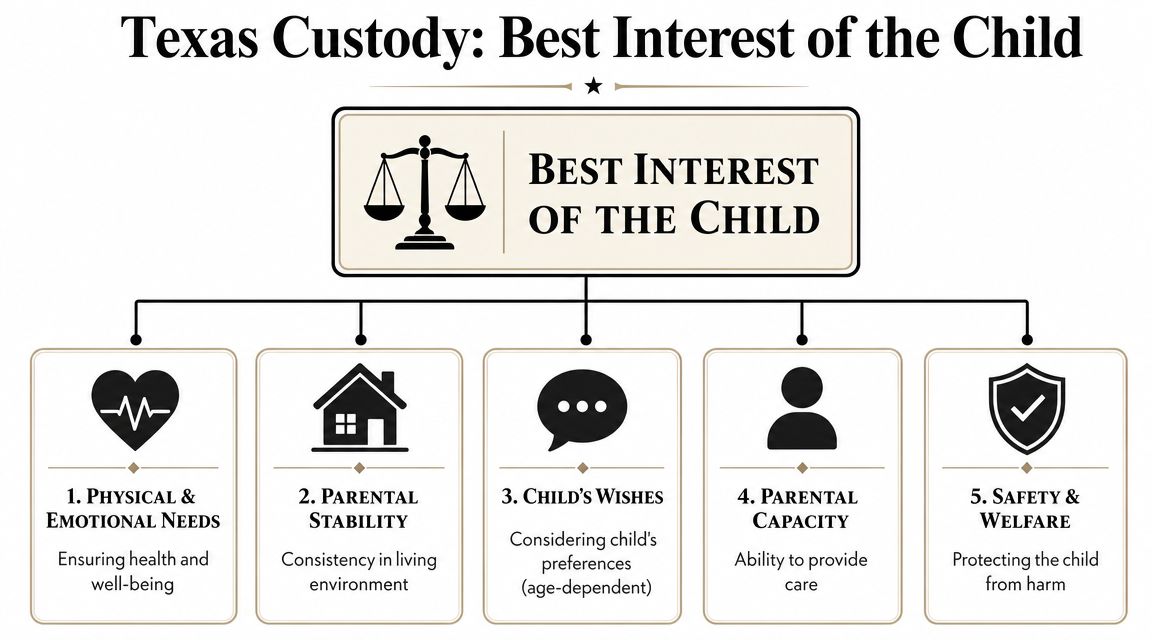
What best interest means in real life
Judges often look at issues like these:
- Stability at home. Who provides a steady routine, school support, and follow-through?
- Parental judgment. Who acts calmly and puts the child first during conflict?
- Safety concerns. Are there real risks to the child, supported by credible evidence?
- Ability to co-parent. Who is more likely to support the child's relationship with the other parent when appropriate?
- Decision-making ability. Who can handle medical, school, and day-to-day issues responsibly?
If you want a deeper look at how courts weigh those factors, this Texas custody best-interest overview gives a useful foundation.
Why honesty carries so much weight
Texas often favors joint managing conservatorship, which means both parents may share important rights and duties unless the facts show that arrangement would not be appropriate. That does not always mean equal time. It means both parents may have a role in major decisions involving the child.
A judge deciding between parents needs believable facts. A lie can affect much more than the single issue it touches. It can make the judge question that parent's judgment across the whole case, including school decisions, exchanges, safety claims, and requests for a different possession schedule.
Children often do better when the adults around them lower the temperature and create consistency. If your child is struggling emotionally during the case, this holistic guide for children of divorce offers practical, child-focused support.
A parent doesn't have to be perfect. But in family court, honesty is one of the clearest ways a parent shows the court they can be trusted with a child's well-being.
What Counts as a Lie in a Texas Custody Battle
Many parents think lying only means obvious perjury in a courtroom. In custody litigation, the picture is wider than that. A lie can show up in sworn papers, messages submitted as evidence, statements to professionals, or strategic omissions that create a false impression.
More than courtroom testimony
Here are examples that often matter in Texas custody disputes:
| Type of dishonesty | What it can look like | Why it matters |
|---|---|---|
| False allegations | Claiming abuse, neglect, or danger without truthful support | Can affect temporary orders and safety findings |
| Financial misrepresentation | Hiding income, lying about work, or misstating expenses | Can influence support and stability arguments |
| Parenting role distortion | Claiming you handle school, medical care, or daily routines when you don't | May affect conservatorship and possession requests |
| Fake or altered evidence | Changed screenshots, incomplete message threads, false documents | Undermines credibility and can trigger sanctions |
| Child-related manipulation | Coaching a child, pressuring them to repeat claims, using them as a messenger | Can damage the child and the court's trust |
A lot of custody cases involve a fight over narrative. One parent says, “I'm the one doing everything.” The other says, “That's not true.” The court then looks for independent proof.
False abuse claims are especially serious
False allegations can change custody outcomes in a measurable way. In one study of custody cases involving abuse and alienation claims, fathers' alienation cross-claims were associated with mothers losing custody at a rate that increased from 26% to 50% when alienation became part of the dispute, according to this discussion of false accusations in custody cases.
That study isn't Texas-specific, but the lesson fits Texas courtrooms. Judges take safety claims seriously. They also take manipulation seriously.
Misleading the court can happen quietly
Some lies are dramatic. Others are subtle. A parent may leave out key facts, such as:
- Who took the child to appointments
- Whether visits were offered or withheld
- What a school counselor said
- Whether a child support issue is being used to justify blocking access
This is also where legal terms matter. If one parent is trying to push for sole control by painting the other as unsafe or absent, that can affect joint managing conservatorship and the possession schedule, which is the calendar for parenting time. Mothers and fathers both need to understand that the court is not just sorting out blame. The court is deciding rights, duties, and time with the child.
The Real Consequences of Lying in a Custody Case
The biggest consequence is often not criminal. It's strategic. A parent who lies can lose the judge's trust, and that loss can affect every disputed issue that follows.

Texas family-law commentary notes that lying in custody litigation does not usually trigger automatic criminal prosecution, but it can still change the outcome because judges may weigh credibility when deciding conservatorship, possession, and visitation. It also notes that if dishonesty is discovered after the order is signed, reopening the case usually requires a significant change in circumstances, which is an important limit in modification cases, as explained in this discussion of lies in Texas custody cases.
Loss of credibility can reshape the whole case
Once a judge believes a parent was dishonest, future testimony from that parent often becomes less persuasive. That matters because custody cases rarely turn on one fact alone. They turn on many disputed facts.
A parent may lose ground on issues such as:
- Primary residence requests
- Expanded or restricted possession schedules
- Decision-making rights for school or medical care
- Requests for temporary protective relief
The practical result can be less parenting time, less influence, or both.
Here's a short video that gives additional context on custody disputes and court strategy:
Sanctions and fee shifting
Family courts also have tools short of criminal charges. A judge may respond to intentional misrepresentations by ordering sanctions or shifting attorney's fees. In plain language, that means the lying parent may have to pay financial consequences because their conduct forced extra litigation.
That can happen when a lie leads to unnecessary hearings, false emergency filings, forged records, or other conduct that wastes the court's time and harms the other parent.
A lie doesn't have to result in handcuffs to do serious damage. In many cases, the custody order itself becomes the real penalty.
Perjury is possible, but proving it is harder
If a parent lies under oath in Texas family court, the conduct can become perjury. But the burden is high. The other side must prove a willful false statement made after an oath was administered, not just a contradiction, misunderstanding, or bad memory. Documentary proof often matters most, as explained in this Texas family-law discussion of perjury in divorce cases.
That distinction is where many parents get confused. They think, “I caught them in something false, so they committed perjury.” Maybe. But the court will want to know:
- Was the statement under oath?
- Was it false?
- Was the falsehood intentional?
- Can you prove it with reliable evidence?
If the lie also involved a false police report, there may be additional legal exposure. Still, most custody cases are resolved through family-court consequences first, not criminal prosecution.
How to Document and Prove Your Co-Parent Is Lying
Anger won't prove a lie. Records will. The strongest response is usually quiet, organized, and boring in the best possible way.
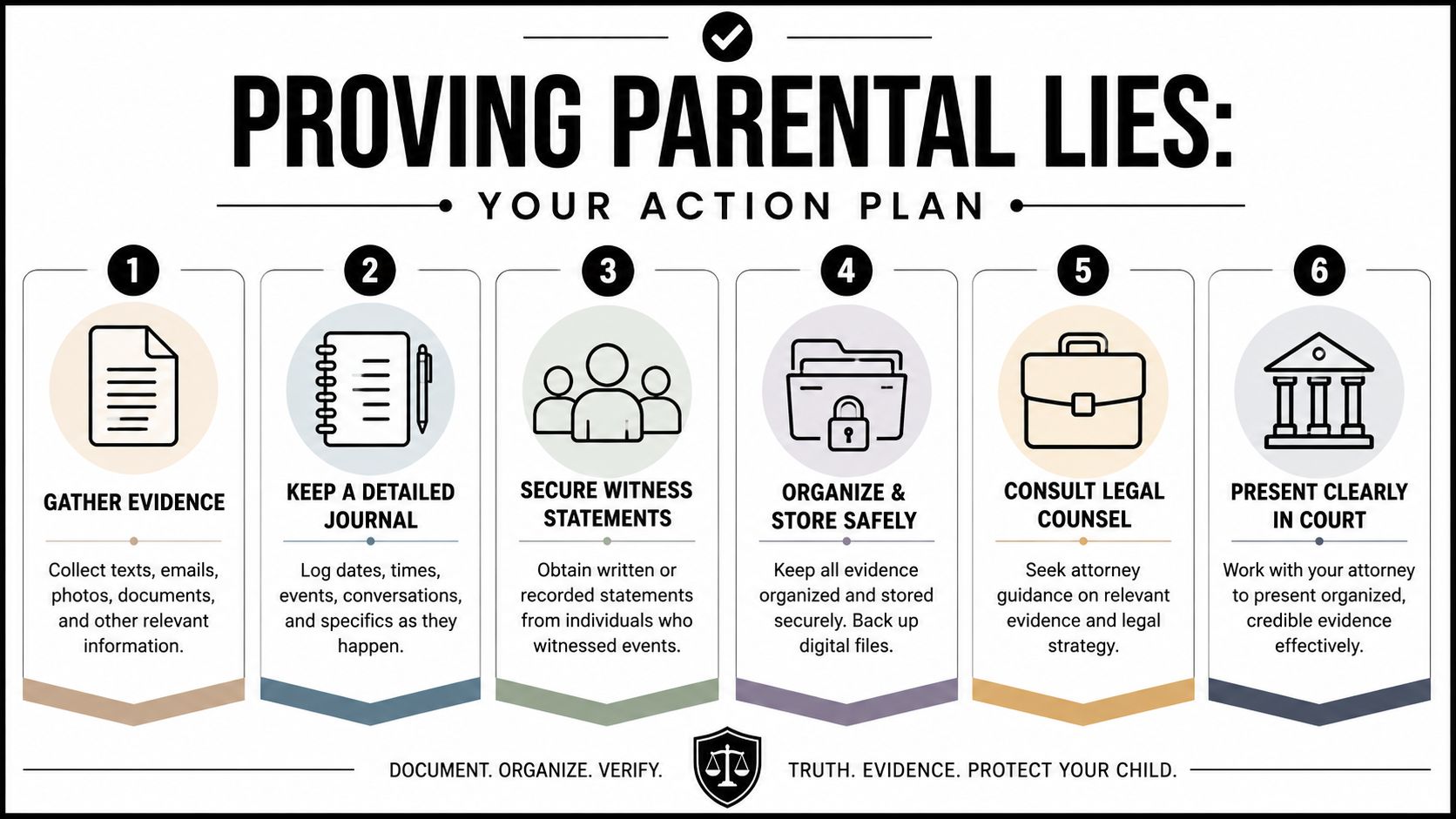
Start with a contradiction file
Create one folder, digital or paper, for every false claim. Label each one by issue, not by emotion. For example:
- Missed exchanges
- School involvement
- Medical claims
- False CPS or police report
- Income and employment statements
Inside each folder, save evidence in date order. Judges and attorneys need a clean timeline.
If you need help turning recordings or long hearings into searchable text for your lawyer's review, tools like legal transcription software can make organizing spoken material easier.
What evidence usually helps most
The strongest proof is often independent and time-stamped.
- Texts and emails. Save full threads, not cropped screenshots that remove context.
- School records. Attendance notices, teacher emails, report cards, sign-in records, and counselor communications can all matter.
- Medical records. Appointment confirmations, discharge papers, and provider instructions can confirm who attended and the content of discussions.
- Possession logs. Keep a calendar of exchanges, late pickups, denied visits, and makeup time.
- Photos and screenshots. Preserve metadata when possible and save the original file.
- Third-party records. Daycare staff, coaches, and therapists may have neutral information about attendance or behavior.
This guide to presenting evidence in a Texas custody case can help you think about what evidence is useful and how it may be introduced.
If the child may be getting coached
This is one of the hardest situations for parents. You may hear your child repeat phrases that sound adult, rehearsed, or disconnected from their own experience. Don't interrogate the child. Don't push them to choose sides.
In situations involving coaching or repeated false reports to CPS, judges may rely on third parties such as custody evaluators or a Guardian ad Litem to help determine what is true, as discussed in TexasLawHelp's explanation of parents' rights when no custody orders exist. A Guardian ad Litem is a person appointed to represent the child's best interests in the case.
Preserve every report and every outcome. If an allegation was investigated and not supported, that record may matter later.
Use process, not just proof
Your attorney may also use formal discovery, which is the legal process for requiring the other side to answer questions, produce documents, or testify under oath before trial. That can uncover missing messages, employment records, medical releases, and other information a parent wouldn't volunteer.
Parents often think proving a lie means showing one dramatic contradiction. More often, it means building a pattern the judge can trust.
Your Next Steps When You Discover a Lie
The first few days after you uncover a lie matter. They set the tone for everything that follows.
What to do first
- Get calm before you act. If you send angry messages, you may create new evidence that distracts from the lie itself.
- Save the evidence immediately. Download messages, export emails, screenshot posts, and store backups.
- Write a timeline while your memory is fresh. Include dates, locations, witnesses, and what documents support each event.
- Tell your attorney what happened. Don't edit the story to sound stronger. Accuracy helps strategy.
- Keep following court orders. Continue with exchanges, communication rules, and child-focused conduct unless your attorney tells you to seek emergency relief.
What not to do
Some reactions make sense emotionally but hurt legally.
- Don't confront the other parent in a rage. That can warn them to delete evidence or refine their story.
- Don't coach your child in response. Courts notice when both parents pull the child into the conflict.
- Don't post online. Social media rarely helps and often gets used against the poster.
- Don't assume the judge will “just know” who's lying. Judges need evidence, not certainty from either parent.
If you're facing false claims right now, this resource on responding to false allegations in a Texas custody case may help you think through a measured response.
Think strategically, not emotionally
A calm parent usually looks more credible than a reactive one. That doesn't mean staying passive. It means making deliberate choices.
Consider this contrast:
| Reaction | Likely result |
|---|---|
| Angry confrontation | More conflict, less useful proof |
| Quiet documentation | Stronger evidence trail |
| Arguing with the child | Risk of harming the child and your case |
| Using neutral records | Clearer picture for the court |
The court isn't grading who is more upset. It's deciding who is more dependable.
How The Law Office of Bryan Fagan Can Protect Your Family
When a co-parent lies, legal help matters because the issue usually isn't just whether the statement was false. The issue is how to prove the falsehood, connect it to the child's best interests, and present it in a way the court can act on.
An attorney can help gather records, compare sworn statements to documents, prepare discovery requests, question the other parent under oath, and ask the court for relief when the lie has real consequences. That may include requests involving conservatorship, possession changes, sanctions, attorney's fees, or emergency orders when safety is at issue.
What legal guidance can look like
A custody lawyer may help you:
- Organize evidence for court use so the judge can follow the timeline
- Spot weak points in the other parent's story before a hearing
- Use subpoenas and discovery tools to get records you can't access on your own
- Protect the child from conflict by keeping the case evidence-focused
- Evaluate modification options if an order is already in place and new facts justify action
Texas family-law commentary notes that the penalty for lying is often indirect but serious. The dishonest parent may lose credibility, face sanctions, and end up with less parenting time if the court decides the lie undermined the child's welfare. That same commentary also notes that changing an existing order after a lie is discovered requires showing a significant change in circumstances, as discussed earlier in this Texas custody analysis.
Keep the focus on the child
Some custody cases can still benefit from structured conflict reduction, especially when both parents need better communication boundaries. For families exploring lower-conflict options where appropriate, WeUnite's guide for navigating conflict may offer helpful background on mediation steps. Mediation isn't right for every case, especially where serious dishonesty or safety concerns exist, but it can be part of the bigger picture in the right situation.
If you need case-specific support, the Law Office of Bryan Fagan, PLLC handles Texas child custody, visitation, modification, and parental-rights matters for mothers, fathers, grandparents, and caregivers. The right legal strategy can help turn a frightening accusation into a clear, documented record of what is true.
Key takeaway
If one parent lies in a custody case in Texas, the most common consequence is not automatic criminal punishment. It's a loss of trust with the judge. That loss can affect conservatorship, possession schedules, and future requests in the case. Your strongest move is to document carefully, stay calm, protect your child from the conflict, and get legal advice before responding.
If you need help with a child custody or visitation case in Texas, our experienced attorneys can guide you every step of the way. Contact The Law Office of Bryan Fagan, PLLC today for a free consultation.