
When your child used to run into your arms, answer your calls, or talk freely about school, and now suddenly seems cold, guarded, or strangely angry, the shift can feel devastating. Many parents don't know whether they're seeing normal stress from divorce or something more serious. They just know the relationship is changing, and fast.
In Texas custody cases, courts do recognize that one parent can undermine a child's relationship with the other parent. But judges usually won't act because a parent says, “My ex is turning my child against me.” They act when the evidence shows a real pattern, real interference, and real harm. That's what makes understanding how courts handle parental alienation in Texas custody cases so important.
If you're in that position now, take a breath. You may have options. The path usually starts with careful documentation, calm decision-making, and a clear focus on your child's well-being rather than your frustration with the other parent.
When Your Child Pulls Away What Should You Do
A common starting point looks like this. Your child once enjoyed visits, texted you back, and acted normally during exchanges. Then things changed. The child starts refusing calls, repeating adult phrases, accusing you of things that don't sound like their own words, or acting fearful without a clear reason.
That situation is painful, and it can make any parent want to react immediately. Some parents confront the other parent in anger. Others pressure the child for answers. Both reactions are understandable. Neither usually helps.
What to do first
Your first job is to slow the situation down and start observing it clearly.
- Write down what changed: Note missed calls, canceled visits, unusual statements, and changes in your child's behavior.
- Keep communication calm: If the other parent is difficult, stay polite and child-focused in every text and email.
- Protect the child from loyalty pressure: Don't ask your child to choose sides or report on the other household.
- Get support for yourself: A parent dealing with rejection often needs emotional support to stay steady. If you need outside help managing the stress, some families also explore Penticton counselling options or similar counseling resources close to home.
Practical rule: The parent who stays calm, organized, and child-focused usually looks more credible when the case reaches court.
What not to do
Don't start making accusations you can't prove. Don't deny your own court-ordered visits out of frustration. Don't send long emotional messages that may later appear in court exhibits.
Texas judges expect parents to act like adults even in difficult co-parenting situations. If you suspect alienating behavior, the strongest early move usually isn't a confrontation. It's building a clean, factual record.
What Is Parental Alienation in a Texas Custody Case
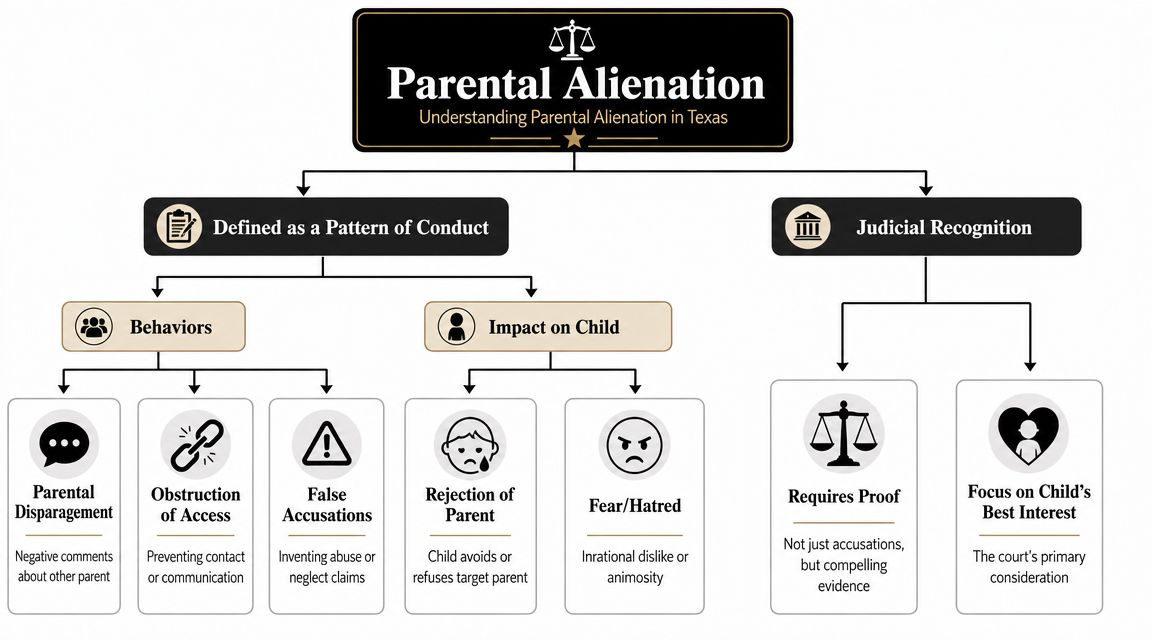
In Texas, parental alienation is not handled as a separate legal label with its own standalone statute. Instead, courts look at the behavior through the child's best interest standard. Texas courts address these issues under the Texas Family Code's best-interest framework, especially § 153.002 and the policy favoring frequent and continuing contact with both parents in § 153.001, as explained in this discussion of parental alienation under Texas law.
What that means in plain English
A judge usually isn't asking, “Did someone use the phrase parental alienation?”
The judge is asking questions like these:
- Is one parent repeatedly undermining the child's relationship with the other parent?
- Is there a pattern of conduct, not just one bad argument?
- Has the child's response changed in a way that suggests interference, pressure, or manipulation?
- Does the current custody arrangement still serve the child's welfare?
Common examples of alienating conduct
Texas courts often focus on repeated behavior, not isolated conflict. That can include:
- Disparagement: speaking badly about the other parent in front of the child
- Interference with visitation: blocking exchanges, creating excuses, or making contact difficult
- Withholding information: failing to share school, medical, or activity details
- Coaching or influencing the child: encouraging rejection, fear, or hostility toward the other parent
A lot of parents are surprised by this. They assume alienation requires dramatic misconduct. It often doesn't. The legal issue is whether one parent's repeated actions are damaging the child's bond with the other parent.
Basic custody terms that matter here
Texas uses words that can feel unfamiliar at first.
| Term | Plain-English meaning |
|---|---|
| Best interests of the child | The standard the court uses to decide what arrangement most helps the child's welfare |
| Joint managing conservatorship | Usually means both parents share important rights and duties, though not always equal time |
| Possession schedule | The calendar for when each parent has time with the child |
Courts don't usually reward the parent who sounds more offended. They protect the child's relationship with both parents when the evidence shows that relationship is being harmed.
That is why these cases are usually built around conduct, documentation, and consequences rather than labels alone.
How Texas Courts Evaluate Alienation Claims
You may walk into court convinced the problem is obvious. Your child has become cold, repeats adult phrases, or resists visits that used to go well. A Texas judge still has to answer a narrower question: what facts prove that one parent's conduct is causing this change, and what court order would effectively help the child?

The legal questions judges are really deciding
Texas courts do not decide alienation claims by asking which parent sounds more hurt or more believable at first hearing. They look for a chain of proof. Has the child's relationship with you changed in a meaningful way? Is that change tied to the other parent's repeated conduct? Has the situation reached the point that the current order no longer protects the child's best interests?
In many modification cases, that means the court will examine whether there has been a material and substantial change in circumstances. In practice, judges want to see more than conflict between co-parents. They want evidence of a pattern, a timeline, and a clear effect on the child.
That distinction matters.
Family courts see plenty of cases where a child is upset for reasons that have nothing to do with alienation. Divorce stress, remarriage, discipline differences, school problems, and a parent's own past inconsistency can all affect the relationship. A good case addresses those alternative explanations instead of ignoring them.
What a judge usually looks for in the evidence
Judges often sort alienation claims into four practical questions:
- Is the conduct repeated? One ugly exchange rarely decides a case. Ongoing interference gets attention.
- Is the conduct aimed at the relationship? The court looks for behavior that undermines contact, trust, or communication with the other parent.
- Is the child showing a measurable change? Refusal of visits, unusual hostility, anxiety tied to exchanges, or scripted accusations can matter.
- Can the court connect the two? Timing, messages, witness testimony, school records, and counselor notes often help establish that link.
That last point is where many cases weaken. Parents often know something is wrong long before they can prove it. The court still needs facts that connect suspicion to a remedy. If you want a practical overview of that proof process, this guide on how to prove parental alienation in court outlines the kind of courtroom showing these cases usually require.
Why some claims persuade the court and others do not
A persuasive claim usually shows progression. Contact became harder. The child's behavior changed. The other parent's communications or actions line up with that change. Neutral sources support the timeline.
An unpersuasive claim usually skips those steps. A parent says, “My ex is turning the child against me,” but cannot show missed exchanges, blocked calls, hostile texts, sudden school issues, therapist concerns, or any witness who observed the shift. Judges are cautious for good reason. A weak alienation accusation can itself become a weapon in custody litigation.
I often tell parents to expect the court to test both sides of the story. If the other parent says the child is resisting because of your temper, inconsistency, substance use, or long absences, the judge will examine that too. Alienation cases are rarely decided in a vacuum.
What usually hurts a parent's credibility
Certain mistakes appear over and over:
- accusing the other parent in broad labels without specific dates or events
- exaggerating normal co-parent conflict into a clinical sounding claim
- ignoring your own communication problems or missed parenting time
- coaching the child to report complaints to support your case
- arriving with conclusions instead of records, witnesses, and testimony
The strongest presentation is usually disciplined and child-focused. Show the court what changed, when it changed, what the other parent did, and how the child was affected. That is the path from concern to proof, and it is the same path judges use when deciding whether to leave orders in place or step in with stronger remedies.
Gathering Compelling Evidence for Your Case
A parent usually reaches this stage after something concrete happens. A child who used to run into your arms now refuses a visit, repeats adult phrases, or goes silent on the phone. At that point, the question is no longer whether the situation feels wrong. The question is what you can prove.

Judges do not rule on suspicion alone. They look for a clean trail from conduct, to the child's change in behavior, to the effect on the parent-child relationship. Your job is to preserve that trail before it gets buried in arguments, deleted messages, or fuzzy memories.
Start a record while events are fresh
The best evidence often begins with a simple log. I tell parents to write things down the same day, while the details are still clear.
Include:
- Dates and times of missed exchanges, blocked calls, denied FaceTime contact, or sudden schedule changes
- What happened in plain facts
- Who saw it if anyone else was present
- What the child said or did right after the event
- What order was supposed to happen under the current custody terms
That last point matters. A judge needs to see more than conflict. A judge needs to see interference with actual parenting time, communication, or access.
Preserve messages in a way the court can use
Texts, emails, app messages, school notices, and calendar records can all help if they show a repeated pattern. Save full conversations. Keep screenshots with dates visible. Download records when possible. If a message only makes sense with the exchange before it, save that too.
Do not edit around your own bad moments. Most parents have one. A few frustrated replies usually do less damage than looking selective or dishonest.
This guide on how to present evidence in a custody case in Texas is useful if you want to understand what gets traction in court and what usually turns into clutter.
Useful documents often include:
- refusals to surrender the child without a valid reason
- messages undermining scheduled possession
- records showing you were left off medical, school, or activity information
- disparaging statements sent to you or shared where others can confirm them
- call logs showing repeated interference with normal parent-child contact
Look for neutral proof
Independent witnesses often carry more weight than family members. Teachers, counselors, coaches, daycare staff, exchange supervisors, and family friends can sometimes confirm a child's sudden shift in language or behavior.
The strongest witness testimony is specific. It sounds like this: the child was calm at prior exchanges, then began refusing contact after repeated negative comments, or the parent repeatedly inserted conflict into school events where the other parent should have had access.
That kind of testimony gives the court something concrete to measure.
Later in the case, some families also rely on structured professional input. This video gives a general overview of the issue and can help parents understand how these disputes are framed in practice.
Build a timeline the judge can follow
A pile of records rarely wins these cases by itself. Organization does.
Set the evidence out in time order. Match each incident to the supporting text, email, school record, witness, or photo. Then identify the child impact tied to that event, such as a refused visit, a sudden accusation, unusual fear, or a break in communication.
Many cases become stronger when a judge observes the progression rather than isolated complaints.
Quality beats volume
Ten well-organized exhibits usually do more work than a binder full of repetitive anger. The goal is not to prove the other parent is difficult. The goal is to prove a pattern that affected the child and interfered with the relationship.
Parents also need to protect their own credibility while collecting evidence. Follow the order. Stay polite in writing. Show up on time. Keep asking for contact in a reasonable way. If the other side claims the child pulled away because of your conduct, your own records should help answer that.
One practical option is to work with counsel who handles Texas custody modifications and evidence presentation, including firms such as the Law Office of Bryan Fagan, PLLC, depending on where your case is pending and what kind of representation you need.
The Role of Experts in Proving Parental Alienation
Some cases are straightforward. Many are not. When both parents tell very different stories, judges often rely on neutral professionals to investigate family dynamics and give the court something more than competing accusations.
Custody evaluators
A custody evaluator usually performs a deeper review of the family situation. That may include interviews, records review, observations, and sometimes input from other professionals involved with the child.
Their role is not to “pick a favorite parent.” Their job is to assess the family and provide recommendations tied to the child's welfare. In alienation cases, that can be important because the evaluator may identify whether the child's rejection has a reasonable basis, whether one parent is influencing the child, or whether the conflict is more mutual and complex.
If you want a broader look at the process, this article on what a custody evaluation in Texas involves can help you understand what to expect.
Amicus attorney and Guardian ad Litem
These two roles are often confused, but they are not the same.
| Role | What they typically do |
|---|---|
| Amicus attorney | Assists the court by focusing on the child's best interests and may investigate facts, review records, and participate in the case |
| Guardian ad Litem | Investigates and reports to the court about the child's circumstances and what may best protect the child |
| Custody evaluator | Conducts a more detailed assessment of family functioning and parent-child dynamics |
A Guardian ad Litem can be especially useful where the court needs an independent view of what is happening beyond what either parent claims. A judge may give significant attention to that kind of neutral assessment.
How parents should handle experts
Don't try to perform for them. Don't coach your child. Don't flood them with accusations that have no backup.
What tends to help instead:
- bring organized records
- answer questions directly
- acknowledge your own mistakes if asked
- show that you support a healthy relationship with the other parent when it is safe and appropriate
The parent who appears most child-centered, most honest, and easiest to verify usually has an advantage with court-appointed professionals.
Potential Court Remedies for Parental Alienation
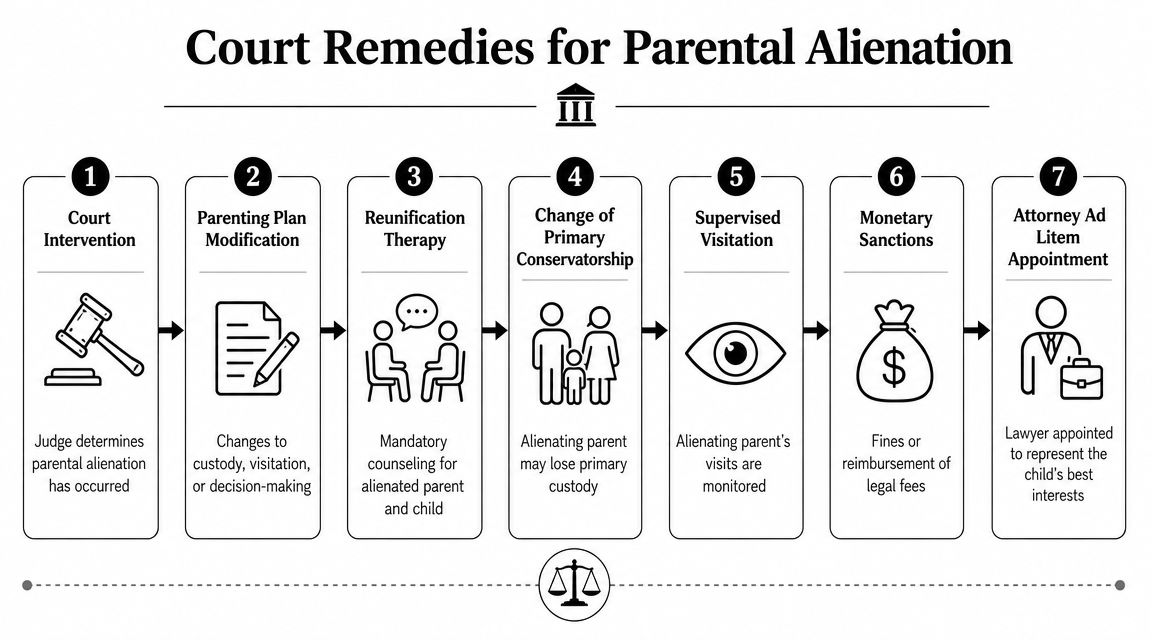
When a Texas judge finds a proven pattern of alienating conduct, the court can treat that pattern as evidence that the current conservatorship arrangement is harming the child's welfare and may respond by modifying custody, limiting the alienating parent's time, ordering counseling or reunification therapy, or appointing a guardian ad litem, as summarized in this discussion of what qualifies as parental alienation under Texas law.
Courts usually start with narrower fixes
A judge doesn't always jump straight to changing primary custody. If the court believes the problem can be corrected, it may begin with less disruptive remedies.
That can include:
- Make-up possession: extra time to restore missed parenting time
- Adjusted exchange procedures: changing where, when, or how exchanges happen
- Orders targeting specific conduct: directives not to interfere with calls, records, or visitation
- Therapy or counseling: efforts aimed at stabilizing the child and repairing the relationship
These measures can work when the behavior is established early and the interfering parent is still willing to comply.
More serious intervention when the pattern continues
If the conduct persists, the court can escalate. This is often where parents begin to understand how courts handle parental alienation in Texas custody cases in a very practical sense. Judges tend to move up the ladder when milder remedies fail.
Possible escalated remedies include:
| Remedy | What it can mean for your case |
|---|---|
| Contempt or enforcement | The court addresses violations of existing orders |
| Supervised visitation | Parenting time is monitored because the court sees ongoing risk or interference |
| Reduced decision-making authority | One parent may lose certain rights if the court believes those rights are being misused |
| Modification of conservatorship | The court changes who has primary authority or where the child primarily resides |
The most significant remedy
In severe cases, a judge may change which parent has the exclusive right to designate the child's primary residence. That is often the remedy parents mean when they say “custody changed.”
This doesn't happen because a judge dislikes rude co-parenting. It happens when the evidence persuades the court that the child's welfare is suffering under the current arrangement.
A custody modification is usually the court's answer to a continuing problem, not its first response to a single conflict.
For mothers and fathers alike, the takeaway is the same. If you're dealing with alienation, the court may have tools to help. But the remedy usually matches the proof. Stronger evidence opens the door to stronger intervention.
Your Next Steps and Key Takeaways
If you suspect alienation, don't panic and don't freeze. These cases are challenging, but they are often decided by disciplined preparation rather than dramatic moments in court.
The biggest mistake many parents make is focusing only on how unfair the situation feels. The court will care about that only if you can translate it into admissible proof, a clear timeline, and a child-focused request for relief.
A practical checklist
- Start documenting today: Keep a clean timeline of incidents, communications, and changes in your child's behavior.
- Stay compliant with current orders: Even if you're frustrated, follow the possession schedule and court rules unless your lawyer advises otherwise.
- Avoid escalating conflict: Angry confrontations, social media posts, and pressure on the child can damage your case.
- Think in legal terms: Conservatorship means decision-making rights. Possession schedules are your parenting-time orders. The best-interest standard drives the judge's ruling.
- Get legal advice early: Modification and enforcement issues are easier to shape before the record gets messy.
What works and what usually doesn't
What works is calm documentation, neutral witnesses, organized evidence, and a parent who consistently supports the child's well-being.
What usually doesn't work is relying on labels, venting to the judge, or assuming the court will “just know” what's happening.
If you're worried that your child is being pushed away from you, you don't have to guess your way through it. A focused legal strategy can help you protect your relationship with your child and ask the court for relief that fits the facts.
Frequently Asked Questions About Parental Alienation Cases
Is my child's resistance always parental alienation
No. Children can pull away for many reasons, including stress, loyalty conflicts, developmental changes, or tension that both parents contributed to. A court usually looks for a repeated pattern of one parent's conduct that undermines the relationship, not just a child who is upset or moody.
Will therapy help or hurt my case
Therapy can help if it is handled appropriately and centered on the child. It may create useful professional observations, support reunification, and reduce pressure on the child. But therapy should not be used as a way to coach a child into making legal claims. Courts are much more receptive when treatment appears genuine, measured, and focused on the child's emotional health.
What if the other parent falsely accuses me of alienation
That risk is real, which is one reason judges look carefully at evidence. If you are falsely accused, your best response is usually the same disciplined approach discussed above. Keep records. Follow orders. Communicate respectfully. Show that you support your child's relationship with the other parent when appropriate. False claims often weaken when tested against actual texts, logs, school records, and neutral testimony.
If you need help with a child custody or visitation case in Texas, our experienced attorneys can guide you every step of the way. Contact The Law Office of Bryan Fagan, PLLC today for a free consultation.