
When a judge orders a custody evaluation, most parents feel two things at once. Fear, and confusion. You may be wondering whether the court already distrusts you, whether your child will be questioned in a stressful way, and whether one mistake could shape the outcome of your case.
Those fears are real. But a custody evaluation in Texas is not a surprise interview or a casual home check. It's a formal process with rules, a purpose, and a structure. If you understand what the evaluator is looking for, and if you prepare in a steady, child-focused way, you can move through the process with more confidence and less panic.
What Exactly Is a Child Custody Evaluation in Texas?
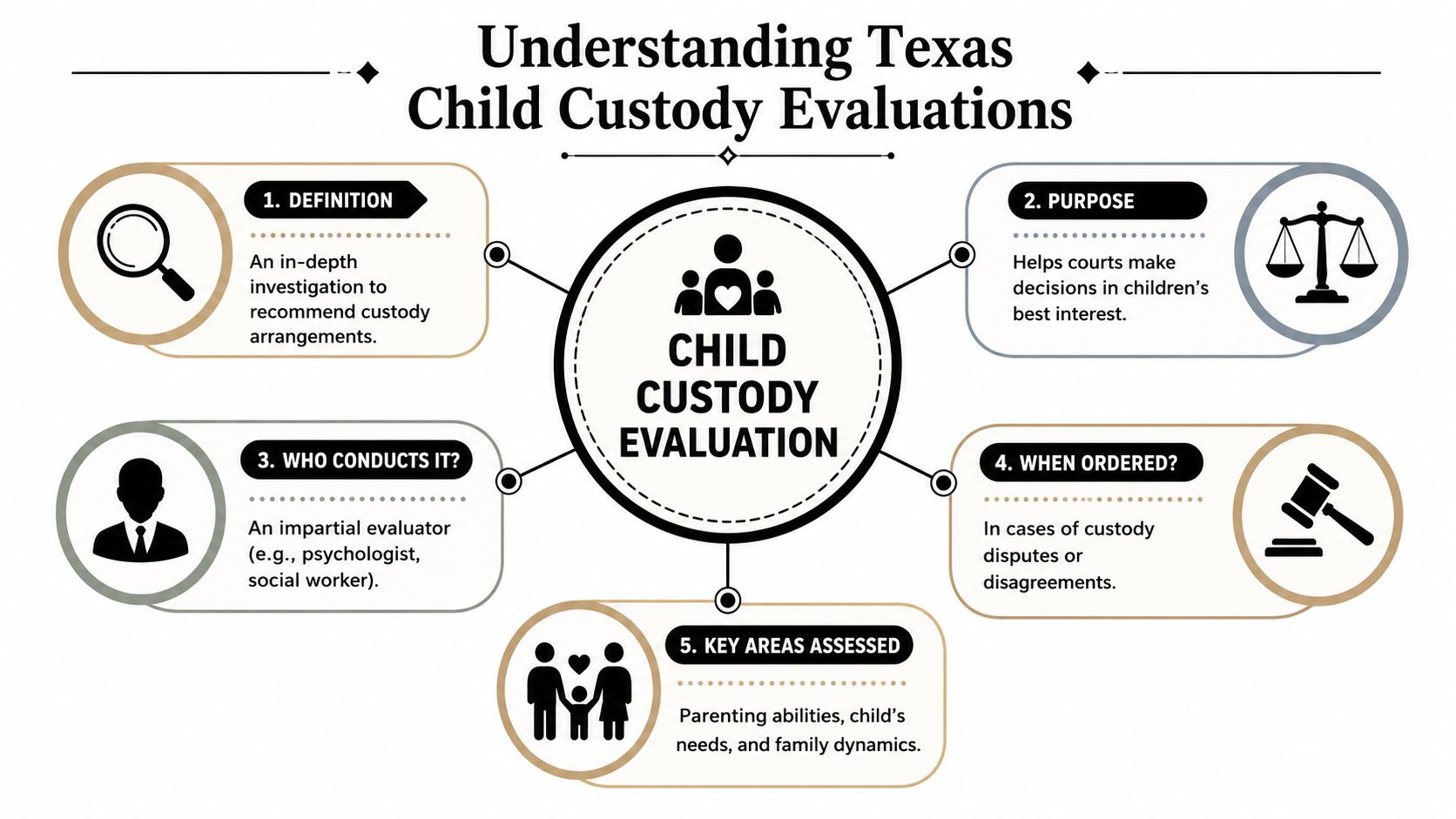
A child custody evaluation in Texas is a court-ordered forensic investigation. In plain English, that means the court appoints a neutral professional to gather information, test what each parent is saying, and give the judge a recommendation about what arrangement appears to serve the child's best interests.
Under Texas Family Code Chapter 107, this is not a routine interview process. According to this explanation of Texas custody evaluations, the evaluator may interview parents, children, significant adults, and collateral witnesses, review records, and conduct home visits. The result is usually a written report that can influence decisions about conservatorship, possession, and access.
What the court is trying to learn
Texas courts decide custody cases based on the best interests of the child. That phrase means the judge is looking for the arrangement that best supports the child's safety, stability, emotional needs, and healthy development.
A custody evaluation helps the court answer practical questions such as:
- Who can meet daily needs: Which parent is consistently handling school, medical care, routines, supervision, and emotional support.
- What home is stable: Whether each household provides a safe and appropriate environment.
- How each parent handles conflict: Whether a parent can make child-centered decisions without pulling the child into adult disputes.
- What arrangement makes sense: Whether the facts support one parent having more decision-making authority or a different possession schedule.
Key terms parents need to know
Texas family law uses words that sound technical, but they're manageable once you translate them into everyday language.
| Term | Plain-English meaning |
|---|---|
| Conservatorship | Legal rights and duties involving the child, such as making important decisions |
| Joint managing conservatorship | Both parents usually share major rights and duties, though not always equally |
| Possession | When the child is physically with each parent |
| Access | A parent's right to see or communicate with the child |
| Possession schedule | The calendar that sets out parenting time |
Sometimes parents also hear about other court-appointed roles, such as a guardian ad litem in a Texas family law case. That role is different from a custody evaluator. The evaluator's main job is to investigate and provide professional recommendations.
A custody evaluation is less about who tells the most convincing story and more about which facts hold up when the evaluator checks them.
Why that definition matters
Many parents walk into this process thinking they need to “perform well.” That usually backfires. Evaluators aren't grading charm. They're looking for credible information, consistent behavior, and signs that a parent can put the child first.
That's why understanding what is a custody evaluation in Texas and how it works matters from the beginning. Once you see it as an evidence-based investigation, your focus changes. You stop trying to win the room and start showing the court, through real facts and steady conduct, that your child's needs are your priority.
Why Would a Judge Order a Custody Evaluation?
A custody evaluation is not automatic in Texas. Judges don't order one in every custody case, and they usually won't order one just because parents disagree. Courts tend to reserve evaluations for cases where the conflict is serious enough that the judge needs deeper, neutral fact-finding.
Tarrant County's guidance states that this kind of investigation requires a minimum of 90 days and is meant for severe or complex cases as a last resort. The same guidance notes that a typical evaluation can take a couple of months to more than one year depending on complexity, allegations, witnesses, and records, as described by Tarrant County family court services. That alone tells you something important. This is not a quick custody check.
Common reasons a judge may order one
Judges often use evaluations when the usual evidence isn't enough to sort out the truth. That can happen when both parents make very different claims about the child's needs, home life, or safety.
A judge may be more likely to order an evaluation when there are concerns involving:
- Serious safety allegations: Claims involving abuse, neglect, unsafe supervision, or family violence.
- Substance use or mental health concerns: Issues that may affect parenting ability or stability.
- High-conflict co-parenting: Ongoing hostility that makes ordinary decision-making difficult.
- Disputes about major parenting roles: Conflict over who should make key decisions or where the child should primarily live.
- Relocation or disruption concerns: Cases where a proposed move or major household change could affect the child's routine and relationships.
It usually isn't a punishment
Parents often assume the order means the judge thinks they've done something wrong. Usually, that's not the point. In many cases, the court is saying the dispute is too fact-specific for guesswork.
If you want a broader view of the legal lens judges use in these cases, this guide on how Texas judges make child custody decisions can help put the evaluation in context.
Practical rule: If an evaluation was ordered, stop asking whether it's “fair” and start preparing for what the evaluator will verify.
What works and what doesn't
What works is treating the evaluation as a serious legal event. Meet deadlines. Follow instructions. Keep your child's routine stable. Speak carefully and truthfully.
What doesn't work is acting offended, refusing to cooperate, or assuming the evaluator will somehow “see through everything” without documentation. In a contested case, unsupported claims usually stay just that. Claims.
The Custody Evaluation Process Step by Step
The process feels less overwhelming when you break it into parts. While each evaluator has their own methods within the court's order, most Texas custody evaluations follow a similar path.
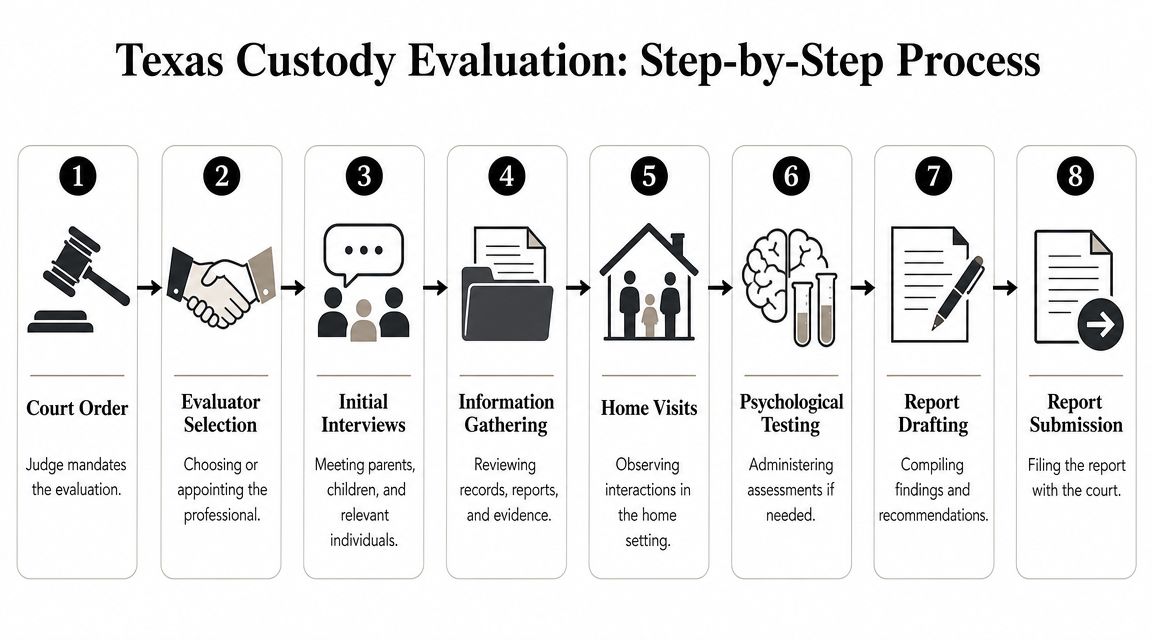
The process usually begins with the court order
The judge signs an order that defines the scope of the evaluation. That order may identify the evaluator or explain how one will be selected. It also usually sets expectations about cooperation, document sharing, and the issues the evaluator should address.
At this stage, parents should read the order carefully with their attorney. Small details matter. If the order mentions deadlines, records, releases, or interview requirements, follow them precisely.
The evaluator gathers the paper trail
One of the earliest phases often involves forms, background information, and records. You may be asked to provide names of doctors, schools, counselors, childcare providers, or other adults who know the child well.
The evaluator may review:
- School information: Attendance, performance, behavior reports, and communications.
- Medical and mental health records: Information tied to the child's care and, when relevant, parental functioning.
- Court and criminal records: Prior orders, filings, and any documented legal concerns.
- Other relevant records: Materials that help show caregiving history, household stability, and compliance with court orders.
Texas custody evaluations are built around multi-source corroboration, meaning the evaluator compares what each parent says against records, observations, and third-party information. That framework is described in this discussion of child custody evaluations in Texas.
Interviews and observation come next
Parents are usually interviewed separately. The evaluator may ask about the child's routine, discipline, school involvement, health needs, communication with the other parent, and the history of the dispute.
Children may also be interviewed or observed in age-appropriate ways. The evaluator isn't asking a child to “pick a side.” The purpose is to understand the child's experience, adjustment, and relationship with each parent.
Home visits may happen as part of this stage. The evaluator may look at safety, sleeping arrangements, household structure, and how the child interacts with the parent in that environment.
Here's a helpful overview if you prefer a visual explanation before your first appointment:
Collateral contacts can shape the report
Evaluators often speak with “collateral witnesses.” These are people with firsthand knowledge of the child or your parenting, such as a teacher, therapist, doctor, coach, or close family member.
That part of the process matters because it tests reliability. If a parent says they handle school communication but school records and teacher feedback suggest otherwise, the evaluator will notice. If a parent claims the other home is chaotic but multiple sources describe it as stable, that matters too.
The evaluator is looking for patterns. One strong interview won't overcome a weak record if the rest of the evidence points the other way.
The final product is a written report
After interviews, observations, and record review, the evaluator prepares a report for the court. It commonly includes the information reviewed, the evaluator's analysis, and recommendations about conservatorship, possession, access, and sometimes related services or safeguards.
This stage can feel like the finish line, but it's better to think of it as the point where the investigation becomes evidence.
How Parents Can Prepare for a Custody Evaluation
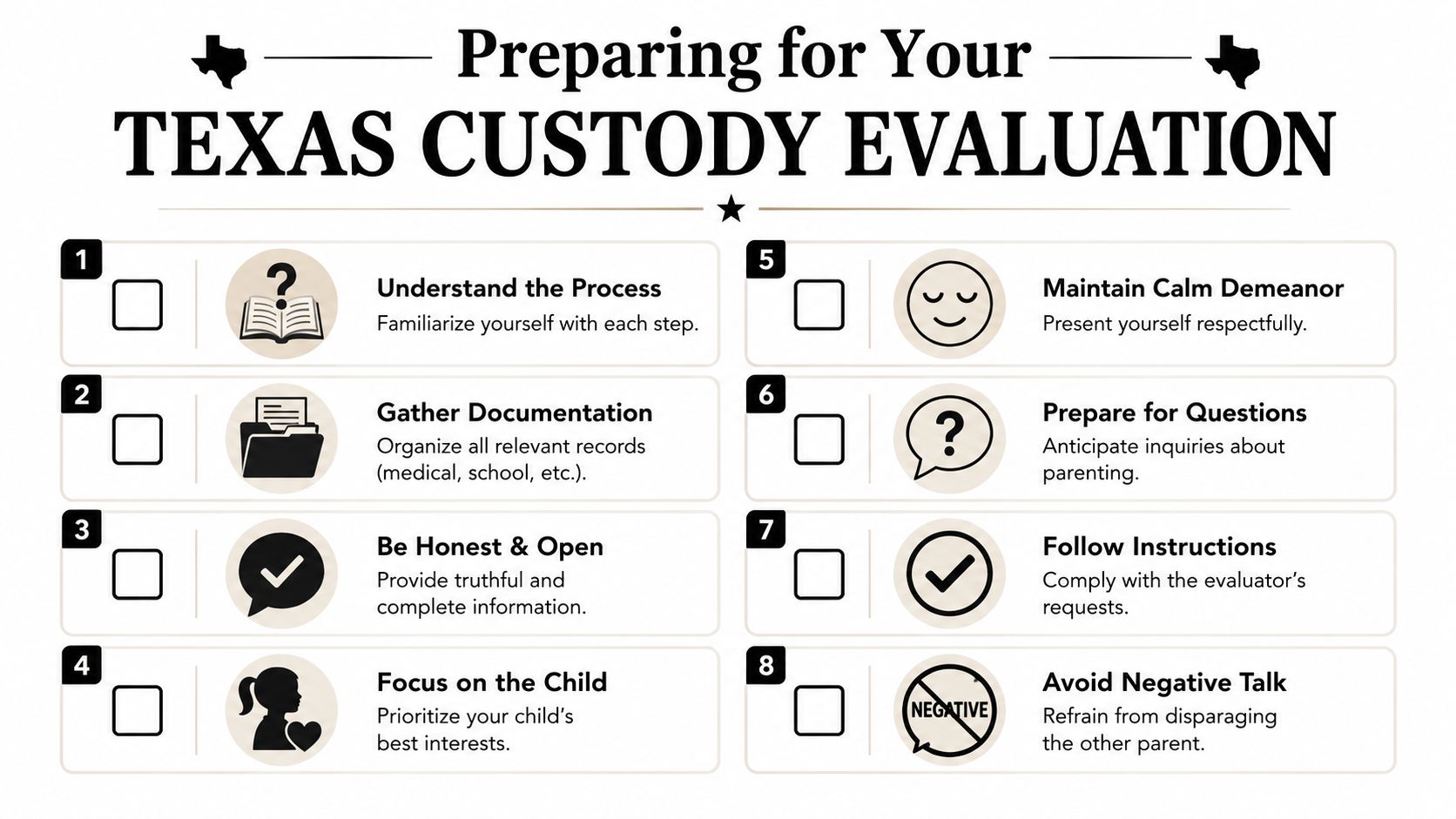
Preparation should be calm, organized, and ethical. The goal is not to “game” the evaluator. The goal is to present a clear, verifiable picture of your parenting and your child's daily life.
Build your case with records, not speeches
Because evaluators compare statements against outside evidence, your preparation should focus on what can be confirmed. School records, medical records, a safe home environment, and credible collateral witnesses usually carry more weight than dramatic accusations.
If you're organizing material for court and for the evaluator, this article on how to present evidence in a Texas custody case is a useful companion resource.
A practical preparation file often includes:
- Parenting records: School emails, appointment confirmations, activity calendars, and proof of participation in the child's day-to-day life.
- Home information: Photos or documents showing the child has appropriate space, supplies, and a stable routine.
- Communication history: Respectful, relevant communications that show cooperation or efforts to solve parenting issues.
- Witness list: Teachers, doctors, counselors, relatives, or caregivers who know the facts firsthand.
Show steadiness in your conduct
Parents sometimes focus so much on documents that they forget the evaluator is also watching how they function under stress. Your demeanor matters. So does your willingness to follow instructions.
Here are habits that usually help:
- Answer directly: Don't dodge hard questions. If there's a problem in your history, acknowledge it and explain what changed.
- Stay child-focused: Talk about your child's needs, routine, learning, health, and emotional life. Don't turn every answer into an attack on the other parent.
- Be consistent: If your timeline, records, and witness accounts line up, your credibility gets stronger.
- Keep the child out of the conflict: Don't coach your child, rehearse statements, or use the child to deliver adult messages.
Get your co-parenting systems in order
One practical issue that often affects credibility is disorganization. Missed exchanges, unclear calendars, and confusing communication threads can make a stable parent look unreliable. In some families, digital tools help reduce that noise. Parents who need a shared scheduling system may find Everblog's co-parenting app solutions useful for organizing schedules, routines, and communication in one place.
If you're working with counsel, an attorney can also help you prepare for the evaluator's likely areas of focus. The Law Office of Bryan Fagan, PLLC handles child custody matters involving conservatorship, possession, modifications, and enforcement, which often intersect with this kind of evaluation.
What helps most: organized records, calm communication, and a clear pattern of putting the child first.
Emotional resilience matters too
This process can make even good parents feel defensive. Try not to let that emotional pressure control your presentation. A parent who seems combative, scattered, or obsessed with punishing the other side can lose credibility even when some of their concerns are legitimate.
Keep your child's routine as normal as possible. Sleep matters. Showing up on time matters. Speaking respectfully matters. If you need support from a counselor, trusted family member, or faith community, use it. Emotional regulation is not just good for you. It's good for your child, and it often shows.
Understanding the Evaluator's Final Report
By the time the report arrives, most parents are exhausted. They've answered questions, gathered records, worried about every interaction, and waited through a process that can feel very personal. It's natural to open the report and treat it like the final word.
It isn't the final word. It is an influential piece of evidence.
What the report usually contains
Most custody evaluation reports include a summary of what the evaluator reviewed, who was interviewed, what observations were made, and how the evaluator analyzed the family dynamics and parenting concerns at issue.
The report may address:
| Part of the report | What it often covers |
|---|---|
| Background summary | Family history, court issues, and the concerns that led to the evaluation |
| Information reviewed | Interviews, records, home observations, and collateral contacts |
| Analysis | The evaluator's view of parenting strengths, limitations, risks, and family dynamics |
| Recommendations | Suggested conservatorship terms, possession schedule, access terms, or related conditions |
How much weight does it carry
In real courtroom practice, the report often matters a great deal because it pulls many sources of information into one professional recommendation. Judges may consider it carefully when deciding who should have decision-making authority, what possession schedule fits the child, and whether protective conditions are needed.
But the evaluator does not decide the case. The judge does.
That distinction matters for both sides. If the report supports your position, it may help move the case toward settlement. If it doesn't, the report can still be challenged, tested, and weighed against other evidence.
A strong report can shape the case. It does not replace the court's job.
Read it with a practical eye
When reviewing the report, don't just ask whether you like the conclusion. Ask whether the evaluator accurately described the facts, relied on complete information, and drew conclusions that match the underlying evidence.
A careful review often focuses on questions like these:
- Were important records omitted?
- Did the evaluator misunderstand a timeline?
- Do witness summaries match what those people know?
- Are the recommendations tied to facts, or do they seem to skip steps?
An emotional reaction is normal. A strategic reaction is better.
Your Next Steps After the Evaluation Report
Once the report is complete, your next move depends on whether the recommendations fit the facts of your case and your child's needs.
If you agree with the report, it may become a roadmap for settlement. Many cases resolve at this point because the parents now have a neutral recommendation to work from. If the report supports a workable conservatorship arrangement and a realistic possession schedule, your attorney may be able to use it to negotiate final orders with fewer hearings and less conflict.
If you disagree with the report, don't assume the case is over. Start by reviewing it carefully with counsel. Look for factual errors, missing records, misunderstood events, or conclusions that don't match the evidence. Your attorney may decide to challenge the report through objections, cross-examination of the evaluator, presentation of contrary witnesses, or additional documentary evidence.

Key takeaway
A custody evaluation can feel invasive, slow, and emotionally draining. But it becomes more manageable when you treat it for what it is. A fact-driven investigation into what arrangement serves your child's best interests.
Parents usually do best when they stay organized, truthful, respectful, and focused on the child instead of the conflict. That applies to mothers, fathers, grandparents, and other caregivers alike. Courts want stability, sound judgment, and credible evidence. Those are the things to build.
If you're trying to understand what is a custody evaluation in Texas and how it works, the short answer is this. It's a serious court process, but it is one you can prepare for with the right guidance and a clear plan.
If you need help with a child custody or visitation case in Texas, our experienced attorneys can guide you every step of the way. Contact The Law Office of Bryan Fagan, PLLC today for a free consultation.