Skip to content
When your child’s future is on the line, understanding your rights and options matters most. The idea of a courtroom battle over custody can be terrifying, but in Texas, there's a more constructive path forward: mediation. Think of it less like a fight and more like a guided conversation, where a neutral third party—the mediator—helps you and the other parent build a parenting plan together, away from the pressure of a judge. It’s a space to find common ground and start building a stable future for your child.

Your First Step Toward a Cooperative Co-Parenting Future
Facing a custody dispute is one of the most stressful experiences a parent can go through. The uncertainty about where your child will live and how your relationship with them will change can feel completely overwhelming. Fortunately, the Texas family court system offers a constructive path forward that avoids the adversarial nature of a trial: custody mediation.
Mediation isn't about winning or losing; it’s about practical problem-solving. The entire process is designed to empower you and the other parent to make the critical decisions about your child’s life, rather than leaving those choices in the hands of a judge who doesn’t know your family. It provides a structured, private setting to talk through disagreements and find respectful resolutions.
Why Mediation Matters for Texas Families
In many Texas counties, a judge will require you to try mediation before you can proceed to a final hearing. This isn't just a procedural hoop to jump through. It reflects a core principle of Texas law, found in Chapter 153 of the Texas Family Code: every decision must prioritize the “best interest of the child.” The courts recognize that parents, when given the right tools and support, are usually the best people to create a lasting parenting plan.
When mediation is successful, it helps you and your co-parent:
- Keep Control: You get to decide the details of your child's schedule and upbringing, not a stranger in a black robe.
- Lower the Conflict: The process encourages cooperation, which can save you the emotional and financial drain of a drawn-out court fight.
- Create Custom Solutions: You can craft a flexible parenting plan that actually works for your family's unique situation—something a one-size-fits-all court order often can't do.
- Set a Healthy Example: Working together shows your kids how to handle disagreements constructively, a lesson that will serve them for life.
To lay a strong foundation for a cooperative co-parenting future, it's crucial to understand and practice active listening in communication. This skill is fundamental to finding common ground during negotiations.
This guide will pull back the curtain on what happens in custody mediation, walking you through every stage from the legal basics to preparing for the day itself. Our goal is to give you the clarity and confidence you need to advocate for your child effectively and build a stable, loving future for your family.
The Legal Framework for Custody Mediation in Texas
When you're dealing with your child's future, understanding the legal side of things is the first step toward feeling in control. In Texas, custody mediation isn't just a friendly suggestion; in most cases, it's a required step in the legal process. Before you can have your day in court for a final trial, the judge will almost always order you and the other parent to first sit down and try to work things out in mediation.
This requirement is rooted in a fundamental principle of the Texas Family Code: every single decision made about a child has to be in their “best interest.” Texas law operates on the belief that parents—not judges who don't know your family—are the best people to figure out what a stable, loving environment looks like for their own kids. Mediation gives you the formal, structured opportunity to do exactly that.
You'll Hear These Legal Terms a Lot
As you step into the world of custody negotiations, you will encounter some specific legal language. Don't let it intimidate you. Understanding these terms is crucial because they are the building blocks of any parenting plan you create.
Here's a plain-English explanation of the key terms:
Key Texas Custody Terms Explained
| Legal Term | Plain-English Explanation |
|---|---|
| Conservatorship | This is the Texas word for custody. It defines your legal rights and responsibilities as a parent, like the right to make decisions about your child's schooling or healthcare. |
| Joint Managing Conservatorship | This is the standard arrangement in Texas. It means both parents share the rights and duties of raising their child. It does not automatically mean a 50/50 time split. |
| Possession Order | This is the visitation schedule. It’s the calendar that spells out exactly when the child will be with each parent—covering weekdays, weekends, holidays, and summer break. |
| Mediated Settlement Agreement (MSA) | If you reach an agreement in mediation, it's written down in this document. Once it's signed by you, the other parent, and your lawyers, it's binding and irrevocable. |
Think of these terms as the framework. Mediation is where you and the other parent fill in all the details that make sense for your family.
Why Texas Pushes for Mediation So Hard
The state’s focus on mediation isn't unique; it's part of a bigger picture. Courts and legal experts everywhere have recognized that children do better when their parents can find common ground instead of fighting it out in a courtroom.
For example, family law statistics from Sweden show that in 2024, the parents of 21,052 children used mediation to sort out custody and support issues. This is just one piece of evidence showing a worldwide shift toward collaborative parenting solutions. You can learn more about these global family law trends if you're interested in the data.
In Texas, the legal system encourages mediation because it puts the decision-making power back into the hands of the parents. It's a structured, legally significant process where your agreements today become the rules that govern your co-parenting relationship tomorrow.
At the end of the day, knowing the legal landscape helps you see mediation for what it truly is: not just an informal chat, but a serious negotiation with permanent consequences. It’s your chance to build a solid foundation for your child's future, with Texas law as your guide and your family's unique needs as the blueprint.
A Step-by-Step Walkthrough of a Typical Mediation Day
If you’ve never been through it, walking into a mediation session can be nerve-wracking. It’s completely normal to feel like you’re stepping into the unknown. That’s why having a clear picture of what the day will actually look like can replace much of that anxiety with a sense of control.
First, you won’t be in a courtroom. Most mediations happen at the mediator’s office or another neutral location. When you arrive, you and your attorney will be shown to your own private conference room, while the other parent and their lawyer get a separate one. This is designed to give you a confidential space to talk freely with your lawyer and think through proposals without feeling pressured.
The Caucusing Process Unpacked
Once everyone is settled, the mediator kicks off a process called caucusing. This is the heart of the entire day. The mediator, who acts as a neutral guide, will move back and forth between the two rooms, serving as a go-between and a problem-solver.
They will usually start by coming to your room to introduce themselves, explain the confidentiality rules, and then listen. This is your chance to lay out your perspective—your goals, your biggest concerns, and what you genuinely believe is in the best interest of your child. You can explain what a realistic possession schedule (the visitation calendar) looks like for your family's life.
From there, the real work begins. The mediator will carry proposals, offers, and counteroffers from one room to the other. But a good mediator does more than just relay messages. They help translate emotionally charged points into practical solutions and may even suggest creative ideas you and the other parent haven't considered. Stuck on a holiday schedule? The mediator might suggest an alternating-year plan or a way to split Christmas Day that honors both of your family traditions.
Key Topics on the Table
Throughout these talks, you’re essentially building a complete parenting plan from the ground up. The conversation will naturally cover all the critical pieces of raising your child in two separate homes.
- The Possession Schedule: This is the nitty-gritty of the regular school-year calendar, figuring out who has the child on which weekends and how mid-week visits will work.
- Holiday and Vacation Time: You'll need to decide how to split up major holidays like Thanksgiving and Christmas, plus spring break and the long summer vacation.
- Decision-Making Rights: This is a big one. It covers who gets the final say on important decisions about your child’s education, non-emergency medical care, and psychological treatment.
- Child Support: While Texas has guidelines that provide a formula, you can negotiate specifics here, like who covers health insurance and how other major expenses are handled.
This flowchart shows how mediation fits into the bigger picture, acting as the essential bridge between going to court and getting a final, signed agreement.
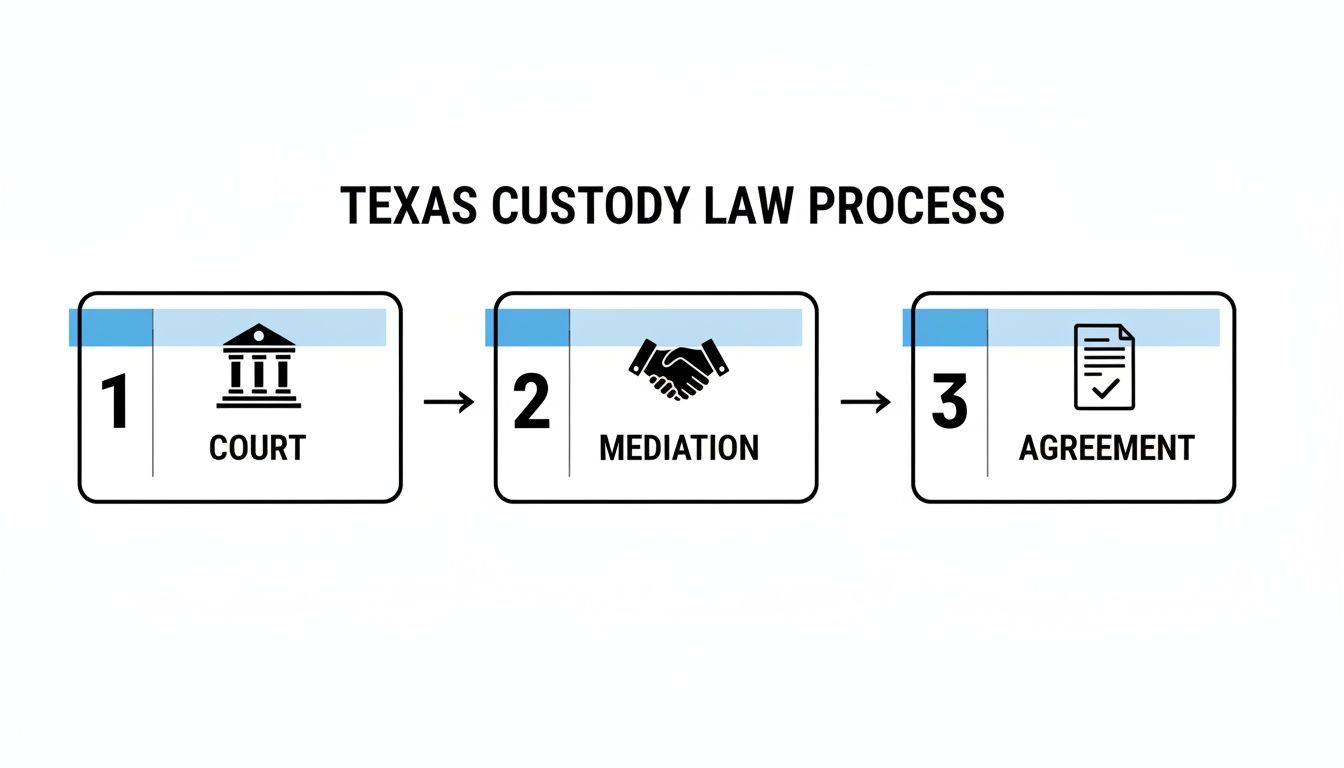
As you can see, mediation isn't just an optional detour; it's a central part of the legal journey toward getting an enforceable parenting plan that works for your family.
Reaching the Finish Line
This back-and-forth negotiation continues throughout the day. It can be long and emotionally draining, so being prepared is key. Your attorney will be right there with you the entire time, giving you legal advice, helping you weigh the pros and cons of each proposal, and making sure your parental rights are protected.
The ultimate goal of the day is to walk away with a signed Mediated Settlement Agreement (MSA). This is a powerful document. Once signed, it is legally binding and irrevocable, meaning you can't just change your mind later. It’s the official record of all the compromises and solutions you and the other parent worked so hard to reach.
If you successfully agree on everything, the mediator and attorneys will draft the MSA right then and there. You'll review every word of it with your lawyer before you sign anything. Once signed, that agreement is filed with the court and becomes a final, formal court order, bringing this chapter of your legal journey to a close.
Understanding Each Person's Role in the Process
Walking into a custody mediation can feel like stepping onto a stage without knowing the script. To feel confident, you first need to understand who the other players are and what part they play. Knowing each person’s role—the mediator, your attorney, and yourself—demystifies the entire process and empowers you to focus on what matters most: your child.
Think of the mediation room as having three distinct but equally important jobs. Each person has a specific function, and when you know what to expect from everyone, the day becomes far less intimidating and much more productive.
The Mediator: The Neutral Facilitator
The mediator is the director of the day, but they are not the judge. Their job is to be a completely neutral, third-party professional who facilitates communication and guides the negotiation. They cannot give legal advice, force you to accept a deal, or take anyone's side.
Instead, a good mediator is an expert in conflict resolution. They are there to:
- Keep the Conversation Productive: They help de-escalate emotional moments and re-focus the discussion on practical, child-centered solutions.
- Explore Creative Options: Mediators can often suggest compromises or unique scheduling arrangements that neither parent had considered.
- Serve as a Go-Between: By moving between separate rooms (a process called "caucusing"), they create a buffer that allows for more honest conversations and less direct conflict.
Their sole allegiance is to the process and to helping both parties find common ground. They don’t have a stake in the outcome other than helping you reach a mutually agreeable resolution.
Your Attorney: Your Dedicated Advocate
While the mediator is neutral, your attorney is anything but. Your lawyer is your advocate, strategist, and legal guide, and their only duty is to protect your parental rights and your child’s best interests.
Throughout the day, your attorney will be by your side to:
- Provide Legal Counsel: They will explain the legal implications of every proposal and ensure you understand your rights under the Texas Family Code.
- Evaluate Offers: Your lawyer will help you analyze offers from the other parent, advising you on whether a proposal is fair, realistic, and legally sound.
- Draft the Agreement: If you reach a settlement, your attorney will help draft or review the final Mediated Settlement Agreement (MSA) to ensure the language is precise and protects your family’s future.
Your attorney is your teammate, providing the legal expertise you need to make informed decisions with confidence.
Your voice is the most important one in the room when it comes to your child's needs, but your attorney ensures that voice is heard within the proper legal framework, turning your parental insights into an enforceable court order.
You: The Parent and Ultimate Decision-Maker
Your role is the most critical of all. While the mediator guides the process and your attorney provides legal advice, you are the expert on your child. You provide the essential insight into your child's personality, needs, and daily life that no one else can.
Your job is to stay focused on finding solutions and to make the final decisions. While you should lean heavily on your attorney’s counsel, you are the one who must ultimately agree to the final terms.
In some complex cases where a child's voice needs to be represented more directly, the court may appoint a special advocate. You can learn more about what a Guardian Ad Litem does in our guide. Understanding this structure helps you lean on the right people for the right reasons, ensuring a more successful outcome.
What Happens After the Mediation Session Ends?
After a long day of hard work and negotiation, your mediation session will eventually conclude. The good news is that no matter how the day ends, there’s always a clear path forward. What happens in custody mediation almost always funnels into one of three outcomes, and knowing what they are ahead of time can help you feel ready for whatever comes next.
The best-case scenario, and the one everyone hopes for, is a Full Agreement. This is the gold standard. It means you and the other parent managed to find common ground on every single issue related to your child, from who gets them on Thanksgiving to how you’ll handle doctor’s appointments.
When this happens, your attorneys get to work drafting a Mediated Settlement Agreement (MSA). This isn't just a friendly handshake; under the Texas Family Code, an MSA is a legally binding contract that becomes irrevocable the moment it’s signed. Your lawyers will then present this document to the judge, who signs it into a final, enforceable court order. Your case is officially concluded.
When You Agree on Some Things but Not All
Sometimes you can make huge strides without getting every last detail nailed down. This is called a Partial Agreement, and it is still a significant victory. It proves that you and your co-parent can work together and find solutions on major issues.
For example, you might settle the entire school-year possession schedule but get stuck on how to split up the summer break. In that case, all the points you agreed on are locked into a Partial MSA. This is incredibly valuable because it narrows the list of issues a judge has to decide on later, which saves everyone time, money, and stress. The few remaining issues are then left for the court to handle at a later hearing or trial.
Reaching an Impasse Is Not a Failure
The third and final possibility is an impasse. This is just a formal way of saying that after giving it your best shot, you and the other parent couldn’t reach an agreement on the core issues. It’s so important to understand that an impasse is not a personal failure or a legal dead end.
Reaching an impasse simply means that the collaborative process didn't produce a final resolution, and the next step is to prepare your case for a judge. Your attorney will then shift focus from negotiation to litigation, preparing to advocate for you and your child’s best interests in court.
Mediation is a powerful tool for families, and not just here in Texas. Research consistently shows that it helps parents sidestep drawn-out court battles. For instance, a 2023 global report found that around 22% of international child abduction cases were resolved by parents reaching an agreement, often through mediation, without ever needing a judge to rule. It’s a testament to how mediation can lead to faster, more stable outcomes for kids. You can discover more insights on the use of mediation in international family law to see its broader impact.
To give you a clearer picture, here’s a quick breakdown of the three outcomes and what to expect from each.
Mediation Outcomes and Next Steps
| Outcome | What It Means | What Happens Next in the Legal Process |
|---|---|---|
| Full Agreement | You and the other parent have resolved all contested issues. | Your attorneys draft a Mediated Settlement Agreement (MSA). A judge signs it, and it becomes a final, enforceable court order. Your case is concluded. |
| Partial Agreement | You've agreed on some issues but still have outstanding disputes. | The agreed-upon terms are put into a Partial MSA. The remaining unresolved issues will be decided by a judge at a later hearing or trial. |
| Impasse | You were unable to reach an agreement on the key issues. | The case proceeds toward trial. Your attorney will prepare to present your case to a judge, who will make the final decisions. |
No matter which path you end up on, the mediation process always brings clarity. You’ll either walk away with a signed agreement ready to become a court order or a much sharper understanding of the exact issues a judge will need to decide. Our guide on what goes into custody agreements in Texas offers more detail on the specific terms you'll be hashing out. Each outcome has a clear, structured next step, so you’re always moving forward.
Your Practical Checklist for a Successful Mediation
Walking into mediation without a plan is like trying to build a house without a blueprint. While your attorney will guide you through the legal aspects, the more prepared you are, the more confident and active you can be in shaping the outcome. A successful mediation day often starts weeks before you ever sit down at the negotiating table.
This isn't just a list of documents to gather. Think of it as a way to organize your thoughts, get crystal clear on your goals, and mentally prepare for a day that’s as emotionally challenging as it is legally important.

Step 1: Figure Out Your Priorities
Before you can negotiate, you have to know what is most important for your child. Take some quiet time to separate your absolute must-haves from your nice-to-haves. This isn't about scoring points; it's about focusing on what is truly in your child’s best interest.
- Must-Haves: These are your non-negotiables—the things critical for your child's stability and well-being. Maybe it's the right to make medical decisions or ensuring your child stays in their current school district.
- Nice-to-Haves: These are things you'd like but could be flexible on to reach an agreement. For instance, you might prefer a specific holiday schedule but would be open to an alternative if it means securing a more important goal.
Step 2: Draft a Proposed Possession Schedule
One of the most powerful tools you can bring to the table is a detailed, proposed possession schedule. Don't just think about a typical school week. Get granular and create a comprehensive calendar that covers every part of your child’s life.
- School Year: Map out a clear plan for weekdays and weekends.
- Holidays: Think through Thanksgiving, Christmas, spring break, and even three-day weekends.
- Summer: Come up with a fair and practical way to divide the summer vacation.
- Birthdays: Include specific plans for your child’s birthday as well as each parent’s birthday.
Having a written proposal shows you've thought seriously about the details and gives the mediator a concrete starting point for negotiations.
Step 3: Get Your Key Documents and Information Organized
Being organized is a huge stress reliever. It frees you up to focus on the conversation instead of searching for information. Gather everything in a binder or a digital folder so you and your attorney can find what you need quickly.
Your document checklist should include:
- Child-Related Schedules: School calendars, extracurricular activity schedules, and a list of doctors or therapists.
- Financial Information: Recent pay stubs, health insurance costs, and proof of any special expenses for your child.
- Communication Records: A log of relevant and respectful communication with the other parent.
- Proposed Schedules: A printed copy of the detailed possession schedule you drafted in Step 2.
This level of preparation isn't just smart; it reflects a global trend in family law. The U.S. government's 2024 Annual Report on International Child Abduction shows that in 2023, 136 outgoing abduction cases were resolved, leading to the return of 205 children—often through voluntary paths like mediation. For Texas parents, this data confirms that negotiation is a powerful tool for achieving quicker, less traumatic outcomes. You can read the full government report on these findings.
Your attorney is your strategic partner. A candid pre-mediation meeting ensures you walk in aligned on goals, know your bottom line, and are ready to respond to potential offers from a position of strength.
By following this checklist, you turn anxiety into action. To dive deeper, check out our guide on how to prepare for mediation in Texas. You'll be well-equipped to advocate for your child and work toward a stable, loving future.
Common Questions About Texas Custody Mediation
Even after walking through the entire process, it's completely normal to have lingering questions. The stakes are incredibly high, and you deserve to feel as clear and confident as possible. We've gathered some of the most common questions we hear from parents just like you and answered them in plain English.
Is What I Say in Mediation Confidential?
Yes, with very limited exceptions. The Texas Family Code makes the mediation process confidential. This creates a safe space where you and the other parent can have open, honest conversations without the fear that every word will be used against you in court if you don't reach a deal.
You can freely explore potential compromises knowing the mediator can't be called to testify and your settlement proposals generally won't be admissible as evidence. The only major exception is the duty to report suspected child abuse or neglect. A child's safety will always come first.
What if the Other Parent Refuses to Negotiate Fairly?
This is a common fear. It's important to distinguish between tough negotiation and true "bad faith." The other parent is allowed to hold firm positions, even ones you think are unreasonable. However, if they are just going through the motions with no real intention of negotiating, that's a different story.
A mediator can't force anyone to agree, but they are experts at identifying roadblocks. If one parent is being completely unreasonable, the mediator will eventually declare an impasse. Your attorney will then make sure the court knows you participated in good faith, and you’ll shift your focus to preparing for trial, where a judge can hear your reasonable proposals.
Can We Change Our Mediated Agreement Later On?
Yes, a Mediated Settlement Agreement (MSA) can be changed, but it requires a formal legal process called a modification. Life happens—people get new jobs, they need to relocate, or a child's needs evolve as they grow. What worked last year might not be workable today.
To modify a court order based on an MSA, you must prove two things to the judge: that there has been a "material and substantial change" in the circumstances of the child or a parent, and that the change you're proposing is in the "best interest of the child." The legal standard is intentionally high to ensure stability.
A Mediated Settlement Agreement is a legally binding contract intended to provide long-term stability. While modifications are possible, the high legal standard underscores the importance of getting the agreement right the first time.
How Much Does Mediation Usually Cost?
The cost of mediation varies. Typically, you and the other parent will split the mediator's fee. Mediators charge either by the hour or offer a flat fee for a half-day or full-day session, and their rates depend on their experience and location.
In addition to the mediator's fee, you’ll have your own attorney's fees for the time they spend preparing with you and attending the session. Because every family's situation is unique, the best way to get a realistic idea of the cost is to discuss it directly with your lawyer during a consultation.
Key Takeaways and Next Steps
- Mediation is Required: In Texas, mediation is a mandatory step in most custody cases, designed to empower parents.
- You Are in Control: Unlike a trial, mediation puts you and the other parent in charge of the outcome.
- Preparation is Power: Walking in with clear priorities and a proposed schedule gives you a significant advantage.
- An Agreement is Binding: A signed Mediated Settlement Agreement (MSA) is irrevocable and becomes a final court order.
- You Have a Path Forward: Whether you reach a full agreement, a partial one, or an impasse, there is always a clear next step in the legal process.
If you need help with a child custody or visitation case in Texas, our experienced attorneys can guide you every step of the way. Contact The Law Office of Bryan Fagan, PLLC today for a free consultation.