Skip to content
When your teenager says they want to live with one parent instead of the other, it can hit hard. You may feel relieved, hurt, angry, or scared all at once. Most parents in that moment ask the same question: will a judge let my teen decide?
In Texas, the answer is more nuanced than most families expect. A teenager's opinion matters, but it is not the whole case. Judges look at the teen's wishes alongside stability, safety, maturity, school support, and each parent's ability to make sound decisions for the child.
That matters even more when a teen is drawn to the more permissive parent. Many parents worry that rules, structure, therapy, curfews, or academic expectations will make them look less appealing in the short term. In court, though, short-term appeal and long-term best interest are not the same thing. That distinction is at the center of what judges consider for teenagers in custody cases in Texas.
Your Teenager Wants a Say in Custody What Happens Now
The first thing to know is that your child's statement is important, but it isn't the end of the discussion. A teenager may strongly prefer one home. The court still has to decide whether that preference fits the child's overall welfare.
Parents often make two mistakes right away. One is assuming the teen now controls the case. The other is dismissing the teen's feelings entirely. Neither approach helps. A court wants to see a parent who listens, stays calm, and keeps the focus on the child's well-being.
A teenager's preference can shape a custody case. It does not replace the judge's job.
If your teen has expressed a preference, start with a few practical steps:
- Stay neutral in the moment. Don't reward the child for choosing you, and don't punish them for choosing the other parent.
- Ask open questions. Find out whether the reason is school, conflict, freedom, friendships, stress, or something more serious.
- Write down concerns carefully. Keep notes about changes in grades, attendance, mood, discipline issues, therapy, transportation problems, or conflict between households.
- Avoid coaching. Judges are alert to pressure and rehearsed language.
This stage is less about winning an argument and more about understanding what is really driving your teen's request.
The Foundation Texas Custody and the Best Interest Standard
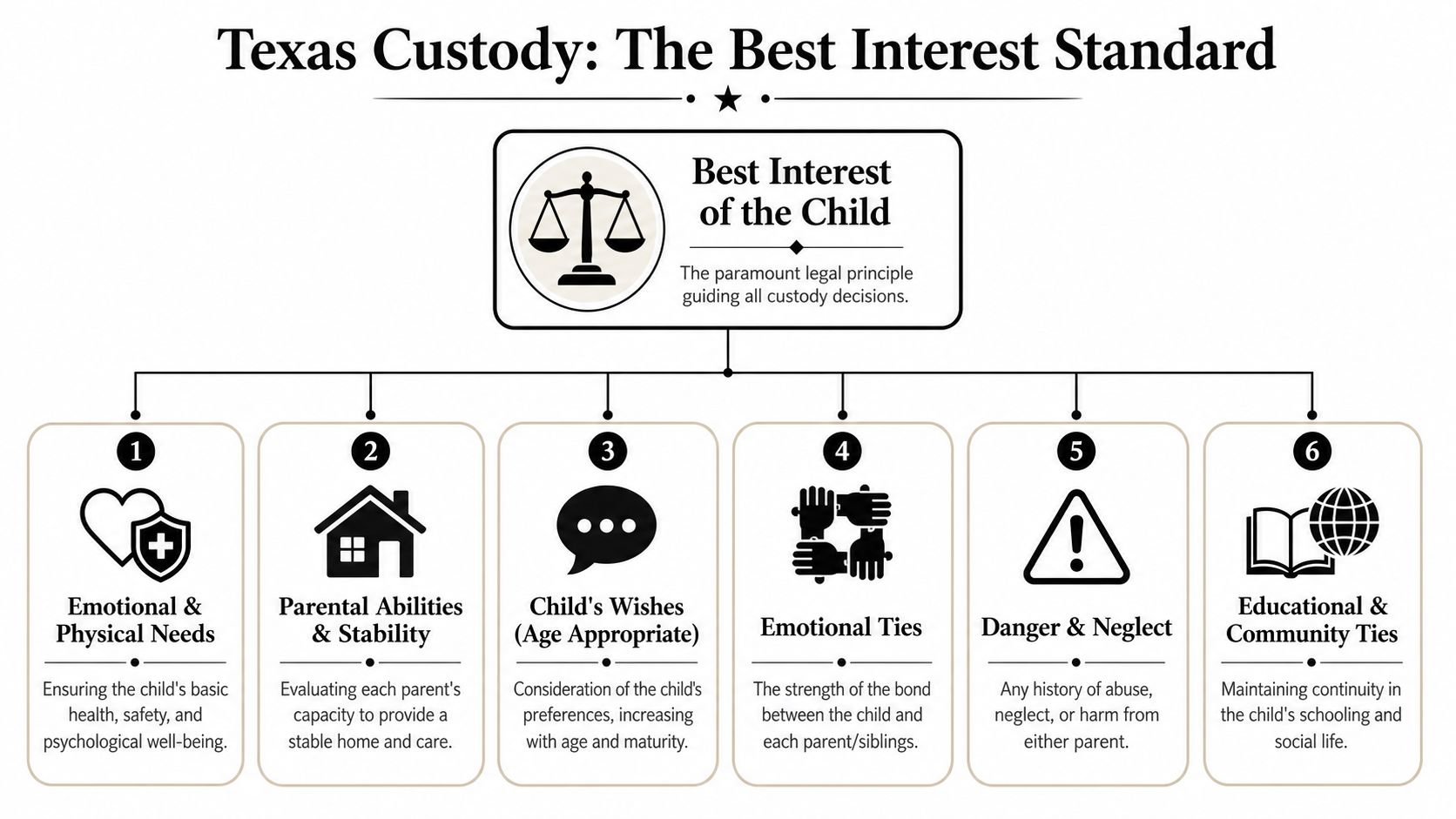
Every custody case in Texas rests on one core rule: the court must act in the best interest of the child. That phrase appears often, but for parents, it helps to translate it into plain English. A judge is trying to decide which arrangement most reliably protects the child's safety, health, emotional development, and daily stability.
Texas courts use that broad best-interest framework rather than a simple rule based on age or parental preference. The Texas Supreme Court's Holley factors guide that analysis. Courts weigh the child's needs, safety, each parent's abilities, and the stability of each home, among other considerations. If you want a fuller breakdown, this guide on Texas custody and the Holley factors is a helpful companion.
What conservatorship and possession mean
Texas uses terms that can sound technical at first.
Conservatorship means decision-making rights and duties. It covers issues like education, medical care, and other major choices. Many parents are appointed Joint Managing Conservators, which usually means both parents share major rights and duties, even if the child spends more time in one home. In some cases, one parent may seek Sole Managing Conservatorship, meaning that parent has more exclusive authority because the facts call for it.
Possession and access refers to the schedule. In everyday language, that is the visitation or parenting time arrangement.
A parent can have meaningful possession time and still not be the parent with the stronger case for primary residence. Likewise, a parent may be highly involved but still struggle to provide structure a teen needs.
What judges are really evaluating
When parents hear “best interest,” they sometimes think it means who loves the child more. Courts don't decide cases that way. They look for proof.
A judge may focus on questions like these:
| Court concern | What it looks like in real life |
|---|---|
| Home stability | Consistent routines, supervision, and reliable housing |
| Emotional and physical needs | Meeting health needs, responding to stress, supporting treatment |
| Parenting ability | Setting limits, following through, staying involved |
| Safety | Avoiding dangerous people, substance abuse, neglect, or violence |
| Child's connections | School continuity, community ties, sibling relationships |
Practical rule: A parent usually helps their case by showing steady judgment over time, not by trying to outshine the other parent in one dramatic moment.
That is why “the fun house” argument often falls flat if it comes with poor supervision, weak boundaries, or avoidable risks.
Your Teenagers Voice How Much Weight Does It Carry in Court
Many parents ask at what age a child gets to choose. Texas law does not give teenagers a final vote. But Texas does give older children a more formal voice in the process.
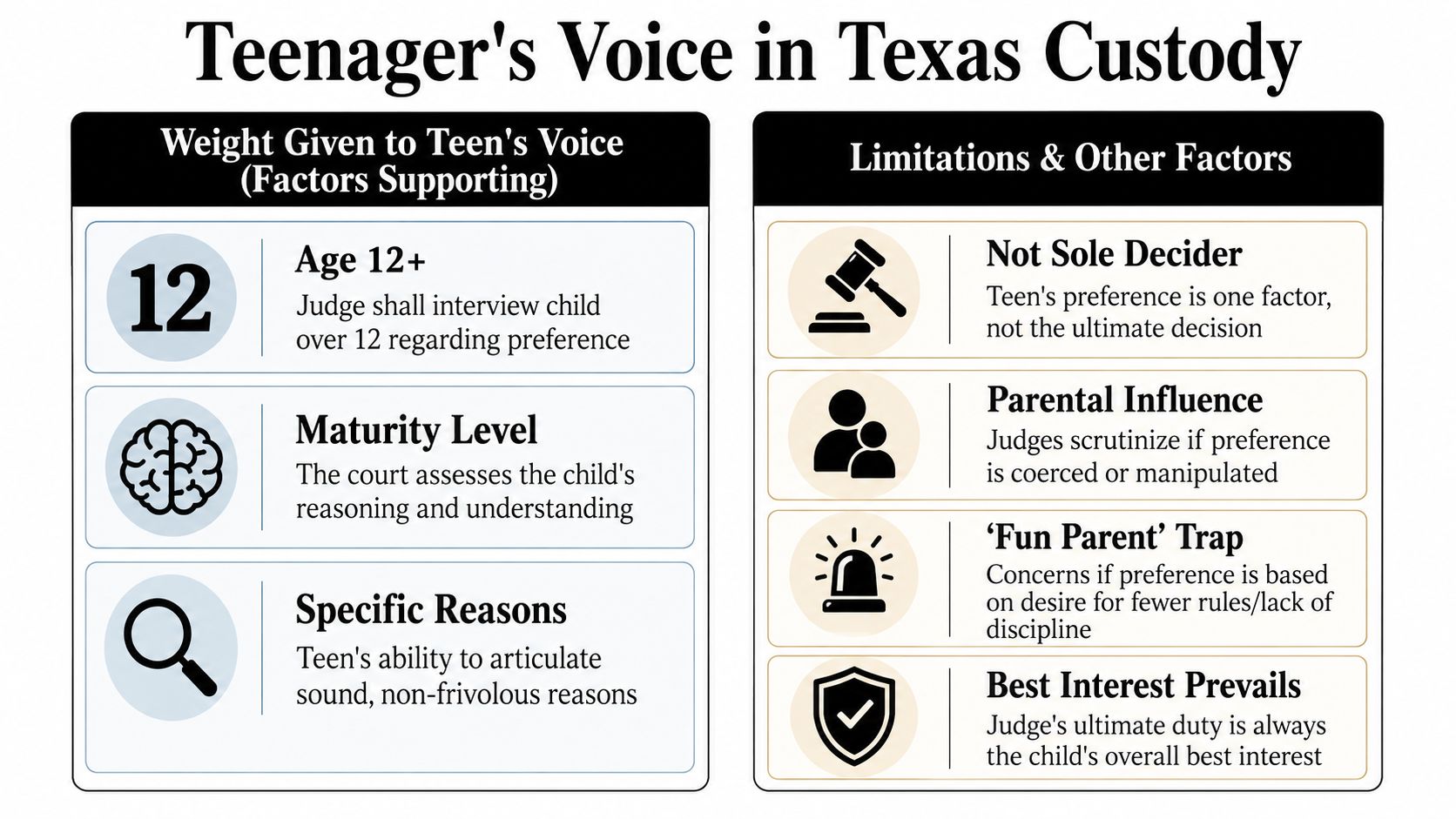
Under Texas Family Code Section 153.009, a judge may interview a child in chambers about conservatorship or possession once the child is 12 or older, and the court is not required to follow the child's preference, as explained in this discussion of teen preferences in Texas custody cases. That same guidance makes clear that the child's wishes are only one part of the larger best-interest analysis.
It is not a vote
That point is worth slowing down on. A judge is not counting ballots between parents. The court is listening for maturity, consistency, and reasoning.
A teen who says, “I want to stay near my school, my activities, and the counselor I've been seeing,” presents something very different from a teen who says, “Dad lets me do whatever I want.” Judges know teenagers often test limits. They also know a preference may reflect loyalty conflicts, pressure, anger, or temporary frustration.
This resource on child preference in Texas custody cases can help parents understand how that voice fits into a broader case strategy.
Here is a helpful overview for families thinking about this process:
Older teens may be heard differently
Texas courts do not use a simple cutoff or a mechanical system. For an adolescent or high-school-aged child (14 to 18 years), judges look closely at whether each parent supports school participation, transportation, future planning, healthy decision-making, and the child's relationship with the other parent, according to the State Bar of Texas discussion of custody evaluation factors.
That does not mean the older teen automatically gets his or her way. It means the court may pay closer attention to how realistic the teen's reasons are and how each home supports the demands of adolescent life.
What helps and what hurts
Some preferences carry more weight than others. Courts tend to look more favorably at a teen's preference when it appears grounded in real needs.
- Stronger reasons might include school continuity, transportation to activities, a calmer home, treatment support, or a better study environment.
- Weaker reasons often involve fewer rules, later curfews, less supervision, or conflict over normal discipline.
- Red flags include scripted language, obvious pressure from a parent, or sudden reversals that do not match the teen's history.
Parents usually hurt their own case when they ask a teenager to “tell the judge the truth” and then define what that truth should be.
The better approach is to let the teen speak for themselves while you build a separate, adult case based on evidence.
Beyond Preferences What Judges Scrutinize for Teen Stability
The hardest cases often involve a teenager who wants to live with the less restrictive parent. That fear is real. One home may offer looser rules, later nights, easier access to friends, fewer consequences, and less pressure about school or treatment. To a teenager, that can feel like freedom. To a judge, it can raise serious concerns.

Texas best-interest guidance allows courts to consider emotional and physical danger, the stability of each home, and any family violence or neglect history. That is especially important when a teen prefers a more permissive parent. Courts can prioritize safety concerns, including substance abuse or mental-health issues affecting a parent's home, over the child's stated preference when that choice appears inconsistent with the child's welfare, as reflected in the judicial child-safety guidance used in custody cases.
The court looks at the whole environment
A judge may ask whether the preferred home provides structure, not just comfort.
That can include whether the parent monitors school attendance, responds to anxiety or depression responsibly, knows where the teen is, enforces reasonable rules, and gets the child to practices, appointments, and classes. If one parent offers more emotional safety and better follow-through, that often matters more than which house feels easier.
Consider a common pattern. A teen says they want to live with the parent who has fewer rules. But the evidence shows falling grades, missed therapy, skipped classes, or unchecked peer issues in that home. Meanwhile, the other parent has routines, transportation, communication with teachers, and firm but appropriate boundaries. That second parent may appear less appealing to the teen in the moment, but more reliable to the court.
Stability is not the same as strictness
Parents sometimes overcorrect and think the answer is to become harsher. That usually backfires. Judges are not looking for the most controlling parent. They are looking for the parent who can combine warmth, supervision, and sound judgment.
Here are examples of what tends to help:
- Consistent routines that cover school nights, homework, sleep, meals, and transportation.
- Healthy boundaries around dating, driving, social media, parties, and substance exposure.
- Support for treatment if the teen is in counseling, psychiatric care, or other services.
- Respect for the other parent unless there is a legitimate safety concern requiring limits.
And here is what often undermines a case:
| Problem | Why a judge may care |
|---|---|
| “I'm the fun parent” approach | It can look like weak supervision |
| Ignoring academic decline | It suggests poor follow-through |
| Undermining therapy or medication | It raises concern about judgment |
| Encouraging rejection of the other parent | It can signal manipulation or poor co-parenting |
A court often sees permissiveness and instability as connected when the parent cannot show reliable judgment.
If your teen is pulled toward the less stable home, the most effective response is not to call your ex irresponsible in broad terms. It is to show, with specifics, how your home protects your child's daily functioning and long-term well-being.
Gathering Powerful Evidence for Your Teen Custody Case
Custody cases are rarely won by emotion alone. Judges need evidence they can weigh. If you are trying to show that your home better serves a teenager's needs, your proof should be organized, specific, and tied to daily life.

For adolescents and high-school-aged children, judges look closely at evidence showing which parent best supports school participation, transportation for activities, future planning such as college applications, and healthy decision-making. The State Bar of Texas also notes that a parent's ability to encourage the child's relationship with the other parent is a key factor evaluated through evidence, as discussed in the earlier linked State Bar resource.
What to start collecting
The strongest evidence usually falls into a few practical categories. This article on how to present evidence in a Texas custody case offers a useful starting point.
- School records such as attendance history, report cards, disciplinary notices, and activity schedules
- Medical and counseling records when they are relevant and properly obtained through your attorney
- Messages between parents that show scheduling, missed pickups, refusal to cooperate, or one parent's effort to solve problems
- Calendars and logs that track appointments, school events, practices, and who handled them
- Witnesses like teachers, coaches, counselors, relatives, or other neutral adults with firsthand knowledge
How to document without looking reactive
Parents sometimes gather too much noise and not enough usable proof. Hundreds of screenshots with no timeline are harder to use than a clear file organized by topic.
A practical method is to build a simple folder system:
- School and activities
- Health and counseling
- Parent communication
- Incidents and concerns
- Positive involvement
If you need legal help turning that information into a courtroom-ready presentation, firms including Law Office of Bryan Fagan, PLLC handle Texas custody, visitation, and modification matters under Chapter 153.
Case-building insight: Good evidence shows patterns. Great evidence shows patterns and explains why they matter to the teen's welfare.
The goal is not to prove you are the better person. It is to prove your proposed arrangement better serves the teenager's actual needs.
Navigating Special Custody Situations with Teenagers
Teen custody disputes become more layered when a family is dealing with deployment, relocation, or a strong grandparent relationship. The legal standard remains centered on the child's welfare, but the facts can look very different.
Military families and sudden change
A military parent may face orders, travel, or uncertainty that affects housing and parenting time. In those cases, a teenager may prefer the parent whose life feels more predictable. That does not mean the military parent loses importance. It means the court will look carefully at continuity, school stability, and whether the plan keeps the teen supported during transitions.
A teen may also feel torn between loyalty and routine. Parents in that position often help themselves by presenting a concrete plan for transportation, communication, school continuity, and make-up parenting time.
Relocation and community ties
Now consider a parent who wants to move. A teenager may want to stay where friends, school, sports, work, church, or extended family are already established. Another teen may want to move with a parent because that household feels emotionally safer. In either situation, judges tend to look beyond the headline preference and into the daily consequences.
That often means examining questions like:
- School continuity and whether the move disrupts progress
- Support systems including relatives, mentors, and counselors
- Travel demands and how realistic the schedule would be
- The teen's reasons for wanting to stay or go
When a teenager is already struggling emotionally, families sometimes also benefit from outside clinical support. In some situations, reading about psychiatry for children and teens can help parents better understand when professional mental health care may need to be part of a broader custody strategy.
Grandparents and other caregivers
Grandparents often step in when a teen needs consistency, supervision, or emotional support. Sometimes a grandparent is part of the child's daily routine even if they are not a formal party to the case. Other times, grandparents seek conservatorship or access because family conflict has disrupted the child's life.
A teenager's bond with a grandparent can matter, especially when that relationship supports school, transportation, and emotional stability. The key is not merely that the relationship exists. The key is how that relationship affects the child's day-to-day functioning and sense of security.
Modifying an Order and Taking Your Next Steps
A custody order that worked in elementary school may not fit high school life. Teens develop new schedules, opinions, academic pressures, social lives, and emotional needs. Sometimes the original order still works with minor adjustments. Sometimes it doesn't.
When that happens, the legal tool is a modification. In plain English, that means asking the court to change an existing custody or possession order. The parent requesting the change usually must show a material and substantial change in circumstances and that the requested modification serves the child's best interest.
When modification may make sense
A teen's growing maturity may be part of that picture, but it usually should not be the only point you bring to court. Stronger modification cases often include a combination of factors, such as a serious shift in school performance, a change in mental health needs, transportation problems, conflict that has become unmanageable, or safety concerns in one home.
If you are considering a modification, focus on these steps:
- Review the current order carefully. Know what it says about conservatorship, possession, and decision-making.
- List what has changed. Keep it factual. School, health, behavior, home routines, treatment, and transportation are common areas.
- Gather supporting records. Use the evidence categories discussed above.
- Consider negotiation or mediation. Some teen-related disputes can be resolved without a final trial.
- Prepare for the long view. Judges often value the parent who responds steadily instead of escalating family conflict.
Key takeaway
If your teenager wants to live with the more permissive parent, don't panic and don't try to compete by becoming permissive yourself. Courts are capable of seeing the difference between a home that feels easier and a home that is safer, steadier, and better for long-term development.
Keep your attention on what you can prove:
- Your teen's real needs
- Your home's structure and stability
- Your support for school, treatment, and future planning
- Your willingness to encourage a healthy parent-child relationship when safe
Parents often feel powerless when a teenager's preference enters the case. You are not powerless. You may have far more influence than you think if you stay calm, document carefully, and present the court with a clear picture of what your child needs now.
If you need help with a child custody or visitation case in Texas, our experienced attorneys can guide you every step of the way. Contact The Law Office of Bryan Fagan, PLLC today for a free consultation.