
When your child's future is on the line, understanding your rights matters most.
A custody schedule can feel stable for years, then suddenly stop fitting real life. The plan that worked when your child was in preschool may fall apart once homework, sports, school events, friendships, and growing independence enter the picture. Many parents tell me the same thing: “We're following the order, but it just doesn't work anymore.”
That feeling is common, and in many cases, it makes sense. In Texas, custody orders are meant to serve a child's best interest, not trap a family in a routine that no longer fits. If you're trying to understand how custody schedules change as a child gets older in Texas, the key is to look at both the law and your child's actual day-to-day life.
Your Child Is Growing Up Does Your Custody Schedule Reflect That
A parent may start with a simple schedule when a child is young. Exchanges are easy, bedtime is early, and weekends feel predictable. Then the child becomes a teenager, and every part of that old routine starts rubbing against real life.
A rigid weekday exchange may now interrupt algebra homework. A Sunday return time may cut into club sports. One parent may be driving to practice while the other is trying to enforce a court order written for a much younger child. That doesn't mean either parent is failing. It often means the child has grown, but the schedule hasn't.
Growth changes more than a calendar
Children don't just get older. They change emotionally, socially, and academically. Parents often benefit from learning how development affects behavior, communication, and independence. Resources like Soul Shoppe's emotional development insights can help parents think through what a child may need at different stages, especially when co-parents are trying to build a schedule that feels supportive instead of disruptive.
The question usually isn't whether your child has changed. The real question is whether your court order still matches your child's life.
Texas family law allows custody arrangements to evolve. Judges understand that a schedule made for a small child may not suit a middle-school or high-school student. That's especially true when the existing arrangement starts interfering with school, activities, sleep, or family stability.
Why parents often wait too long
Many parents keep forcing an outdated plan because they don't want conflict. Others assume the original order can't be changed unless something dramatic happens. But the law doesn't require families to ignore obvious problems.
If your child is older and your current order is creating stress, missed activities, or constant arguments, it may be time to look at whether the schedule should be updated. In some families, the smartest move is not merely reacting later. It's building age-based transitions into the order from the beginning so the plan can grow along with the child.
Understanding the Building Blocks of Texas Custody
Before you can change a schedule, it helps to understand what your order is saying. Texas custody language can sound intimidating, but the core ideas are simpler than they seem.
Think of your custody case like a house. One part covers who makes important decisions for the child. Another part covers when the child spends time with each parent. Both matter, but they are not the same thing.
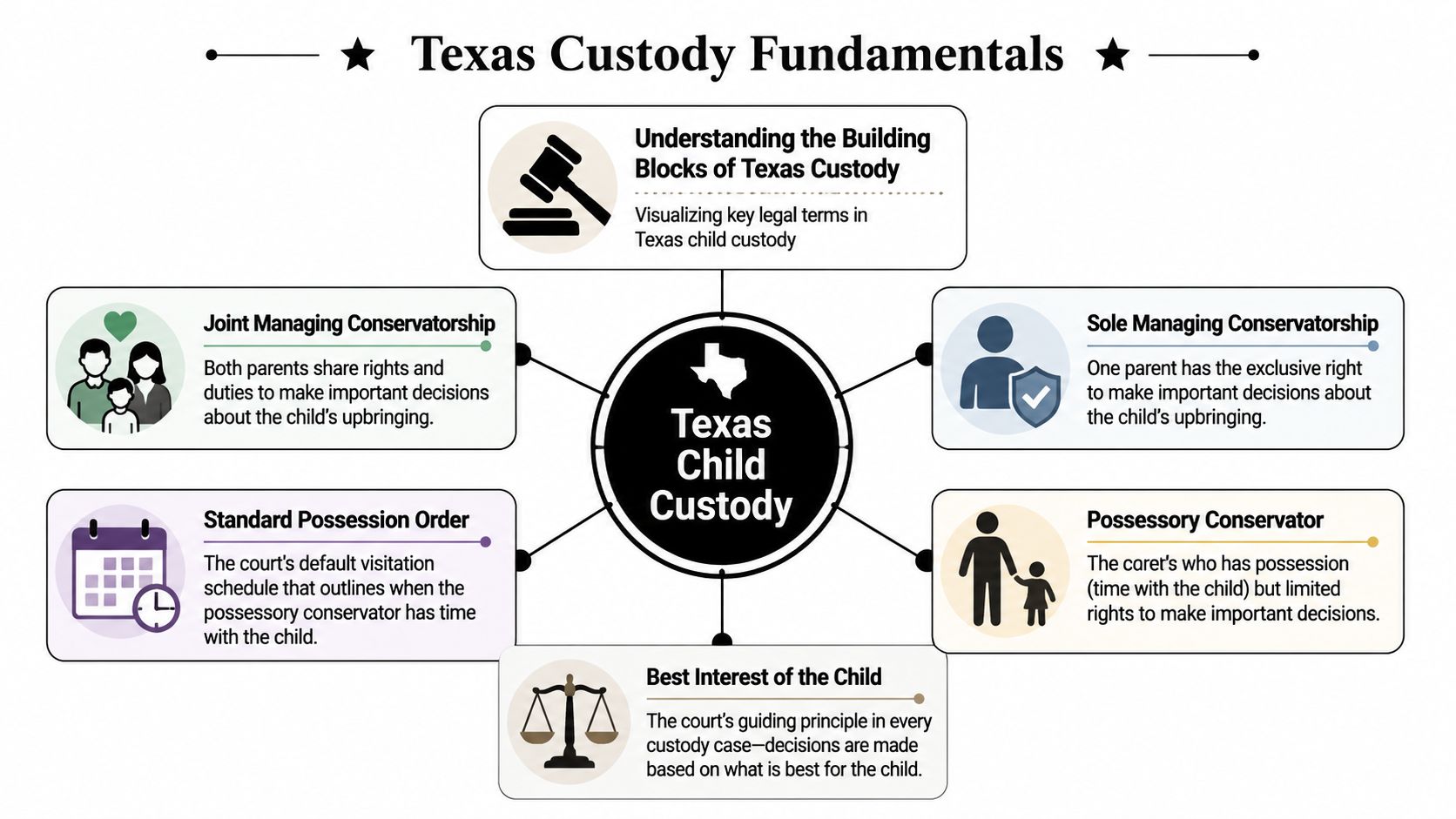
Conservatorship means decision-making authority
In Texas, conservatorship refers to parental rights and duties. This includes major decisions about the child's education, medical care, and general welfare.
Here are the main terms parents usually see:
- Joint Managing Conservatorship means the parents share rights and duties. This does not always mean equal time.
- Sole Managing Conservatorship means one parent has exclusive rights over certain major decisions.
- Possessory Conservator usually refers to a parent who has possession and access rights, but fewer decision-making rights than a managing conservator.
Parents often confuse conservatorship with possession. They are related, but different. A parent can share in decision-making without having equal time on the calendar.
Possession and access means the schedule
A possession order is the practical calendar. It tells you when the child is with each parent. This is the part that is widely referred to as visitation or a custody schedule.
Common schedule terms include:
| Term | Plain-English meaning |
|---|---|
| Possession | When the child is physically with a parent |
| Access | Contact with the child, including communication or visits |
| Standard Possession Order | The default Texas schedule used in many cases |
| Custom Schedule | A schedule tailored to the child's needs and family routine |
Best interest guides every custody decision
The phrase best interest of the child is the guiding rule in Texas custody law. It means the court focuses on what helps the child remain safe, stable, and supported.
Practical rule: A schedule is not “good” just because it's familiar. It needs to fit the child's current needs.
For mothers, fathers, grandparents, and other caregivers, this principle matters because it shifts the focus away from winning and toward functioning. Courts are not grading who feels more frustrated. They are looking at what arrangement helps the child thrive.
That's why an order can change over time. The legal words stay the same, but what serves a child's best interest at one age may not serve that child later.
Custody Schedules for Infants and Toddlers Ages 0 to 5
Very young children usually need something different from school-age children. A long, rigid weekend-based schedule may not make sense for a baby, a toddler, or a child just learning a regular routine.
At these ages, consistency matters. Young children often do better with shorter, predictable contact that helps them stay connected to both parents without too much disruption. Parents are usually balancing naps, feeding routines, daycare, comfort objects, and early bedtimes. A schedule that ignores those realities can create stress for everyone.
Why younger children often need customized schedules
For infants and toddlers, the goal is often steady contact and smooth transitions. That may mean more frequent visits, shorter blocks of time, or a plan that expands as the child matures.
A family might choose a schedule that starts with brief but regular parenting time, then gradually adds longer visits, overnights, or expanded weekends once the child is developmentally ready. That kind of planning can lower conflict because it gives both parents a roadmap instead of leaving future changes up for debate.
Parents who want a closer look at this issue can review this guide on possession schedules for infants in Texas.
Step-up plans can reduce future stress
A step-up schedule is a parenting plan that changes in stages. Instead of returning to court every time the child reaches a new milestone, the order can state in advance what happens next.
For example, a plan might account for changes tied to milestones such as:
- Starting preschool when the child can handle a more regular weekday routine
- Sleeping through the night more reliably, which may affect overnight possession
- Handling longer separations well, making transitions easier on the child
- Beginning structured activities, which may call for a more organized calendar
This proactive approach is often more peaceful than waiting until the old schedule breaks down.
A thoughtful order for a toddler should leave room for the child to become a kindergartener without forcing the family back into conflict.
Daily life matters too. If you're trying to build parenting time around realistic activities for a young child, practical resources like fun ideas for 2-year-olds can help parents think through age-appropriate routines and how each household can support them.
When parents design these early schedules well, they aren't just solving today's problem. They are creating a smoother path for the next stage of childhood.
The Standard Possession Order for School Age Children
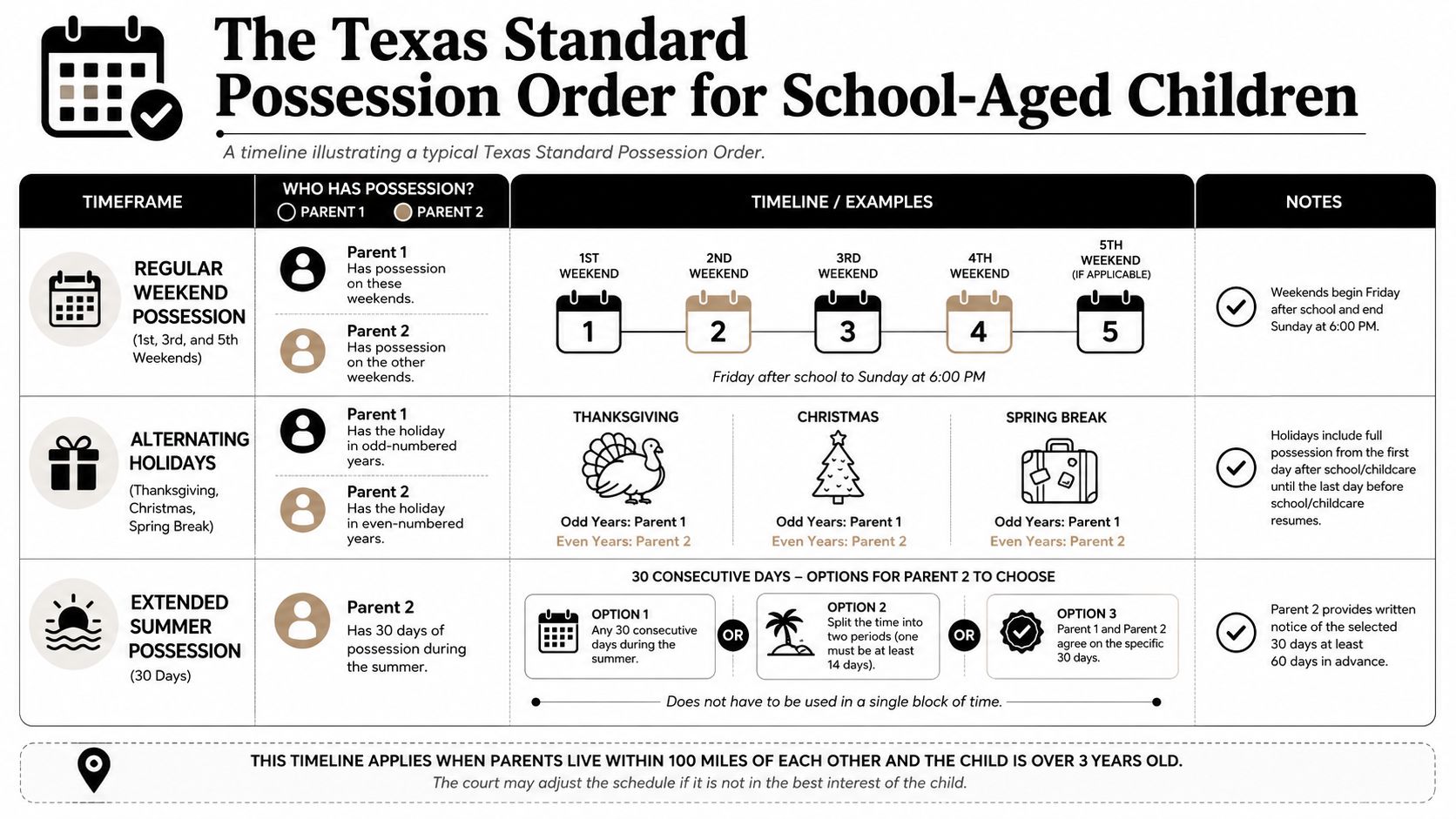
Once children are older and school becomes the center of the week, many Texas families move closer to a Standard Possession Order, often called an SPO. This is the default framework many courts use for children over three when a custom schedule is not needed.
For many families, the SPO offers structure. It gives parents a predictable rhythm and creates a starting point for discussion. But it is still a baseline, not a one-size-fits-all answer.
What the standard schedule usually looks like
Parents often recognize the SPO by its familiar pattern:
- Weekends often follow a first, third, and fifth weekend structure for the parent who does not determine the child's primary residence
- Holidays are typically divided between parents on a rotating basis, including major school breaks
- Summer possession gives the noncustodial parent a longer uninterrupted block of time
If you want a more detailed breakdown of how this works in practice, this overview of Texas standard possession orders and visitation can help you compare the default schedule to your own family routine.
Distance can change the summer schedule
Where the parents live matters. Under the Texas standard possession rules, distance affects the amount of summer parenting time. If parents live within 100 miles, the noncustodial parent is entitled to 30 days of summer possession. If they live more than 100 miles apart, that increases to 42 days, as explained in this discussion of parenting plan adjustments.
That difference can significantly affect planning for camps, vacations, summer school, and extended family visits.
Why school-age years are often the turning point
School-age children bring a new kind of complexity. Their routines are more fixed than a toddler's, but they still need adults to manage transportation, homework, and consistency. That is why many parents either adopt the SPO or modify it to better fit:
| Common issue | How parents often respond |
|---|---|
| Homework disruptions | Reduce late-night exchanges |
| Busy activity calendar | Build in transportation rules |
| Different school expectations in each home | Clarify homework responsibility |
| Long travel between homes | Adjust weekday possession |
Some families do well with the standard schedule for years. Others discover that school demands call for a more customized plan. Neither result is unusual. The key question is whether the child can succeed under the schedule being used.
Adapting Schedules for Teenagers and High Schoolers
Teenagers usually outgrow rigid schedules before they outgrow the court order. A high school student may be juggling advanced classes, athletics, church groups, band, a part-time job, and a social life. Even when both parents are loving and involved, a schedule built for a younger child can start causing friction.
Flexibility becomes more important than symmetry. Many parents focus on fairness between adults. Judges usually focus on whether the schedule still works for the child.
A teen's preference matters, but it doesn't control the case
In Texas, a child who is at least 12 may express a preference about which parent should have primary custody, but the judge still makes the final best-interests decision. A change still requires a material and substantial change in circumstances, not just the child's age or wishes alone, as explained by Texas Law Help's custody modification guidance.
That point causes a lot of confusion. Parents sometimes assume that once a child turns 12, the child gets to choose. That isn't how Texas law works. The child's voice can matter, but it is one factor among many.
What judges and parents usually look at
With older children, the strongest argument is often practical, not emotional. Courts tend to take schedule changes more seriously when parents can show the current order no longer fits daily life.
Helpful examples may include:
- School demands that make late exchanges disruptive
- Extracurricular commitments that conflict with rigid possession times
- Transportation problems that leave the teen exhausted or constantly late
- Medical or counseling routines that need steadier coordination
- A teen's ability to explain a thoughtful preference, especially when supported by the overall facts
Older children often need fewer exchanges, more breathing room for homework, and a schedule that respects the life they're actually living.
The legal end of the schedule arrives later than many parents expect
For older teens, another major issue is timing. In Texas, the biggest legal milestone is when the child turns 18. At that point, the child is no longer subject to court-ordered custody arrangements and can decide where to live and when to visit without court oversight. Child support may continue to 19 if the child is still enrolled in high school. For families with multiple children, financial changes can happen quickly. The cited example shows support for three children at 25% of net monthly income dropping to 20% when one child ages out, as discussed in this explanation of the age-out effect in Texas.
That change can reshape family logistics for younger siblings too. If the oldest child begins moving more freely between homes, the family may need to rethink whether one shared schedule still makes sense for everyone else.
How to Formally Request a Custody Schedule Modification
When a schedule no longer works, an informal agreement may feel easier. Sometimes parents do make side arrangements for school, sports, or pickup times. The problem is that an unwritten agreement is usually hard to enforce if cooperation breaks down.
A formal modification gives you a new court order that matches current life. That can reduce confusion and protect both parents.
The legal standard you must meet
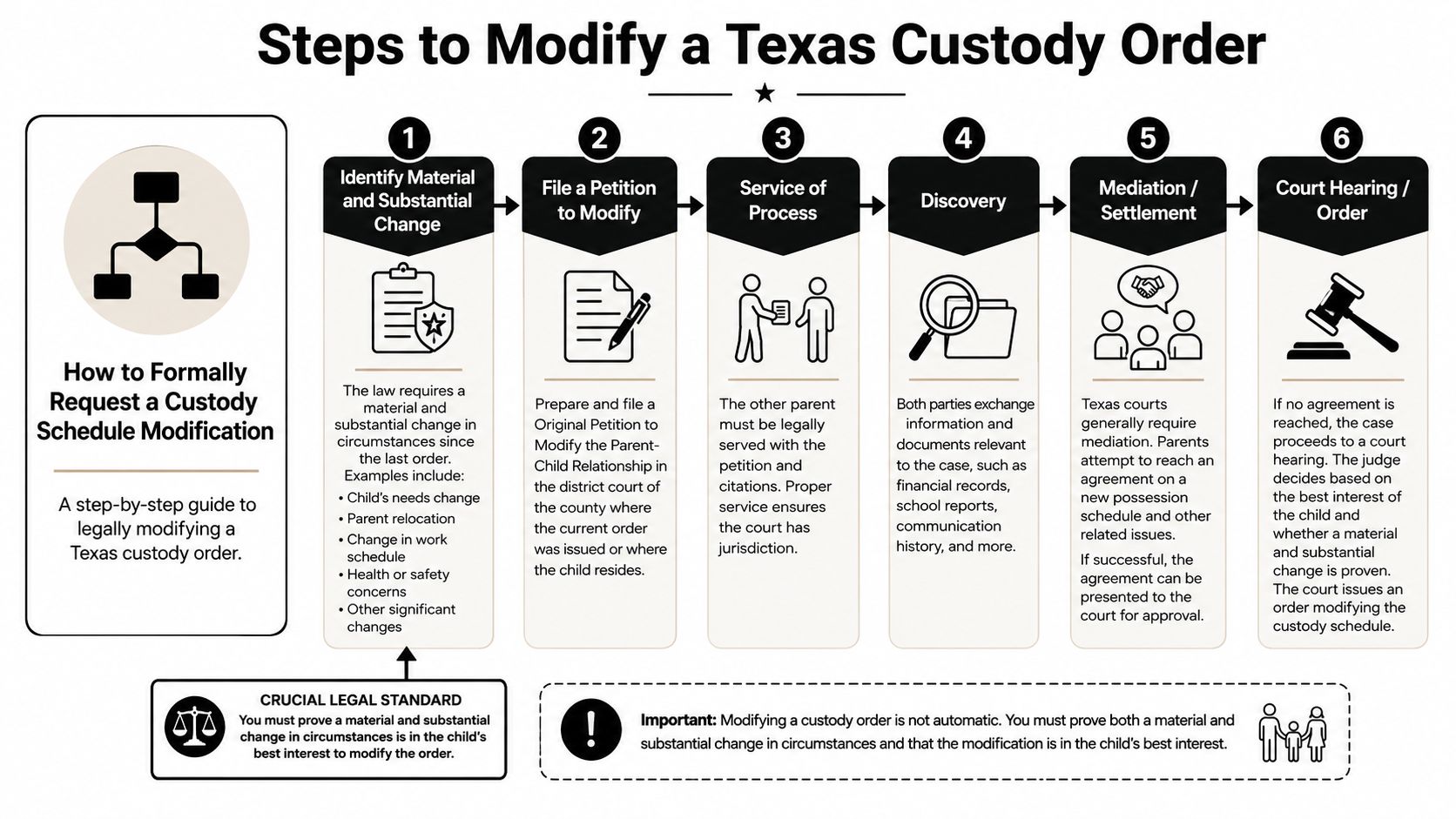
To change a custody order in Texas, a parent must prove a material and substantial change in circumstances since the last order was signed. That change could relate to the child's age, a parent's relocation, or new school and activity schedules that make the old order unworkable. The legal standard is described in the earlier-cited Texas family law discussion in this article.
That phrase sounds technical, but in practice it often means this: real life has changed enough that the existing order no longer serves the child well.
What the process usually looks like
Parents often feel calmer once they can see the path clearly. A modification case commonly includes these steps:
Identify the problem clearly
Write down what is no longer working. Focus on facts, not blame.Gather documents
School calendars, practice schedules, report cards, medical records, and communication logs can help show why the current order no longer fits.File the case
This is typically done through a formal request to modify the parent-child relationship. Parents can learn more through this guide on how to modify custody in Texas.
Before going further, it can help to hear the process explained in a straightforward way:
Serve the other parent
The other side must receive legal notice.Try negotiation or mediation
Many cases resolve through agreement rather than a contested hearing.Get a signed court order
Until the judge signs a new order, the old one usually remains in effect.
If the schedule has changed in practice but not on paper, you may still be one disagreement away from a serious enforcement problem.
Formal modification can feel intimidating, but it often brings needed structure to a situation that has already become stressful.
Next Steps Practical Tips for Evolving Your Parenting Plan
A seven-year-old who was fine with a midweek overnight may suddenly be struggling once homework, reading logs, and soccer practice fill the week. A schedule that fit your child at age three can start to feel tight or disruptive by second grade. That does not always mean something went wrong. It often means your child is doing what children are supposed to do. Growing.
A well-drafted parenting plan should make room for that growth. The goal is not just to solve today's schedule. It is to set up a plan that can still work after your child starts school, joins activities, or becomes more independent. Parents who address those likely changes early often save themselves future stress, legal expense, and avoidable conflict.
The order works a lot like a set of adjustable straps on a child's car seat. You do not buy a new seat every few months. You set it up so it can be adjusted safely as your child gets bigger. Parenting plans can be written the same way.
Build transitions into the order when possible
One of the smartest drafting tools is a step-up schedule. Instead of waiting until the current plan stops working, parents can include clear future transitions in the original order. As noted in this overview of step-up parenting plans, that approach allows parenting time to change at set milestones, so long as the arrangement still serves the child's best interest.
That matters because many custody problems are predictable. A preschool schedule may need more frequent, shorter periods. A school-age schedule may need fewer exchanges and more consistency. A teenage schedule may need room for jobs, sports, and social commitments. If the order accounts for those stages from the beginning, parents are less likely to end up back in court because time passed and life became fuller.
Useful milestone triggers can include:
- School milestones, such as starting kindergarten or middle school
- Routine milestones, such as managing overnights comfortably and consistently
- Transportation milestones, such as when long weekday exchanges no longer make sense
- Activity milestones, such as entering competitive sports, band, or other demanding programs
Practical habits that help co-parents stay ahead
Even a carefully written order benefits from regular attention. Small check-ins can prevent larger disputes later.
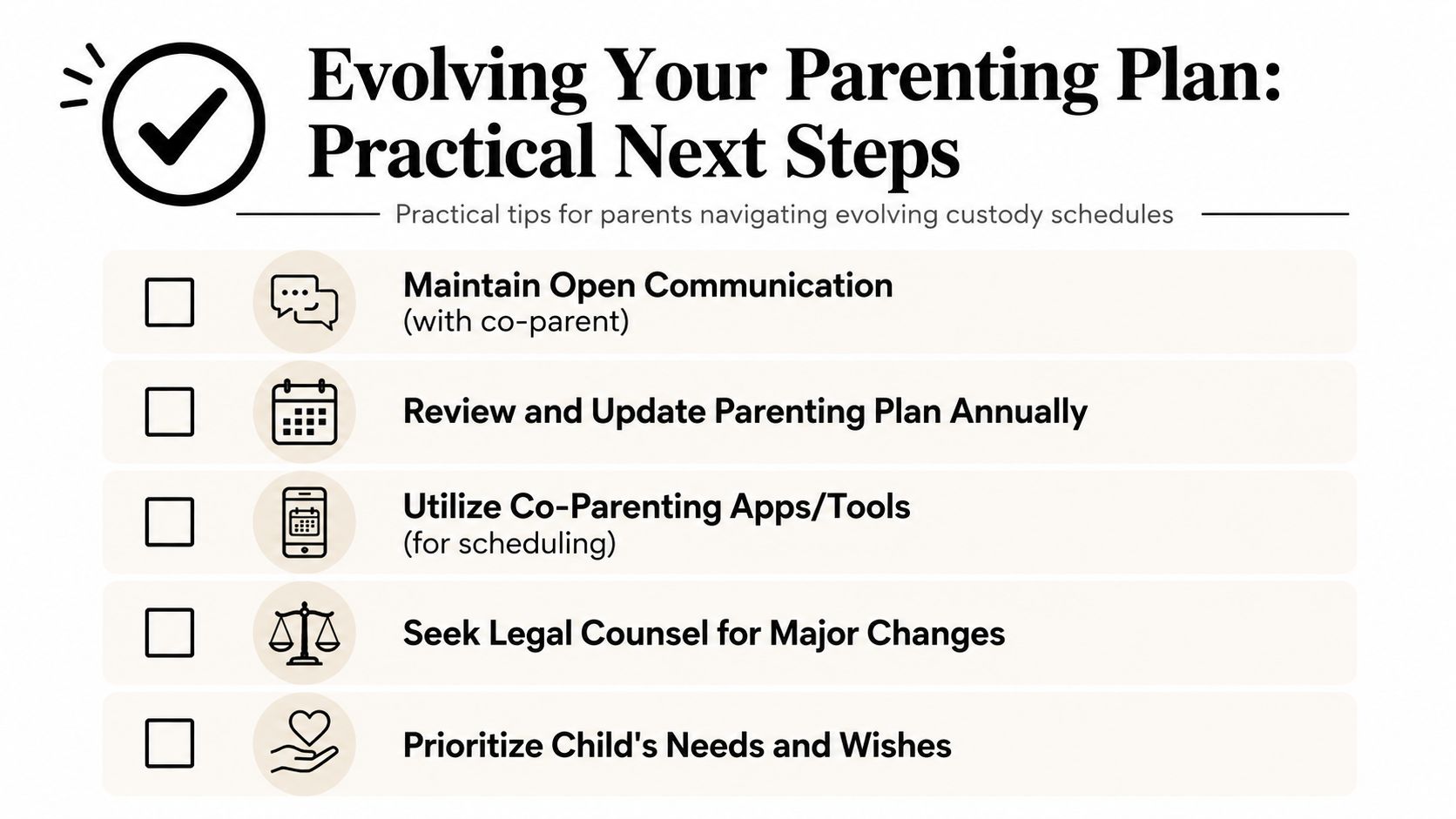
Helpful habits often include:
- Review the schedule at set times each year, such as before school starts or before summer planning
- Keep one shared calendar for school events, practices, medical appointments, and travel
- Use child-focused communication, especially when discussing changes
- Confirm important schedule adjustments in writing, even if both parents agree
- Ask for legal advice before informal changes become the new normal
That last point is easy to underestimate. Many parents make practical side agreements because they are trying to help their child. That instinct is good. The problem comes later, when one parent believes the new routine is permanent and the other sees it as temporary. Clear written orders reduce that confusion.
Legal counsel from firms like the Law Office of Bryan Fagan, PLLC can help families update plans, clarify milestone-based language, and reduce the risk that ordinary growth turns into an avoidable legal dispute.
Key takeaway
The strongest parenting plans are built with the next few years in mind, not just the next few months.
If you want to understand how custody schedules change as a child gets older in Texas, start there. A schedule should fit your child's actual stage of life. Planning for those age-based transitions early can give your child more stability and give parents a clearer path as school, activities, and responsibilities change.