Skip to content
When your child’s future is on the line, understanding your rights matters most. Life rarely stands still after a divorce or separation. The custody schedule that made perfect sense for your toddler might be completely unworkable for a teenager with their own job and social life. A parent's new work schedule, a cross-country move, or a change in financial stability can make your current court order feel like it’s stuck in the past.
If you're feeling trapped by an outdated order, you’re not alone. It's one of the most common reasons parents walk through our doors, stressed and wondering if they have any options.
The good news is that Texas law expects families to change. A custody order isn't a permanent trap; it’s a legal framework designed to evolve with your family’s real-world needs. But to prevent endless court battles over minor issues, judges need a very good reason to reopen a case.
How Texas Determines if a Custody Order Can Be Changed
In Texas, you can’t change a custody order just because it’s inconvenient. You must first prove there has been a material and substantial change in circumstances since the last order was signed by a judge. This is the legal key that unlocks the door to a modification.
According to the Texas Family Code, a court can only modify a prior order if two things are true: there has been a material and substantial change in the circumstances of the child or a parent, and a modification would be in the best interest of the child.
This two-part test is the heart of every single custody modification case in Texas. Let's break down what that really means for you as a parent.
First, you have to show the judge that something significant has happened since they signed your last order. This isn't about small, everyday frustrations. We're talking about major life events that directly affect your child, such as:
- A parent remarrying or moving in with a new partner who impacts the child's life.
- A parent losing a job or getting a promotion that drastically changes their income or work hours.
- The child developing new health, emotional, or educational needs that require a different approach.
- Serious concerns about a parent’s lifestyle, such as new problems with substance abuse or criminal activity.
Second, even if you prove a major change has occurred, you must also prove that changing the order is what's best for your child. This is the “best interest of the child” standard—the single most important rule in all of Texas family law. The court's primary focus will always be on your child's physical and emotional well-being, not the parents' convenience or wishes.
What Qualifies As A "Material And Substantial Change"?
When your family’s life changes, it's natural to wonder if your old custody order still fits. The key to modifying that order in a Texas court is proving a “material and substantial change in circumstances.” But what does this legal phrase actually mean for you and your child?
Think of it like the difference between a small ripple and a genuine tidal wave. A Texas court needs to see that tidal wave—a significant, meaningful shift in the life of the child or one of the parents that happened after your current order was put in place. This isn't about minor annoyances or the usual ups and downs of co-parenting; the change has to be powerful enough to directly impact your child's physical or emotional well-being.
The change must be something the judge could not have known about or considered when the last order was signed. The entire point is to show that the old order is now unworkable or no longer serves your child’s best interests because of this new development.
Pinpointing a True Substantial Change
The question of what qualifies as a substantial change in circumstances for custody in Texas is completely fact-specific, meaning every single case is unique. A judge will dig into the specific details of your family's situation. That said, certain events are far more likely to meet this high standard than others.
For example, if the other parent suddenly starts working a night shift and can no longer care for your child after school, that could very well be a substantial change. On the other hand, if they are occasionally ten minutes late for a pickup, a judge will likely see that as a minor inconvenience, not a reason to upend the entire custody arrangement. It all comes down to the degree of the change and its real-world impact on the child.
This decision tree helps visualize the very first questions a court will consider when you seek a modification.
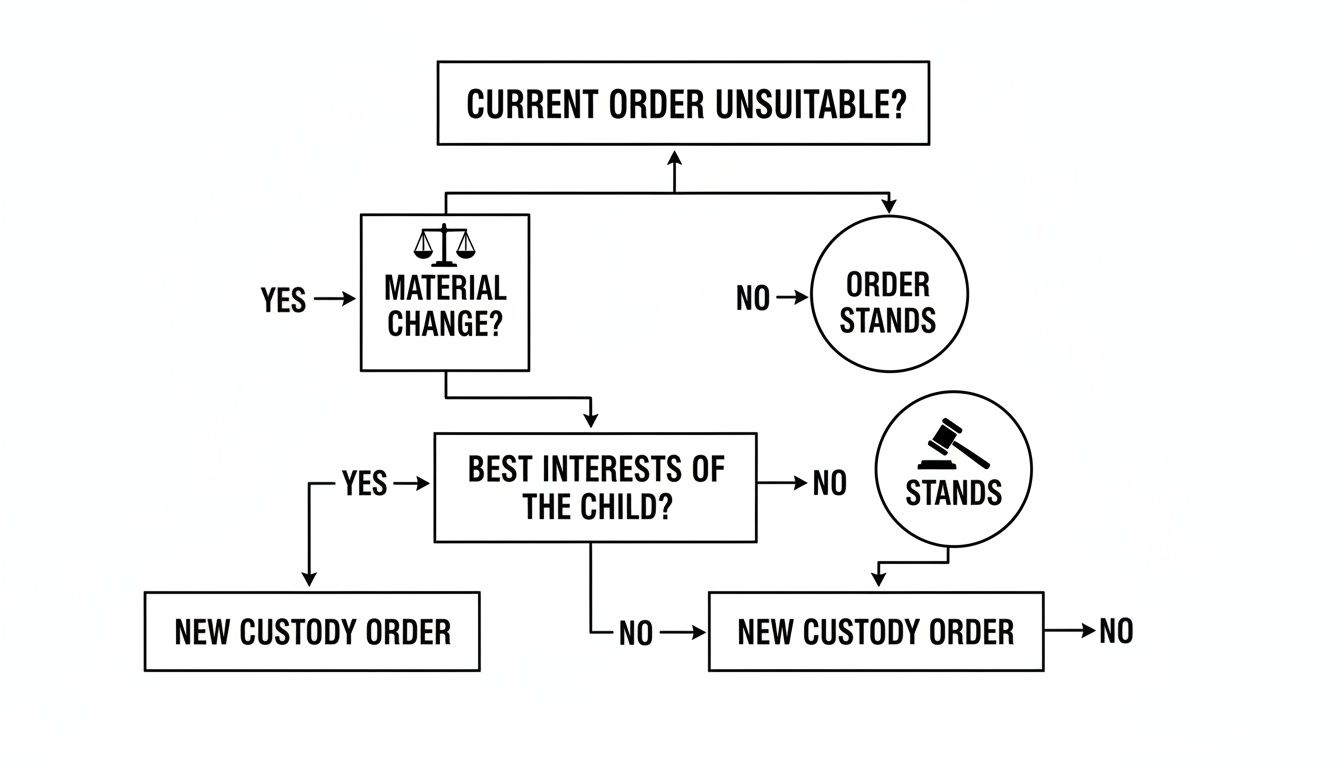
As you can see, if the situation doesn't involve a material and substantial change, the path to modification stops before it even really begins.
To give you a clearer idea, let's compare some common life events. Understanding these distinctions is a crucial part of learning how to win a custody modification case and will help you figure out if your situation truly meets the legal bar.
Examples Of Potential Substantial Changes Vs Minor Inconveniences
This table helps parents understand the types of events a Texas court is more likely to consider a 'material and substantial change' versus those that typically do not warrant a custody modification.
| Event Category | Often Considered a Substantial Change | Often Considered a Minor Inconvenience |
|---|---|---|
| Parental Relocation | One parent plans a long-distance move out of state or far enough away to make the current possession schedule impractical. | One parent moves to a different neighborhood within the same school district. |
| Parental Fitness | A parent develops a substance abuse problem, is convicted of a violent crime, or exposes the child to dangerous situations. | A parent occasionally makes poor parenting judgments, like allowing too much screen time. |
| Child's Needs | A child is diagnosed with a significant medical condition or learning disability that requires specialized care from one parent. | A child's extracurricular schedule becomes busier, causing minor scheduling conflicts. |
| Home Environment | A parent remarries and the new stepparent has a negative or abusive relationship with the child. | A parent remarries and the child takes some time to adjust to a new stepparent. |
| Parental Employment | A parent's work schedule changes dramatically (e.g., from day shift to night shift), making them unavailable during their possession time. | A parent gets a new job with a similar schedule and income. |
Ultimately, the court is going to evaluate how the change affects the child. A parent's remarriage, on its own, isn't automatically a substantial change. But if that remarriage brings instability, a chaotic home life, or a new stepsibling relationship that profoundly impacts your child's well-being, then it absolutely could be. Your focus must always be on connecting the event directly to what is best for your child.
Gathering Evidence To Prove Your Case

When your child’s well-being is on the line, simply telling a judge that things have changed won’t cut it. In a Texas courtroom, evidence is everything. To successfully argue for a substantial change in circumstances for custody in Texas, you have to build a rock-solid case backed by credible proof.
This means getting past the emotional "he said, she said" arguments and focusing on cold, hard facts. Think of yourself as a detective building a case for your child's best interest. Your job is to find the documents, records, and testimony that paint a clear picture for the judge—showing why the old order is broken and how your proposed change will fix it.
You’re not alone in this. In 2021, Tarrant County saw over 1,000 child custody modification filings, making up more than half of all post-divorce family law cases. This shows just how often parents need to adjust orders as life moves on, but success always comes down to the quality of the proof you bring to court.
Building Your Evidence File
The kind of evidence you’ll need depends entirely on the specific changes that triggered your case. Your attorney will be your guide, but being proactive and organized from day one will make a world of difference.
Start a dedicated file—digital or physical—and begin gathering documents tied to the change. Here are a few common scenarios and the kind of proof that tends to be most persuasive:
- Parental Relocation: You'll want the new lease or mortgage papers, a job offer letter showing the new city, and school enrollment forms. A simple map showing the new distance and drive time can also be a surprisingly powerful visual for the judge.
- Concerns About a Parent's Lifestyle: This is where you gather any police reports, CPS records, or criminal charges. Statements from credible, neutral witnesses (like teachers, coaches, or neighbors) can be incredibly powerful.
- A Child's New Needs: Get your hands on medical records, letters from therapists or doctors, and school documents like report cards or an Individualized Education Program (IEP). These records offer an objective look at how your child’s needs have evolved.
- Changes in a Parent's Job: Collect new work schedules, pay stubs that show a significant change in income, or any disability paperwork.
The Power of Digital and Witness Evidence
In our hyper-connected world, a parent’s online activity can be a goldmine of information. When you’re trying to prove your case, a thorough social media investigation can uncover critical evidence about a parent's lifestyle, new relationships, or activities that show a substantial change has occurred.
Remember: Screenshots of public posts, photos, and messages can be compelling evidence. Save anything that contradicts what the other parent is claiming in court or shows behavior that could put your child at risk.
Witness testimony is another cornerstone of a strong modification case. These are the people who have seen the changes firsthand. Your list of potential witnesses might include:
- Teachers or school counselors
- Doctors, therapists, or coaches
- Family friends or neighbors who have observed the situation
You and your attorney will work together to figure out who can best speak to the changes and how they’ve impacted your child. Your lawyer will help prepare these witnesses and may even take their formal testimony in a deposition. If you want to get a better feel for what that process is like, you can learn more by reviewing common custody deposition questions and how to prepare for them.
The "Best Interest of the Child" Standard Explained
Even if you prove a substantial change in circumstances for your custody case in Texas, you’ve only cleared the first hurdle. The second—and arguably more critical—step is showing the judge that the changes you’re asking for are in the “best interest of the child.” This isn't just a legal phrase; it's the single most important principle in Texas family law, and the court will view every piece of your case through this lens.
This is where you have to shift your focus entirely. The court isn't concerned with what feels fair to you, what’s convenient for the parents, or who seems like a "better" person. Its sole job is to craft a living situation that best supports your child's emotional and physical well-being.

What Are The Holley Factors?
To keep decisions objective and avoid relying on gut feelings, Texas judges use a specific set of criteria known as the “Holley Factors.” Established by the Texas Supreme Court, these factors are the official roadmap for determining a child’s best interest. You don’t have to prove every single one, but the more you can connect your evidence to these factors, the stronger your case will be.
Think of them as the court’s checklist. They force the judge—and you—to look at the complete picture of your child’s life and how each parent fits into it. The goal is to create a safe, stable, and loving environment for the child.
Breaking Down The Most Common Holley Factors
While the complete list is long, a few factors pop up in modification cases more than any others. Getting familiar with them will help you build a more persuasive argument, whether you're a mother, father, or grandparent seeking a change.
- The emotional and physical needs of the child, now and in the future: This covers everything from love and affection to guidance and daily care. For example, a father might show that his new work-from-home job allows him to better meet the needs of an anxious child who needs direct supervision after school.
- Any emotional or physical danger to the child, now and in the future: This is one of the most powerful factors. Hard evidence of a parent's new partner having a criminal record, a parent’s substance abuse, or an unsafe home can sway a judge’s decision dramatically.
- The parental abilities of each person seeking custody: Who is better equipped to handle the day-to-day work of parenting? Think homework, doctor visits, and discipline. A mother could present a detailed log showing she has always managed her child's complex medical needs, arguing she's the more suitable primary parent.
- The stability of the home or proposed home: Courts value consistency for children. A parent who can offer a stable, predictable routine in a familiar community often has an edge over a parent whose life is in flux.
Proving the best interest of the child is a detailed and often complicated process. For a much deeper look, you can read our guide on how to prove the best interest of the child in Texas, which breaks down specific strategies for presenting your evidence.
Ultimately, your goal is to tell a compelling story that is backed up by solid facts. That story needs to paint a clear picture of how your child’s life will be safer, more stable, and more emotionally supported if the judge grants the modification you’re requesting.
Steps to Modify a Custody Order
When your family’s life has been turned upside down, knowing you have a legal path to update your custody order is a relief. But what does that path actually look like? The legal system can feel like a maze, but breaking down the process step-by-step can replace anxiety with a clear plan.
This section lays out the roadmap for a Texas custody modification, showing you exactly what to expect from start to finish.
Step 1: Filing The Petition And Serving The Other Parent
The first official move is to file a Petition to Modify the Parent-Child Relationship. This formal legal document is filed with the same court that issued your original custody order. It’s your chance to tell the judge what has changed and exactly what new orders you are asking for.
Once the petition is filed, the other parent must be formally notified through a process called service of process. You can't just hand them the papers or send a text. A neutral third party, like a sheriff's deputy or a private process server, has to deliver the documents. This crucial step ensures everyone is officially aware that a new legal action has begun.
Step 2: Temporary Orders And Discovery
Sometimes, you can’t wait months for a final decision. You can ask the court for a Temporary Orders Hearing to tackle immediate issues, like setting up a temporary possession schedule (visitation) or ordering a drug test. These orders establish a set of ground rules for everyone to follow while the full case moves forward.
Next up is the discovery phase. Think of this as the formal evidence-gathering stage. You can send written questions (Interrogatories), ask for specific documents (Requests for Production), and take sworn testimony outside of court (Depositions). This is where you and your attorney build the factual foundation for your case.
Step 3: Mediation And The Path To Resolution
Before you ever see the inside of a courtroom for a final trial, nearly every Texas judge will require you and the other parent to attend mediation. This is a confidential meeting where a neutral, third-party mediator helps you try to find common ground and reach an agreement.
Mediation is often successful because it empowers parents to craft their own solutions—solutions that can be far more creative and customized than what a judge might order.
If you settle in mediation, your attorneys will draft an Agreed Order. Once the judge signs it, this becomes your new, legally binding custody order. If you can't agree, your case is set for a Final Trial, where both sides present their evidence and a judge makes the final call based on that two-prong test: a substantial change and the child’s best interest.
What If It Is An Emergency?
In rare, serious situations where a child is in immediate physical or emotional danger, you can file for a Temporary Restraining Order (TRO) on an emergency basis. This requires a much higher level of proof showing that the child faces imminent harm in their current environment. A judge can sign a TRO without the other parent even being present, but a full hearing must be scheduled very shortly after to give both sides a chance to be heard.
The Texas court system is built to be thorough, not rash. For instance, in Fiscal Year 2021, state courts managed tens of thousands of family law cases, with a case clearance rate hitting 93%. This efficiency reflects a system that reserves modifications for significant life shifts, not minor disagreements. You can discover more insights about the evolving landscape of Texas family law and see how these trends impact cases like yours.
Next Steps: Protecting Your Child And Your Rights
It’s completely normal to feel emotionally exhausted when you’re thinking about changing a custody order. The good news? You’ve already taken the most important step: educating yourself. Knowing the road ahead is the best way to turn that knot of anxiety into a sense of control.
Key Takeaway
At the end of the day, winning a modification case comes down to three fundamental truths:
- You must prove a material and substantial change has happened since the last court order was signed.
- You must show the judge that the changes you’re asking for are in the best interest of the child.
- You must be able to back up both of these points with credible, compelling evidence.
Feeling overwhelmed is part of the process. The stakes don't get much higher than your child’s future, and that pressure can lead even the most well-intentioned parents to make mistakes. When the current custody order feels deeply unfair or even harmful, the temptation to take matters into your own hands is powerful. This might look like refusing to return the child on time, blocking the other parent's calls, or making big decisions without their input.
These actions, known in the legal world as "self-help," are a direct violation of a court order and will damage your credibility with a judge. No matter how justified you feel, the only way to legally change your custody order is through the court system.
Instead of going rogue, your most powerful and strategic move is to get professional legal advice. An experienced family law attorney can give you a straight answer on whether you have a solid case for a substantial change in circumstances for custody in Texas and start mapping out a strategy. Thinking about what comes next can be daunting, but you don’t have to do it alone.
If you need help with a child custody or visitation case in Texas, our experienced attorneys can guide you every step of the way. Contact The Law Office of Bryan Fagan, PLLC today for a free consultation.
Common Questions About Modifying Texas Custody Orders
Working through the details of a custody modification can bring up a lot of very specific, practical questions. You're not alone in wanting clear answers. Here are some of the most common questions we hear from parents in your exact situation, along with the straightforward answers you need.
How Long Does It Take To Modify A Custody Order In Texas?
The timeline for a modification can range from a couple of months to well over a year. It all depends on one thing: whether you and the other parent can agree.
An uncontested modification, where both parents agree on the changes and sign a new order for the judge's approval, is the fastest path. If your case is contested, however, the timeline stretches out. Delays often come from backed-up court dockets, the discovery process, and waiting for a trial date.
My Teenager Wants To Live With Me. Is That A Substantial Change?
Yes, this can absolutely be a significant factor. Under Texas Family Code § 153.009, the preference of a child who is 12 years of age or older is a valid reason to file for a custody modification. The child can even sign a legal document, a "Choice of Managing Conservator," to make their wishes known to the court.
It's critical to understand that while a judge will give a mature child's preference serious weight, it is not the final word. The court must still find that making the change is in the child’s overall "best interest."
Typically, the judge will interview your child privately in their office (or "in chambers") to understand their reasoning. This helps the judge ensure the child’s decision is genuine and not the result of pressure from a parent.
Can I Stop Paying Child Support If The Other Parent Denies My Possession Time?
Absolutely not. This is an understandable frustration, but it’s a legal minefield. In Texas, child support and visitation (possession) are two entirely separate legal duties.
Withholding child support is a direct violation of a court order and can trigger serious consequences, including wage garnishment, driver’s license suspension, and even jail time.
The correct way to handle denied possession time is to file an Enforcement action with the court. An attorney can help you ask a judge to force the other parent to follow the possession schedule, order make-up time with your child, and sometimes even require the other parent to pay your attorney’s fees.
Once a new custody order is in place, managing the new schedule smoothly is key. Many parents find that using a co-parenting schedule app helps keep everyone organized and focused on what’s most important—the kids.
If you need help with a child custody or visitation case in Texas, our experienced attorneys can guide you every step of the way. Contact The Law Office of Bryan Fagan, PLLC today for a free consultation at https://texascustodylawyer.net.