
When your child's future is on the line, understanding your rights matters most.
If you're looking for the best child custody lawyer in Texas, you're probably not shopping in a calm moment. You're trying to protect time with your child, keep life stable, and avoid mistakes that could follow your family for years. That pressure is real, and it can make every lawyer website sound the same.
The right choice usually isn't the lawyer with the flashiest marketing. It's the advocate who understands Texas Family Code Chapter 153, knows how local courts handle conservatorship and possession, and can turn your parenting history into a clear, credible case. That matters whether you're a mother seeking stability, a father fighting to stay fully involved, a grandparent trying to understand your options, or a caregiver facing a sudden change in family life.
A good custody lawyer also helps you regain control. They explain what the court cares about, what evidence effectively helps, and what behavior can subtly hurt your position. They don't just talk about winning. They help you make smart decisions for your child.
If you're still comparing attorneys, this guide on how to choose a family law attorney is also useful alongside the practical points below.
Your Guide to Choosing a Legal Advocate for Your Child
The search for the best child custody lawyer often starts with one urgent question. Who can I trust with something this important?
In Texas, the answer should come from fit, not hype. Custody cases aren't only about courtroom skill. They're about judgment, preparation, communication, and the ability to present your family story in a way that fits the legal standards judges use. A lawyer can have years of experience and still be the wrong match if they don't listen, don't explain things clearly, or don't understand the details that make your case different.
What parents need most at the start
Most worried parents don't need a lecture. They need a roadmap.
That roadmap starts with a few practical truths:
- Texas custody law is child-centered. The court isn't grading which parent is more upset or more persuasive. The court is looking for an arrangement that serves the child's best interest.
- Your lawyer should help you organize facts. Strong custody cases are built on records, patterns, and parenting history. They're not built on outrage alone.
- Style matters. Some cases need careful negotiation. Others need firm litigation. The best child custody lawyer for your case is the one whose approach fits the conflict level, safety concerns, and evidence.
Practical rule: Choose the attorney who makes your situation clearer, not the one who makes bigger promises.
What a strong lawyer-client partnership looks like
The attorney-client relationship in a custody case should feel steady and purposeful. You should know what your goals are, what the court can realistically do, and what steps come next. That doesn't mean you'll hear only good news. It means you'll hear honest advice.
Parents often feel powerless at the beginning of a case. Good legal guidance changes that. Once you understand the rules, the documents, and the likely pressure points, the process becomes easier to manage. You may still feel anxious, but you won't feel lost.
Understanding the Foundation of Texas Custody Law
Texas custody law uses terms that can sound colder than the family issues they describe. Once you translate those terms into plain English, the process becomes more manageable.
What conservatorship means in Texas
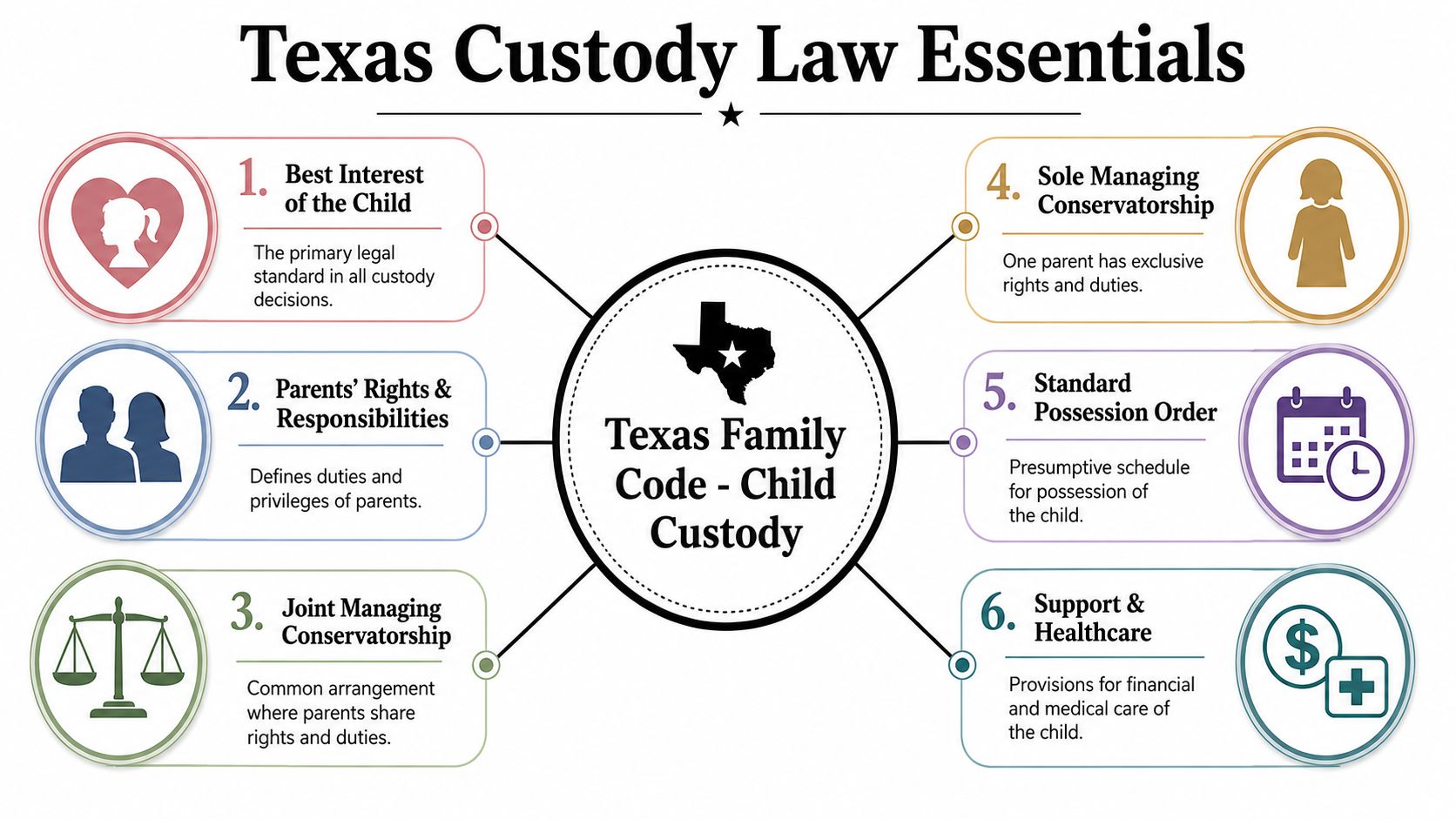
Texas usually uses the word conservatorship instead of custody. Conservatorship covers decision-making rights and duties for a child. Possession and access cover the schedule, meaning when each parent has time with the child.
Under Texas law, joint managing conservatorship is the default assumption in most custody cases, meaning both parents share legal custody and decision-making authority unless the court finds that such an arrangement isn't in the child's best interest, as explained in this discussion of Texas child custody under Chapter 153.
That point causes confusion for many parents. Joint managing conservatorship does not automatically mean a perfect 50/50 split in parenting time. It means both parents usually stay involved in major decisions unless the facts show that a different arrangement is necessary.
What the best-interest standard really means
The phrase best interest of the child guides Texas custody decisions. This concept serves as the court's measuring tool. Every request gets tested against one question: does this arrangement support the child's emotional and physical needs, stability, safety, and healthy development?
Texas courts also consider the child's voice in some cases. Under Chapter 153, the court may privately interview a child who is 12 or older to learn the child's wishes, while still keeping the focus on maturity and best interest, as summarized in this explanation of Texas custody standards and child interviews.
For a closer look at the factors courts use, The Best-Interest Standard and the Holley Factors gives a factual overview of the considerations Texas courts apply.
Courts don't reward the parent who sounds the angriest. They respond to the parent who shows stability, follow-through, and a child-focused plan.
What possession schedules usually look like
A possession schedule is the calendar for parenting time. In many Texas cases, courts use a standard structure unless parents agree on something else or the facts support a different plan. Texas possession schedules usually reserve the child's primary residence to one parent while granting the other parent possession every first, third, and fifth weekend of each month, plus certain holidays and extended summer periods, including alternating Thanksgiving breaks and roughly 30 days in the summer, according to this summary of standard possession schedule terms.
That doesn't mean every family should accept the standard schedule without question. A parent with a nontraditional work schedule, a very young child, or a long-distance parenting issue may need a more individualized plan.
Why details outside the courtroom can still matter
Some custody cases overlap with immigration, relocation, or international family issues. If you're handling paperwork in more than one system, practical tasks like translate divorce decree for immigration can become part of keeping records usable and consistent.
Parents who need case-specific legal help on conservatorship, possession, or access issues can also review Texas Child Custody Lawyer for a general overview of representation in Chapter 153 matters.
Identifying the Key Qualities of an Effective Lawyer
Not every experienced attorney is the right custody attorney. The best child custody lawyer for your case is someone who can match legal skill to the facts, the judge, the conflict level, and your child's needs.

Look for strategy, not just credentials
Credentials matter. So does concentrated family law experience. But in custody work, strategy is what parents feel day to day.
A strong lawyer should be able to answer questions like these in plain English: What facts matter most? What weakens my position? Should we push for an agreed order or prepare for a hearing? What will the judge likely want to see from me over the next few months?
Those questions tell you whether the lawyer is thinking ahead or only reacting.
Match the lawyer to the conflict
Some cases involve communication problems but no real safety risk. Others involve substance abuse allegations, relocation disputes, digital evidence, mental health concerns, or claims that one parent is interfering with access. Those cases need different lawyering styles.
Here is the practical split:
- Negotiation-focused counsel can work well when both parents are capable of compromise and the main dispute is over schedule details or decision-making structure.
- Litigation-ready counsel is often necessary when the other side hides information, ignores orders, manipulates the children, or makes serious allegations.
- A balanced lawyer is often the best fit because most custody cases involve both. Settlement efforts early. Court readiness if that fails.
Representation changes outcomes
Parents sometimes delay hiring counsel because they hope the case will stay simple. Sometimes it does. Often it doesn't.
In cases where both parents are represented by lawyers, joint physical custody is the outcome 82% of the time, compared to about 70% when only one or neither party has counsel, a 12-point difference noted in Custody X Change's attorney and custody survey summary. That doesn't mean every represented case ends well. It does show that legal representation can materially shape how parenting arrangements are negotiated and finalized.
A useful custody lawyer doesn't just argue. They organize the case so the judge can trust the picture being presented.
Local knowledge matters more than parents expect
Texas law is statewide, but courtrooms are local. Filing practices, scheduling realities, and judicial preferences vary by county. A lawyer who regularly handles custody matters in your area may know how a particular court views temporary orders, contested hearings, communication apps, parenting plans, and presentation style.
That local familiarity can affect practical decisions like how much evidence to front-load, whether a judge expects specificity in possession proposals, and how to prepare you for testimony. Those aren't flashy details. They are often the details that shape results.
Questions to Ask and Red Flags to Avoid
The consultation is where marketing ends and real judgment begins. You don't need to impress the lawyer. You need to find out whether this person can protect your relationship with your child.
Essential Questions for Your Attorney Consultation
| Category | Question to Ask |
|---|---|
| Experience | What kinds of Texas custody cases do you handle most often? |
| Court familiarity | How familiar are you with the courts and judges in my county? |
| Case strategy | Based on what I've told you, what issues do you think will matter most in my case? |
| Communication | Who will be my main point of contact, and how will updates be shared? |
| Negotiation | When do you recommend settlement, and when do you recommend a hearing? |
| Evidence | What records, messages, school information, or witness information should I start gathering now? |
| Digital issues | How do you handle social media, text messages, location data, and screenshots in custody cases? |
| Risk assessment | What facts could hurt my case, and how would you address them? |
| Temporary orders | Do I need temporary orders for possession, support, or decision-making? |
| Costs | How do you bill, and what tends to increase costs in a custody case? |
If you want a longer consultation checklist, this resource on questions to ask a custody lawyer in Texas can help you prepare.
Ask directly about digital evidence
This issue is no longer niche. Over 70% of family court cases now involve digital evidence like social media posts, location data, and chat logs, according to this discussion of digital evidence in custody disputes. A lawyer who can't explain how to preserve, review, and challenge digital material may miss evidence that shapes the entire case.
Ask practical questions. Should you stop posting on social media? How should screenshots be saved? What if the other parent edits messages or takes content out of context? Can metadata matter? You don't need a technical lecture. You need a lawyer who recognizes that phones now hold much of the evidence in modern custody disputes.
Red flags that should make you pause
Some warning signs appear in the first ten minutes.
- Guaranteed outcomes: If a lawyer promises primary custody before reviewing documents, hearing the full history, or assessing the other side, be careful. No honest custody attorney can guarantee a result.
- Confusing language without explanation: Good family lawyers know the law. Better ones can explain it so a worried parent can act on it.
- No interest in facts: If the attorney doesn't ask about school involvement, caregiving patterns, medical issues, prior orders, or communication history, they may be thinking too generally.
- One-size-fits-all advice: A lawyer who gives the same speech to every parent may miss the facts that actually drive your case.
- Dismissive attitude toward bias or perception: Parents with mental health histories, lower income, or nontraditional family roles often need careful framing, not judgment.
If the consultation leaves you feeling smaller, more confused, or pressured, keep looking.
What a good first conversation feels like
A strong consultation usually has a clear rhythm. The lawyer listens. They ask for dates, documents, and context. They identify legal issues without dramatizing them. They tell you what you can fix, what you can't control, and what to do next.
That kind of conversation doesn't always feel comforting in the moment, because honest advice can be hard to hear. But it gives you something better than reassurance alone. It gives you direction.
Preparing for Your First Consultation and Understanding Costs
The first meeting works best when you bring order to a stressful situation. Your lawyer doesn't need a perfect presentation. They need usable information.
Start with a fact-matrix
Research on custody prediction shows that outcomes can be modeled with over 85% accuracy when factual evidence, such as parenting history and home stability, is systematically structured and presented, as discussed in this review of structured factual modeling in child custody cases. In practice, that means one of the most helpful things you can do is prepare a chronological fact-matrix for your lawyer.
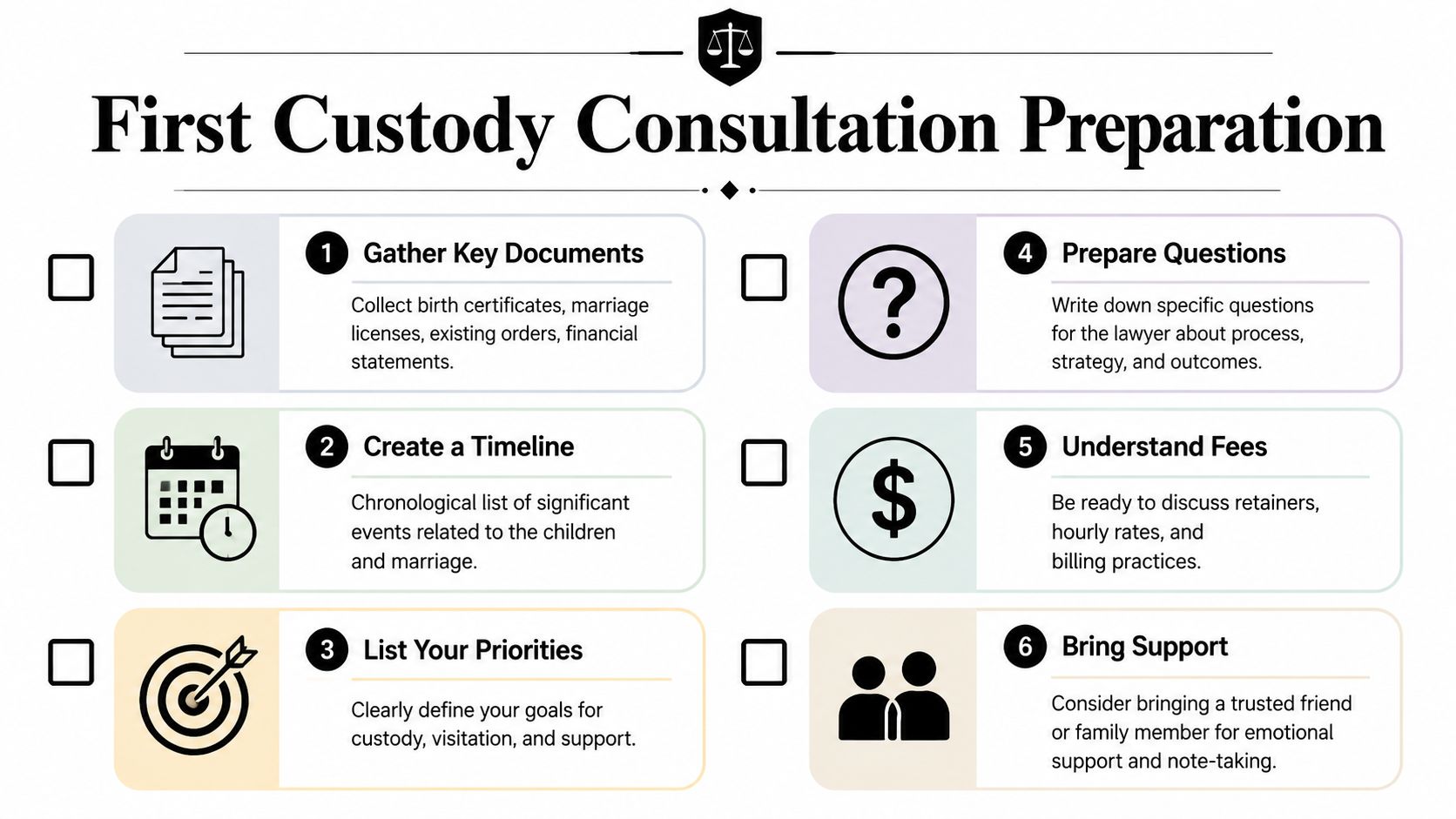
That sounds more complicated than it is. Create a timeline with dates, major events, caregiving patterns, school involvement, medical issues, exchanges, communication problems, and anything affecting the child's daily life. Keep it factual. Short entries are better than emotional essays.
What to bring to the meeting
The most productive consultations usually involve a small, organized packet, not a box of loose papers.
- Court papers: Prior custody orders, divorce filings, modification requests, or notices.
- Child-focused records: School records, attendance issues, medical information, counseling records if applicable and lawfully available.
- Communication samples: Relevant texts, emails, parenting app logs, or call records.
- Your timeline: A dated outline of key events and caregiving history.
- Your goals: Whether you're seeking primary custody, a more workable possession schedule, enforcement, or modification.
For a more detailed checklist, review how to prepare for a custody consultation in Texas.
A short video can also help you think through the meeting before you walk in:
How legal fees usually work
Parents often avoid asking about cost because they don't want to seem difficult. Ask anyway. Clear billing discussions prevent conflict later.
Most custody lawyers use one of these structures:
- Retainer: An upfront deposit placed against future work.
- Hourly billing: Time spent on calls, drafting, hearings, review, and negotiation is billed as work is performed.
- Flat fees for limited tasks: Sometimes used for a specific filing or narrowly defined service, though contested custody matters often don't fit neatly into a flat-fee model.
The right question isn't only "What do you charge?" It's also "What tends to make a case more expensive?" The answer often includes emergency motions, extensive conflict, poor document organization, repeated communication crises, and avoidable disputes over small issues.
Bring facts in organized form, and you usually save time, money, and stress.
Making Your Final Decision and Next Steps
By the time you've spoken with a few lawyers, the right choice often becomes clearer. It usually isn't the person who sounded the most dramatic. It's the one who understood your concerns, spotted the legal pressure points quickly, and gave you a realistic plan.
How to choose when more than one lawyer seems qualified
Use both logic and instinct.
Ask yourself:
- Did this lawyer explain Texas custody law clearly?
- Did they listen for facts, not just conflict?
- Did they take my role as a parent seriously?
- Did I leave with a better understanding of risks and next steps?
- Can I trust this person to present me fairly if bias becomes part of the case?
That last point matters. National family law statistics show primary custody is still awarded to mothers more often than fathers, even when the legal standard is gender-neutral, as discussed in Clio's family law statistics overview. Fathers, non-primary caregivers, and other parents who feel underestimated should pay close attention to whether the lawyer has a practical plan for addressing assumptions rather than pretending those assumptions never arise.
What happens after you hire counsel
Once you decide, the next steps are usually straightforward:
- Review and sign the fee agreement. Read it carefully. Ask who will handle hearings, drafting, and routine communication.
- Pay the required retainer or initial fee. Make sure you understand replenishment terms if hourly billing applies.
- Send your documents promptly. Delays at this stage often slow early strategy decisions.
- Work on your timeline and evidence file. Organized facts help your lawyer move quickly.
- Follow behavior guidance. That may include communication boundaries, social media limits, and parenting conduct during the case.
Some parents also benefit from reviewing a firm overview such as Texas Child Custody Lawyer when comparing the scope of Chapter 153 representation options.
Key Takeaway
The best child custody lawyer in Texas isn't just the person with the strongest resume. It's the advocate who understands Texas law, explains your options clearly, prepares evidence carefully, and knows how to present your role in your child's life with credibility and care.
If you're a mother seeking stability, a father trying to protect meaningful parenting time, a grandparent exploring legal standing, or a caregiver dealing with a major change, the right legal partner can make this process less overwhelming and more focused. Good custody representation doesn't erase the stress. It gives that stress direction.
If you need help with a child custody or visitation case in Texas, our experienced attorneys can guide you every step of the way. Contact The Law Office of Bryan Fagan, PLLC today for a free consultation.