
When your child's future is on the line, understanding your rights matters most.
You may be here because a school packet came home, a pediatrician raised the issue, or your co-parent suddenly said no to vaccines. What looked like a medical decision turned into a legal conflict fast. For many Texas parents, the primary question isn't only Can I choose not to vaccinate my child? It's also, who gets to decide when parents disagree?
That's where family law matters. In Texas, vaccine disputes can affect conservatorship, possession, school planning, and how a judge views each parent's ability to make decisions in the child's best interest. This article isn't medical advice. It's a practical legal guide for parents, grandparents, and caregivers trying to protect a child while navigating a difficult family situation.
A Parent's Choice a Co-Parent's Conflict
The conflict often starts in an ordinary moment. One parent signs a school health form without much hesitation. The other says the child should claim an exemption. Both love the child. Both believe they're protecting the child. But the disagreement can quickly spill into text fights, missed appointments, and threats to “take it back to court.”
That situation is more common than many parents realize. In the United States, a Washington Post poll reported that 1 in 6 parents had either delayed or skipped at least some standard childhood vaccines for their children, which shows this isn't a fringe issue but a real parenting choice affecting families nationwide, according to the Washington Post poll coverage referenced here.
For divorced or separated parents, the pressure is even heavier. A disagreement about vaccines can become a disagreement about school enrollment, travel, daycare, and trust. If one household follows one set of rules and the other follows another, the child gets caught in the middle.
What matters most in court: Texas judges don't decide these cases based on which parent argues louder. They focus on the best interest of the child.
That phrase sounds broad because it is. Texas courts use it to evaluate parenting decisions, safety, stability, and each parent's judgment. So even if a parent believes they have a personal right to refuse vaccines, that doesn't automatically answer who has the legal right to make that choice for the child.
This tension can also overlap with schooling choices. Some families compare public school rules, private school expectations, and homeschooling obligations while sorting through co-parenting disputes. If education planning is part of your conflict, it may help to review understanding UK homeschooling regulations as a general example of how school compliance issues can shape parental decision-making, even though Texas law will control your own case.
Texas School and Daycare Vaccination Requirements
Texas starts from a simple baseline. Children are generally expected to meet immunization requirements for school and many childcare settings unless a valid exemption applies. In plain English, the default rule is participation through compliance, and an exemption is the exception.
That matters in custody cases because parents sometimes talk past each other. One parent says, “I have the right to refuse.” The other says, “The school won't accept that.” Both may be partly right depending on the child's setting, the paperwork, and the exact wording of the court order.
The default rule in everyday life
For most families, vaccine requirements show up in practical places:
- School enrollment: Public and many private school settings typically require proof of required immunizations or approved exemption paperwork.
- Daycare and childcare: Younger children often run into these rules even earlier than school-age children.
- Activities and records: Camps, programs, and care providers may ask for health records because they need to follow facility rules and outbreak procedures.
A parent should treat this as an administrative issue as much as a personal one. If paperwork is incomplete, the child may be the one who can't start school on time or continue attending care.
Why this matters in a custody dispute
Texas family courts often divide rights and duties between parents. One parent may have the right to make certain medical decisions. Another may have a larger share of day-to-day possession. Those are not always the same thing.
That's why a disagreement over vaccines can't be solved by saying, “It's my weekend,” or “I'm the one who usually handles doctor visits.” The legal answer depends on the order.
A related custody question also comes up when parents ask whether an older child's opinion settles the issue. It usually doesn't. If you're dealing with a child who has strong views about where they live or which parent they agree with, Does a Child Get to Choose Which Parent in Texas? gives a helpful overview of how a child's wishes factor into a Texas custody decision.
School rules and custody orders do different jobs. One tells you what's required for attendance. The other tells you which parent has authority to decide.
The practical point
Before arguing about principle, check the paperwork. Look at the school or daycare requirements, then look at your court order. Many parents skip the second step and assume they have authority they don't hold.
How to Legally Opt Out with Exemptions in Texas
Texas parents usually want a clear answer to one question: if they don't want their child vaccinated, how do they do that legally? The short answer is that Texas recognizes exemption paths, but each one depends on proper documentation.
Nationally, exemption laws vary widely. By 2024 to 2025, U.S. childhood immunization data showed that non-medical exemptions reached 3.4%, the highest level ever recorded in that dataset, while medical exemptions stayed flat at 0.2%. The same public health summary notes that all U.S. states allow medical exemptions, but only 15 states allow personal-belief exemptions, which is why understanding Texas-specific rules matters, as explained by Johns Hopkins IVAC's review of exemption trends.
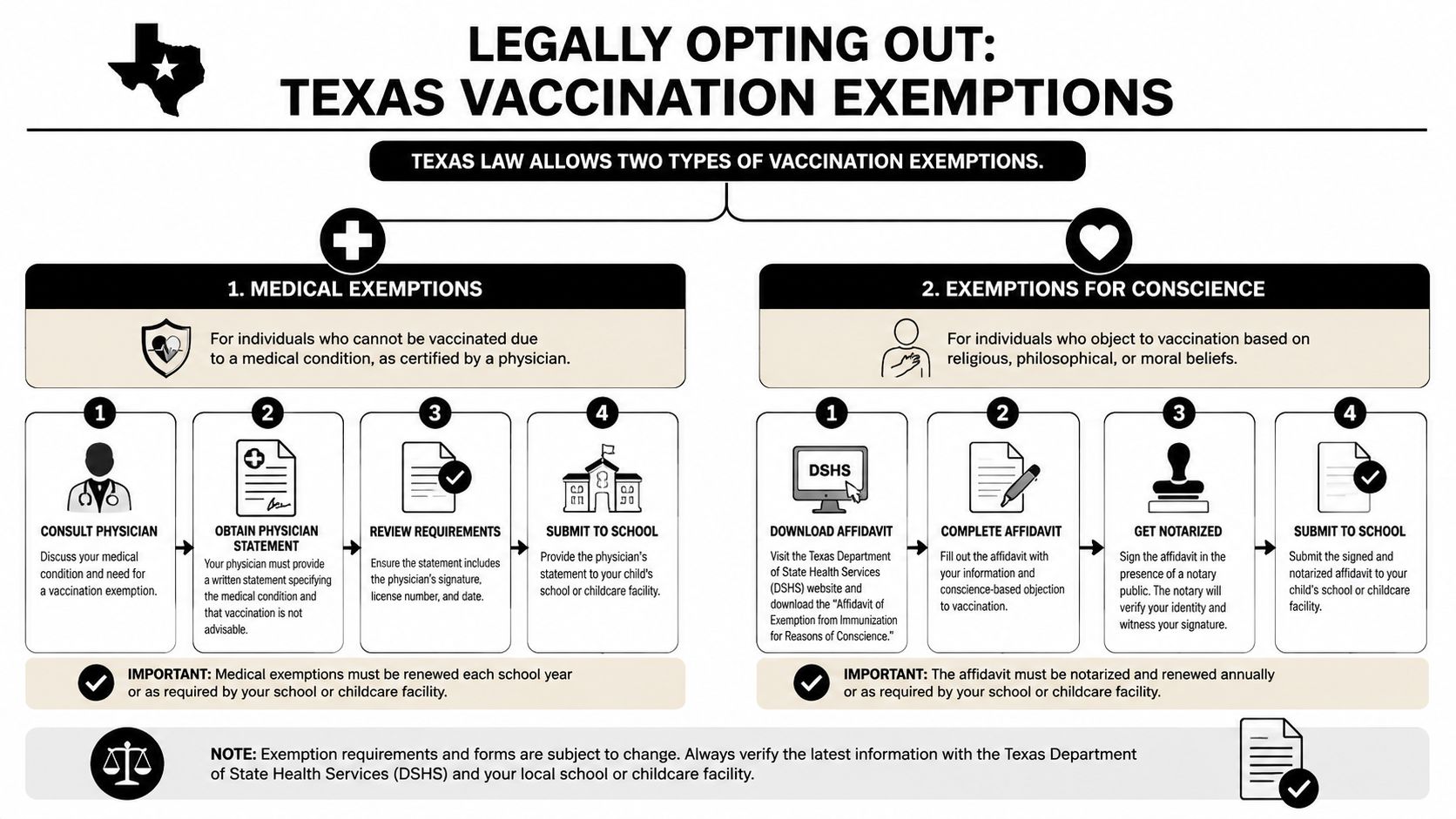
Medical exemption
A medical exemption generally depends on a physician's statement. The key idea is that the exemption is tied to the child's medical condition, not merely a parent's preference.
A parent pursuing this route should usually expect to:
- Talk to the child's physician: Ask whether the child has a medical reason that supports exemption.
- Obtain the required statement: The provider's documentation needs to satisfy the applicable school or childcare requirements.
- Submit it properly: Give the paperwork to the school, daycare, or program that requires it.
- Track expiration or updates: Some medical documentation may need renewal or revision.
This is one area where parents often get confused. A doctor's general concern or informal conversation usually isn't the same thing as the formal paperwork a school accepts.
Exemption for reasons of conscience
Texas also allows an exemption path based on reasons of conscience, which can include religious beliefs. This process is not handled the same way as a medical exemption.
Parents usually need to complete the state-required affidavit process and submit the correct form to the school or facility. That means details matter. Timing matters too.
Common steps include:
- Requesting the official form: Parents must use the proper state process.
- Completing the affidavit carefully: Errors can cause delays.
- Notarizing the form when required: An unsigned or incomplete form may not work.
- Filing it with the school or daycare: Keep copies for your own records.
A legal warning for co-parents
Even if Texas law offers an exemption route, a parent in a custody case still has to ask a separate question: Do I have the right under my court order to make this decision for my child?
That's where many disputes begin. A parent may be fully capable of obtaining exemption paperwork and still be acting outside the authority granted in the custody order.
Who Decides When Parents Disagree About Vaccines
When parents separate, Texas family law doesn't assume they'll agree on every major issue. Instead, the court creates a structure for decision-making. That structure usually appears in a SAPCR, which stands for a suit affecting the parent-child relationship, or in a divorce decree with custody terms built into it.
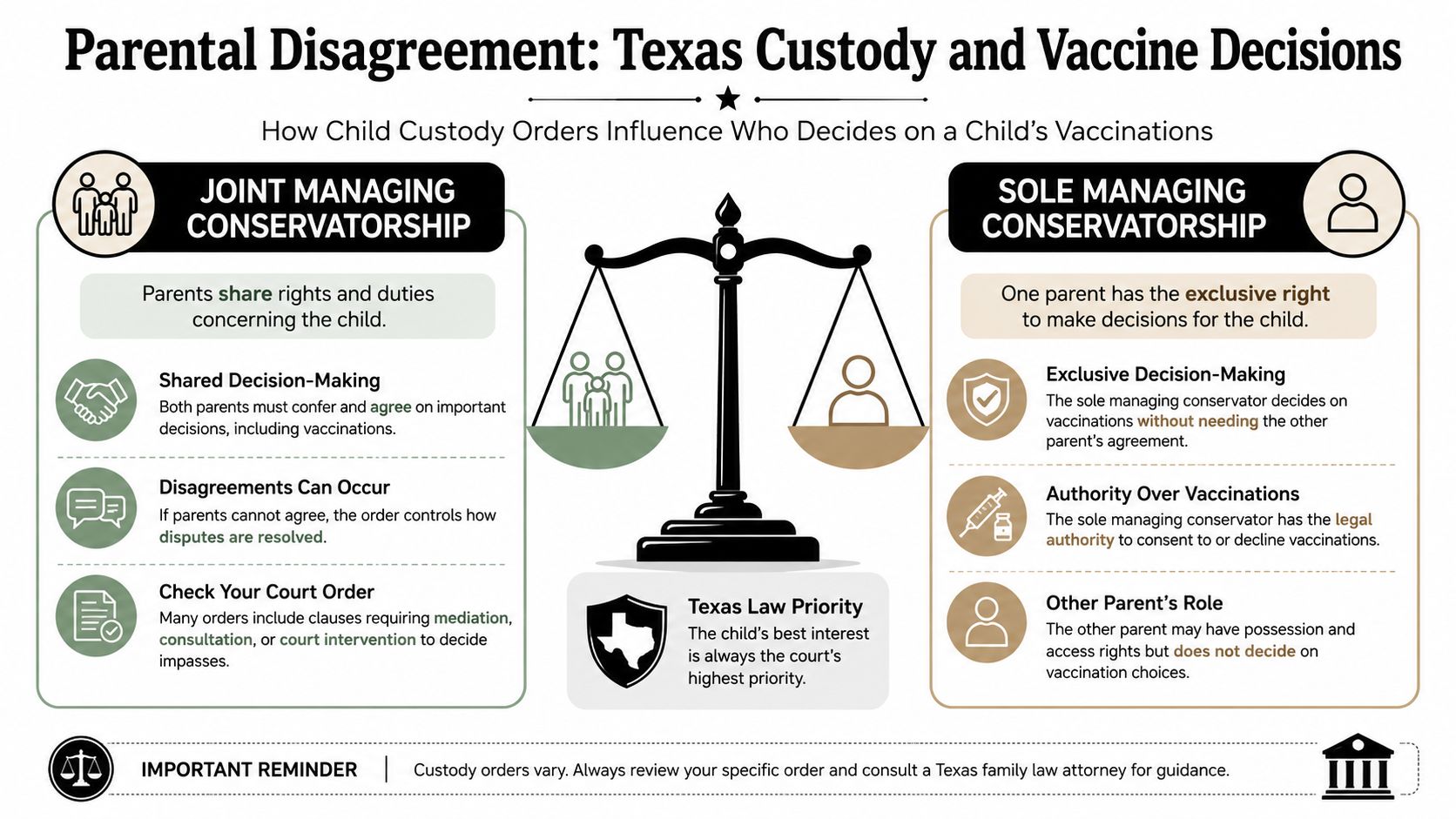
The legal term many parents hear first is joint managing conservatorship. In plain English, that usually means both parents keep important rights and duties regarding the child. But “joint” does not always mean equal power on every issue. It also doesn't mean each parent can make a major medical decision on their own whenever they want.
A major gap in public discussion is the family-law fallout when parents disagree about vaccination after divorce. Public guidance often explains exemptions, but it rarely answers who gets to decide when one parent wants vaccines and the other refuses, or how a court may weigh that conflict in a best-interests analysis, as discussed in this family-law and vaccination overview.
Joint managing conservatorship
Under a Joint Managing Conservatorship, parents may share some rights in one of several ways:
| Possible setup | What it can mean for vaccine disputes |
|---|---|
| Shared by agreement | Both parents must agree before a major medical decision is made |
| Independent rights | Each parent may act alone for certain listed matters, but not always major invasive or disputed care |
| Exclusive right to one parent | One parent has the final say on a specific category, such as non-emergency medical decisions |
This is why reading the actual order matters more than relying on labels. Two parents can both be joint managing conservators, yet only one may have the final authority over medical choices.
Sole managing conservatorship
A sole managing conservatorship gives one parent broader decision-making authority. The other parent may still have visitation, access to records, and important duties, but not the final word on major issues assigned exclusively to the sole managing conservator.
If your case involves that structure, it helps to understand how sole managing conservatorship in Texas affects parental authority in day-to-day life and in high-conflict decision-making.
Possession is not the same as decision-making
Texas parents also confuse possession schedules with legal authority. A possession schedule is the calendar that sets when the child is with each parent. It answers “when,” not necessarily “who decides.”
For example:
- Weekend possession: A parent has the child for the weekend but may still lack authority to overrule a medical decision assigned to the other parent.
- Primary residence: A parent may determine the child's residence within a geographic area but still share medical decision-making.
- Emergency care: A parent with the child can usually seek urgent treatment in an emergency, even if they don't control broader non-emergency medical choices.
If the order gives one parent the exclusive right to make non-emergency medical decisions, that language often controls the vaccine dispute unless the court changes it.
What if the order is unclear
Some orders are vague. Others were written before the issue ever came up. If the wording is unclear, one parent may insist they can refuse vaccines while the other says they can authorize them.
That's when families often need mediation, a clarification request, or a modification case. The answer rarely comes from who feels more strongly. It comes from the text of the order and, if needed, the court's interpretation of it.
How a Texas Judge Views Vaccination Disputes
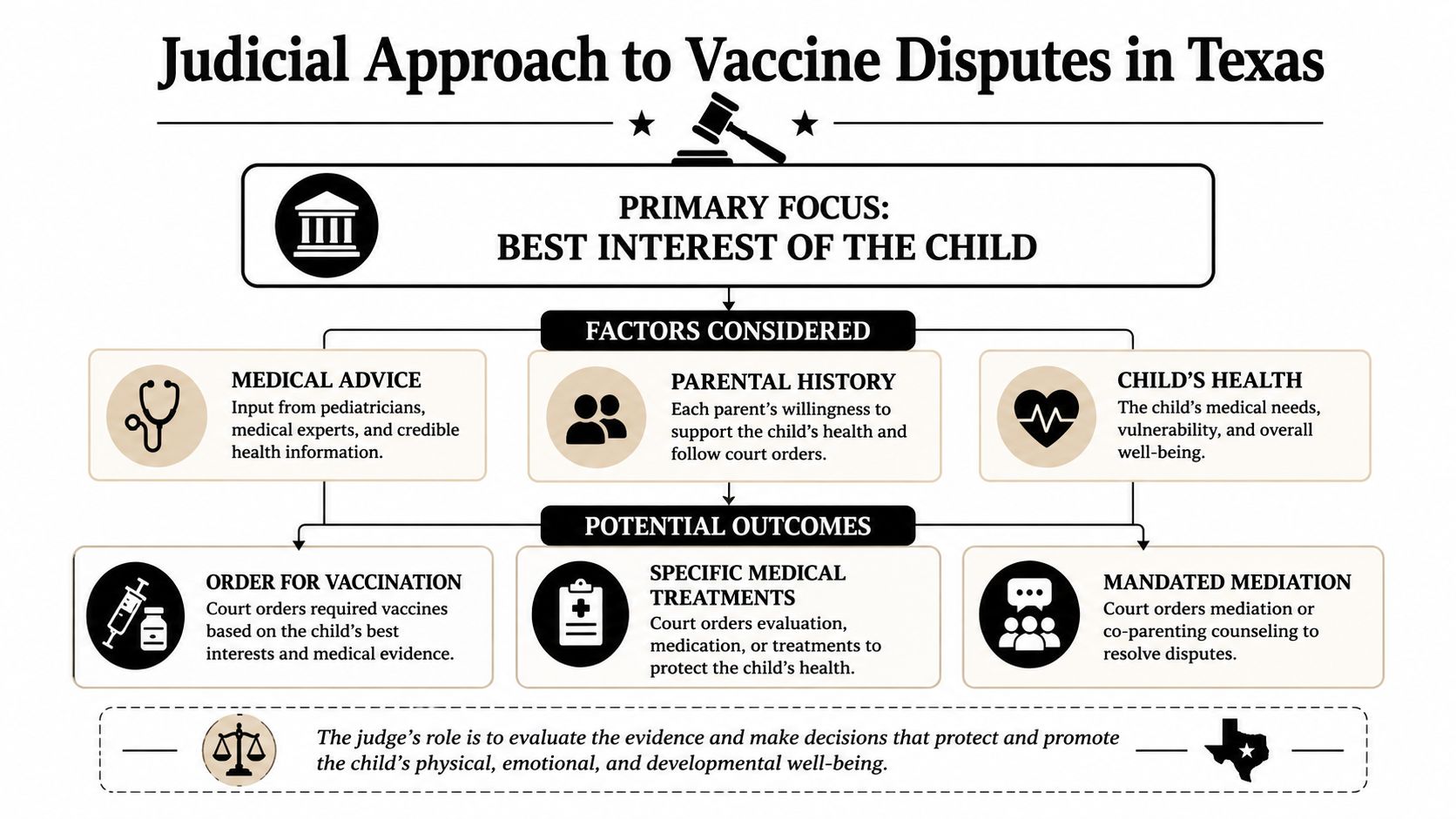
When parents can't resolve the issue, a Texas judge steps in with one guiding rule: the best interest of the child. That standard runs through Texas custody law, including disputes over conservatorship, possession, and decision-making authority.
A judge usually won't treat the case as a debate about abstract parental rights alone. The court will ask how the decision affects this child, in this family, under these circumstances.
If you want a broader look at that standard, how judges make custody decisions in Texas gives useful context for how courts weigh competing parental claims.
What evidence can matter
Judges often look for specific, child-centered evidence rather than broad political or philosophical arguments. That may include:
- The child's health history: Existing medical conditions, vulnerabilities, and prior treatment history.
- Recommendations from treating professionals: Especially when the dispute concerns an individual child rather than a general belief.
- The current court order: The judge will review who already holds decision-making authority.
- School and childcare impact: Whether the decision affects attendance, stability, and routine.
- Parental conduct: Whether either parent acted reasonably, communicated clearly, and followed the order.
A parent who hides records, refuses to communicate, or makes unilateral decisions in violation of the order may damage their credibility even if they believe they're acting for good reasons.
What judges usually want to see from parents
Judges tend to respond better when parents show they can focus on the child rather than turn every disagreement into a loyalty test. That means:
- Bringing organized records.
- Showing the court you tried to resolve the conflict.
- Explaining the practical impact on the child.
- Avoiding personal attacks that don't help the judge decide the issue.
Courtroom reality: A judge is often deciding not only the vaccine issue, but also which parent appears more able to make calm, child-focused decisions in the future.
Possible outcomes
Depending on the case, a judge may:
- Leave the existing order in place and enforce it.
- Clarify who has authority to make the decision.
- Modify conservatorship rights going forward.
- Order parents to follow a dispute-resolution process built into the decree.
For mothers and fathers alike, the key is the same. Don't assume the court will reward passion by itself. The court is looking for judgment, stability, and a child-centered explanation.
Practical Consequences for Your Child and Family
A legal exemption doesn't erase practical consequences. It just changes the path your family may have to walk.
Take a common example. A child has an exemption on file, attends school without a problem for months, and life feels normal. Then the school notifies families about an exposure event. Suddenly the issue isn't theoretical anymore. The family must figure out transportation, missed classroom time, after-school plans, and which parent can stay home.
Public-health guidance explains that if a parent chooses not to vaccinate, the child may be excluded from school, child care, or other organized activities during exposure or outbreak control periods, and the child may have to stay home for up to several weeks depending on the disease and incubation window, according to this guidance on risks and responsibilities when parents decline vaccination.
The day-to-day impact
That can create real stress for separated families:
- Work conflicts: One parent may say the other should handle the child's time at home.
- Possession disputes: Exchanges become harder if one household has vulnerable family members.
- School disruption: Missed instruction can create tension about tutoring, absences, and routine.
- Family exposure concerns: Parents may have to think about newborns, grandparents, or immunocompromised relatives.
The question isn't only whether a parent can opt out. It's whether the family is prepared for what follows if school access changes quickly.
Why parents should think past the form
Many parents focus on getting the exemption approved. Fewer think through what happens next. If you're sorting through broader health questions as part of that decision, resources that compare immunity and vaccines can help you understand the kinds of issues families often weigh, alongside guidance from your child's own medical providers.
In family court, those practical consequences matter. A judge may ask which parent planned ahead, kept the child's schedule stable, and responded responsibly when conflict affected school or childcare.
Your Next Steps in a Parental Vaccine Disagreement
A vaccine dispute can turn serious fast in a co-parenting case. One parent schedules the appointment. The other objects after the fact. By then, the disagreement is no longer just about health care. It can become a question of whether someone violated the court order, created avoidable conflict, or put the child in the middle.
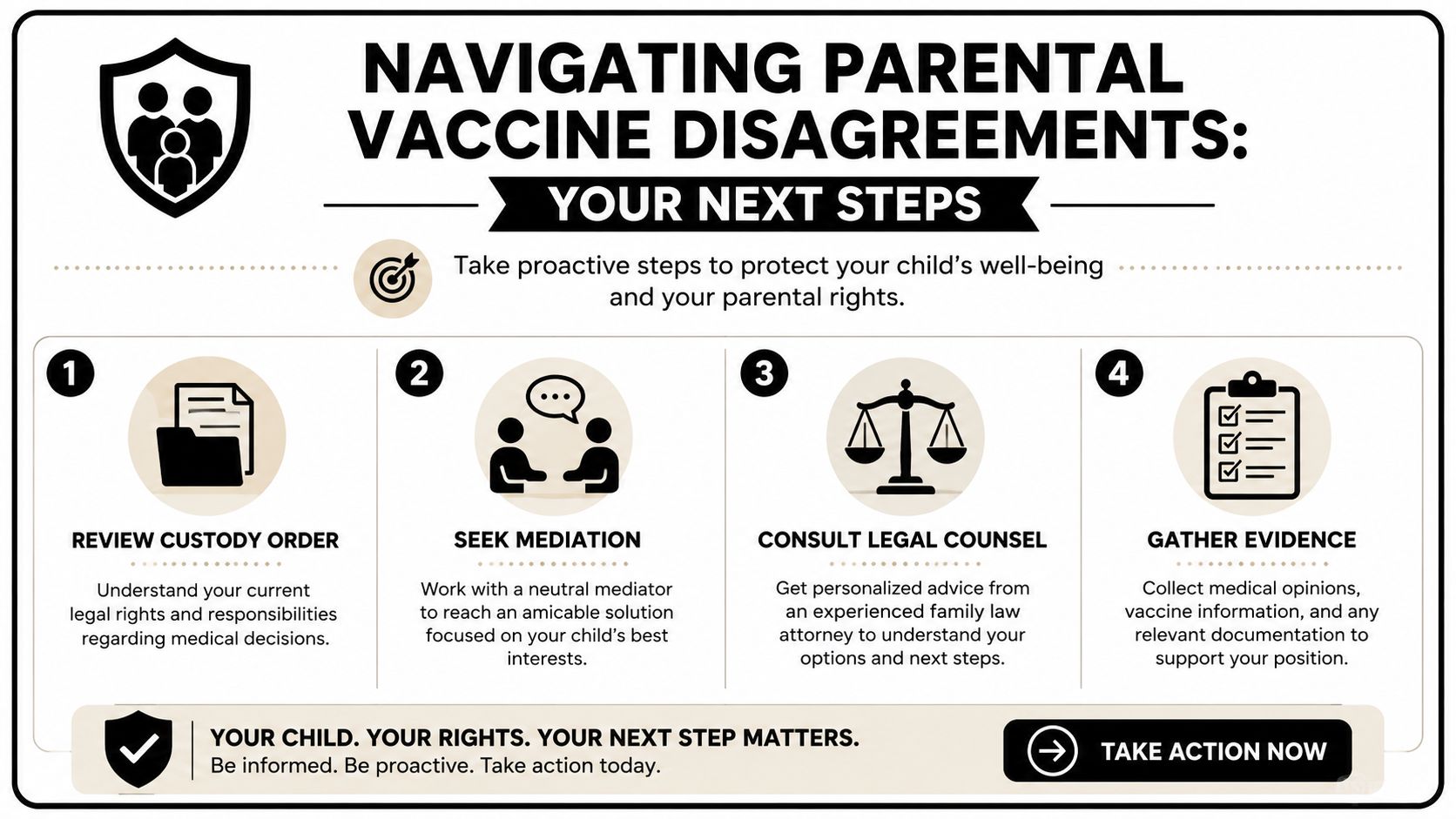
Start with your orders. In Texas, the answer often lives in the conservatorship language, especially the parts dealing with medical decisions, each parent's rights and duties, and any required dispute-resolution process. Court orders can read like instructions written in a different dialect. A small phrase such as “independently,” “jointly,” or “subject to agreement” can change who has the legal right to decide.
Four smart steps
Read the medical decision-making language carefully
Check who has the right to consent to non-emergency medical care. Some parents share that right. In other cases, one parent has it exclusively. That distinction matters.Build a clear paper trail
Save school notices, pediatric records, vaccine recommendations, messages with the other parent, and anything showing deadlines or consequences. Judges often look for the parent who stayed organized, communicated clearly, and kept the focus on the child.Use the dispute process in the order before rushing to court
Many Texas orders require mediation or another effort to resolve the disagreement first. To understand how that usually works, review what happens during custody mediation in Texas.Get legal advice before taking unilateral action
A lawyer can tell you whether you are dealing with interpretation, enforcement, or a modification issue. That is an important difference. Enforcement asks the court to address a violation of the current order. Modification asks the court to change who gets to make the decision in the future.
When modification may be the better fix
Some conflicts are not one-time disputes. They are symptoms of an order that no longer works. If your current order is vague about medical authority, or if vaccine disagreements are tied to larger problems involving doctor access, school attendance, or repeated co-parenting breakdowns, a modification may give the family a clearer rule going forward.
A good way to think about it is this. Enforcement deals with a broken traffic signal. Modification installs a new one that is easier to follow.
The goal is not to “win” the argument. The goal is to show that your choices protect your child's stability, health, schooling, and relationships. In Texas family court, that child-centered approach usually carries far more weight than anger, suspicion, or a rush to act first.
Key takeaway: Read the order closely, document carefully, follow the required dispute process, and keep your child's best interest at the center of every decision.