
When your service to the country overlaps with the end of your marriage, the path forward can feel incredibly complicated. For military families, a divorce in Texas isn’t just about state law—it’s a unique mix of both state and federal rules. Understanding how Texas divorce laws for military personnel work is the first step toward building a stable future for you and your kids.
How Texas Manages Military Divorce Cases

Navigating a divorce is a deeply emotional journey for any family. But for military families, the process is layered with extra complexities. You're dealing with deployments, relocations, and a specific set of federal regulations designed to protect service members and their spouses. Here at The Law Office of Bryan Fagan, we understand the immense pressure you’re under and are here to bring clarity and compassionate guidance to your situation.
While your case will move through the Texas family court system like any other, it’s critical to understand that it won’t be treated exactly like a civilian divorce. Federal laws add important layers of protection and specific rules that everyone—you, your spouse, and the court—must follow.
Key Federal Laws to Know
Two main federal acts have a major impact on military divorces in Texas. They work hand-in-hand with the Texas Family Code to make sure the outcome is fair for everyone involved.
-
The Servicemembers Civil Relief Act (SCRA): Think of this law as a shield. It’s designed to protect active-duty service members from being put at a legal disadvantage because of their military obligations. For example, it allows a service member to request a temporary pause, or a "stay," in divorce proceedings if their duties prevent them from fully participating.
-
The Uniformed Services Former Spouses’ Protection Act (USFSPA): This is the act that governs how military retirement pay can be divided as community property in a divorce. It gives a state court, like one in Texas, the legal framework to award a portion of a service member’s disposable retired pay to their former spouse.
Understanding these laws isn’t just about legal procedure; it’s about making sure your service-related circumstances are properly recognized and handled by the court. Your rights—whether you’re the service member or the military spouse—are protected.
Our goal is to demystify these rules and empower you right from the start. While the general roadmap of a divorce is similar for everyone, knowing how to file for divorce in Texas is the foundational first step. The intersection of state and federal law simply means your case needs a more knowledgeable and strategic approach.
Establishing Jurisdiction for Your Military Divorce
When your family's future hangs in the balance, the first question is often the most stressful: "Where do we even file for divorce?" For military families, the answer isn't always obvious. It all comes down to a legal concept called jurisdiction—the court's official power to hear your case. Getting this right from the start is absolutely critical.
For any Texas court to handle your divorce, the state has some clear residency rules. The Texas Family Code says at least one spouse must have lived in Texas for the past six months and in the specific county where you file for the last 90 days.
If you're a civilian, that's pretty straightforward. But for military families, who are constantly on the move thanks to PCS orders, those requirements can feel like an impossible bar to clear.
How Domicile Works for Service Members
This is where Texas law provides a crucial workaround for military families: the concept of domicile. Your domicile isn't just where your boots are on the ground today; it's your permanent, legal home—the place you consider "home base" and intend to return to.
This distinction changes everything. If you or your spouse has kept Texas as your legal home of record, you can still meet the state's residency requirements and file for divorce here, even if you haven't physically set foot in Texas for months.
- Example 1: Stationed in Texas: Let's say you're a service member stationed at Fort Cavazos (formerly Fort Hood). If you've lived there for the last year, you easily meet the rules to file for divorce in Bell or Coryell County. No problem.
- Example 2: Deployed Overseas: Now, imagine you're deployed. But your Home of Record is Texas, you have a Texas driver's license, and you maintain your Texas residency for tax purposes. You can almost certainly file for divorce in Texas because the court understands your absence is due to military orders, not a choice to move away.
Unique Stressors and Texas Residency Rules
Military life brings a unique set of pressures that can strain a marriage—from the stress of long deployments to the challenges of reintegrating back into family life. These factors are a big reason why Texas makes its filing rules so accommodating for service members at bases like Fort Cavazos.
The key takeaway is simple: being stationed outside of Texas doesn't automatically lock you out of the Texas court system. Your legal ties to the state are what truly matter.
These rules also tie directly into child custody. If your kids have lived in multiple states because of your service, figuring out which court has jurisdiction over them can get complicated fast. Understanding the essentials of child custody across state lines is a vital piece of the puzzle, ensuring your children's best interests are protected no matter where your military career takes you.
Understanding Your SCRA Protections

Serving your country is a profound commitment. The last thing you should have to worry about while deployed or on assignment is losing your legal footing in a divorce back home. That’s exactly why a powerful federal law called the Servicemembers Civil Relief Act (SCRA) exists.
Think of the SCRA as a legal shield. It recognizes that your military duties—whether you’re in training, deployed overseas, or executing a PCS move—can make it practically impossible to respond to a lawsuit. Its main job in a divorce is to prevent a default judgment from being entered against you simply because you couldn't show up in court.
A default judgment is when a judge makes a final ruling without hearing your side of the story. That can be devastating for your parental rights, your share of the property, and your financial future. The SCRA ensures the case doesn’t move forward without you.
How the SCRA Pauses Divorce Proceedings
The most powerful tool in the SCRA’s arsenal is the ability to request a "stay," which is just the legal term for hitting the pause button on your divorce case. If you get served with divorce papers but your service obligations prevent you from responding or appearing in court, the SCRA allows you to ask the judge to put the proceedings on hold.
This isn’t a free pass to delay the divorce indefinitely, but a vital protection. It’s designed to give you the breathing room you need to hire an attorney and properly prepare your case. To get a stay, you’ll need to show the court how your military duties directly interfere with your ability to participate.
The SCRA ensures that your commitment to national security doesn't compromise your ability to secure a fair outcome for your family. It is a fundamental right for every service member.
For many service members, this protection is a game-changer. The Servicemembers Civil Relief Act (SCRA) provides a critical layer of security by allowing them to pause the case, buying precious time to find the right legal help without the threat of a default judgment looming. This federal protection applies to U.S. forces worldwide, making sure service obligations don't derail their fundamental rights in family court. You can find more insights about military divorce protections on texasdivorcelawyer.us.
To help you quickly grasp what this law does for you, here is a quick-reference table summarizing its key protections in a Texas divorce.
SCRA Protections Quick Reference
| SCRA Protection | What It Does | How It Helps In A Divorce |
|---|---|---|
| Stay of Proceedings | Temporarily pauses all legal actions, including hearings and deadlines. | Prevents the divorce from moving forward when you are deployed, in training, or otherwise unable to participate due to service. |
| Default Judgment Protection | Prohibits a court from entering a final judgment against you without your participation. | Ensures your spouse can’t finalize the divorce and get everything they asked for just because you couldn’t respond to the lawsuit in time. |
| Interest Rate Caps | Lowers interest rates on pre-service debts (like credit cards or mortgages) to 6%. | While not a direct divorce protection, it can ease financial strain during the case, which is often a major source of conflict. |
| Lease Terminations | Allows you to legally break residential and auto leases due to a PCS or deployment orders. | Gives you financial flexibility if you need to move or downsize your living situation as a result of the separation and your military orders. |
These protections are not automatic—you have to ask for them. But knowing they exist gives you a powerful advantage when facing a divorce while on active duty.
Invoking Your SCRA Rights
Requesting a stay under the SCRA is a formal legal process. It won't happen automatically; you or your attorney must actively petition the court for these protections.
Here’s how it generally works:
- Initial Stay: Once you properly notify the court of the conflict, a judge will typically grant an initial stay of at least 90 days.
- Required Documentation: You’ll need to submit a letter or a sworn statement (an affidavit) explaining why your military duties make it impossible for you to appear and providing an estimated date when you might be available.
- Commanding Officer Letter: To back up your request, a letter from your commanding officer is almost always required. This letter verifies your duties and confirms that you are unavailable for leave to attend court.
The key is to act quickly. If you ignore divorce papers, the court might assume you’re choosing not to participate and could move forward without you. Understanding how to use the SCRA is one of the most critical steps in defending your rights under Texas divorce laws for military personnel. This law empowers you to focus on your mission, knowing your voice will be heard back home.
Dividing Military Retirement and Benefits
When you’ve dedicated your life to service, your military pension isn't just a future paycheck—it’s one of the most significant assets you and your spouse have built together. For many military families, understanding how this retirement pay is handled in a Texas divorce is the key to ensuring both of you have a secure financial future.
This might feel like wading into a sea of acronyms and legal jargon, but the process is more straightforward than it seems. At its core, Texas law, working hand-in-hand with federal acts, creates a clear framework for a fair split. The trick is to stop seeing it as one person's benefit and start seeing the portion earned during the marriage as a shared marital asset.
Community Property and the USFSPA
First things first: Texas is a community property state. Think of your marriage as a partnership. Most assets and debts you acquire from the day you say "I do" until the day the divorce is final are considered jointly owned by both spouses.
This is where a federal law, the Uniformed Services Former Spouses’ Protection Act (USFSPA), comes into play. The USFSPA gives Texas courts the authority to treat disposable military retired pay earned during the marriage as community property. This empowers a judge to divide it in a way that is "just and right"—the same standard used for any other marital asset, like a house or a civilian 401(k).
The Frozen Benefit Rule Explained
One of the biggest game-changers in modern military divorce is the "Frozen Benefit Rule." Before 2017, there was a ton of confusion and conflict over how to value a pension, especially if the service member kept climbing the ranks after the divorce. Did the ex-spouse get a piece of those future promotions? It was a mess.
The 2017 National Defense Authorization Act (NDAA) cleared it all up. This law freezes the value of the military pension at the time of the divorce. The split is based only on the service member's rank and years of service accumulated during the marriage, not on any future promotions or pay raises.
This rule is a critical protection for the service member. It ensures that your post-divorce career advancements and hard work benefit you directly, while still giving your former spouse their fair, court-ordered share of the retirement you built together as a couple.
In simple terms, the pension is valued as if the service member retired on the date of the divorce. This provides certainty for everyone and prevents years of legal battles over recalculating the final amount down the road.
Getting Paid: The 10/10 Rule
While a Texas court can award a share of the retirement, a completely separate federal rule decides how that money gets paid. This is where the "10/10 Rule" trips a lot of people up.
Let's be clear: this is not an eligibility rule. A court can divide a military pension even if the marriage lasted only five years. The 10/10 Rule is strictly a rule about the method of payment.
For the Defense Finance and Accounting Service (DFAS)—the military's payroll department—to make direct payments to the former spouse, two things must be true:
- The couple must have been married for at least 10 years.
- Those 10 years of marriage must have overlapped with at least 10 years of the member's creditable military service.
If the 10/10 Rule is met, DFAS will cut a check directly to the former spouse each month. If it's not met, the service member is still on the hook to pay their ex, but they'll have to make those payments themselves.
Continued Health Benefits: The 20/20/20 Rule
Beyond retirement checks, the loss of healthcare coverage is a massive concern for many non-military spouses. The "20/20/20 Rule" offers a lifeline, granting some former spouses lifetime TRICARE benefits, just as if they were still married.
The requirements for this are much stricter than the 10/10 Rule:
- The marriage must have lasted at least 20 years.
- The service member must have at least 20 years of creditable military service.
- There must be at least a 20-year overlap between the marriage and the military service.
If all three of those "20s" line up, a former spouse can keep their TRICARE benefits. If you don't meet the rule, you might be eligible for temporary coverage under the Continued Health Care Benefit Program (CHCBP), but it’s crucial to start planning for your long-term healthcare needs.
Beyond the complexities of dividing military retirement and benefits, it's equally important to understand how major life changes like divorce impact your taxes. Financial clarity across the board is your best tool for moving forward with confidence.
Creating Custody And Support Plans For Military Parents
For military parents, a divorce brings a unique set of worries, and at the top of that list is always the children. How will you maintain stability for them when your life is defined by deployment and relocation? When your child’s future is on the line, understanding your rights as a parent matters most.
The good news is that Texas law is built to protect your child's best interests while accommodating the realities of military service.
The guiding star for any Texas family court is the “best interest of the child” standard. This isn't just a phrase; it's the legal framework a judge uses to decide everything related to custody. The court looks at a whole host of factors, from the child's emotional and physical needs to each parent's ability to provide a stable home. For military families, this standard is applied with a deep understanding of the sacrifices you make.
How Texas Determines Custody For Military Families
Here in Texas, we don't really use the word "custody." Instead, the law refers to “conservatorship.” Most military parents are named Joint Managing Conservators, which is a formal way of saying you share the rights and responsibilities of raising your child.
This is the preferred outcome because Texas law believes that having both parents actively involved is almost always what's best for the child.
But being joint conservators doesn't necessarily mean a 50/50 split of time. One parent is usually designated as the "primary" conservator who has the right to decide where the child lives (usually within a certain geographic area). The other parent then has a set visitation schedule, which we call a possession schedule.
The default schedule in Texas is the Standard Possession Order (SPO), but let's be honest—it rarely works for military life. A rigid schedule of the first, third, and fifth weekends is completely impractical for a parent who might be deployed for six months or gone for weeks of training. This is where a customized, military-specific parenting plan becomes absolutely essential.
Building A Military-Specific Parenting Plan
Think of a well-crafted parenting plan as your roadmap for co-parenting after divorce. For military families, this document has to be detailed, flexible, and forward-thinking. It goes far beyond a basic calendar to address the unique "what ifs" that come with military service.
A strong plan empowers both parents to create a stable, predictable environment for their kids, no matter where duty calls.
A military-specific parenting plan should address unique challenges. This table highlights essential provisions to include for stability and clarity.
Military Parenting Plan Key Provisions
| Provision | Why It's Important for Military Families | Example Clause |
|---|---|---|
| Deployment Procedures | Creates a clear protocol for when the service member parent is deployed, preventing last-minute conflicts. | "Upon receipt of deployment orders exceeding 90 days, the Service Member shall designate, in writing, a grandparent or stepparent to exercise their possession periods. The non-military parent shall be notified within 7 days of the Service Member receiving said orders." |
| Communication During Deployment | Ensures the deployed parent remains a consistent presence in the child's life, maintaining the parent-child bond. | "The Service Member shall have the right to at least three (3) video calls per week with the child, scheduled at mutually agreeable times. The non-military parent shall facilitate these calls." |
| Relocation (PCS) Clauses | Establishes a clear process for handling Permanent Change of Station (PCS) orders, which are a certainty in military life. | "In the event of a PCS order, the Service Member must provide 60 days' written notice to the other parent and file a modification suit to address geographic restrictions and establish a new possession schedule." |
| Make-Up Possession Time | Compensates for time missed due to training or short-term assignments, allowing the service member to catch up on parenting time. | "The Service Member shall be entitled to 'make-up' possession time for any weekend periods missed due to military duty of 30 days or less. This time shall be exercised within 90 days of the Service Member's return." |
Having a detailed and proactive plan isn't about planning for conflict; it’s about creating a framework for cooperation. It gives both parents and, most importantly, your children the security of knowing how your family will function through any challenge military life presents.
Here are a few other critical provisions your plan should include:
- Deployment Orders: The plan must clearly state what happens when the military parent is deployed. This could involve temporarily transferring their possession time to a trusted family member, like a grandparent, or creating a schedule for make-up visitation when they return.
- Communication Protocols: Get specific about how, and how often, the deployed parent can communicate with the children. This includes video calls, emails, and phone calls, ensuring you remain a consistent presence in their lives.
- Relocation (PCS) Clauses: Permanent Change of Station (PCS) orders are a reality. Your plan can outline the process for notifying the other parent and seeking court approval for a move. This is a complex issue, so understanding the specifics of military relocation and child custody is a critical next step.
Calculating Child Support With Military Pay
In Texas, child support is calculated using a pretty straightforward formula based on the paying parent's net monthly resources. For service members, though, this calculation includes more than just base pay. It's crucial to get this right.
The court will look at the total compensation package, including:
- Base Pay: The foundation of a service member's salary.
- Basic Allowance for Housing (BAH): This tax-free allowance is considered income for child support purposes.
- Basic Allowance for Subsistence (BAS): This is also a tax-free allowance for food that gets included in the calculation.
Once the total monthly income is determined, the Texas child support guidelines are applied. For one child, this is typically 20% of the parent's net resources, with the percentage going up for each additional child. These payments can be made directly from the service member's pay through the Defense Finance and Accounting Service (DFAS), ensuring consistent and timely support for your family.
This decision tree shows how a former spouse might qualify for different military benefits after a divorce, from direct retirement payments to TRICARE health coverage.
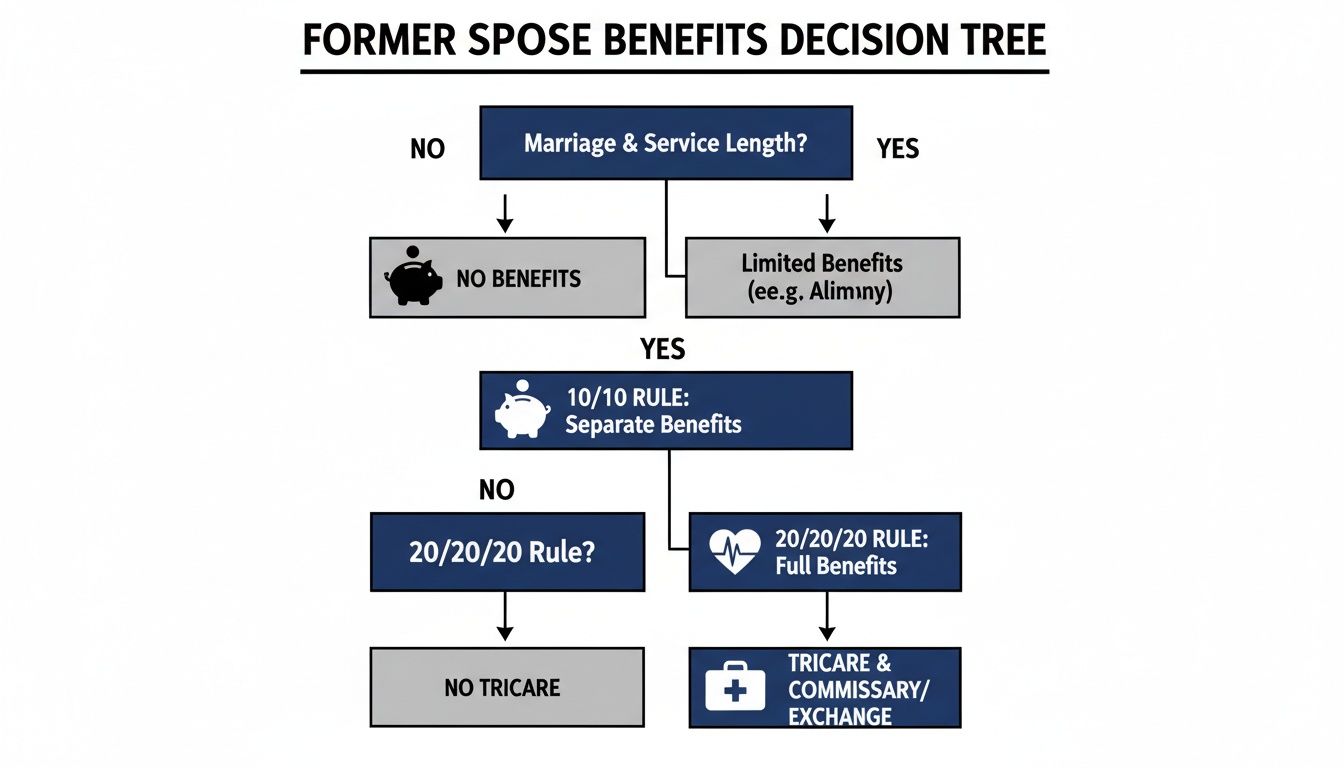
As the chart shows, eligibility for key benefits like direct retirement payments (the 10/10 Rule) and continued TRICARE coverage (the 20/20/20 Rule) depends on strict requirements regarding the length of the marriage and its overlap with military service.
What Female Service Members Need to Know
Serving your country as a woman in the military demands a unique kind of strength and sacrifice. When a divorce is on the horizon, those challenges don’t just fade away—they often become sharper and more complicated. We get it. Your experience is different, and your legal strategy has to reflect the realities of your service, your career, and your role as a mom.
It's a tough truth, but the strains of military life hit marriages hard. Research has consistently shown that female service members face markedly higher divorce rates than their male counterparts, a reality often amplified by the unique pressures of military family life. Deployments, in particular, can be a breaking point when the expectations of life back home collide with the demands of service. You can learn more about the factors driving military divorce rates at jamiegrahamlaw.com. Acknowledging this isn't about placing blame; it's the first step toward building a case that fiercely protects your future.
Protecting Your Parental Rights as a Military Mother
For military moms, one of the biggest fears is that your service will be used against you in a custody battle. There’s an outdated, harmful myth that a mother's deployment or a demanding training schedule somehow makes her a less capable parent.
Let’s be clear: Texas law doesn’t see it that way. Your military service cannot be the sole reason a court restricts your rights as a parent.
Under the Texas Family Code, every custody decision comes down to one thing: the “best interest of the child.” This means a judge looks at the whole picture—your deep involvement, the stable home you provide, and your bond with your child. To fortify your position, you need to be proactive:
- Document Everything: Keep a running log of your involvement. Track every school meeting you attended by video call, every bedtime story you read over FaceTime, and all the ways you stay connected during training.
- Create a Rock-Solid Plan: Don’t wait for your ex to dictate the terms. Work with your attorney to build a military-specific parenting plan that addresses deployments head-on. Designate a trusted family member to step in for your possession time and spell out exactly how communication will work.
- Own Your Narrative: Never let your spouse—or anyone else—imply that your commitment to your country is a lesser commitment to your kids. We can help you showcase your incredible strengths as a dedicated, organized, and loving parent.
Spousal Support and Dividing Your Assets
Your military career is a massive financial asset, one you’ve worked incredibly hard to build. When it's time to talk about spousal support (alimony) and the division of community property, your unique career path has to be front and center.
We’ll fight to make sure the court understands the sacrifices you've made. Any division of assets, especially your military retirement, must be handled fairly under both Texas law and the USFSPA. Your service is a strength, and your legal approach should reflect that every step of the way.
Next Steps: Key Takeaways for Your Path Forward
Going through a military divorce in Texas takes a clear head and a solid legal game plan. It’s easy to feel like you’re navigating in the dark, but just by reading this guide, you’ve already taken the most important step: arming yourself with knowledge to build a stable future.
The journey from filing to final orders is a series of critical moves. Each one builds on the last, from figuring out if Texas is even the right state to file in, to understanding the federal laws that protect you and shape the final outcome.
As you move forward, keep these key points front and center:
- Jurisdiction is Everything: You can only file in Texas if you or your spouse can establish it as your legal home (domicile). Simply being stationed here isn't enough.
- The SCRA is Your Shield: If you’re on active duty, the Servicemembers Civil Relief Act (SCRA) is a powerful tool. It protects you from default judgments and lets you hit pause on the proceedings if your military duties get in the way.
- Retirement is a Shared Asset: Don't forget that the slice of military retirement earned during the marriage is considered community property. The Frozen Benefit Rule is also crucial—it makes sure any post-divorce promotions aren't part of the division.
- Your Parenting Plan Needs to Be “Military-Proof”: A standard possession order just won't cut it. Your plan must be built to handle deployments, relocations, and long-distance communication to truly protect your child’s best interests.
This guide is designed to empower you with information, but it is not a substitute for personalized legal advice. Every family's situation is different, and a one-size-fits-all approach just won’t protect what you’ve worked so hard for.
This process is about more than just ending a marriage; it’s about setting the stage for a stable, secure new chapter for you and your kids. Right now, making informed decisions is your greatest strength.
If you need help with a child custody or visitation case in Texas, our experienced attorneys can guide you every step of the way. Contact The Law Office of Bryan Fagan, PLLC today for a free consultation.