
No, you can't legally change a custody order without involving the court in Texas. But if both parents agree, you can often avoid a court fight and ask the judge to sign an agreed modification instead.
That distinction matters more than most parents realize. A lot of families already have a new routine that works better. Maybe pickup times changed because of work, maybe your child started a new school, or maybe both homes finally found a schedule that feels calmer. The problem is that a better routine isn't the same thing as a new legal order.
When your child's future is on the line, understanding that difference protects everyone involved. In Texas, the goal usually shouldn't be “How do I avoid court completely?” It should be “How do I avoid a courtroom battle while still getting a legally enforceable order?”
The Critical Difference Between an Agreement and an Order
Families change. Court orders don't change on their own.
That's where many parents get tripped up. You and your co-parent may both agree that the current schedule no longer makes sense. You may even be following a new arrangement already. But an informal agreement is just that. It's informal.
A custody order in Texas is usually called an order about conservatorship and possession and access. Conservatorship means who has rights and duties involving the child, such as making major decisions. Possession and access means the parenting time schedule, which many parents call visitation. If you already have a signed court order covering those issues, that order stays in effect until a judge signs a new one.

What parents can do on their own
Parents absolutely can talk through changes outside the courtroom. In many cases, that's the best place to start.
You might agree to:
- Adjust exchange times so they fit school or daycare better
- Change weekday possession because of a new work schedule
- Revise holiday plans to reflect travel or family traditions
- Update communication rules for calls, texts, or school notices
If you want a clearer overview of how these arrangements work, this guide to custody agreements in Texas is a helpful starting point.
What doesn't work
What doesn't work is stopping at the handshake stage.
If one parent follows the new plan for months and the other suddenly changes course, the old signed order controls. Police, schools, and courts generally look to the written order, not to text messages about what the parents intended.
Practical rule: If you want the new schedule to be enforceable, it has to become a signed court order.
That's why the right question behind “can i change my custody order without going to court in texas” is really this: can we solve this cooperatively and then file the agreement properly? In many families, the answer is yes.
Why a Judge's Signature is Non-Negotiable
A court order can only be changed by the court.
TexasLawHelp puts it plainly in its article on changing a custody, visitation, or child support order: “Can I change a court order without going to court? No. Once you have a court order, only a judge can change it.” That rule comes from Texas Family Code § 156.301, which requires filing a Petition to Modify the Parent-Child Relationship.
A simple way to think about it
An informal custody change is a lot like trying to transfer a house with a handshake instead of a signed deed. The two people involved may completely agree. They may trust each other. But if a dispute comes up later, the legal paperwork controls.
The same is true here. If the existing order says Parent A gets the child on certain weekends and Parent B gets weekday time, that written order remains enforceable until the judge signs a different one.
Why the rule exists
This isn't about making life harder for parents. It's about protecting children and creating stability.
When parents rely on side agreements only, several things can go wrong:
- One parent changes their mind and goes back to the old schedule
- A school or caregiver refuses to honor the new arrangement because it doesn't match the order
- Enforcement becomes difficult because the court still sees the original order as controlling
- Misunderstandings grow because verbal deals often leave out details
The judge's signature turns a private understanding into a binding rule both parents can rely on.
That protection matters for mothers and fathers equally. It also matters for grandparents or other caregivers who need clarity about who has authority to pick up, transport, or care for a child under the current order.
Court involvement doesn't always mean a hearing
Many parents hear “you must involve the court” and assume that means standing before a judge in a heated dispute. Often it doesn't.
Court involvement may mean filing the correct modification paperwork in the same case and waiting for judicial review. The legal step is mandatory. The conflict usually isn't.
Paths to Agreement That Avoid a Courtroom Battle
Parents usually have more control than they think. The best results often come from reaching an agreement before anyone asks a judge to decide.
That's especially true when the issue is practical rather than personal. A child's school changed. A parent's work hours shifted. Transportation has become harder. The current order may no longer fit real life, even if nobody did anything wrong.
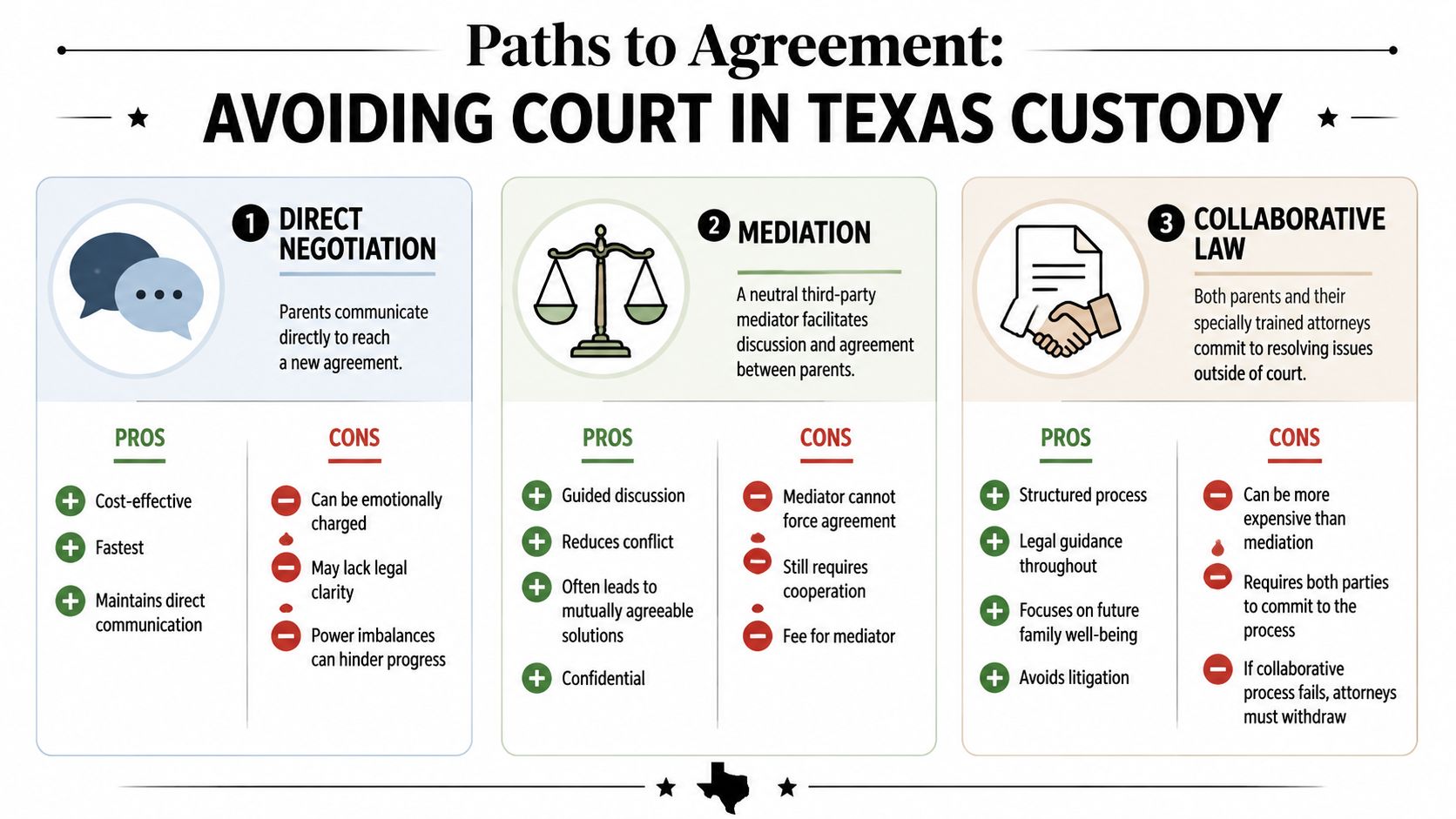
Direct negotiation
Some parents can work this out themselves. That usually works best when communication is respectful and both people are focused on the child instead of old relationship grievances.
Direct negotiation is often a good fit when:
- The change is narrow and everyone agrees on the basic solution
- Both parents share information openly about work, school, and logistics
- There's a history of reliability with exchanges and co-parent communication
What helps in those talks?
- Lead with the child's routine instead of your own convenience
- Put the proposal in writing so both sides can review details
- Spell out specifics like exchange times, holidays, transportation, and notice requirements
Mediation
When parents agree on the need for change but not every detail, mediation can help. A mediator is a neutral third party who helps both sides communicate and work toward a workable solution. The mediator doesn't act as the judge and doesn't impose an outcome.
If you want a fuller picture of the process, this article on what happens in custody mediation explains what many Texas parents can expect.
Mediation works well when both parents want a solution but keep getting stuck on the wording, schedule details, or who gives a little more on a specific point.
Collaborative law
Some families want more structure than informal negotiation but still want to stay out of litigation. Collaborative law can be an option. In that process, both parents and their attorneys commit to resolving the issues outside of court if possible.
That route isn't right for every case, but it can be useful when parents need legal guidance throughout the negotiation process.
Choosing between the main paths
| Path | Best For | Potential Downside |
|---|---|---|
| Direct Negotiation | Parents who communicate well and agree on most details | Important legal details may get overlooked |
| Mediation | Parents who need help working through sticking points | No agreement happens unless both participate in good faith |
For many families, the answer to “can i change my custody order without going to court in texas” is this: you may be able to avoid the fight, but you still need the paperwork and judge's approval at the end.
How to Finalize Your Agreement with an Agreed Modification
Once both parents agree, the next step is turning that agreement into something the court can sign. In Texas, that usually means an agreed modification.
That process is often where parents feel overwhelmed. The legal system uses formal names, formal documents, and formal filing rules. But in practical terms, the idea is straightforward. You're asking the court to replace part of the old order with a new agreed one.

The two legal standards the judge still reviews
Even when both parents agree, the judge doesn't just rubber-stamp the paperwork.
As explained in this discussion of changing a custody agreement without going to court in Texas, Texas Family Code § 156.101(a) requires proof of two things: a material and substantial change in circumstances, and that the new arrangement is in the best interest of the child.
In plain English:
- Material and substantial change means something important has changed since the last order. That could involve work schedules, the child's needs, or another major life change.
- Best interest of the child means the new plan should support the child's well-being, stability, safety, and healthy development.
A judge will still look at those points, even in an agreed case.
What an agreed modification usually includes
The paperwork often includes:
- A Petition to Modify the Parent-Child Relationship, which formally asks the court to change the current order
- A proposed modified order, which sets out the exact new terms
- Signatures from the parties, showing the agreement is real and voluntary
- Filing in the original court, usually under the same cause number
If you're trying to understand the paperwork before you file, these Texas custody modification forms can help you see what the process generally involves.
When you draft any legal agreement, clarity matters. Even a cooperative deal can create future problems if the wording is vague. A general guide to settlement agreement clauses is useful for understanding why precise language matters in written agreements, although custody orders in Texas have their own family-law-specific requirements.
Here's a helpful overview of the process in visual form:
You may not need a courtroom appearance
This is the part many parents are relieved to learn. An agreed modification can often be handled through filed documents and judicial review, without a contested hearing.
That doesn't mean you're skipping the court. It means you're using the court correctly, without asking the judge to referee a fight.
A calm, well-drafted agreed order often gives families what they actually want: a legal solution without the stress of trial.
Common Pitfalls and When You Need a Lawyer
An agreed change sounds simple until one small issue turns into a major problem.
The most common trouble spot is this: one parent says yes in conversation, yes in text, and yes in principle, but never signs the final paperwork. Until the documents are signed and filed, you don't have a legal modification. You have a plan that can fall apart.
Problems that come up more often than parents expect
Some issues look minor at first but can derail an agreed modification:
- Verbal agreement only. If the other parent won't sign, the process usually stops being cooperative.
- Vague terms. “We'll be flexible” sounds nice, but it creates conflict when holidays, transportation, or missed exchanges come up.
- Support issues tied to schedule changes. A change in parenting time sometimes raises child support questions too.
- A judge may reject the proposal. If the agreement doesn't appear to serve the child's best interest, the court may not approve it.
Red flags that call for legal help
Some cases should not be handled casually, even if the other parent says they want to cooperate.
Look more closely if your case involves:
- A history of conflict that makes follow-through doubtful
- Substance abuse concerns or unsafe behavior around the child
- Family violence or coercive control
- A planned relocation that affects school, travel, or regular possession
- Disagreement over decision-making rights, not just the calendar
- Military deployment issues, where temporary arrangements may need special handling under Texas law
Mothers and fathers face these risks equally. One parent may worry about losing time with the child. The other may worry that the proposed change shifts too much power without enough protection. Both concerns are legitimate.
If your case involves safety, relocation, or a co-parent who won't reliably follow through, a do-it-yourself agreement can leave you exposed.
When a lawyer adds real value
A lawyer isn't only for high-conflict trials. In agreed cases, legal help is often about precision and prevention. Strong drafting can prevent future fights over exchange locations, holiday schedules, school decisions, transportation costs, and notice requirements.
That's especially important when grandparents are involved in regular caregiving, when one parent lives far away, or when the child has educational or medical needs that require very clear terms.
Your Next Steps to a New Custody Order
If you're asking can i change my custody order without going to court in texas, the practical answer is simple. You can often avoid a court battle, but you can't skip the legal step of getting a new order signed.
Key takeaway
Use this checklist to move forward the right way:
- Start with the core problem. Identify what no longer works in the current order.
- Talk through a child-focused solution. Keep the conversation on stability, school, routines, and the child's needs.
- Get specific. Agree on dates, times, holidays, transportation, and decision-making details.
- Put the agreement into proper legal documents. Don't rely on texts or verbal promises.
- File in the correct court. The modification must be presented to the court that handles the existing order.
- Wait for the judge's signature. That's what makes the new arrangement enforceable.
For many Texas families, the best path is cooperative, not combative. A peaceful solution is possible. It just has to be formalized the right way.
If you need help with a child custody or visitation case in Texas, our experienced attorneys can guide you every step of the way. Contact The Law Office of Bryan Fagan, PLLC today for a free consultation.
If you need help turning a parenting agreement into a legally enforceable order, Law Office of Bryan Fagan, PLLC can help you understand your options and protect your rights. Whether you're dealing with an agreed modification, a contested custody issue, or questions about visitation and conservatorship, our team is here to provide clear guidance designed for your family. Contact The Law Office of Bryan Fagan, PLLC today for a free consultation.