
When your child's future is on the line, understanding your rights matters most.
A lot of Fort Worth parents first start looking for a child custody lawyer at the worst possible moment. Maybe your spouse just said they're moving out. Maybe you were handed papers. Maybe a simple disagreement about school pickup suddenly turned into talk about “primary custody.” In that moment, panic sets in fast because this doesn't feel like paperwork. It feels like your relationship with your child is at risk.
That fear is real. So is the confusion. Texas custody law uses terms most parents don't hear until their family is already under stress. The good news is that you can move from panic to a plan. The right guidance helps you protect your child's routine, your parental rights, and your credibility with the court.
Your Child's Future Is at Stake What Now
A parent sits at the kitchen table after the kids are asleep, rereading a text message that says, “I think the children should stay with me for now.” It's late, your chest feels tight, and every bad outcome starts playing in your head at once. Will I still see my child every week? Can the other parent just decide where my child lives? Did I already make a mistake by arguing over text?
That moment is more common than people think. Parents in Fort Worth often reach out after a breakup, a sudden separation, or a fight that made the future feel unstable overnight. Some are mothers worried about safety and consistency. Some are fathers afraid they'll be pushed into a visitor role instead of staying fully involved in daily life. Some are grandparents trying to protect a child caught in adult chaos.
The first useful step isn't escalating the conflict. It's getting clear on your rights and your options. A search for a child custody lawyer in Fort Worth isn't a declaration of war. It's a way to steady yourself and make careful decisions while emotions are running high. If you're still weighing whether litigation is necessary, this guide on whether it's worth fighting for custody can help frame the decision.
You don't need to know everything today. You need to avoid preventable mistakes and start making decisions that protect your child's stability.
Texas courts focus on the child's best interests. That standard can feel broad, but it gives parents a roadmap. Show that you can provide safety, routine, communication, and sound judgment. That's where a strong case begins, long before anyone steps into a courtroom.
Finding the Right Child Custody Lawyer in Fort Worth
Not every attorney who handles “family law” handles custody disputes with the same depth. If your child's residence, school, medical care, or visitation schedule may be disputed, you need someone who works in this area regularly and understands how Texas conservatorship law plays out in real families.
What to look for first
Start with practice focus. You want a lawyer whose work clearly includes custody, visitation, conservatorship, and modifications. A broad general practice office may be perfectly competent in other areas, but child custody cases require a different kind of judgment. These cases involve evidence, parenting history, communication patterns, and often fast decisions about temporary orders.
One useful benchmark is whether the lawyer's resources teach. A firm that publishes practical material about custody issues usually spends real time in this area. For example, best child custody lawyer articles can help you compare attorneys based on substance instead of marketing language alone.
If you're reviewing service pages, look for plain statements about what the lawyer handles. A page like Texas Child Custody Lawyer should tell you whether the firm provides representation in conservatorship, possession, and access matters under Chapter 153.
A short checklist that actually helps
Use this checklist when narrowing your options:
- Custody-specific experience: Does the attorney talk specifically about conservatorship, possession schedules, enforcement, emergency orders, or modification?
- Fort Worth familiarity: Do they appear to know Tarrant County practice, local procedure, and how custody disputes usually move through the courthouse?
- Clear communication: Can you understand their writing and answers without needing a translator for legal jargon?
- No guarantees: A trustworthy lawyer won't promise sole custody in a first call.
- Balanced strategy: Do they talk about negotiation and mediation, not just court fights?
- Respect for both parents: Good custody counsel should understand the concerns of mothers, fathers, grandparents, and caregivers.
Red flags parents miss
Some warning signs are obvious. Others are subtle.
| Issue | Why it matters |
|---|---|
| Guaranteed outcome language | No lawyer can promise what a judge will do. |
| Only aggressive talk | Custody cases often require restraint, not constant escalation. |
| Vague answers about process | If they can't explain next steps clearly, communication may stay difficult. |
| Pressure to sign immediately | You should feel informed, not rushed. |
Practical rule: Hire the lawyer who helps you think clearly, not the one who makes the biggest promises.
The right child custody lawyer in Fort Worth isn't just a legal technician. They're a decision-making partner. They should help you separate what feels urgent from what the court considers important.
How to Prepare for Your First Lawyer Consultation
Your first consultation goes better when you treat it like an interview, not a confession session. You don't need a perfect binder or a polished story. You do need the basics organized so the attorney can spot legal issues quickly and give useful advice.
What to bring
If you have documents, gather them. If you don't, bring what you can and start a list of what exists.
- Existing court orders: Prior custody, divorce, child support, or protective orders.
- A timeline: Major dates like separation, moves, school changes, police calls, rehab, CPS contact, or prior agreements.
- Communication records: Texts, emails, app messages, or voicemail summaries that show parenting issues.
- Child-focused records: School notices, attendance concerns, medical information, counseling records if available to you legally.
- Your schedule and the child's schedule: Work hours, school hours, exchange routines, and childcare arrangements.
A simple timeline often helps more than a stack of screenshots. Put events in date order and keep your wording calm. “Child missed school three times while with other parent” is more useful than “They never care.”
Questions worth asking
The consultation is your chance to learn how this lawyer thinks. Ask direct questions.
- How do you approach temporary orders? Temporary orders often shape daily life while the case is pending.
- What facts matter most in a case like mine? This tells you whether the lawyer can separate strong points from emotional noise.
- How do you handle communication with clients? You need to know who calls back, how often, and how updates happen.
- When do you push for settlement and when do you prepare for trial? A good custody lawyer knows both.
- What should I stop doing right now? This answer can save your case from avoidable damage.
One concern many parents carry quietly
Many fathers walk into consultations assuming the system is stacked against them. Many mothers fear the court will expect them to “share” even where serious concerns exist. Texas law matters here. Under Texas Family Code § 153.003, a court is prohibited from discriminating based on sex or marital status when making custody decisions. Courts must evaluate parents on their qualifications, not their gender.
That doesn't mean outcomes are automatic. It means your case should be built around facts, parenting capacity, safety, reliability, and the child's needs.
If you want a practical list before your meeting, this guide on how to prepare for a custody consultation in Texas is a strong place to start.
Bring facts, not speeches. A lawyer can work with facts.
Understanding Key Texas Custody Terms
Texas custody language can sound cold when you're talking about your own child. Once you translate it into plain English, the picture becomes much clearer.
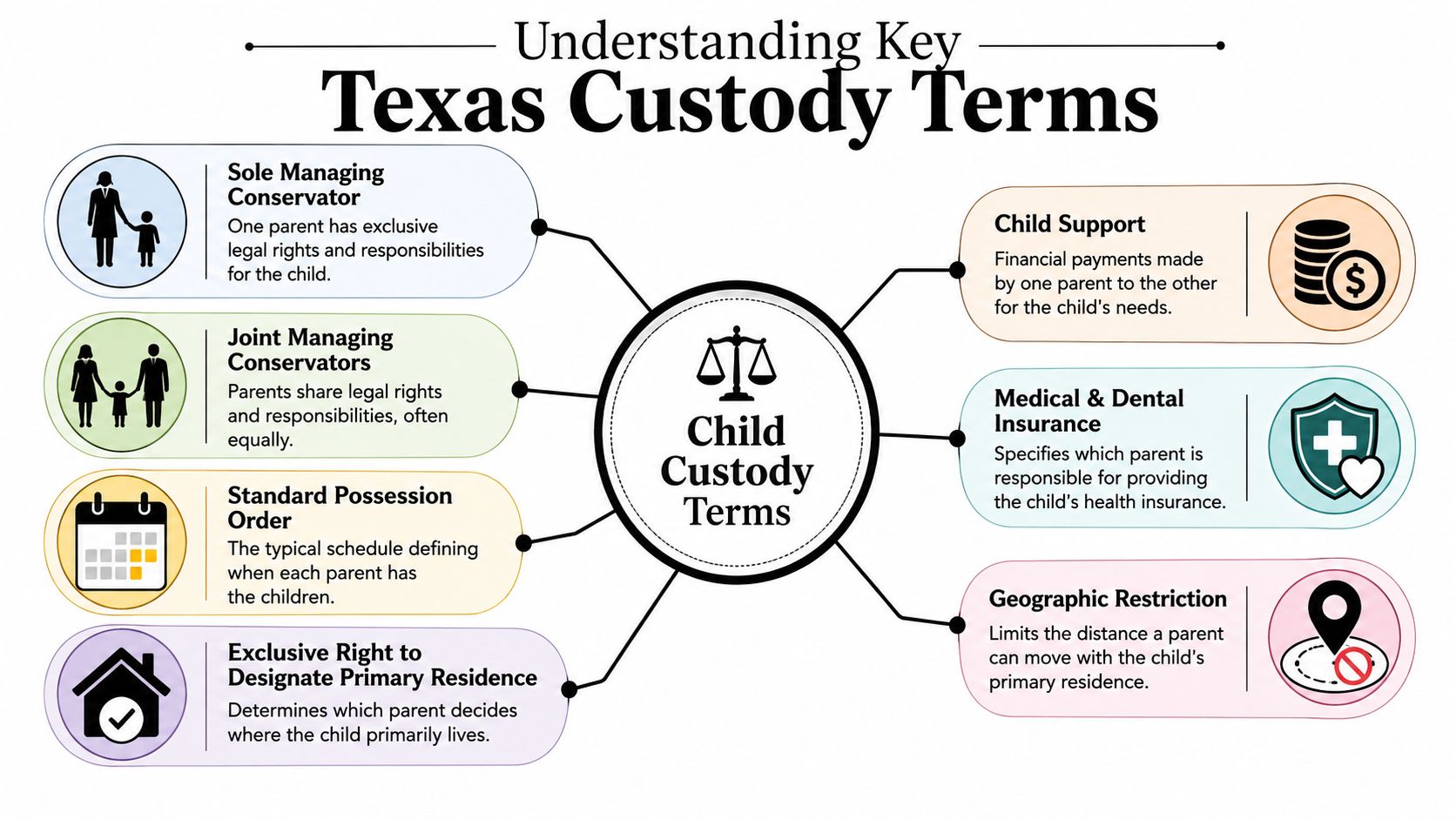
A visual can help before the legal terms start blending together:
Conservatorship means decision-making
In Texas, “custody” usually shows up in the law as conservatorship. That means legal rights and duties involving the child.
Joint managing conservatorship usually means both parents share important rights and responsibilities. This does not always mean equal time. It often means both parents remain involved in major decisions such as education, medical care, and general upbringing.
Sole managing conservatorship means one parent holds the primary legal authority for major decisions. Courts usually reserve this arrangement for situations where shared decision-making would not protect the child's best interests.
This is also where parents hear the phrase exclusive right to designate the primary residence. In plain English, that means one parent gets to decide where the child primarily lives, often within a geographic area set by the court.
Possession and access means the parenting schedule
Texas often uses possession and access where most parents would say “visitation” or “parenting time.” It refers to when each parent has the child and how exchanges happen.
The usual schedule is often called the Standard Possession Order. When parents live within 100 miles of each other, the noncustodial parent has possession on the 1st, 3rd, and 5th weekends of each month, Thursday evenings from 6:00 pm to 8:00 pm during the school year, and an extended 30-day summer period under TexasLawHelp's explanation of possession orders. If the parents live more than 100 miles apart, the summer period increases to 42 days under that same resource.
Here's the practical version:
| Term | What it means at home |
|---|---|
| Joint managing conservators | Both parents stay involved in major decisions |
| Sole managing conservator | One parent gets primary legal decision-making authority |
| Possession and access | The calendar for parenting time |
| Primary residence | Where the child mainly lives |
| Geographic restriction | Limits how far the child's home can be moved |
Texas parents often ask whether a standard schedule is enough. For some families, yes. For others, no. Children with medical needs, long-distance parenting, unusual work schedules, or high conflict may need a custom arrangement.
A lot of parents also worry that “standard” means fair for everyone. It doesn't always feel that way. In Texas, fathers are often awarded only 120.5 days per year with their children, or 33% of the time, according to state custody data summarized here. That's one reason possession terms matter so much. The details of pickup times, holiday rotation, summer periods, and school-year overnights can shape your real relationship with your child far more than broad labels do.
For parents wondering how much a child's wishes matter, Does a Child Get to Choose Which Parent in Texas? gives helpful context.
A short video explanation can also make these terms easier to absorb:
Best interests of the child is the guiding standard
This phrase is the center of every custody case. Best interests of the child means the court looks at what arrangement best supports the child's safety, stability, development, and emotional needs.
That includes things like consistent caregiving, healthy co-parent communication, school stability, safe housing, and the ability to put the child's needs ahead of adult anger. The court is not grading who's more hurt by the breakup. It is deciding what serves the child best moving forward.
Navigating the Tarrant County Court System
Fort Worth custody cases don't happen in the abstract. They move through Tarrant County courts, and local reality matters. The system is busy, but it is also moving.
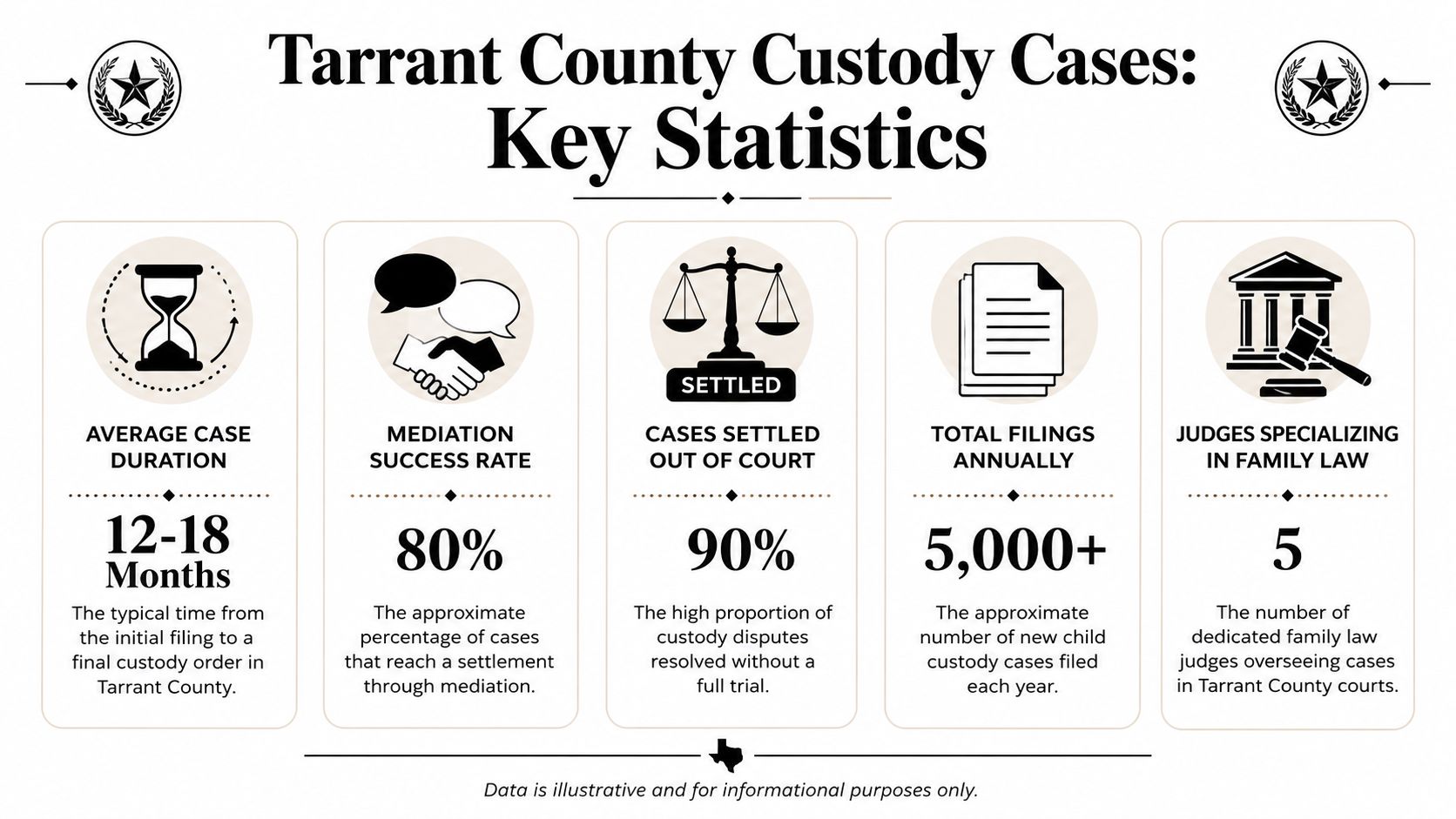
What the local numbers tell you
In 2025, Tarrant County family courts disposed of 20,995 cases while receiving 17,580 new filings, for a 119.4% clearance rate, according to this Tarrant County family court analysis. That tells you two important things.
First, these courts handle a heavy volume. Second, cases are being resolved rather than sitting untouched. For a worried parent, that's encouraging. Your case isn't entering a frozen system. It's entering an active one where deadlines, preparation, and local experience matter.
What usually happens early in a case
Most parents are surprised by how much can happen before a final order. Early stages often include filing, service, temporary orders, document exchange, and mediation. Temporary orders are especially important because they may decide where the child lives, who pays support, and how parenting time works while the case is pending.
That's why the first weeks matter so much. Judges notice who shows up prepared, who communicates reasonably, and who keeps the focus on the child. Rash texts, social media posts, missed exchanges, or informal side deals can create problems fast.
In Tarrant County, being organized is not optional. Busy courts reward clarity.
What a local lawyer helps with
A lawyer familiar with Fort Worth practice can help you make choices that fit the local process instead of fighting the wrong battles.
Consider the difference:
Unfocused approach: Bringing every grievance from the relationship into court papers.
Effective approach: Isolating the facts that affect parenting, safety, schedule, and decision-making.
Unfocused approach: Waiting to organize records until after the first hearing is set.
Effective approach: Building a clean timeline and pulling records early.
Unfocused approach: Treating mediation as a formality.
Effective approach: Entering mediation with fallback positions, proposed schedules, and clear priorities.
Many parents also ask about cost. The honest answer is that cost depends on conflict level, urgency, and how much work the case requires. A negotiated temporary agreement often costs less than repeated emergency hearings. A parent who stays calm, documents well, and follows advice usually spends more efficiently than a parent who turns every disagreement into a new crisis.
Tarrant County's pace is a reason to prepare, not a reason to panic. A child custody lawyer in Fort Worth should know how to move through that pace without losing sight of your child's day-to-day life.
Handling Special Custody Issues in Texas
Some custody cases don't fit the standard pattern. They involve sudden safety concerns, relocation fights, addiction issues, or military service. These cases need a tighter strategy because one wrong move can change the tone of the entire dispute.
When emergency action may be necessary
A mother learns the other parent has been driving with the child after drinking. A father finds out the child was left alone overnight. A grandparent sees bruising and hears explanations that don't make sense. In those moments, waiting for “things to calm down” may not be enough.
Emergency relief can include temporary restraining orders or requests for immediate court intervention. The key is evidence. Judges need specific facts, dates, records, and a clear explanation of why the child faces immediate risk. General fear won't carry the day by itself.
If substance abuse is part of the concern, families often need both legal guidance and treatment information. In that setting, a practical resource on understanding rehab legalities can help parents understand how treatment and court orders sometimes intersect.
When one parent wants to move
Relocation cases often start with words like “better opportunity” or “fresh start.” Sometimes the move is reasonable. Sometimes it would break a stable parenting routine and weaken the child's relationship with the other parent.
Geographic restrictions matter here. If a parent has the right to designate the child's primary residence, that right may still be limited to a county or region. A proposed move can trigger a modification fight, especially when it affects school continuity, travel burdens, or the child's bond with both parents.
Military families face unique custody pressure
A Fort Worth service member gets deployment orders and worries the other parent will use that absence to cut them out long term. That fear is understandable, especially when communication between parents is already strained.
With 12% of Tarrant County families having a military connection, Texas law's protections matter. Texas law prevents deployment from being used to deny visitation and provides protections for modifying custody orders during active duty, as discussed in this Texas military custody resource. Temporary changes during service should be handled carefully so a parent doesn't unintentionally lose ground permanently.
Military service changes logistics. It should not erase a parent's role in a child's life.
These special cases move quickly and carry emotional weight. Calm, well-documented action usually works better than outrage.
The Path Forward Negotiation Mediation and Litigation
Once you've hired counsel, the process usually becomes more structured than most parents expect. That alone lowers stress. You stop reacting to every message and start making decisions with a purpose.
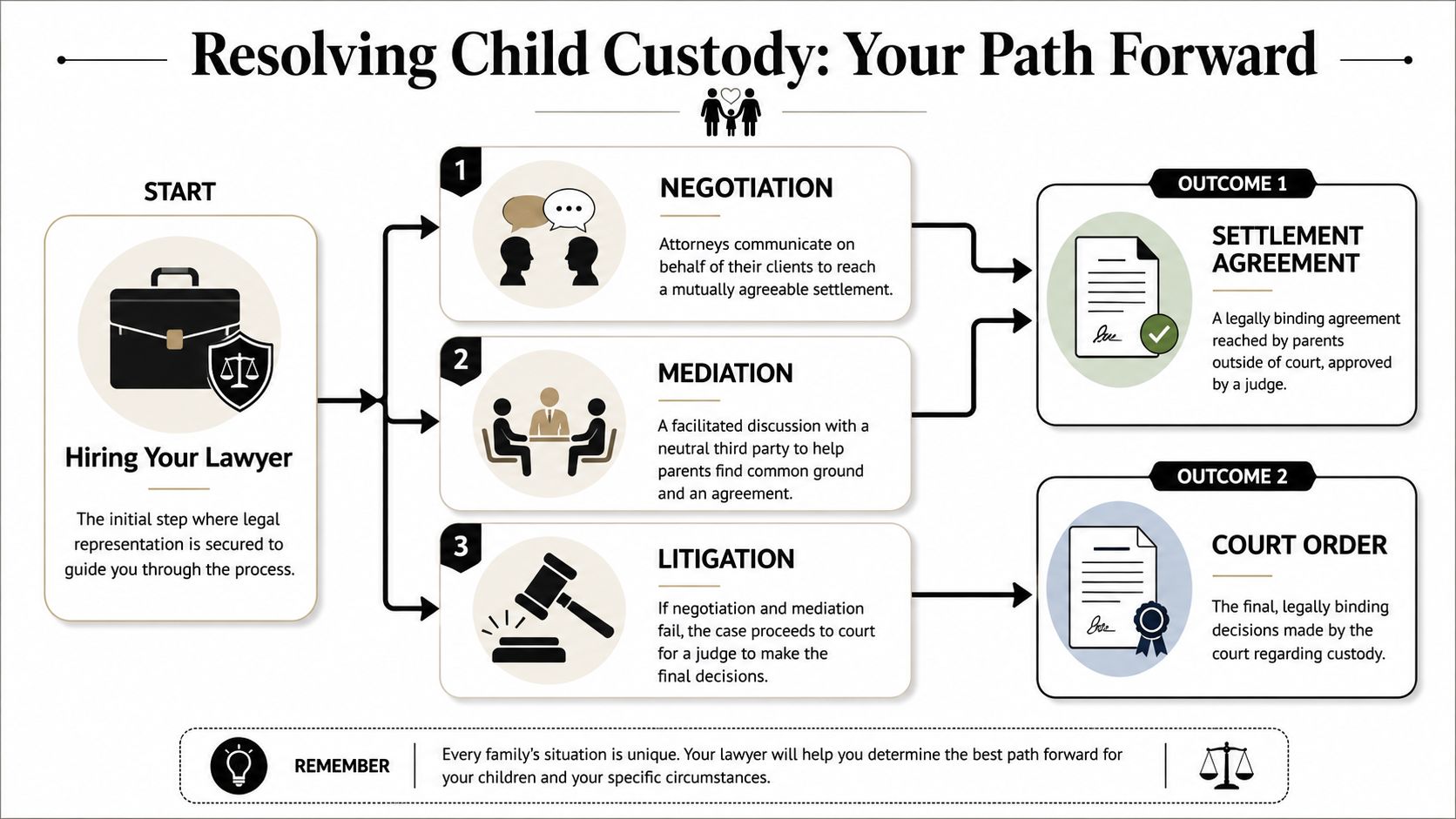
Negotiation often comes first
Lawyers usually start by identifying key issues, exchanging proposals, and testing whether a workable agreement is possible. That may involve temporary schedules, primary residence terms, holiday plans, child support, and rules for communication.
Good negotiation isn't weakness. It's discipline. A fair agreement reached early can protect children from conflict and give parents more control over the outcome.
Mediation resolves many cases
Mediation puts both sides in a structured setting with a neutral third party. Parents often assume mediation is just a box to check. It isn't. It's where many cases make real progress because each side has to confront practical options, not just emotional positions.
Approximately 90% of child custody disputes are resolved without a court trial, according to Clio's family law statistics summary. That's why negotiation and mediation skills matter so much in a custody lawyer.
Litigation is the fallback, not the goal
Some cases do need a judge. When one parent won't cooperate, when safety is at stake, or when facts are sharply disputed, litigation may be necessary. But even then, preparation matters more than theatrics. Judges respond to credible evidence, child-focused arguments, and reasonable parents.
Key Takeaway
If you're facing a custody dispute in Fort Worth, don't let fear make your first decisions for you. Start with the facts. Organize your documents. Learn the key terms. Choose a lawyer who knows Texas custody law, understands Tarrant County practice, and can pursue settlement without losing sight of trial preparation when needed.
For many parents, the legal journey starts in panic and ends in something steadier. A clear schedule. A workable order. A protected relationship with your child. That's the point of this process.
If you need help with a child custody or visitation case in Texas, our experienced attorneys can guide you every step of the way. Contact The Law Office of Bryan Fagan, PLLC today for a free consultation.