
When your child's future is on the line, understanding your rights matters most.
When seeking a child custody lawyer in Houston, it's likely not on a calm day. You may be worried about where your child will sleep, who will make school and medical decisions, or whether the other parent is about to change everything without warning. Those fears are real, and they deserve clear answers.
Texas custody law can feel cold when you're living through a very personal experience. The good news is that the law does give parents, grandparents, and caregivers a framework for protecting children and preserving important family relationships. The key is knowing how Houston courts use that framework in real life, and how to prepare before small problems become bigger ones.
The Language of Texas Custody Conservatorship and Possession
Texas doesn't usually use the word "custody" the way most parents do. In court, you'll hear conservatorship and possession and access. Knowing the difference helps you make better decisions from the start.
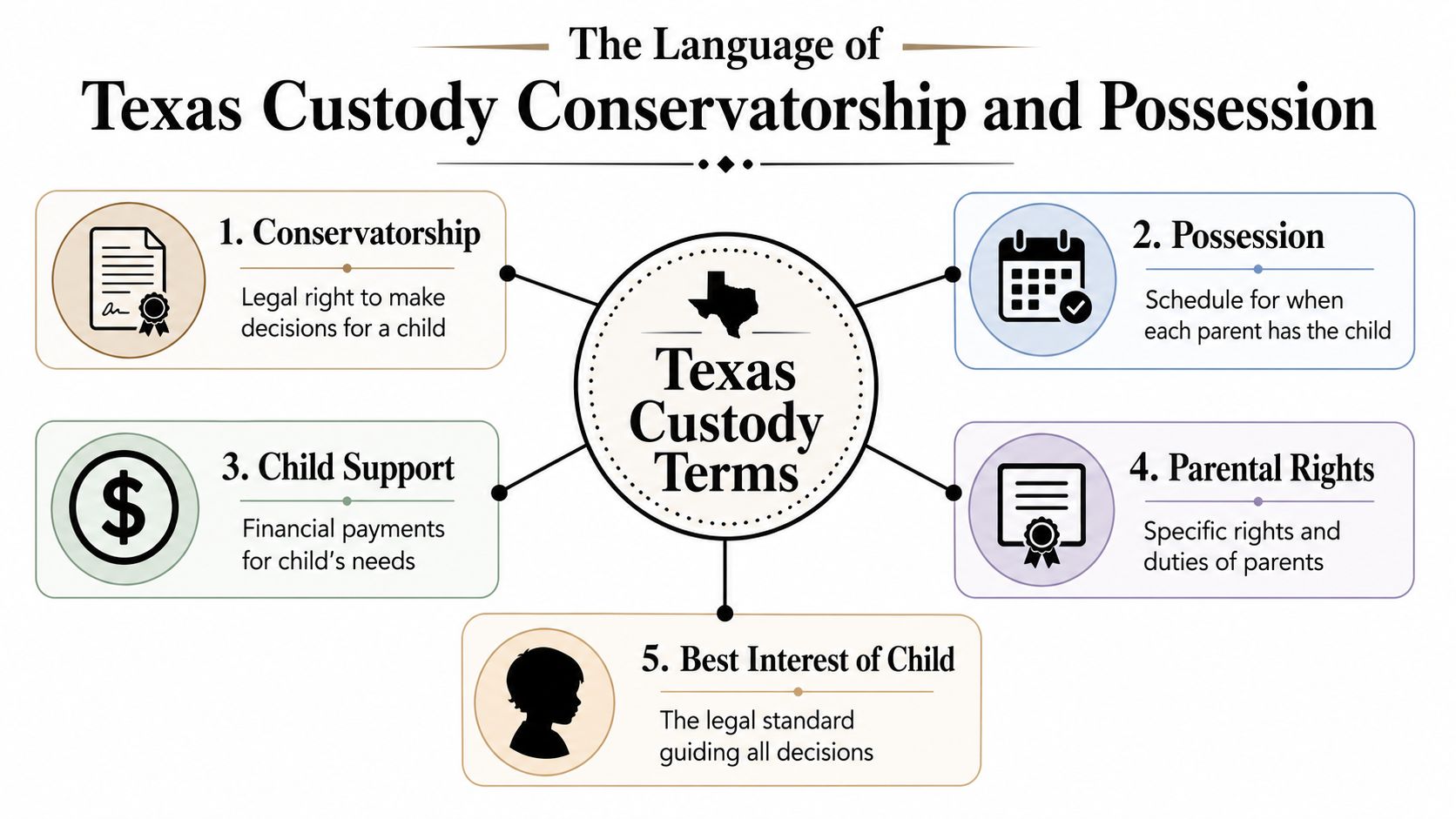
Conservatorship means decision-making power
Conservatorship is the legal right to make decisions for a child. Think of it as the "who decides" part of parenting. It can cover major issues like education, medical care, and where the child primarily lives.
A parent can have some rights alone and others jointly. For example, one parent may have the exclusive right to choose the child's primary residence, while both parents share the right to review school records or consent to routine care.
Texas courts start with a presumption favoring joint managing conservatorship. In plain English, that means courts often begin with the idea that both parents should share important parenting rights unless there are serious reasons not to. A good plain-language overview appears in Joint Managing Conservatorship in Texas.
Possession and access means the parenting schedule
Possession and access is the schedule for when each parent has the child. This is what many parents mean when they say "physical custody" or "visitation."
Texas family courts operate under a default statutory presumption for joint managing conservatorship, barring extenuating circumstances such as abuse or neglect, and this is typically paired with a Standard Possession Order for parents living within 100 miles of each other, according to the Houston child custody glossary discussing Harris County practice.
The Standard Possession Order is a structured calendar. It commonly uses first, third, and fifth weekends for one parent if the parents live close enough. If they live farther apart, the schedule often changes to make travel more workable.
Practical rule: A parent can share conservatorship rights and still have less possession time. Decision-making and time with the child are related, but they are not the same thing.
Other terms that matter in daily life
A few more words often cause confusion:
- Best interests of the child: The rule the judge must follow in every custody decision.
- Child support: Financial support for the child's needs. It is separate from possession.
- Parental rights and duties: Specific legal rights to information, care, and decision-making.
- Primary residence: The home base the court designates for the child when that issue is contested.
One point matters a lot in tense cases. Visitation cannot be denied just because child support hasn't been paid. Texas treats parenting time and financial support as separate obligations. Parents who mix them usually make their cases harder, not stronger.
If you're overwhelmed by the language, that's normal. Once these terms are translated into plain English, the case usually feels less mysterious and more manageable.
The Best Interest of the Child Standard in Houston Courts
It often starts the same way. One parent walks into my office convinced the judge will see who has been more hurt, more patient, or more forgiving. Houston courts are focused on a different question. What arrangement serves the child's best interest?
Under Texas law, that is the standard judges use in custody cases. In plain English, the court is deciding what setup is healthiest and most stable for the child, not which parent tells the stronger story. The Texas Attorney General's overview of child custody and visitation in Texas reflects that same principle.
What judges actually look for
Judges in Harris County usually want specific, grounded facts about daily parenting. They are trying to understand how your child's life works now, where the pressure points are, and which orders will reduce conflict instead of feeding it.
The court often focuses on:
- Who has handled the child's day-to-day needs. School drop-offs, homework, meals, medical appointments, bedtime, and discipline matter.
- How stable each home is. Stability does not mean perfect. It means safe housing, consistent routines, reliable supervision, and follow-through.
- Each parent's judgment. Judges notice who can make child-focused decisions and who keeps pulling the child into adult conflict.
- Safety problems. Family violence, substance abuse, untreated mental health issues, neglect, or unsafe partners can change a case fast.
- The child's individual needs. A child with anxiety, learning issues, medical conditions, or a demanding school schedule may need a plan that looks different from a standard schedule.
Trade-offs are real here. A parent may love the child deeply and still struggle with consistency. Another parent may have a steadier routine but a work schedule that limits weekday availability. Courts weigh those realities. They are rarely looking for a perfect parent because there usually is not one.
Evidence carries more weight than accusations
Custody cases are often full of strong feelings. Feelings alone do not prove anything.
Judges give more weight to a documented pattern than to a broad attack. A calendar showing who missed exchanges, school attendance records, report cards, medical records, photos, police reports, and text messages about the child usually matter far more than calling the other parent selfish or unstable. Witnesses with firsthand knowledge can help too, especially teachers, counselors, relatives, or caregivers who observed the parenting issues at the center of the case.
One practical point I give parents early is this: start organizing your proof before there is a hearing date. Clean records are easier to use than a last-minute stack of screenshots. If you want a better sense of when that evidence becomes important, this guide on the Texas child custody case timeline and what to expect helps put the court process in context.
When the child's wishes matter, and when they do not
Parents are often surprised by how this works. A child does not get to choose custody the way people say on social media.
Texas courts may consider a child's preference if the child is 12 or older and wants to talk to the judge about primary residence. Even then, the judge is not required to follow that preference. The court still looks at maturity, whether the child is being pressured, and whether the requested arrangement is realistic and healthy.
That distinction matters. A child's voice can be part of the evidence, but it is not the whole case.
For worried parents, the best way to approach this standard is to stop framing the case around who deserves to win. Build it around what your child needs, what you can prove, and what order will work in real life over time. That is the lens Houston judges use, and cases usually become clearer once you start using it too.
Your Houston Custody Case Timeline from Filing to Final Order
The court process feels less intimidating when you know what usually happens next. Most Houston custody cases move through a series of practical stages. Some settle early. Others need temporary hearings, mediation, or trial.
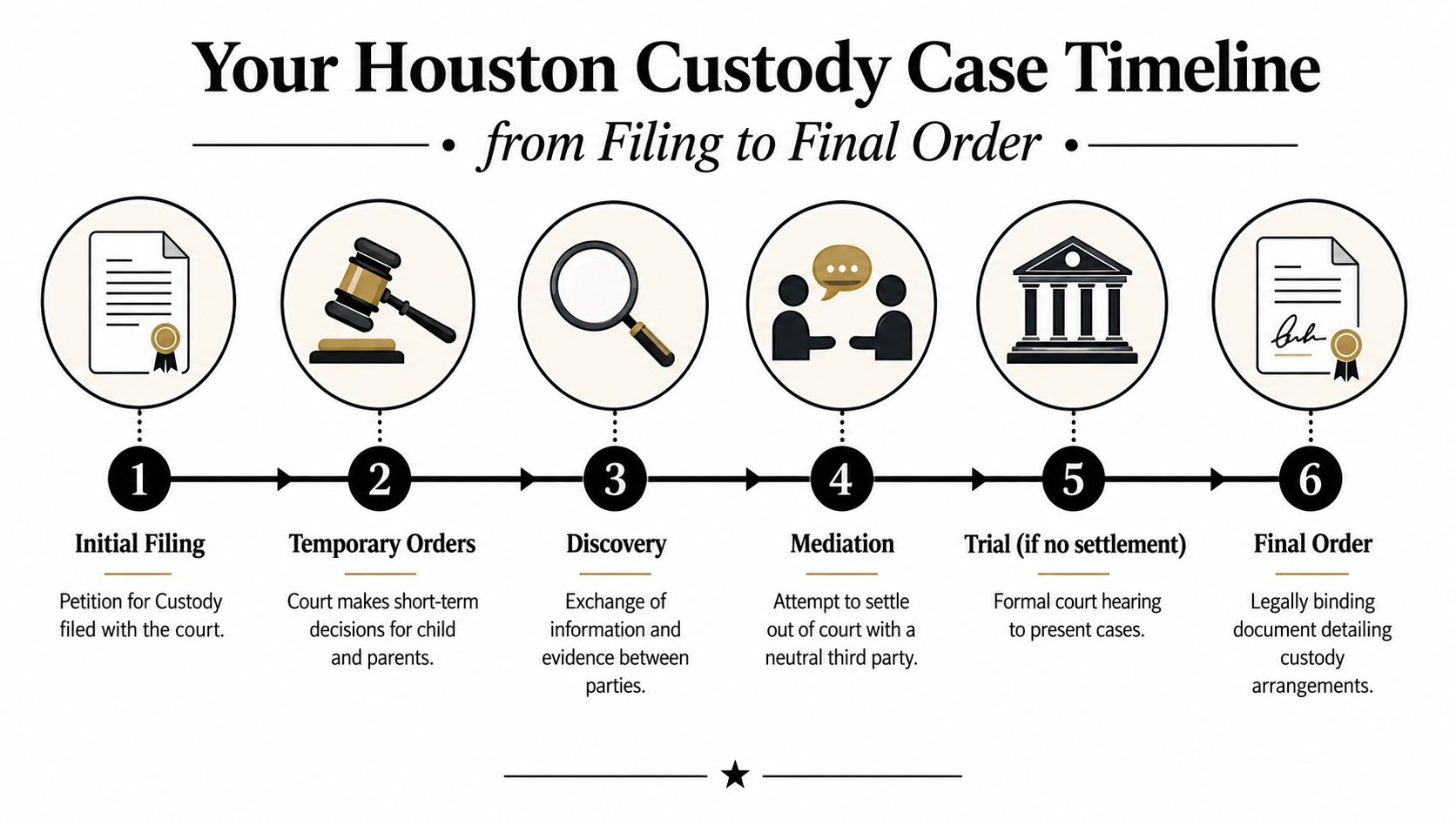
Filing and service start the case
A custody case often begins with an Original Petition in Suit Affecting the Parent-Child Relationship, usually called a SAPCR. That document tells the court what orders you're asking for. It may involve conservatorship, possession, child support, or paternity-related issues.
After filing, the other parent must be formally served unless service is waived. This step matters because the court needs proof that the other side received notice and has a chance to respond.
If you want a fuller walkthrough, this guide on what to expect in a Texas child custody case timeline is a useful companion.
Temporary orders set short-term rules
Many parents need structure right away. Temporary orders can decide where the child stays, who pays support, how exchanges happen, and which parent makes certain decisions while the case is pending.
These orders aren't the final result, but they often shape the tone of the case. A parent who takes temporary orders seriously usually puts themselves in a better position than one who treats them as optional.
Here is a simple view of how the process often unfolds:
| Stage | What happens |
|---|---|
| Filing | One parent opens the case and asks for specific relief |
| Service and response | The other parent is notified and files an answer |
| Temporary orders | The court sets ground rules while the case continues |
| Discovery | Both sides gather records, messages, and other evidence |
| Mediation | A neutral third party helps try to settle disputes |
| Final hearing or trial | The judge signs final orders if no full agreement is reached |
Discovery and mediation narrow the dispute
Discovery is the evidence-gathering phase. Parents may exchange documents, answer written questions, or request records. During this phase, facts start replacing assumptions.
Mediation is often the point where a case either becomes manageable or clearly heads toward trial. A strong mediation position usually comes from preparation, not emotion. Parents who arrive with organized documents, realistic priorities, and a child-focused mindset often do better than parents who arrive wanting to punish the other side.
Many good custody outcomes are built in mediation. Not because the issues are small, but because a workable agreement often serves a child better than a scorched-earth courtroom fight.
Final orders are meant to last
If parents reach agreement, the court can sign an agreed final order. If they don't, the judge decides the disputed issues at trial. The final order becomes the legally binding roadmap for parenting going forward.
That order should be read carefully, followed exactly, and stored where you can access it quickly. Many post-divorce and post-separation problems start because a parent relied on memory instead of the written order.
Common Custody Issues for Houston Families
No two custody cases look exactly alike. Some start with paternity questions. Others involve grandparents stepping in, or a parent wanting to move away with the child. The legal rules stay the same, but the strategy changes with the facts.

Fathers who need more than legal recognition
For many fathers, the first issue isn't whether they love their child. It's whether the law recognizes and protects their role strongly enough. Texas statistics show fathers are awarded about 33% of custody time, or about 120.5 days per year, slightly below the national average, according to this Texas family law breakdown.
That number doesn't decide any one case, but it does show why passive fathers often get squeezed into a smaller role than they expected. In real cases, what tends to help is filing promptly, documenting caregiving, attending school and medical events, and asking for clear orders instead of relying on handshake arrangements.
A father who waits for conflict to "settle down" often loses time that is hard to get back. A father who shows a steady pattern of involvement usually gives the court something concrete to work with.
Grandparents and other caregivers
Grandparents often call after routines have already broken down. They may be caring for the child after school, taking the child to appointments, or filling gaps during a parent's instability. But emotional importance alone doesn't automatically create legal rights.
Grandparent cases are fact-heavy. Courts want to know why court intervention is necessary, not just why continued contact would be nice. If a grandparent has been part of the child's daily support system, records and witness testimony matter.
Relocation changes everything fast
Relocation disputes usually start with one parent saying a move is necessary for work, family help, or a fresh start. The other parent hears something else: less time, harder travel, and a weaker relationship with the child.
A move case often turns on practical details:
- School impact: Will the move improve or disrupt the child's education?
- Parenting time: Can the schedule still preserve a meaningful relationship with the nonmoving parent?
- Support network: Are relatives or caregivers in the new location part of a stable plan?
- Motivation: Is the move tied to a real need, or does it look like an effort to limit contact?
A relocation request becomes stronger when the parent proposing it can explain how the child's daily life will improve, not just how the adult's life will.
If you're dealing with one of these issues, don't use a one-size-fits-all approach. Paternity, grandparent access, and relocation each require a different kind of proof and a different kind of argument.
Handling Emergency Orders and Military Custody
Some custody problems can't wait for the usual pace of litigation. If a child faces immediate danger, or if military service changes the schedule overnight, the response has to be fast, precise, and well documented.
Emergency orders require real proof
Texas courts can enter emergency relief in the right case, but judges expect more than fear or suspicion. They want specific facts showing a real threat to the child.
If credible evidence shows a history or pattern of family violence by one parent, a Texas court is prohibited from appointing the parents as joint managing conservators under Texas Family Code § 153.004. That rule is one reason emergency filings often focus so heavily on police reports, medical records, threatening messages, photographs, and witness statements.
Useful emergency evidence may include:
- Recent incidents: Police involvement, injuries, threats, or unsafe conduct
- Written proof: Texts, emails, or messages showing intimidation or instability
- Third-party records: Medical records, school reports, or counselor notes
- Witness accounts: People who saw or heard the conduct firsthand
A parent who seeks emergency relief should be prepared to explain not just what happened, but why waiting would put the child at risk.
For a real-world example of how careful legal work can expose false claims in serious litigation, this article on winning a high stakes custody battle offers useful perspective on preparation and credibility.
Military parents need tailored orders
Military families face a different challenge. Deployment, training, and relocation can disrupt even a solid parenting plan. Generic orders often don't address exchange logistics, communication during deployment, or what happens when a service member returns.
A strong military custody plan usually addresses:
- Notice procedures: How and when the military parent informs the other parent about orders
- Remote contact: Video calls, phone calls, and ways to preserve the relationship during absence
- Make-up time: Whether missed possession can be reasonably restored later
- Temporary delegation issues: Who may help with care when military duties interfere
Parents dealing with service-related moves should review legal guidance on military relocation and child custody in Texas. In military cases, clarity matters as much as flexibility. Without both, small misunderstandings can turn into expensive disputes.
Choosing and Working With Your Houston Custody Lawyer
The right lawyer doesn't just know the Family Code. That lawyer helps you make better decisions when you're stressed, angry, and tired. In custody work, that matters as much as courtroom skill.

What to look for first
Start with fit, not slogans. A child custody lawyer in Houston should understand conservatorship, possession disputes, temporary orders, modifications, and emergency practice in Texas family court. But technical knowledge alone isn't enough.
Look for an attorney who can do three things clearly:
- Explain the law in plain English. If you leave a consultation more confused than when you arrived, that's a problem.
- Discuss trade-offs candidly. Good lawyers don't promise perfect outcomes. They explain what may help, what may hurt, and what may cost more conflict than it's worth.
- Build a child-focused strategy. Courts care about the child's needs, not a parent's desire to "win" at all costs.
For families comparing options, the Houston family law firm guide can help frame what to ask during consultations.
Questions worth asking in a consultation
You don't need to know every legal term before speaking with an attorney. You do need to ask practical questions.
Consider asking:
- How do you approach temporary orders? Early strategy often shapes the whole case.
- What documents should I start gathering now? The answer should be specific.
- How do you handle communication with clients? Some parents want frequent updates. Others want concise check-ins.
- When do you push for settlement, and when do you prepare for trial? The answer tells you a lot about judgment.
- Have you handled issues like mine before? That might mean relocation, paternity, military custody, or emergency filings.
The best consultation often isn't the one where you hear what you want. It's the one where you understand what the case will require.
Working with your lawyer the right way
Once you hire counsel, your role matters. Clients help their cases when they organize records, answer questions directly, follow court orders, and avoid emotional texting with the other parent.
One factual resource some families review is the Texas Child Custody Lawyer page, which outlines representation in conservatorship, possession, and access matters under Chapter 153. Whatever firm you choose, make sure you understand who will handle your case day to day and how strategy decisions will be made.
A lawyer is your advocate, not your voice memo app. Use that relationship to solve problems, test options, and stay focused on outcomes that a judge can sign.
Preparing for Your Custody Case Your Action Plan
If you are lying awake wondering what the judge will ask, start here. The parents who present the clearest, calmest record usually put themselves in a better position than the parent who shows up angry and unprepared.
Custody cases are built from everyday facts. In Texas, that means facts tied to conservatorship, which is decision-making authority, and possession, which is the parenting schedule. Your job is to show how your day-to-day parenting supports your child's stability, safety, schooling, health, and routine.
Build a file that shows real parenting
Start with the documents that answer practical questions. Who gets the child to school. Who schedules doctor visits. Who helps with homework. Who handles pickups when a child is sick.
A useful file often includes:
- School records: attendance, report cards, teacher emails, behavior notes, and calendars
- Medical records: appointment summaries, immunization records, prescriptions, diagnoses, and provider contact information
- Parent communications: texts, emails, and app messages that relate to the child's care, schedule, health, or school
- A parenting calendar: overnights, exchanges, missed visits, extracurriculars, and major events
- Photos or notes: only when they document a relevant condition, caregiving task, or concern
Organization matters as much as volume. A dated timeline and labeled folders help your lawyer far more than hundreds of screenshots with no context.
Fix the habits that hurt custody cases
Judges notice patterns. So do opposing lawyers.
A parent who sends hostile texts, ignores exchange times, or pulls the child into adult conflict can damage a solid case. A parent who stays steady, follows orders, and keeps communication child-focused often looks more credible.
Focus on conduct you can control:
- Keep messages short and factual
- Follow the current order unless the court changes it
- Do not post about the case or the other parent on social media
- Do not ask your child to carry messages or report back
- Attend school, medical, and extracurricular events consistently
Small choices add up fast.
If you need a modification, prove what changed
Parents often tell me, "The order just does not fit our life anymore." That may be true, but inconvenience alone is usually not enough. To modify a custody order in Texas, courts generally look for a material and substantial change in circumstances and a new order that serves the child's best interest. The Texas Family Code addresses modification standards in Texas Family Code Chapter 156.
That changes how you prepare the case. Do not just explain why you are frustrated. Show what is different now.
Useful examples can include a serious change in work schedule, relocation, a child's medical or educational needs, repeated possession problems, safety concerns, or a major shift in who provides daily care. The stronger cases tie those changes to records, dates, and witnesses.
Put your facts in order before you ask the court to change the order.
If you treat preparation like a checklist instead of a reaction, you give your lawyer something concrete to work with and give the court a clearer picture of what your child needs now.
Frequently Asked Questions About Houston Child Custody
Parents often need short answers before they can absorb the bigger picture. These are some of the questions that come up most often in Houston custody cases.
Do mothers automatically get custody in Texas
No. Texas law says courts must decide conservatorship and possession without regard to the sex of the parent or child under Texas Family Code § 153.003. That means mothers and fathers stand on equal legal footing in the statute.
That said, facts still matter. A parent who has handled most of the daily care may have stronger evidence on stability and routine, regardless of gender.
I'm an unmarried father. Is establishing paternity enough
Usually not. Establishing paternity is a critical first step, but it doesn't automatically produce a strong possession schedule or shared decision-making. While 70% of Texas fathers who never marry the mother file for paternity, only 38% of those cases result in joint conservatorship or regular visitation orders within 12 months, according to TexasLawHelp's family and children resource.
The practical lesson is simple. Don't stop at legal recognition if you need enforceable parenting rights. Ask for orders that address conservatorship and possession directly.
Can grandparents ask for visitation
Sometimes, yes, but these cases are very fact-specific. A grandparent usually needs more than a close bond with the child. The court will want to know why legal intervention is necessary and how the requested order serves the child's welfare.
Grandparents do better when they come prepared with concrete facts about caregiving, stability, and the child's needs.
Can child support and visitation be traded off
No. A parent doesn't get to withhold possession because support wasn't paid, and a parent doesn't get to stop support because visitation problems exist. Those issues are handled through different enforcement tools.
Trying to self-help this problem usually backfires.
What if my child wants to live with me
The child's views may matter, especially for older children, but preference alone doesn't control the case. Judges still evaluate safety, stability, school, emotional needs, and whether the choice appears influenced by pressure or conflict.
How should military parents protect their rights
Military parents need detailed orders, not broad assumptions. Deployment, remote communication, and changing duty stations should be addressed directly in the parenting plan. If those issues are left vague, conflict tends to grow later.
Do I need a lawyer if the other parent and I are mostly cooperative
Sometimes a cooperative case still benefits from legal guidance. An attorney can help turn a verbal understanding into an enforceable written order. That can protect both parents and reduce future misunderstandings.
Key Takeaway and Next Steps
Custody cases don't become easier because you ignore them. They become clearer when you learn the language, gather the right records, and act early with a child-focused plan.
If you're trying to protect your time with your child, respond to a custody filing, seek a modification, establish paternity, address grandparent access, or handle a military or emergency issue, don't wait for the conflict to define the case for you. Early, organized action usually works better than late, emotional reaction.
If you need help with a child custody or visitation case in Texas, our experienced attorneys can guide you every step of the way. Contact The Law Office of Bryan Fagan, PLLC today for a free consultation.