
Your phone buzzes. The other parent says they're keeping the kids longer, changing the schedule, or moving without talking to you first. Your chest tightens because you don't know what's legal, what's a threat, and what you need to do before a bad situation turns into a court order you'll be stuck with.
That fear is real. So is the confusion. Many parents in San Antonio are trying to protect their children while also managing work, school drop-offs, family pressure, and the emotional shock of separation.
A custody case doesn't have to stay chaotic. When you understand how Bexar County custody cases work, what Texas law says, and where early mistakes happen, you can make calmer, smarter decisions. If your child is struggling with the family changes, a practical mental health resource like helping children cope with divorce can also help you support them outside the courtroom.
For a broader overview of how Texas courts approach these cases, this guide to Texas child custody is a useful starting point. What matters most right now is simple: protect your relationship with your child, create stability, and get clear about your legal options before the conflict hardens.
Navigating Your Child's Future in San Antonio
One San Antonio parent may be dealing with a sudden school pickup dispute. Another may be trying to figure out whether a verbal agreement still counts after a breakup. A military parent may be wondering what deployment means for parenting time. The facts change, but the emotional core is often the same. You want to know where your child will sleep, who makes decisions, and whether the court will hear your side fairly.
Texas family law can feel cold when your family life is anything but. Parents often come in carrying guilt, anger, worry, and exhaustion all at once. That doesn't mean they're unprepared for custody. It means they're human.
What parents often need first
Clients don't need more legal jargon on day one. They need a steady plan.
- Clarity about the process: You need to know what happens first, what can wait, and what can hurt your case.
- A child-focused strategy: Courts care about stability, safety, involvement, and good judgment.
- A way to lower conflict: In many cases, the strongest custody position comes from calm documentation and consistent parenting, not dramatic messages or threats.
Practical rule: The parent who stays focused on the child's routine, school, health, and emotional stability usually presents better than the parent who stays focused on winning against the other adult.
Why local context matters
A child custody lawyer in San Antonio should understand more than the statutes. Local practice matters. Bexar County cases move through specific procedures, and judges expect parents to treat custody as a long-term parenting issue, not a short-term fight.
That's why good legal help is partly legal analysis and partly guidance under pressure. You need to know when to push, when to negotiate, and when a temporary conflict needs immediate court action. Those choices shape the outcome more than panic ever will.
The Role of a San Antonio Child Custody Lawyer
A custody lawyer doesn't just show up in court and argue. In a well-run case, the lawyer becomes the person who turns a stressful family conflict into an organized legal plan. That includes identifying the right type of case, gathering proof, preparing for temporary orders, and keeping the focus where it belongs, on the child.
One of the biggest misunderstandings in Texas custody cases is assuming that an informal agreement is enough. It often isn't. Legal conservatorship in Texas can only be created by a court order; without one, no judge can enforce visitation rights, and each parent is free to take the child at any time, according to Texas Law Help's explanation of conservatorship and custody orders.
What a lawyer actually does in a custody case
A good custody attorney usually handles several jobs at once:
Case strategist
The lawyer looks at the facts, your parenting history, the child's needs, and the likely pressure points in the case.Evidence organizer
Text messages, school records, medical records, calendars, and witness information all matter more when they are presented clearly.Negotiator
Many custody disputes improve when someone removes emotion from the discussion and frames options in workable legal terms.Court guide
Deadlines, filings, service, hearings, and local procedure can overwhelm parents who are already under stress.
If you're looking at representation in conservatorship, possession, and access matters under Chapter 153, Texas Child Custody Lawyer is one example of a resource focused on those issues.
What works and what doesn't
Some parents think being “nice” means avoiding court entirely. Others think being “strong” means refusing every compromise. Neither approach works by itself.
What tends to help:
- Documented involvement with the child
- Reasonable communication
- A proposed schedule that fits the child's actual life
- Fast action when there's no enforceable order
What usually hurts:
- Treating the child as a bargaining chip
- Making threats by text
- Assuming unpaid support or bad behavior automatically changes possession rights
- Waiting too long to formalize custody
You don't need to know every statute before you act. You do need a court-enforceable plan before the conflict gets worse.
Understanding Texas Custody Laws and Terms
Texas doesn't use the word “custody” the way most parents do in everyday conversation. Courts usually talk about conservatorship, possession and access, and the best interests of the child. Once those terms are clear, the process gets much less intimidating.
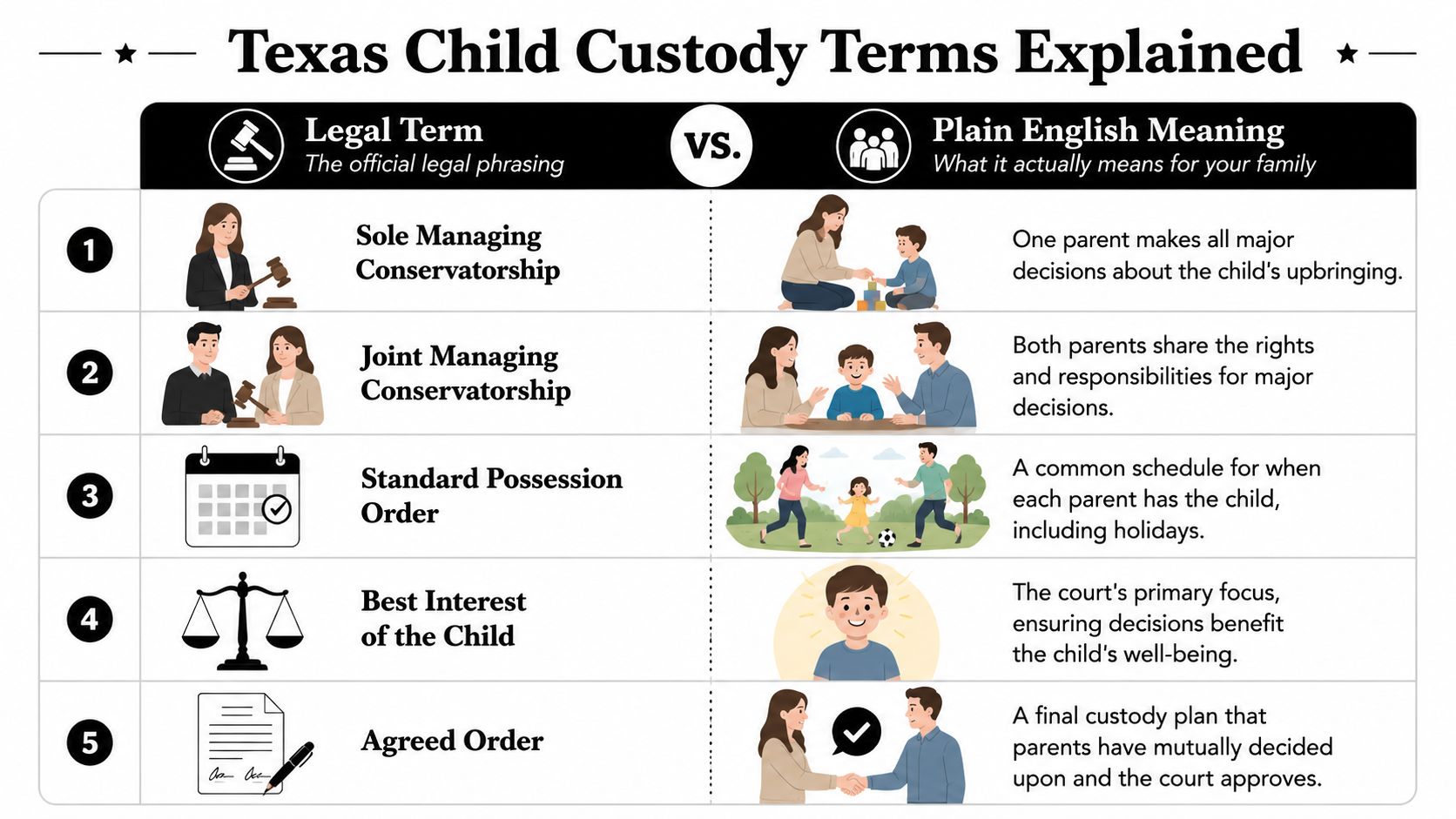
The words Texas courts use
Here's a plain-English breakdown:
| Legal term | Plain English meaning |
|---|---|
| Conservatorship | Who has the right to make major decisions for the child |
| Possession and access | When each parent has time with the child |
| Best interests of the child | The court's guiding standard for deciding what arrangement helps the child most |
| Order | A signed court document that can be enforced |
| Modification | A later change to an existing custody order |
The phrase best interests of the child sounds broad because it is. Judges look at the child's safety, routine, needs, relationships, and each parent's judgment. In real life, that means the court wants to see who shows up consistently, who can make sound decisions, and who helps the child stay stable.
Joint and sole conservatorship
In Bexar County, the court can award Joint Managing Conservatorship or Sole Managing Conservatorship. Under Texas law, a judge in San Antonio may order either one. The court generally presumes parents can cooperate under a Joint Managing Conservatorship, but can award Sole Managing Conservatorship if one parent's history or inability to cooperate makes joint decision-making harmful to the child's best interests, as explained in this overview of Texas conservatorship types.
That distinction matters because it affects decision-making authority.
- Joint Managing Conservatorship: Parents share major rights and duties, though one parent may still have the right to choose the child's main residence.
- Sole Managing Conservatorship: One parent has exclusive authority over major decisions because shared decision-making would not serve the child well.
Possession schedules in plain terms
A possession schedule is the calendar for parenting time. Some schedules follow a standard pattern. Others are customized around the child's age, school routine, health needs, or the parents' work demands.
For families trying to understand how legal work gets supported behind the scenes, resources about scaling your family law team can also help explain why organized document handling, scheduling, and case support often matter in custody disputes.
A strong custody case is rarely built on one dramatic moment. It's usually built on steady facts that show who has been meeting the child's needs over time.
One common question is whether children get to decide where they live. Texas courts may consider a child's views in some cases, but the judge still decides based on the child's best interests. If that issue is on your mind, this article on whether a child gets to choose which parent in Texas can help frame that question in a practical way.
A Step-by-Step Timeline of a San Antonio Custody Case
Most custody cases feel overwhelming because parents can't see the road ahead. In Bexar County, there is a sequence. Once you know the sequence, the case becomes easier to manage.
A visual overview helps many families understand where they are in the process.
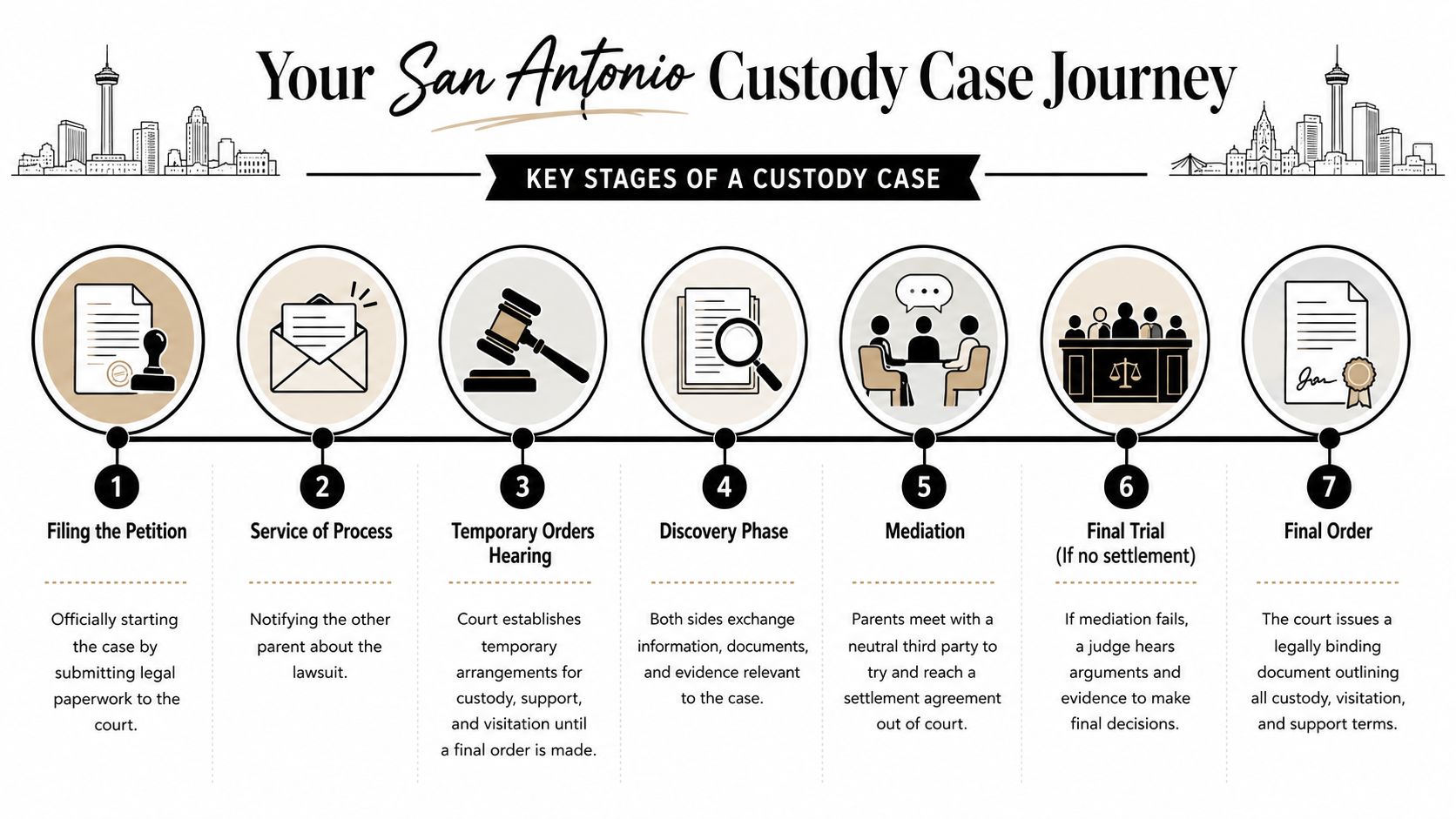
The usual path from filing to final order
Filing the case
A parent starts the case by filing the appropriate petition. In many custody-only disputes, that means a Suit Affecting the Parent-Child Relationship, often called a SAPCR.Service on the other parent
The other side has to be formally notified. Informal notice is not the same as proper service unless the legal requirements are met.Temporary orders
If parents need immediate rules about where the child stays, who makes decisions, or how exchanges happen, the court may enter temporary orders while the case is pending.
After that, the case usually shifts from crisis response to information gathering.
Discovery, mediation, and trial
Discovery is the stage where both sides exchange information. That can include school records, medical information, calendars, photos, communication logs, and other evidence that helps the judge understand the child's life.
Then comes one of the most important stages in San Antonio custody litigation. Parents must attend mediation before a formal trial can proceed, and this requirement resolves many cases. In Texas counties with mandatory mediation, about 85% of custody cases resolve without a full trial, according to this San Antonio custody process overview.
That doesn't mean every agreement is fair. It does mean parents should prepare carefully for mediation because it often becomes the turning point in the case.
How to prepare at each stage
| Stage | What helps most |
|---|---|
| Filing | Clear facts and the right legal requests |
| Temporary orders | Proof of the child's present routine and needs |
| Discovery | Organized records and complete responses |
| Mediation | Realistic goals and fallback options |
| Trial | Focused evidence, not anger |
For a more detailed walkthrough, this guide to a step-by-step custody case timeline in Texas gives parents a fuller picture of what to expect.
The parents who do best in custody cases usually prepare for mediation as seriously as they would prepare for trial.
What to Do Right Now to Protect Your Family
When custody trouble starts, delay can create risk. Parents often wait because they hope things will calm down. Sometimes they do. Sometimes the lack of a plan gives the other side room to control the child's schedule, limit access, or create a new routine that later gets presented as the status quo.
That's why early action matters. Not reckless action. Focused action.
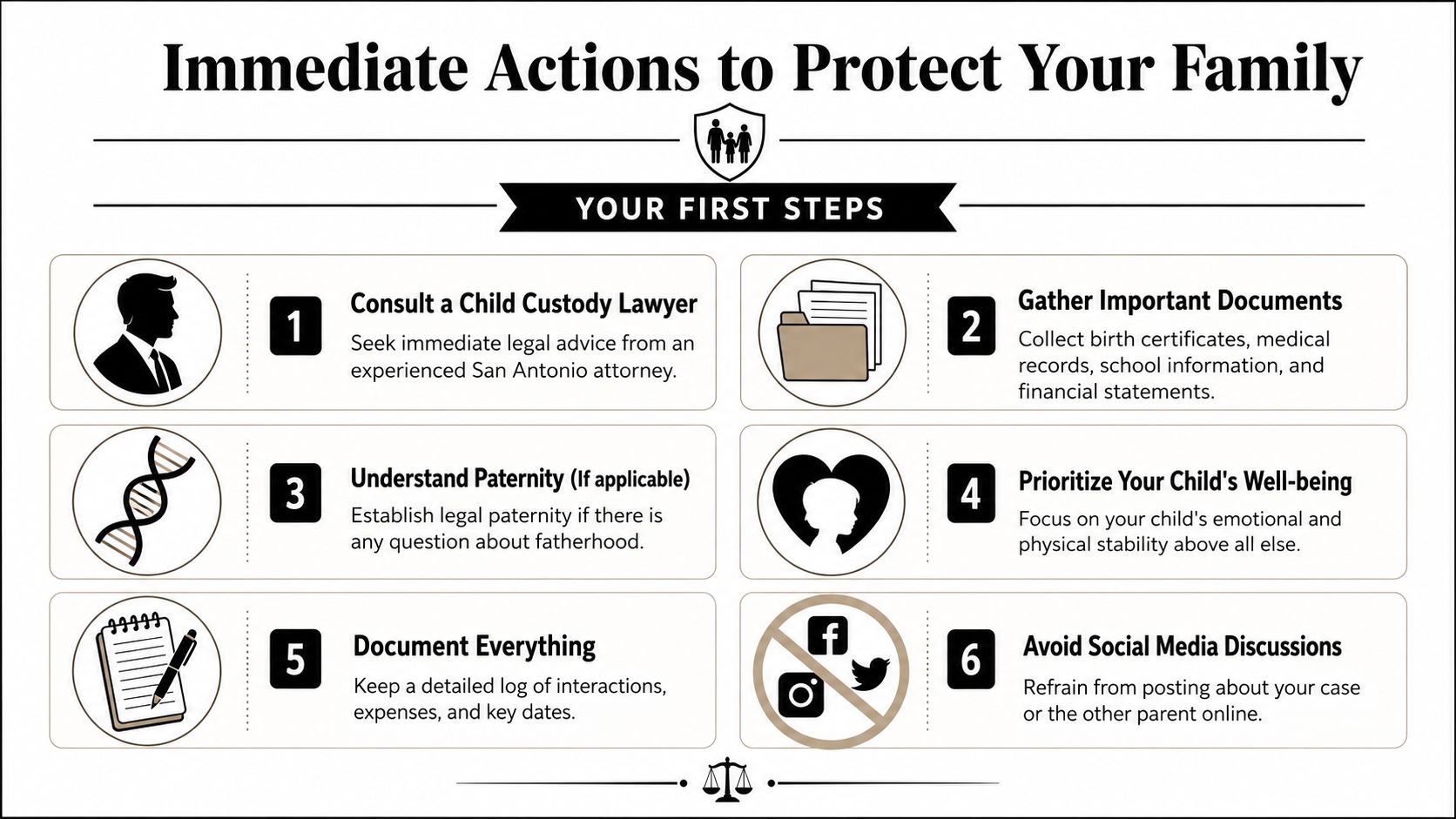
Your first moves should be practical
Start by collecting the records that tell the story of your parenting.
- School and daycare information: Attendance records, teacher communications, pickup routines
- Medical records: Appointment history, prescriptions, doctor contact information
- Communication logs: Texts, emails, and co-parenting app messages
- Your calendar: Overnight time, activities, appointments, and missed exchanges
- Legal paperwork: Birth certificates, prior orders, paternity documents, and support records
If there is no existing order, unmarried parents should also look closely at paternity. Legal rights often depend on whether paternity has been formally established.
Protect the child and your position
The most persuasive parent in court is often the one who creates steadiness under pressure.
Do this now:
- Keep the child's routine stable
- Communicate briefly and respectfully
- Write down key events while they are fresh
- Follow existing orders exactly if one already exists
- Get legal advice quickly if safety is a concern
Avoid this:
- Posting about the case online
- Arguing in front of the child
- Blocking access without legal grounds
- Deleting messages or records
- Relying on handshake agreements during high conflict
If the situation involves immediate risk, this guide to an emergency motion for custody in Texas may help you understand when urgent court action becomes necessary.
When inaction becomes the problem
Parents sometimes believe the court will automatically sort out obvious unfairness later. That belief causes damage. Judges work from evidence, orders, and documented facts. If you've been cut out of important decisions or denied time for weeks without taking action, rebuilding your position often gets harder.
A child custody lawyer in San Antonio can help you decide whether the issue calls for negotiation, temporary orders, or emergency relief. The sooner you know which path fits, the better you can protect both your child and your own credibility.
Choosing and Working With Your San Antonio Lawyer
Not every family law attorney is the right fit for every custody case. Some parents need a lawyer who can negotiate an agreement with minimal conflict. Others need someone ready to handle temporary orders, contested hearings, or a difficult modification. Choosing carefully at the start can save stress, time, and money later.
This visual highlights common decision points parents look at when comparing counsel.
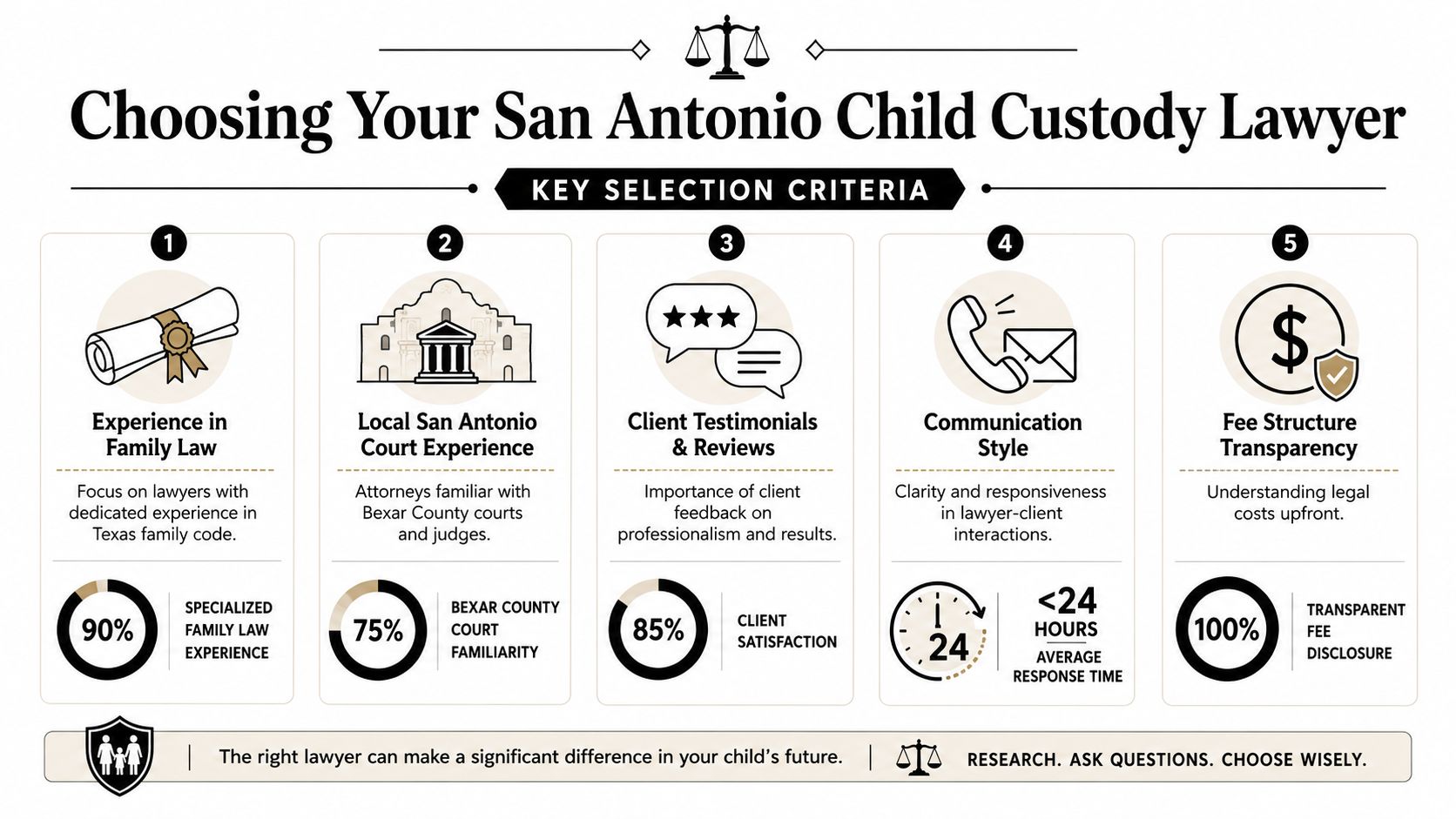
Questions worth asking in a consultation
Use the first meeting to learn how the lawyer thinks, not just what the lawyer charges.
Ask questions like:
- How do you approach temporary orders in a custody case like mine
- What facts in my situation matter most to a Bexar County judge
- How do you prepare clients for mediation
- What kind of communication should I expect during the case
- What problems do you see early in my fact pattern
Listen for direct answers. A useful attorney should be able to tell you what's legally important, what isn't, and where your expectations may need adjustment.
What the financial side usually looks like
Parents deserve straight talk about cost. In San Antonio, custody battles typically cost between $3,500 for uncontested cases and $40,000 or more for highly contested disputes. The average parent in a contested custody dispute spends about $15,000 to $25,000 on attorney fees alone, with hourly rates commonly ranging from $250 to $600. Initial retainers often start at $5,000 to $10,000 for contested matters, based on this San Antonio custody cost breakdown.
That isn't the full picture in every case. Some disputes also involve extra expenses such as mediation, evaluations, or other court-related costs. The practical question isn't just “What will this cost?” It's also “What process choices increase or decrease those costs?”
Trade-offs that matter
Here are some real trade-offs parents face:
| Choice | Likely effect |
|---|---|
| Early organized settlement effort | Can reduce conflict and legal spend |
| Poor document handling | Can increase attorney time and cost |
| Fighting over minor issues | Often drains resources without improving the outcome |
| Preparing thoroughly for mediation | Can improve the odds of reaching a durable agreement |
| Waiting to hire counsel until a crisis hearing | Often makes the case more expensive and reactive |
Paying for legal work is easier to manage when you understand which tasks protect your child and which fights only feed the conflict.
A good lawyer-client relationship also depends on your participation. Bring documents promptly. Answer questions truthfully. Don't hide bad facts. Custody cases are easier to manage when the legal strategy is grounded in reality instead of wishful thinking.
Special Custody Issues for San Antonio Families
San Antonio families often bring issues to court that generic custody articles barely mention. Military service is a major one. So are post-order changes that make the old parenting plan stop working in real life.
Military service and deployment
This city has a large military community, so deployment and relocation come up often. Texas law gives service members important protection here. Texas Family Code §153.433 establishes that a parent's absence due to military service cannot be the sole basis for denying primary custody, as explained in this Texas military custody overview.
That matters because military parents often worry that service-related absence will be treated as abandonment or lack of commitment. It shouldn't be treated that way by itself. The court still looks at the child's best interests, temporary needs, and workable scheduling, but military duty alone cannot be the only reason to deny primary custody.
For military families, useful planning questions include:
- Who will handle temporary care during deployment
- How will communication with the child continue
- What schedule will apply after return
- Does the current order need temporary changes in writing
Modifying an existing order
Many parents already have orders. Their problem isn't getting the first custody order. Their problem is that life changed and the current order no longer fits.
Texas courts require a parent seeking modification to show a substantial and material change in circumstances since the prior order. According to this Texas custody modification explanation, examples can include serious issues such as jail, abuse, drug use, or a criminal relationship. Courts must also consider evidence of family violence or sexual abuse within the relevant period, and proven abuse can prevent appointment of the abusive parent as a joint managing conservator.
Young children need different schedules
Parents of infants and toddlers often assume the standard schedule applies automatically. It doesn't. When a child is under three, the legal presumption that the Standard Possession Order is in the child's best interest does not apply. Texas judges can create customized schedules based on the child's developmental needs, as described by Texas Law Help's guidance on possession orders.
That flexibility matters for feeding, sleep, attachment, and gradual transitions. A schedule that works for a school-age child may be completely wrong for a baby.
Your Next Steps and Common Custody Questions
If you feel overwhelmed, narrow your focus. You do not need to solve every future problem this week. You do need to protect the legal and practical basics.
Key takeaway
Start here:
- Find out whether you already have an enforceable court order
- Gather the records that show your role in the child's daily life
- Stop treating verbal promises as legal protection
- Keep your communication child-focused and calm
- Get legal advice before temporary problems become permanent patterns
Parents who act early usually have more options. Parents who wait often end up reacting to a situation the other side has already shaped.
Common custody questions
Can a child choose who to live with
A child's preference may matter in some cases, but the judge makes the final decision based on the child's best interests. A preference is one fact, not the whole case.
Can my ex deny visitation if I'm behind on child support
No. Texas Family Code Chapter 153 prohibits courts from conditioning possession of or access to a child on payment of child support, which means visitation and support are separate legal issues under Chapter 153 of the Texas Family Code.
Are custody schedules different for babies and toddlers
They can be. For children under three, Texas courts may use a customized schedule instead of assuming a standard possession schedule fits the child's needs.
What if we already have an order but things have changed
That may call for a modification. The court will want proof that circumstances changed in a substantial and material way, and that a new order would better serve the child.
Do fathers and mothers get treated the same
Texas law directs courts to consider the qualifications of the parties without regard to sex. In practice, both mothers and fathers improve their positions by showing involvement, consistency, judgment, and a workable parenting plan.
If you need help with a child custody or visitation case in Texas, our experienced attorneys can guide you every step of the way. Contact The Law Office of Bryan Fagan, PLLC today for a free consultation.
If you need help with a child custody or visitation case in Texas, our experienced attorneys can guide you every step of the way. Contact The Law Office of Bryan Fagan, PLLC today for a free consultation.