
When your child’s routine suddenly feels uncertain, every decision can feel heavier than it should. You may be wondering where your child will sleep on school nights, who will make medical decisions, or how to keep life stable while your family changes. Those worries are normal, and they matter.
Many people who search for a family law firm houston aren’t looking for legal jargon. They want clear answers, calm guidance, and a plan that protects their child without making an already hard season worse. Parents, grandparents, and caregivers often come in feeling overwhelmed. They leave feeling more grounded once they understand their options under Texas law.
When Your Child’s Future Is at Stake
A mother in Houston may be trying to figure out how to keep her child in the same school after separation. A father may be worried that time with his son is slipping away because no one has a written schedule yet. A grandparent may be stepping in because the child’s home life has become unstable.
Those situations look different on the surface, but they often carry the same fear. Will my child be okay?

Texas family law gives families a path forward, but the process can feel confusing at first. Terms like conservatorship, possession, and SAPCR can sound cold when what you’re really dealing with is bedtime routines, report cards, and your child asking hard questions. A good lawyer translates the law into plain English and helps you make decisions that support stability.
Practical rule: The earlier you understand your rights and responsibilities, the easier it is to avoid mistakes that can affect custody, visitation, or support later.
Houston families also face a competitive legal market. Harris County had 25,505 active attorneys in 2023, up from 22,824 in 2013, an 11% increase over 10 years, according to the State Bar of Texas archive on attorney population trends. That same source notes the Houston Bar Association’s Family Law Section has almost 500 attorneys, which shows how important family law is in this city.
That can be good news for families. It means there are lawyers focused on custody, visitation, child support, and related family issues. But it also means choosing counsel should be thoughtful, especially when your child’s daily life is on the line.
How Our Houston Family Law Firm Can Help
A family case rarely arrives in one neat box. A parent may come in asking about custody and learn that paternity must be established first. A grandparent may be caring for a child already and need to know whether Texas law allows a court filing at all. A military parent may be trying to protect contact with a child while preparing for deployment orders.
That is why clear legal advice matters. Good counsel helps you sort the problem into parts, then address them in the right order.
Our Family Law Services for Houston Parents and Caregivers
| Service Area | What It Means for Your Family |
|---|---|
| Child custody | Protecting your relationship with your child, including decision-making rights, parenting schedules, and where the child primarily lives |
| Visitation and possession | Creating a workable schedule so each parent knows when the child will be with them |
| Child support | Making sure your child has financial support for everyday needs |
| Paternity | Legally identifying a child’s father so rights and duties can be addressed |
| Divorce involving children | Resolving the marriage while also addressing custody, support, and parenting plans |
| Custody modification | Updating court orders when life changes, such as relocation, work shifts, or safety concerns |
| Enforcement actions | Asking the court to enforce orders when a parent isn’t following the schedule or support terms |
| Emergency custody matters | Seeking quick court action when a child may be at risk |
| Grandparents’ rights | Evaluating whether a grandparent may seek visitation or conservatorship under Texas law |
| Military and relocation custody | Addressing deployment, interstate issues, and long-distance parenting arrangements |
What these services mean in everyday life
Texas family law uses terms that can feel distant from real parenting. "Conservatorship" means who makes important decisions. "Possession and access" means the parenting schedule. A court order is the written rulebook everyone is expected to follow.
That rulebook matters because families are living real life, not legal vocabulary. Children still need rides to school, medicine picked up on time, and a plan for holidays. The law works best when it protects those ordinary routines.
Child custody cases usually focus on two questions. Who will make major decisions for the child, and what schedule will support the child’s stability? In Texas, those questions can involve joint managing conservatorship, sole managing conservatorship, and detailed possession schedules.
Child support is a separate issue. Support is for the child’s needs, not a prize for one parent or a penalty for the other. Parents are often surprised by that, especially if parenting time is shared.
Paternity can be the gate that opens the rest of the case. Until legal fatherhood is established, a father may not have enforceable rights to possession or decision-making. A mother may also need that legal step before the court can enter support orders.
One written order can prevent months of avoidable conflict.
Support shaped to the role you carry
Families do not all stand in the same place, so the legal strategy should not be identical.
- For mothers: You may need a stable parenting plan, support orders, or enforcement if the other parent’s involvement changes from week to week.
- For fathers: You may be trying to establish paternity, protect meaningful parenting time, or correct the assumption that your role should be limited.
- For grandparents: You may already be providing day-to-day care and need a careful review of standing, visitation rights, or conservatorship options under Texas law.
- For military parents: You may need orders that account for deployment, temporary duty, missed visitation, virtual contact, and the practical strain of distance on a child.
Military and grandparent cases often need extra care because they raise questions many general overviews skip. For example, military families may need attention to federal protections and deployment-related parenting adjustments, while grandparents often need a close analysis of whether the court can hear their request in the first place. In Houston, where many families are connected to military service and many grandparents step in during family crises, those details are not side issues. They can decide whether a case moves forward.
The Law Office of Bryan Fagan, PLLC handles child custody, visitation, possession rights, paternity, child support, enforcement, modifications, and emergency custody issues for Texas families. The focus is practical. Protect the parent-child relationship, reduce confusion, and keep the child’s well-being at the center.
Navigating the Texas Child Custody Process Step by Step
One reason custody cases feel intimidating is that parents don’t know what happens next. Once you see the process in order, it becomes easier to manage.
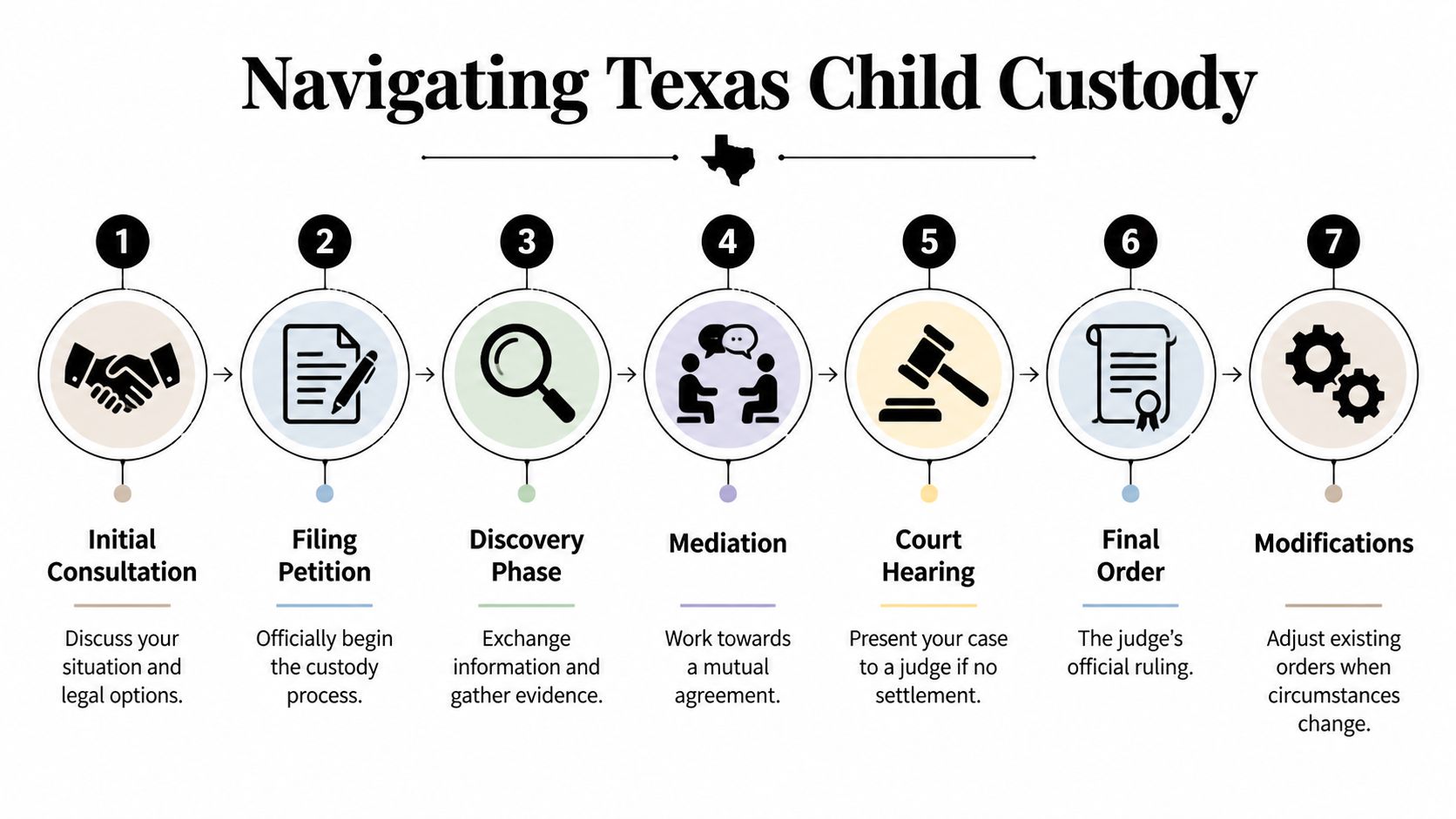
The usual path through a custody case
Initial consultation
You talk through your family’s situation, your goals, and any urgent issues. This is often where parents first learn whether they need to file for divorce, a modification, or a Suit Affecting the Parent-Child Relationship, often called a SAPCR.Filing the case
A petition is filed with the court to start the process. The other party is formally notified.Temporary orders
If you need rules in place while the case is pending, the court can enter temporary orders. These can address where the child stays, temporary support, and how decisions will be made until the final order.Discovery and evidence gathering
Each side collects information. That may include school records, medical records, calendars, messages, and witness information.Mediation
Many Texas family cases settle through mediation. A neutral mediator helps both sides work toward an agreement.Final hearing or trial
If the parents can’t agree, a judge decides. The court signs final orders that control conservatorship, possession, and support.Modification later if needed
Life changes. Existing orders can sometimes be changed if circumstances materially shift.
For a fuller overview of these issues, parents can review this guide to Texas child custody.
How Texas decides what’s best for a child
The legal standard you’ll hear most often is the best interests of the child. In plain English, that means the court focuses on the child’s welfare, not the parents’ frustration with each other.
Judges often look at questions like these:
- Stability: Which home can better provide consistency in school, routines, and care?
- Safety: Is there any concern about neglect, violence, substance abuse, or dangerous behavior?
- Parenting ability: Who is meeting the child’s daily needs and making sound decisions?
- Co-parenting: Can each parent support the child’s relationship with the other parent?
- Child-specific needs: Does the child have medical, educational, or emotional needs that affect the schedule?
Modern evidence matters
Many parents are surprised to learn how much digital information can affect a case. In modern custody disputes, digital evidence from emails, text messages, and social media is often admissible and can be critical, as explained in this discussion of technology and family law in Texas.
That doesn’t mean every angry text decides a case. It does mean patterns matter. Messages about missed exchanges, posts showing risky conduct, or location data tied to parenting-time disputes can become important pieces of evidence.
Save communication carefully. Don’t edit screenshots, delete messages, or post online as if your case doesn’t exist. A judge may eventually see more than you expect.
Understanding Your Rights as a Texas Parent
Texas uses terms that can sound unfamiliar, but the ideas behind them are easier to understand once they’re translated into daily life.

Conservatorship in plain English
Joint Managing Conservatorship usually means both parents share certain rights and duties regarding the child. It does not always mean equal time. One parent may still have the exclusive right to decide the child’s primary residence, while other decisions may be shared or allocated in specific ways.
Sole Managing Conservatorship means one parent has more exclusive decision-making authority. Courts may consider this when shared decision-making would not serve the child well, such as in cases involving family violence, serious instability, or an inability to co-parent safely.
A Possessory Conservator usually has periods of possession or access and may still hold some rights and duties, even if major decisions are assigned to the other parent.
For a closer look at these protections, visit this resource on parental rights in Texas.
What rights are parents usually talking about
When parents say they want “custody,” they may mean different things. The court often separates parenting into specific rights, such as the right to:
- Make educational decisions
- Consent to medical and dental care
- Receive school and medical information
- Determine the child’s primary residence
- Access records
- Make decisions in an emergency
That’s why two parents can both be very involved, even if one has the exclusive right to decide where the child lives most of the time.
Possession schedules and everyday life
Texas also uses the term possession for parenting time. A Standard Possession Order, often called an SPO, is a common schedule that gives parents a predictable framework for weekends, holidays, and extended time in the summer. Courts can use that framework, or they can approve a custom schedule if it better fits the child.
A schedule should work in real life. If one parent works nights, travels often, or lives farther away, the order may need to account for that. If the child is very young, the court may consider a schedule that supports frequent contact while still protecting routine.
Here’s a short video that helps explain how parental rights issues can play out in Texas custody cases:
A mother does not automatically win because she is the mother. A father does not automatically lose because he is the father. Texas courts are supposed to focus on the child’s best interests and the evidence before them.
That’s important for both parents to hear. If you’re a father, your role matters. If you’re a mother carrying most of the day-to-day load, that work matters too. The court process should recognize substance, not stereotypes.
Specialized Support for Military and Grandparent Custody
A Houston parent gets deployment orders with little warning. A grandmother has been caring for her grandchild for months because a parent is in crisis. Both families are trying to protect a child. Both are also stepping into parts of Texas family law that are more technical, and less forgiving, than many people expect.
Military family cases often involve two legal systems working at the same time. Texas family law sets the rules for conservatorship and possession. Federal law can affect timing and procedure when a parent is on active duty. For many Houston families connected to Ellington Field, the Texas National Guard, or other service branches in the region, that overlap creates stress fast.
Military families need orders that work during deployment and after
A custody order for a military family should read less like a rough outline and more like a detailed map. If the order leaves gaps, conflict usually shows up at the worst possible moment, during training, mobilization, or a transfer to a new duty station.
Texas cases may involve the Service Members Civil Relief Act, or SCRA, which can affect deadlines and court proceedings for a service member on active duty. The Uniform Child Custody Jurisdiction and Enforcement Act, or UCCJEA, can also matter when parents are living in different states or a child has recently moved. That law helps courts decide which state has authority to enter and enforce custody orders.
A well-drafted order should answer practical questions before the emergency arrives:
- Who will exercise parenting time during deployment, if anyone
- How the deployed parent will have contact with the child by phone or video
- Whether makeup time will be available after return
- What happens if military orders require a move across state lines
- How school records, medical updates, and activity schedules will be shared
Children usually handle change better when the adults have already made the plan. Clear terms give a child structure, and they give the deployed parent a fair chance to stay connected.
Grandparents often provide care, but standing is the first hurdle
Grandparents are often the steady hands in a family emergency. They may handle school pickup, meals, bedtime, and doctor visits while a parent deals with addiction, illness, incarceration, or domestic conflict. That role matters significantly in a child’s life. It does not automatically give a grandparent the right to ask a court for custody or visitation.
Texas law sets a high bar. Texas Family Code §153.433 addresses certain grandparent access claims, and conservatorship cases can require even more proof. Courts usually want specific evidence showing that the child’s present circumstances would significantly impair the child’s physical health or emotional development, or that the legal requirements for visitation have been met despite a parent’s constitutional right to make decisions for the child.
That distinction confuses many families. Daily involvement and legal standing are related, but they are not the same. One shows commitment. The other determines whether the court can hear the request at all.
If you are trying to sort out whether a grandparent may have a viable claim, this guide to grandparents custody rights in Texas explains the legal standards in more detail.
Why focused legal strategy matters in these cases
Military custody cases can turn on timing, federal protections, and enforceability across state lines. Grandparent cases can rise or fall on standing before the judge ever reaches the question of what schedule would help the child most. Those are threshold issues. If they are mishandled early, the rest of the case may never get traction.
For Houston families, local experience matters in a very practical way. A lawyer handling these cases needs to understand Texas statutes, how Harris County courts expect proof to be organized, and how to build orders that still make sense when real life changes quickly.
Why Choose a Houston-Focused Family Law Firm
Local knowledge matters in family law because the same Texas statutes play out in real courtrooms, with local procedures, local judges, and local expectations. A lawyer who regularly handles Houston-area family cases can often spot practical issues earlier, from filing habits to mediation dynamics to the kind of documentation that tends to matter most in contested parenting disputes.
Houston is also a highly specialized legal market. According to Houston family law listings on Super Lawyers, the city has 295 top-rated family law attorneys, and the verified market data also notes a Harris County family law section with nearly 500 members. That level of specialization means families can look for lawyers who focus on family law rather than treating it as a small part of a broader practice.
What local focus can mean for your case
- Court familiarity: Your lawyer understands how Houston-area family courts typically handle scheduling, evidence, and settlement efforts.
- Stronger issue spotting: Local experience helps identify when a case may need a temporary order, emergency request, or modification strategy.
- Better fit for complex cases: If your matter involves relocation, military service, or grandparent standing, a focused family law practice is more likely to recognize the pressure points early.
Reputation matters, but substance matters more
Most parents start online. They read reviews, compare websites, and try to decide who sounds trustworthy. That’s reasonable. It also helps to understand how law firms manage their public presence and client feedback. For that broader context, this guide to law firm reputation management explains how reputation systems work and why online signals should be considered alongside experience, communication style, and practice focus.
The right lawyer for your family isn’t just someone with a polished website. It’s someone who can explain your options clearly, prepare your case carefully, and keep the focus on your child.
Your Next Steps Toward Protecting Your Family
If you’re facing a custody, visitation, support, or modification issue, clarity usually starts with a few simple steps.
Next steps
- Gather the basics: Collect any existing court orders, school records, calendars, and important messages.
- Write down your concerns: Focus on the child’s needs, schedule problems, safety concerns, and major decision-making issues.
- Avoid reactive communication: Keep texts and emails calm, factual, and child-centered.
- Get legal guidance early: A short conversation now can prevent bigger problems later.
The most important thing to remember is that you do have options. Texas law gives parents, and sometimes grandparents, tools to ask the court for structure, protection, and a workable plan. The process may feel unfamiliar, but it isn’t impossible to work through with good guidance.
You don’t have to have every answer before you reach out. You just need a place to start.
If you need help with a child custody or visitation case in Texas, our experienced attorneys can guide you every step of the way. Contact The Law Office of Bryan Fagan, PLLC today for a free consultation.