
Deciding to change your child's name is a significant step, often rooted in a desire for a fresh start or a stronger sense of family identity. When your child’s future is on the line, understanding your rights matters most. In Texas, this process requires a court order, and at the heart of every judicial decision is one guiding principle: what is in the best interest of the child.
This guide is designed for parents, grandparents, and caregivers seeking clarity. Let's walk through why families start this journey, what Texas law requires, and how you can navigate the process with confidence.
Why Families Consider a Child Name Change
The reasons for wanting a name change are as unique as the families themselves, but they almost always come from a place of wanting to give a child a greater sense of stability, family unity, or emotional safety. This is about more than just paperwork—it’s about identity and belonging.
We often see both mothers and fathers exploring this after a divorce and remarriage. A parent who has resumed their maiden name might want their child's last name to match, especially if new siblings come along. It simplifies life at school, at the doctor's office, and in the community.
Common Reasons for a Name Change
The motivations are usually tied directly to the child's well-being and the family's current reality. Some of the most common situations we encounter include:
- Adoption or Blended Families: A stepparent who has stepped up as a primary caregiver may want to make that bond official by giving the child their last name, creating a single, unified family identity.
- Absent Parent: If a biological parent has been out of the picture, uninvolved, or has a history of abuse, changing the child’s name can be a powerful way to cut ties with a negative past and start fresh.
- Correcting an Error: Sometimes it's as simple as fixing a mistake made on the original birth certificate.
- Personal or Cultural Reasons: A family might want a name that better reflects their heritage, or the child may want a name that aligns with their own identity as they get older.
No matter the reason, the court's entire decision will boil down to one single question: Is this name change genuinely in the child's best interests? This legal standard is woven throughout the Texas Family Code and forces the judge to look past what the parents want and focus completely on the child's emotional and developmental needs.
The Emotional Impact on Your Family
The process of changing a child's name can stir up a lot of emotions for everyone. While it can feel like a fresh start, it might also bring up feelings of loss or create conflict, especially if the other biological parent is against it. Navigating these complex feelings and improving communication can sometimes be supported by approaches like family systems therapy, which looks at how the change impacts the entire family unit.
Around the world, changing a child's name is most common after major life events like adoption or a shift in family dynamics. While hard numbers are tough to come by, naming trends often follow wider cultural shifts. In most places, the legal process involves a deep look into the child’s identity and what the change will mean for their future. You can read the full research about these evolving naming trends.
Who Can Legally Petition for a Name Change in Texas?
Before you can even start the paperwork for a child name change, you have to answer a critical question: do you have the legal right to ask the court for one? The Texas legal system is very specific about who gets to initiate this process. Figuring out your legal standing from the get-go saves you time, money, and the frustration of having your petition dismissed before it even gets a fair look.
In Texas, the person filing the petition is known as the child’s “next friend.” This isn't just a friendly title; it's a legal term for an adult who has the authority to bring a lawsuit on behalf of a minor. The law is designed this way to ensure that the person asking for something as significant as a name change has a legitimate, recognized relationship with the child.
Who Qualifies as a "Next Friend"?
So, who exactly can step into this role? The law is pretty clear on this. Generally, the court recognizes these individuals as having the authority to file a name change petition for a child:
- A Parent: This is the most straightforward and common situation. Either of a child’s parents can file the petition, regardless of their marital status.
- A Managing Conservator: If a court has appointed you as the sole or joint managing conservator, you have the right to make key legal decisions for the child. This includes petitioning for a name change. While this is often a parent, it can also be another relative like a grandparent.
- A Guardian: A legally appointed guardian, whether of the child’s person or their estate, also has the standing to file.
The bottom line is that you must have a formal, legal relationship with the child. For instance, a stepparent who loves their stepchild dearly cannot file a petition on their own. They would first need to have legally adopted the child or been appointed as a managing conservator by a court.
Navigating Common Family Scenarios
Every family dynamic is different, and the law has ways of addressing these unique situations. If both parents are on board with the name change, the process is usually smooth. But things get a bit more complicated when you don't have that universal agreement.
- Divorced or Separated Parents: Even if you're divorced, you can still file the petition. The key is that you are legally required to give the other parent formal notice. If they object, it doesn’t automatically kill your case, but you'll have to convince the judge that the name change is truly in your child's best interest, even over the other parent's disagreement.
- An Uninvolved Parent: What if the other parent has been out of the picture for years? You still have to make what the court calls a "diligent effort" to find them and notify them. This is a critical step that requires careful documentation of your search. If you can prove to the judge you’ve done everything reasonably possible to locate them without success, the case may be allowed to move forward without them.
- Unmarried Parents: For fathers who were never married to the child's mother, legal standing often comes down to one thing: paternity. If you haven't legally established your parental rights, that is the absolute first step you must take before you can have any say in a name change case. You can learn more about the steps involved in establishing paternity in Texas in our detailed guide.
Under Texas Family Code § 45.003, there's a huge requirement for older kids: a child who is 10 years of age or older must provide their written consent to the name change. This isn't something they can just sign at home; it has to be given in court. This ensures the judge knows the child genuinely understands and agrees with this major life decision. Without it, the petition will not be granted.
This rule is a powerful reminder that the court’s focus isn’t just on what the parents want. It places real weight on the child's own feelings and identity. Making sure you meet all these eligibility rules is the foundational first step to a successful petition.
Navigating the Texas Legal Process Step-by-Step
The legal road to changing your child's name in Texas can feel like a maze, but it’s a journey you can absolutely manage with the right map. This isn't just a list of steps; it's a guide to help you understand the why behind each part of the process, empowering you to move forward with confidence.
We’ll break down everything from the initial paperwork to the final court hearing.
Your very first move is to prepare a Petition to Change the Name of a Child. This is the formal legal document that kicks off the entire case. It tells the court who you are, who your child is, and most importantly, why you believe this change is in your child's best interest. You'll need to provide specific information, including your child’s current full name, their proposed new name, and a clear, honest reason for the request.
This infographic lays out the key people involved and highlights a crucial element: the child's own wishes, if they're old enough to express them.
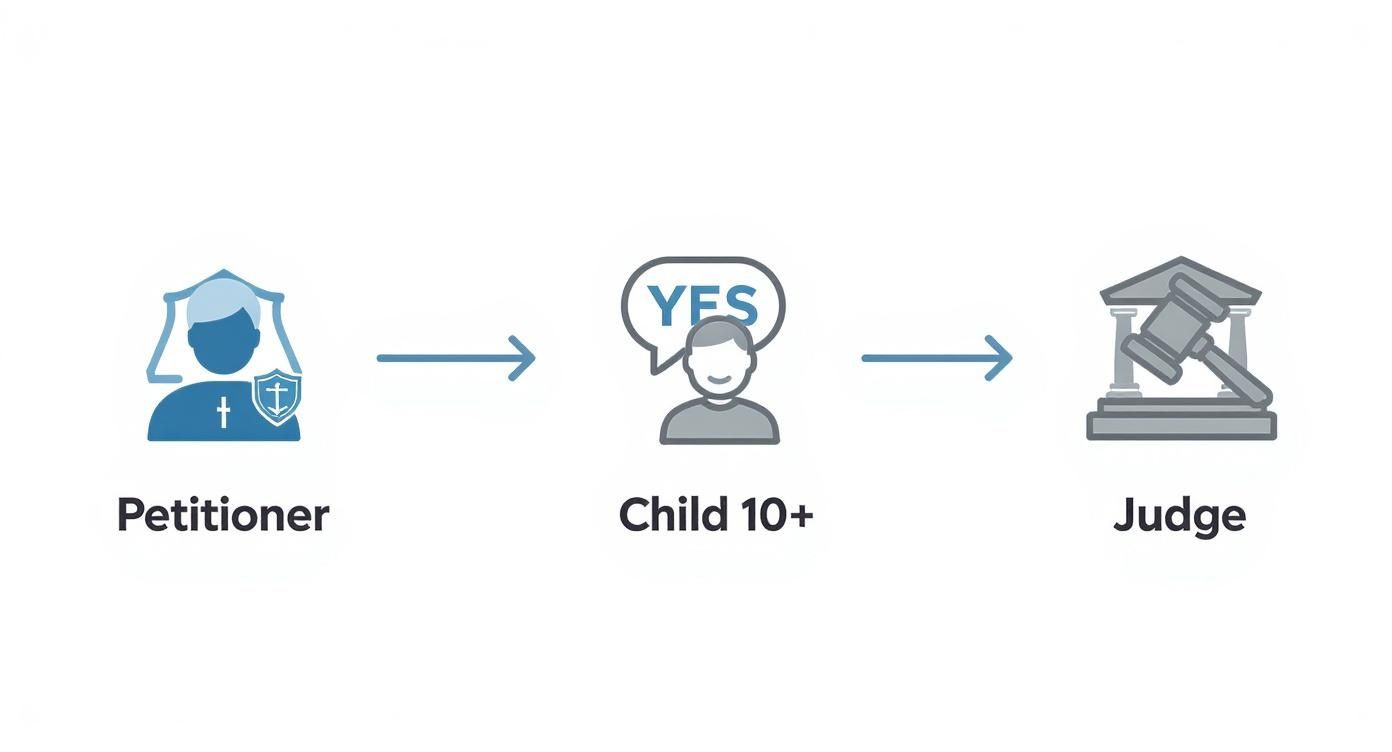
As you can see, the whole process revolves around you (the petitioner), your child's voice (if they are 10 or older), and the final decision-maker—the judge—all operating within the legal framework.
Filing the Petition and Notifying the Other Parent
Once the petition is filled out and ready to go, you must file it with the district court in the county where your child lives. When you file, you’ll also need to pay a filing fee, which typically runs between $250 to $350, depending on the county. Be prepared for this initial cost.
After filing, you hit one of the most critical stages: formally notifying the other parent. The law demands this to keep the process fair and transparent. You can't just send a text or make a phone call; you have to complete a legal process known as service.
Service means having the other parent officially delivered a copy of the filed petition and a citation from the court. This is usually handled by a sheriff, constable, or private process server. This step is non-negotiable, even if the other parent is completely uninvolved. If you fail to serve them properly, the judge simply cannot move forward with your case.
What if You Cannot Find the Other Parent?
Life gets complicated, and sometimes, a parent’s whereabouts are a total mystery. Texas law anticipates this. If you genuinely cannot locate the other parent, you can't just skip the notification step. Instead, you have to prove to the court that you've made a diligent search.
This means you’ve done things like:
- Checking their last known address and workplace.
- Searching public records and online databases.
- Contacting their friends and relatives.
If you can show you’ve exhausted all reasonable options, the court might allow you to provide notice in another way, like posting it at the courthouse or publishing it in a newspaper. In some situations, a judge will appoint an attorney ad litem—an independent lawyer whose job is to search for the missing parent and represent their interests.
This requirement gets to a core principle of family law: both parents have a constitutional right to be involved in major decisions affecting their children. The court takes this very seriously, so documenting your search efforts is absolutely essential for your case to succeed.
Completing the Required Background Check
Another mandatory step is a criminal history check for your child. Under the Texas Family Code, any child who is the subject of a name change petition must be fingerprinted and have their criminal record checked if they are 10 years of age or older. This is to make sure the name change isn't being used to evade law enforcement or hide a criminal history.
You'll need to coordinate with a local law enforcement agency to get the fingerprints taken and submit them to the Texas Department of Public Safety. The results will be sent directly to the court. This can take several weeks, so it's smart to get it started soon after you file your petition to avoid delaying your court date.
To help you keep track of these milestones, here's a quick overview of the key stages in the process.
| Stage | Primary Purpose | Key Document or Action |
|---|---|---|
| Petition Preparation | To formally request the name change and state the reasons. | Original Petition to Change the Name of a Child |
| Filing with the Court | To officially begin the legal case and get it on the court's docket. | Filing the Petition, Paying the fee |
| Service of Process | To legally notify the other parent of the pending case. | Having a citation and petition served by a process server. |
| Criminal Background Check | To comply with state law for children 10 and older. | Fingerprinting and submitting to DPS. |
| Final Hearing | To present your case to the judge and get a final decision. | Testifying in court about the child's best interest. |
| Final Order | To legally finalize the name change. | Order Changing the Name of a Child, signed by the judge. |
Each of these steps builds on the last, bringing you closer to the finish line.
Scheduling and Preparing for the Hearing
Once all the preliminary steps are complete—the petition is filed, the other parent is served (or an alternative is approved), and the background check is submitted—you can schedule your final hearing. This is your day in court, the moment you'll present your case directly to the judge.
At the hearing, the judge will review all your documents and listen to your testimony. They'll ask questions to confirm all legal requirements have been met and, most importantly, to decide if the name change is truly in the best interest of the child. If the other parent has objected, they will also get a chance to present their side.
Being prepared for this hearing is the key to a successful outcome. For a more detailed breakdown of the forms and information you'll need, you can explore our comprehensive guide in our free child name change e-book.
Preparing for Your Court Hearing
The court hearing is the moment of truth in a **child name change** case. It’s where all your preparation comes together and a judge makes the final, binding decision. Walking into that courtroom can feel incredibly intimidating, but knowing exactly what to expect can give you the confidence you need to present your case clearly and effectively.
Your one and only job in that hearing is to show the judge that the name change is truly in your child’s best interest. This isn't just a phrase; it's the legal standard that forms the bedrock of every decision a Texas family court makes about a child. The judge isn't there to simply rubber-stamp your paperwork. Their duty is to be a guardian of your child's well-being.
The "Best Interest of the Child" Standard
So, what does “best interest of the child” really mean in the context of a name change? It’s a broad concept that gives the judge the flexibility to look at the whole picture of your child’s life. They will be asking questions to figure out how this change will positively impact your child's emotional world and their future.
A judge will weigh several key factors, including:
- The Child’s Preference: If your child is 10 or older, their written consent is a legal requirement. For younger kids, a judge may still listen to their wishes if they seem mature enough to have a genuine preference.
- Family Unity: Will the new name help the child feel more connected to their family? This comes up a lot in blended families where siblings or the parent they live with have a different last name.
- Avoiding Harm or Embarrassment: Is the child’s current name a source of ridicule, confusion, or embarrassment? This could be because it's hard to pronounce, has negative associations, or is just plain unusual.
- Parental Connections: The judge will also consider the importance of the child maintaining a link to both parents' family names. An objection from the other parent will be taken very seriously.
The judge’s questions will be direct and to the point. Be ready to answer honestly and from the heart, always focusing on how this benefits your child, not just what you want. You need to explain why this is good for them.
What to Expect During the Hearing
The hearing itself is a formal process, but it's usually straightforward and pretty brief if no one is objecting to the change. You'll be sworn in and asked to give testimony, which is really just a formal way of saying you'll answer the judge's questions under oath.
The judge will probably ask you to confirm the details in your petition, explain your reasons for the request, and verify that you've followed all the legal steps, like notifying the other parent. If your child is 10 or older, they'll need to be in the courtroom to give their consent in person.
While the courts don't track statistics on name changes, societal trends tell us a lot. Pop culture, for example, can create naming crazes that feel dated or strange later on. It's not uncommon for these cultural shifts to be a factor in a family's decision to seek a change down the road.
Responding to an Objection From the Other Parent
If the other parent shows up to object, the hearing shifts from a simple proceeding to a contested matter. This doesn't mean you'll automatically lose, but it definitely raises the bar. An objection forces you to prove to the judge that the benefits of the name change strongly outweigh the other parent’s desire to keep the name as is.
The other parent needs a valid reason for their objection; just saying "I don't like it" won't cut it. A legitimate objection usually centers on the argument that changing the name would damage the child's bond with that parent or erase their connection to that side of the family's heritage.
If you find yourself in this boat, preparation is everything. You will need to bring evidence to back up your case, which could include:
- Your own testimony about the child’s daily life and why the new name offers more stability or less confusion.
- Evidence of the other parent’s limited involvement in the child's life, if that's the situation.
- Statements or testimony from teachers, counselors, or even family friends who can speak to the child’s emotional state and the positive impact the change would have.
Navigating a contested hearing requires a solid strategy. For more practical advice on handling yourself in a courtroom, our article on how to prepare for a custody hearing offers some fantastic insights that are just as relevant here. Being ready for anything will make you a much stronger advocate for your child.
Next Steps After the Judge Approves the Name Change
That moment when the judge finally grants your petition is an incredible feeling—a huge win for your family and a massive sigh of relief. The signed court order, officially called the Order Changing the Name of a Child, is the legal key that unlocks the final chapter of this journey. But your work isn't quite done yet.
Now it's time to take that powerful piece of paper and make your child's new name official across every part of their life. This last leg is all about administrative legwork. It's less about courtrooms and legal arguments and more about being careful and methodical. Getting these steps done promptly will save your child from a world of confusion and headaches down the road.
Get Your Hands on Certified Copies—And Get More Than You Think You Need
Your very first move should be to get several certified copies of the signed name change order. You can get these from the district clerk’s office right where your hearing was held. A certified copy isn't just a quick run through the office scanner; it has an official stamp or seal from the clerk, proving it’s a true and correct copy of the original court document.
Think of a certified copy as a golden ticket. Government agencies, schools, and other official places won't accept a simple photocopy. You'll need an original certified copy for almost every update you make, so I always tell clients to get at least five to ten copies right off the bat. It's much easier to get them all at once.
Your Must-Do Update Checklist
With your certified copies ready, you can start updating your child's records. I've found it’s best to treat this like a checklist to make sure nothing slips through the cracks. While every kid's situation is a little different, these are the non-negotiables.
Update the Social Security Card
One of your first stops should be the Social Security Administration (SSA). You'll need to fill out Form SS-5 (Application for a Social Security Card) and bring it in along with proof of your identity, your child's identity, and a certified copy of the name change order. The SSA will issue a brand-new card with your child’s new name but keep the same Social Security number.
Amend the Birth Certificate
This is a big one. To officially change your child's birth certificate, you'll need to submit an application to the Texas Vital Statistics Unit. You’ll send them a certified copy of the name change order, the required application, and the fee. This process can take a few weeks, but it's a fundamental step that makes the new name a permanent part of your child's official record.
The Social Security Administration (SSA) has actually done research on naming trends, noting that the reasons parents change names often reflect broader cultural shifts. It speaks to how parents today are more open to finding a name that truly fits their family's story. You can read the full research about these evolving naming trends.
Notify Schools and Medical Providers
It’s crucial to get all educational and medical records updated right away. Take a certified copy of the court order to:
- Your child’s school or daycare
- Their pediatrician and any specialists they see
- Their dentist and orthodontist
- Your health insurance provider
This makes sure that everything from report cards and prescriptions to medical bills is issued in the correct name, preventing a ton of confusion and potential administrative nightmares.
Update Financial and Travel Documents
Finally, don't overlook any financial or travel-related documents. This could include:
- Updating their U.S. Passport
- Changing their name on any bank accounts or savings bonds
- Notifying any trusts or life insurance policies where they are a beneficiary
Tackling these steps methodically ensures your child's new identity is recognized everywhere. It officially closes this chapter and lets your family move forward with confidence and clarity.
Key Takeaway: Your Child's Best Interest is the Guiding Star
Navigating the legal process for a child name change in Texas requires careful attention to detail and a clear focus on what truly benefits your child. From filing the initial petition and properly notifying the other parent to presenting a compelling case in court, every step is designed to protect your child's well-being. Remember that if your child is 10 or older, their consent is not just important—it's mandatory.
While you can technically navigate this process alone, the guidance of an experienced family law attorney can provide invaluable peace of mind, especially if any complications arise. An attorney ensures that all legal requirements are met, helps you build the strongest possible case, and stands by your side, empowering you to advocate effectively for your child's future.
If you need help with a child custody or visitation case in Texas, our experienced attorneys can guide you every step of the way. Contact The Law Office of Bryan Fagan, PLLC today for a free consultation.