
When you're navigating a divorce, your child's well-being is the top priority. In Texas, court-ordered health insurance acts as a crucial safety net, ensuring your child’s medical and dental needs are met without interruption. This order transforms a potential point of conflict into a structured legal obligation for both parents.
Your Child's Health Insurance During a Divorce
When your family is going through a significant transition, understanding your rights and your child's protections matters most. The Texas Family Code places a huge emphasis on making sure children have consistent access to healthcare. Why? Because the court sees it as a fundamental part of the child's “best interest.” This legal standard guides all custody-related decisions, and health insurance is no exception.
A court order for health insurance cuts through the confusion and accomplishes a few key things:
- Establishes Clear Responsibility: The order spells out exactly which parent is responsible for providing the insurance policy. No guesswork.
- Ensures Continuous Coverage: It prevents dangerous gaps in coverage that could leave a child vulnerable during or after the divorce is finalized.
- Divides Financial Duties: The order outlines how premiums and out-of-pocket medical expenses will be shared between parents, creating a predictable financial plan.
Think of this court order not as a burden, but as a shield for your child. It provides predictability and stability, ensuring that doctor visits, prescriptions, and emergency care are always covered. The court’s goal is to create a practical, enforceable plan that supports your child’s health long after the divorce is finalized.
This legal framework is especially critical for unmarried parents, where establishing who the legal father is becomes the first step toward securing these essential benefits. You can learn more about this process by reviewing our guide on establishing paternity in Texas.
The "best interest of the child" is the primary consideration for Texas courts in all decisions affecting children. This includes ensuring stable access to quality medical and dental care, which is why health insurance is a mandatory part of nearly every custody order.
By making health insurance a legal requirement, the court removes ambiguity and gives both parents peace of mind. It confirms that no matter how circumstances change, your child’s access to necessary healthcare is legally protected.
How Texas Courts Decide Who Provides Health Insurance
When you're trying to figure out your child's future after a divorce, few things feel as urgent as their health and well-being. So, how does a Texas judge decide which parent is responsible for providing health insurance? It’s not a random choice or a coin toss. It’s a careful, logical process laid out in the Texas Family Code, with one primary mission: to do what’s in the best interest of the child.
The court's goal is to find a practical and stable solution. They don’t just automatically assign this responsibility to the parent with the higher income. Instead, they look at several key factors to figure out the most sensible way to ensure your child has continuous, reliable healthcare.
The Standard of Reasonable Cost
At the heart of this decision is a concept called "reasonable cost." It’s not just a vague idea; Texas law gives it a very specific definition. The cost of adding a child to a health insurance plan is considered reasonable only if it doesn't exceed 9% of the parent's annual gross income.
Think of this 9% rule as a financial guardrail. It’s there to prevent a parent from being saddled with a plan that’s financially impossible to maintain, which could put the child’s coverage at risk down the road. The court is always looking for stability and affordability, making sure the plan is something the parent can reliably keep up with month after month.
Key Factors the Court Considers
Beyond that hard-and-fast 9% rule, a judge will weigh several other real-world elements to make the final call. They're looking for the best overall fit for the child's needs.
A Texas judge will weigh several factors when deciding which parent should provide health insurance for a child. Below is a table that breaks down what the court typically considers.
Factors Influencing the Court's Health Insurance Decision
| Factor | What the Court Considers |
|---|---|
| Employer-Sponsored Plans | Does one parent have access to a better, more affordable plan through their job? These are often the first and best option. |
| Quality of Coverage | The court looks past the premium to see the real value: lower deductibles, better prescription coverage, and a wider network of doctors. |
| Overall Financial Picture | A judge will review each parent's complete financial situation—income, assets, and other support obligations—to ensure the order is fair. |
This table provides a snapshot, but remember, the judge's ultimate goal is to create an order that is both fair and manageable for everyone involved, with the child's continuous care as the top priority.
This infographic helps pull all these pieces together, showing how the court's decision-making process leads to security for your child's health.
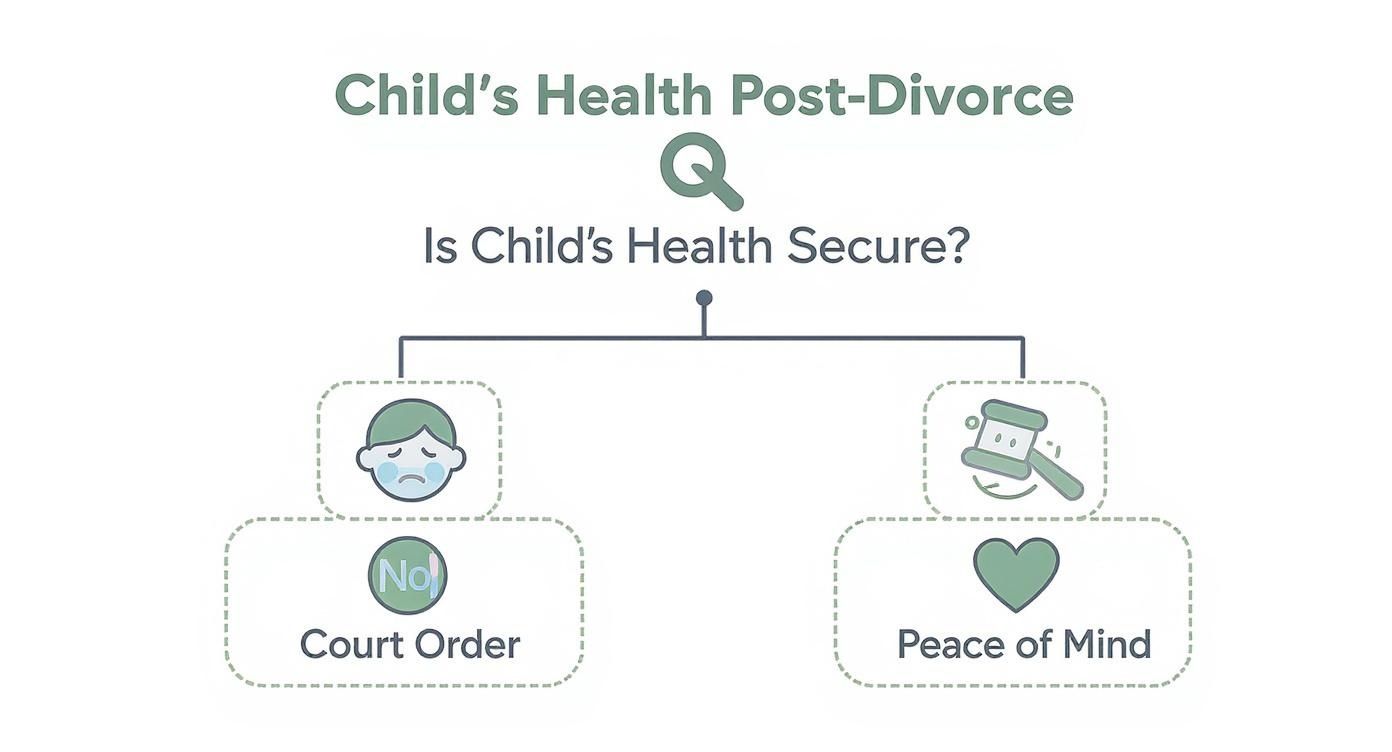
As you can see, a court order is the legal tool that turns all the uncertainty and worry into genuine peace of mind. These health insurance decisions don't exist in a vacuum; they are woven into the larger fabric of a comprehensive parenting plan, which spells out all parental rights and responsibilities. You can see how all the pieces fit together by checking out a detailed Texas parenting plan template.
Managing the Costs of Your Child's Healthcare
Getting a court order for health insurance is a huge win for your child’s future. But that insurance policy? It's just the starting line. The next, and equally critical, piece of the puzzle is figuring out how all the costs tied to that coverage get divided between you and your co-parent. Thankfully, Texas law gives us a clear framework for handling these expenses, which helps keep things fair and prevents small bills from turning into big fights.
When one parent is providing the health insurance, they're taking on a hefty monthly expense. To make things more balanced, Texas courts will often give that parent a credit in their child support calculation. This means the amount they pay in monthly child support might be reduced to offset the cost of those insurance premiums. It’s a practical, common-sense way to acknowledge their financial contribution to the child's healthcare.

Dividing Out of Pocket Medical Expenses
Beyond that monthly premium, every parent knows that healthcare comes with a whole slew of other costs. These are the out-of-pocket expenses that insurance doesn’t cover completely.
We're talking about things like:
- Deductibles: The amount you have to pay before the insurance company even starts to chip in.
- Co-pays: That fixed amount you pay for every doctor’s visit or prescription.
- Uncovered Treatments: Any medical or dental services that your specific plan doesn't include.
So, who foots the bill for these? The standard approach in Texas is to split these costs right down the middle. Most court orders for health insurance will state that each parent is responsible for 50% of all uninsured medical expenses.
But that 50/50 split isn't set in stone. If there’s a major gap in income between the parents, a judge has the discretion to adjust the percentage to something more equitable. For instance, the court might order a 60/40 or 70/30 split to make sure the financial burden is fair, based on each parent’s actual ability to pay.
Clear communication is your best tool for managing shared medical costs. A court order provides the legal framework, but proactive and respectful conversations with your co-parent can prevent small bills from turning into major disagreements.
Practical Tips for Managing Shared Costs
To make this whole process smoother and keep the focus where it belongs—on your child's well-being—it's essential to stay organized and communicative. Keep detailed records of every single medical bill, payment, and receipt. Many co-parents find success using shared spreadsheets or apps specifically designed for co-parenting expenses, which keeps everything tracked in one central place.
By setting up a clear system for tracking and reimbursement from the get-go, you can easily uphold the terms of your court order and ensure your child’s care is never delayed because of financial confusion.
What to Do When a Parent Fails to Provide Insurance
It's one of the most frustrating and frankly, scary, situations a co-parent can face. You have a court order—a legally binding document that says your ex is supposed to provide health insurance for your child. But for whatever reason, they just… haven't. Or maybe they did, but let the policy lapse.
This isn't just an inconvenience; it's a direct violation of a court order that puts your child’s health at risk. A court order is not a polite request. It’s the law. Thankfully, Texas law gives you powerful ways to step in and fix the problem.

If your co-parent is dropping the ball on health insurance, you don’t have to just sit there and hope for the best. You have the right to file an enforcement action with the court. Think of this as the legal equivalent of sounding the alarm—you’re formally asking a judge to intervene and force the other parent to follow the rules.
Taking Legal Action Through Enforcement
Filing an enforcement action gets the issue right back in front of the judge who made the original ruling. It sends a powerful message that you are serious about protecting your child’s health and that there are real consequences for ignoring a court order. The process starts by filing a petition that lays out exactly how and when the other parent failed to comply.
At the enforcement hearing, the judge has a whole toolkit of options to get things back on track. These penalties aren't just about punishment; they're designed to make things right for you and ensure your child is covered immediately.
A judge can order some pretty serious remedies, including:
- Full Reimbursement: The court can order the non-compliant parent to pay you back for 100% of any premiums you had to cover for another policy. They can also be ordered to repay every penny you spent on out-of-pocket medical, dental, or vision costs while your child was uninsured.
- Fines and Fees: A judge can impose fines for the non-compliance and, importantly, can order the other parent to pay your attorney’s fees for having to bring the issue to court.
- Contempt of Court: For repeat offenders or those who willfully ignore the order, the consequences get much more severe. A parent can be held in contempt of court, which could mean jail time until they finally comply.
A court order is your child’s shield. When a parent fails to provide insurance, filing an enforcement action is the legal mechanism to lift that shield back into place and protect your child’s access to healthcare.
This is a scenario Texas courts see all the time. With some experts estimating that nearly 900,000 divorces happen each year in the U.S., judges are well-versed in enforcing post-divorce duties like health insurance. You can find more insights about global divorce statistics and how these trends affect families.
The bottom line is you don't have to navigate this alone. The law is on your side, and acting quickly is the best thing you can do to protect your child’s well-being and your own financial stability.
Can We Change the Health Insurance Court Order?
Life happens. The court order that seemed perfectly fair the day your divorce was finalized might feel completely out of touch a year or two down the road. Maybe you lost your job, or maybe your ex landed a new one with a fantastic benefits package. Insurance costs can skyrocket overnight.
The good news? A court ordered health insurance plan in Texas isn't carved in granite. The legal system gets that family needs change over time. If the current order just isn’t working anymore or isn't what’s best for your child, you can ask the court for a modification. Think of it as a built-in safety valve to keep the order practical and fair for the long haul.
The Magic Words for a Modification
To get a judge to change any part of a custody or support order, including health insurance, you have to prove there’s been a “material and substantial change in circumstances” since the original order was signed. This is the legal key that opens the door. It can’t be something small or temporary; it has to be a significant shift that messes with a parent’s ability to follow the order or impacts the child’s well-being.
So, what does that look like in the real world? Here are a few common scenarios that usually fit the bill:
- A Parent Loses Their Job: The parent ordered to provide insurance gets laid off and loses their employer-sponsored health plan.
- A Better Plan Pops Up: The other parent starts a new job with a much better insurance plan—one that’s more affordable and has better coverage for your child.
- Premiums Go Through the Roof: The cost of the current plan jumps so high that it’s no longer considered a "reasonable cost" (meaning it costs more than 9% of that parent’s gross income).
- The Child's Needs Change: Your child develops a health issue and needs to see specialists who aren't in-network on the current insurance plan.
Your family's well-being isn't static, and neither is the law. A material and substantial change in circumstances allows the court to re-evaluate the health insurance order to ensure it continues to serve your child's best interests.
Changing a health insurance order often goes hand-in-hand with tweaking other financial responsibilities. If you're thinking about going down this road, it helps to understand the whole picture. Our guide on how to modify child support in Texas breaks down the bigger process. The goal is always the same: create a fair, sustainable plan that protects your child.
What If Neither of Us Has an Employer Plan?
It’s a scenario that causes a lot of stress for parents going through a divorce: what happens when neither you nor your co-parent has access to a decent, affordable health plan through work? It’s a common problem, but the good news is that Texas law is built to handle this exact situation, making sure your child never has to go without coverage.
When your child’s future is on the line, you need real solutions, not just more worries.
The court’s number one priority is always the child’s best interest, and that absolutely includes consistent medical care. If traditional employer-sponsored plans aren't a viable option, a judge will simply look at the other tools available to meet the court ordered health insurance requirement. The goal is to prevent any gaps in your child's medical, dental, or vision care.
Exploring Texas Health Coverage Programs
Texas has some excellent state-run programs designed specifically to offer low-cost or even free health insurance for kids, depending on family income. These are often the first place a court will look when private insurance isn't a reasonable choice.
- Children’s Health Insurance Program (CHIP): Think of CHIP as a bridge for families who earn too much to qualify for Medicaid but still can't afford the high cost of private insurance. It’s comprehensive, covering everything from regular check-ups and shots to dental visits and prescriptions.
- Children’s Medicaid: For lower-income households, Children's Medicaid provides a vital safety net, offering extensive health benefits at no cost. Eligibility is tied to your household income and family size.
Another strong option is the Health Insurance Marketplace, which was created under the Affordable Care Act (ACA). A divorce is considered a "qualifying life event," which means you get a special enrollment period to shop for a new plan outside of the normal open enrollment window. You might even qualify for subsidies that dramatically lower your monthly premiums.
A lack of employer-sponsored insurance does not mean a lack of options. Texas law and federal programs provide multiple pathways to secure high-quality, affordable health coverage for your child.
It's also a smart move to learn how to find affordable health insurance plans that can be tailored to your new family structure. A judge has the authority to order one or both parents to enroll the child in any of these programs and will then decide how the costs are split, ensuring your child’s health is always the top priority.
Next Steps to Protect Your Child's Health
Trying to figure out court ordered health insurance after divorce can feel like you're trying to read a map in the dark. It’s complicated, a little scary, and you’re not sure which way to turn. But here's the good news: you don't have to figure it out by yourself.
The most important thing to remember is that Texas law isn't just a set of rules; it's a structured, enforceable system built to put your child’s well-being first. It’s designed to bring clarity and stability right when your family needs it most.
Key Takeaways for Parents
- The “Best Interest” Standard is Key: All court decisions, including health insurance, are guided by what is best for your child.
- Orders are Legally Binding: A court order is not a suggestion. There are serious legal consequences for failing to provide required insurance coverage.
- Orders Can Be Changed: If your circumstances change significantly, you can petition the court to modify the health insurance order to better fit your family's new reality.
- Help is Available: You are not alone in this process. Legal guidance and state programs are available to ensure your child’s healthcare needs are met.
Acting fast is also key, especially with insurance enrollment deadlines. Divorce is a major life event, and it's helpful to get familiar with understanding qualifying events for health insurance so you don’t miss a critical window to get coverage. Taking proactive steps will ensure your child’s healthcare is protected without a single gap and that financial responsibilities are divided fairly.
By understanding your rights and the legal options in front of you, you can confidently secure a stable and healthy future for your child. The law is on your side, and a dedicated legal advocate can help you use it effectively to protect what matters most.
If you need help with a child custody or visitation case in Texas, our experienced attorneys can guide you every step of the way. Contact The Law Office of Bryan Fagan, PLLC today for a free consultation.