Skip to content
Your budget used to make sense. Then a layoff happened, a new job started, daycare went up, your child needed treatment, or the other parent’s income changed and the old number stopped matching real life.
That moment is frustrating because child support isn’t just another bill. It affects housing, groceries, school costs, health coverage, and the daily stability your child depends on. If you’re staring at a court order that no longer fits your family’s reality, you’re not overreacting by asking whether it can be changed.
Texas law allows child support orders to be modified for exactly this reason. A support order is supposed to reflect real circumstances, not trap parents inside outdated assumptions. A child support modification lawyer helps you figure out whether the change in your life is legally significant, what proof matters, and how to ask the court for a new order that is fair and enforceable.
Parents often feel guilty for seeking a reduction or nervous about asking for an increase. Both concerns are common. The legal system isn’t supposed to punish a parent for life changing. It’s supposed to protect the child while looking objectively at each parent’s ability to contribute.
Your Life Has Changed Should Your Child Support Order Change Too?
You open your banking app after payday, pay rent, cover groceries, and realize the child support number in your order no longer fits the life you are living. Maybe your income dropped. Maybe your child now needs therapy, medication, or after-school care that did not exist when the order was signed. Maybe the other parent is earning more, but the order still reflects an old job and an old schedule.
That is usually the point when parents start asking the right question: should the order be changed?
In my experience, the parents who handle this best do one thing early. They stop arguing in general terms and start collecting proof. Before you call a lawyer, gather the papers that show what changed and when it changed. That preparation saves time, lowers stress, and gives you a clearer sense of whether a modification case is worth filing.
Start with a short paper trail
Write down the single biggest change since the last order. One sentence is enough.
Examples:
- I was laid off and now earn less.
- My child has ongoing medical expenses that were not part of the last order.
- The other parent’s income has increased.
- My child is spending substantially more overnights in my home.
Then pull the documents that match that sentence. Good starting points include recent pay stubs, the last two tax returns, proof of job loss or reduced hours, health insurance cost information, daycare invoices, medical bills, school or therapy records, and any calendar or messages showing a meaningful change in the child’s schedule.
If you are not sure what support should look like under current numbers, review how Texas courts generally approach the calculation with this guide on how child support is calculated in Texas.
What parents get wrong early
The biggest mistake is waiting and hoping the problem fixes itself. The second is relying on a handshake deal.
If both parents agree to a temporary reduction or increase but never get a new signed order, the old order usually still controls. Arrears can keep building. Enforcement can still happen. Parents are often shocked by that, especially when they believed they were being reasonable.
A child support modification case is a request to bring the court order back in line with current facts. The goal is accuracy. That matters whether you are asking for lower support because income fell or higher support because the child’s needs or the other parent’s income changed.
Use this section as your first checklist
Before making calls, gather these items in one folder:
- The current child support order
- The date the last order was signed
- Your last six months of income records
- Your most recent tax return
- Proof of any job change, disability, or business decline
- Proof of new child-related expenses
- Notes or records showing a changed possession schedule
- Any written communication with the other parent about support or expenses
That folder gives your lawyer something concrete to assess. It also helps you walk into the first conversation with facts instead of fear.
The Legal Standard for Modifying Support in Texas
Texas courts do not change support because a parent feels the order is unfair. The court looks for a material and substantial change in circumstances or a guideline-based basis for review under the time-and-difference rule commonly discussed in Texas modification cases.

What material and substantial change means
In plain English, this means something important has changed since the last order. The change must be real, supported by documents, and serious enough to affect support.
Common examples include:
- Job loss or reduced income: Especially when the drop was not voluntary.
- A significant increase in earnings: This can matter if the current order understates what a parent can now pay.
- Changed insurance costs: If a parent is now paying more to cover the child’s health insurance.
- Medical or educational needs: New ongoing expenses can support a request for more support.
- A change in custody percentages: If the child’s schedule has shifted in a meaningful way.
What usually doesn’t work is a short-term dip, rough estimates, or broad statements like “money is tight.” Judges want records. Pay stubs, tax returns, employment letters, insurance premiums, and receipts often matter more than emotions, even when the emotions are completely understandable.
The benchmark many parents hear about
Texas modification law is often discussed using a benchmark tied to whether the guideline amount would change by 20% or $100. As noted in this discussion of modification standards and support thresholds, many states use set percentage rules, while Texas focuses on a material and substantial change, with that benchmark often coming up in practice.
That’s where many parents get tripped up. They assume a noticeable life change automatically means they qualify. It doesn’t. The court still needs a correct recalculation using the right income information and the right support framework. If you want a clearer sense of the math involved, this guide on how to calculate child support is a useful starting point.
Practical rule: A strong modification case is usually built on documents first and explanations second.
Why recalculation gets messy fast
The hardest cases are not always the most dramatic ones. They are often the ones involving income that doesn’t show up neatly on a regular paycheck.
A W-2 employee with recent pay stubs is easier to analyze than a parent who is self-employed, receives bonuses, has fluctuating commissions, or earns from multiple sources. Parents also make avoidable mistakes by leaving out overtime, using old tax returns, or failing to show whether a drop in income is temporary or ongoing.
Here is a simple way to view it:
| Issue | What often goes wrong | What usually helps |
|---|---|---|
| Income change | Parent gives rough estimates | Recent pay records and tax documents |
| Child expenses | Parent talks generally about costs | Bills, insurance statements, invoices |
| Timing | Parent files too early | A record showing the change is ongoing |
| Guideline comparison | Parent guesses at the new amount | A proper support calculation |
Child support and custody are connected, but not identical
Parents often ask whether support and custody are decided the same way. They are related, but they are not the same issue. In Texas custody cases, the court focuses on the best interests of the child, meaning the child’s safety, stability, and overall well-being. A parent may be named a joint managing conservator, which usually means both parents share important rights and duties, even if one parent has the right to determine the child’s primary residence. A possession schedule sets out when each parent has time with the child.
Those custody terms can matter in a support case when the parenting arrangement has changed enough to affect the financial picture. But the court will still want proof, not assumptions.
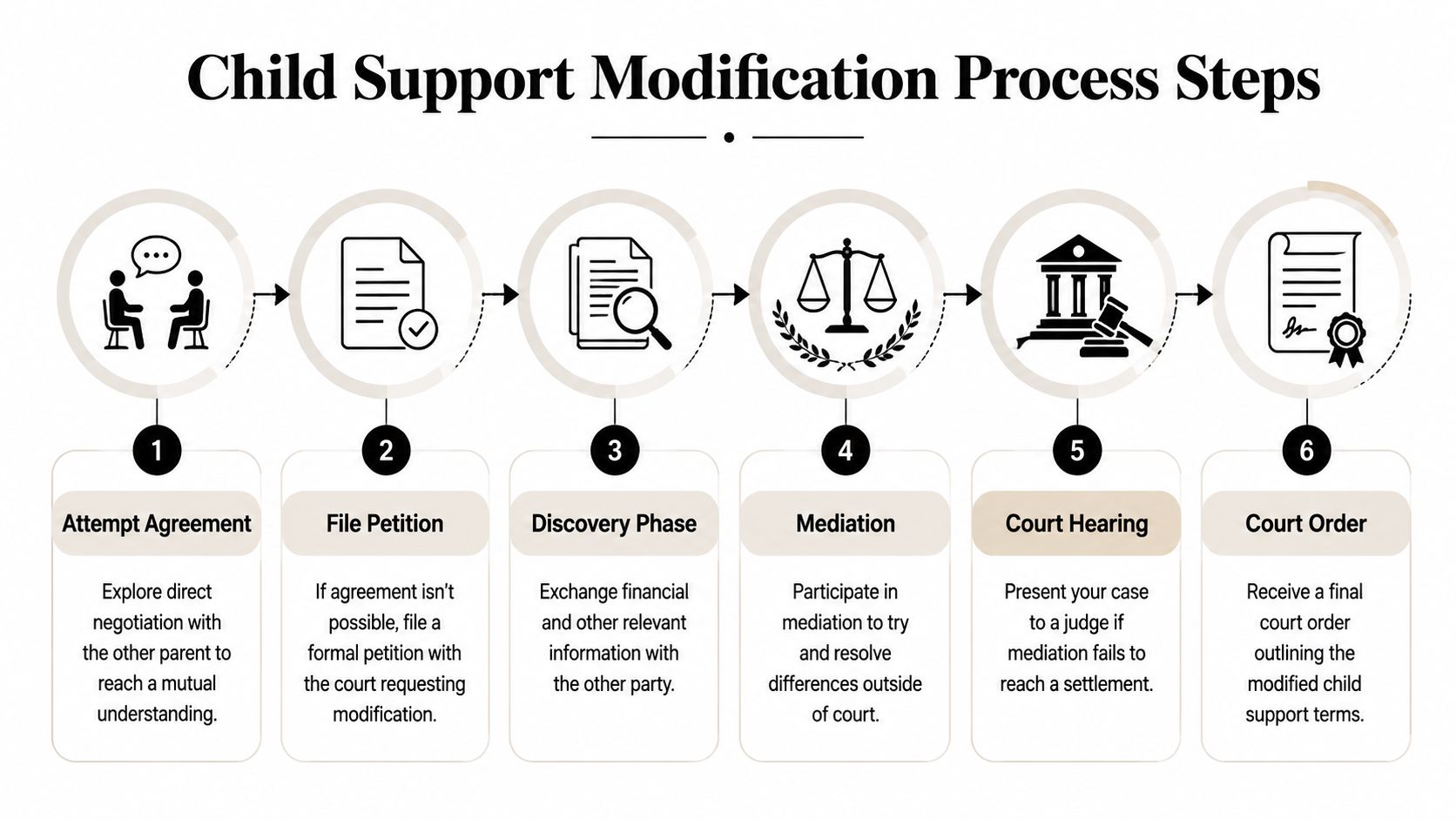
How the Child Support Modification Process Works
Most parents hope the process will be simple. Sometimes it is. Often it becomes manageable once you know the sequence and stop trying to solve everything in one conversation with the other parent.
Start with agreement if you can
If both parents agree the current support order no longer works, that’s usually the least expensive and least stressful place to begin. A calm, documented conversation can solve a lot.
But there is one mistake parents make over and over. They agree informally, change the payment amount on their own, and assume that is enough. It isn’t. Until a judge signs a new order, the old order controls.
That means a parent who pays less based on a handshake deal can still face arrears later. A parent who accepts less support informally may have trouble enforcing the original amount if conflict returns.
When agreement is not enough
If there is no agreement, the usual path is to file a formal request with the court that issued the current order. In many cases, that means filing a petition to modify the parent-child relationship and asking the court to review support.
The broad process often looks like this:
- Review the current order and identify what has changed.
- File the modification request with the proper court.
- Serve the other parent so they have legal notice.
- Exchange information about income, expenses, and the child’s needs.
- Attend mediation if the court or local practice requires it.
- Go to a hearing if no agreement is reached.
- Obtain a signed order and follow its exact terms.
For a fuller overview of that path, see this page on how to modify child support in Texas.
Discovery and mediation matter more than people expect
“Discovery” is the part of the case where each side exchanges relevant information. In a child support case, that often means income documents, tax records, health insurance information, and records tied to the child’s expenses.
Mediation is a structured settlement meeting with a neutral third party. It is not counseling. It is not the judge’s final ruling. It is a chance to resolve the dispute with more control and often less damage to the co-parenting relationship.
A good mediation position is built before the session starts. Parents who walk in with organized records usually negotiate from a much stronger position.
What to expect emotionally and practically
Support modification cases can stir up old divorce issues even when the legal question is narrow. One parent may hear “I need a reduction” as “I don’t care about my child.” The other may hear “I’m asking for more support” as “I’m being attacked.”
Courts don’t decide the case based on who sounds more hurt. They look at evidence, legal standards, and whether the requested amount is justified. That’s why staying focused matters.
A few practical points help:
- Keep paying the current order until a new order is signed.
- Avoid text fights about support if the case is active.
- Save everything related to income changes and child costs.
- Think long-term about enforceability, not just today’s frustration.
The Advantage of Hiring a Child Support Modification Lawyer
A parent loses overtime, the other parent picks up a second job, and both assume the judge will sort it out once the paperwork is filed. That is usually where problems start. In Texas, child support cases often turn on details parents do not realize matter until they are already behind, overpaying, or defending a request they were not ready for.

A lawyer helps you prepare the case before it starts
The strongest modification cases usually begin before the first filing. A lawyer can tell you whether your facts are likely to meet the legal standard, what proof the court will expect, and what gaps need to be fixed before the other side sees your position.
That matters more than parents expect.
A support case may look like basic math, but the actual dispute is often about what counts as income, whether a job change was voluntary, how health insurance should be treated, or whether the numbers in a proposed order are based on complete records. If you bring a lawyer organized pay stubs, tax returns, insurance costs, daycare records, and a copy of the current order early, you give yourself a much better chance to file the right request the first time.
What a lawyer actually adds
A child support modification lawyer does far more than submit forms. In a Texas case, that often means:
- Testing the facts before filing: Some parents have a real change in circumstances. Others have frustration, but not yet a case the court is likely to grant.
- Working through irregular income: Bonuses, commissions, self-employment revenue, cash flow from a small business, and new side work all need careful review.
- Spotting proof problems early: Missing tax returns, unclear payroll records, and incomplete insurance information can weaken an otherwise valid request.
- Drafting settlement terms carefully: The amount matters, but so do the start date, withholding language, medical support terms, and wording that can be enforced later.
- Preparing for disputed hearings: Judges often want clean calculations and credible backup documents, not broad statements about what feels fair.
Parents usually know the history of the case. Lawyers know which parts of that history belong in evidence and which parts distract from the issue the judge has to decide.
Good counsel can save money even when fees are a concern
Many parents hesitate because they are already stretched thin. That concern is real. Hiring counsel costs money, but so does filing a weak case, agreeing to the wrong amount, or waiting months while arrears continue to build under an order that no longer fits the facts. If you are weighing the numbers, this guide on child support lawyer cost can help you evaluate the expense in practical terms.
I often tell parents to focus on cost and risk together. A cheaper approach on the front end can become much more expensive if it leads to a bad order or a preventable enforcement fight.
In many modification cases, the biggest mistake is not hiring a lawyer. It is waiting too long to gather the records that would let a lawyer assess the case correctly.
A lawyer also acts as a buffer
Support disputes are rarely only about support. Old resentment, fear about money, and arguments about parenting time can spill into texts and emails fast. A lawyer brings structure to that process and keeps the case tied to records, legal standards, and realistic settlement options.
Some cases settle quickly once both sides see the documents and the likely guideline range. Others need a hearing. Firms handling Texas family law matters, including Law Office of Bryan Fagan, PLLC, often assist with both negotiated modifications and contested hearings, depending on what the facts require.
Clear legal information helps parents choose wisely
Parents usually start evaluating lawyers before they ever make the first call. They read articles, compare explanations, and look for signs that a firm can explain the process plainly and handle the details carefully. That is one reason online legal education matters. For a broader look at how firms present useful information to prospective clients, this resource on SEO and content for law firms gives helpful context.
Your First Meeting A Checklist for Success
The most useful thing you can do before meeting a lawyer is get organized. Not perfect. Organized.

Bring the orders that control your case
Start with the court papers already in place. Many consultations slow down because a parent remembers the result of the old case but doesn’t have the actual language.
Bring copies of:
- Your current child support order
- Your divorce decree or SAPCR order
- Any later modification orders
- Any wage withholding order
- Any enforcement orders or payment records
If you don’t have all of them, bring what you can and make a note of the county and court that issued the order.
Gather income proof before anyone asks for it
For most support cases, income documents are the backbone of the file. Bring recent records, not just year-old paperwork.
A useful packet often includes:
- Recent pay stubs
- Recent tax returns
- W-2s or 1099s if you have them
- Profit and loss records if you’re self-employed
- Proof of health insurance premiums for the child
- Proof of unemployment, disability, or other benefits if applicable
If you know the other parent’s income has changed, bring any lawful information you already have. That might include prior financial disclosures, email admissions, or other documents you already possess. Do not guess. Do not alter records.
Show the change, not just the conclusion
Lawyers need proof of what changed since the current order was signed. The stronger the paper trail, the more productive the first meeting will be.
Examples include:
| Type of change | Helpful records |
|---|---|
| Job loss | Termination letter, unemployment records, recent pay history |
| Reduced hours | Employer notice, pay stubs showing the drop |
| Promotion or raise | Offer letter, new pay records |
| Child medical needs | Bills, treatment plans, insurance statements |
| School or activity costs | Invoices, registration records, payment history |
| Parenting schedule shift | Calendars, school pickup records, messages confirming schedule changes |
Make a simple expense summary
You do not need a polished spreadsheet. A one-page list is enough if it is honest and current.
Include the child’s regular expenses such as insurance, school-related costs, medical bills, daycare, and other recurring needs. Separate recurring monthly costs from occasional costs. If an expense is shared with your household generally, note that clearly instead of trying to inflate the child’s portion.
Bring documents that answer questions. Leave home the stack that only proves you are angry.
Write down your goals before the meeting
This helps more than people expect. On one page, answer these questions:
- What do you want changed
- Why now
- What documents support that
- What is the other parent likely to argue
- What outcome could you live with if the case settles
That short list helps your lawyer assess the case quickly. It also helps you stay focused if the conversation becomes emotional, which is normal in family law.
Navigating Common Hurdles After the Order Is Signed
Many parents feel relief when the judge signs the modification order. That relief is real, but it isn’t always the end of the problem.
Enforcement still matters
A new order only helps if it is followed. If the paying parent falls behind, enforcement may involve wage withholding, payment record review, and a return to court. If the receiving parent blocks agreed terms tied to the order, that can also create follow-up litigation.
The key is to use the signed order exactly as written. Parents get into trouble when they start making side deals again after the case ends. If support is due in a specific amount and on a specific schedule, stick to the order unless the court changes it later.
Watch for downstream consequences
A modification can affect more than the monthly support figure. As noted in this discussion of post-modification issues and overlooked consequences, changes in support may interact with public benefits like TANF, connect with Social Security benefits, or create tax-related concerns.
That doesn’t mean you should avoid modification. It means you should look at the full picture before you finalize it.
Here are common areas to review with counsel or another qualified professional:
- Public benefits: A changed support amount can affect how some benefits are calculated.
- Social Security-related issues: If a child receives certain benefits, support planning may require closer review.
- Future review timing: Even after one modification, later changes may justify another.
- Enforcement planning: Wage withholding and payment tracking should be handled carefully from the start.
Custody changes can trigger future support issues
Parents often discover that support problems are really schedule problems in disguise. If the child’s living arrangement has changed in a meaningful way, the support order may not be the only order that needs attention.
That is where terms like joint managing conservatorship, best interests of the child, and possession schedules become important again. If a parent has taken on substantially more day-to-day care, the legal paperwork should match the lived reality. Otherwise, conflict tends to come back.
Key takeaway
If you think your support order no longer fits your family, act early and act carefully. Gather records, avoid informal payment changes, and look at the whole impact of any proposed modification. What works in these cases is preparation, documentation, and a strategy grounded in real facts. What usually fails is delay, guesswork, and verbal agreements that never become enforceable orders.
If you need help reviewing a support order, preparing for a modification, or understanding how child support connects to custody, visitation, conservatorship, and your child’s best interests under Texas law, a focused legal consultation can give you a clearer path forward. Mothers, fathers, grandparents, and caregivers often feel overwhelmed at the start, but you do have options. If you need help with a child custody or visitation case in Texas, our experienced attorneys can guide you every step of the way. Contact Law Office of Bryan Fagan, PLLC today for a free consultation.