
When your child’s future is on the line, understanding your rights matters most.
If you're searching for a fathers rights attorney texas, there’s a good chance you’re not looking for a lecture. You want answers. You want to know whether Texas will treat you fairly, what you can do today, and how to protect your role in your child’s life before distance, delay, or conflict turns into a new normal.
Many fathers come into a custody case feeling like they’re already behind. Some were never married to the child’s mother. Some are being told they’ll only get “every other weekend.” Others are watching the other parent make school, medical, or living decisions without them. Those fears are real. So is the frustration.
Texas law gives fathers meaningful rights, but rights only help when you know how to use them. In family court, good intentions are not enough. Judges look for proof of involvement, stability, follow-through, and a parenting plan that serves the child’s best interests. That’s where strategy matters.
Your Rights as a Father Matter Now More Than Ever
Texas family law is gender-neutral. The law does not tell a judge to favor a mother over a father. At the same time, historical outcomes show that fathers often need to be more deliberate in how they present their case. According to Texas family law custody statistics, fathers are awarded approximately 33% of custody time, or about 120.5 days per year.
That doesn’t mean a father is limited to that result. It means preparation matters.
A strong custody case is rarely built on one dramatic moment. It’s built on ordinary proof. School pickups. Medical appointments. Bedtime routines. Messages that stay calm. A home that is safe and consistent. A parent who supports the child’s relationship with the other parent, even during conflict.
What fathers need to understand early
Texas courts want orders that protect children, reduce chaos, and support healthy parent-child relationships. Fathers usually improve their position when they act early in these areas:
- Legal status: If paternity hasn’t been established, you may not yet have full standing to seek custody and possession orders.
- Documented involvement: Keep records of parenting time, expenses, school participation, and communication.
- Court compliance: Follow temporary orders exactly, even when the other parent isn’t doing the same.
- Child-focused conduct: Avoid turning the case into a score-settling exercise.
Practical rule: A judge is less interested in who feels wronged and more interested in which parent is acting like a reliable, child-focused adult.
A useful way to think about your case is this. You are not trying to “beat” the other parent. You are building a record that shows your child benefits from substantial, dependable involvement from you.
That same mindset applies outside the courtroom too. Fathers often underestimate how much organization affects legal outcomes. Even resources on high-impact law firm marketing tactics make a broader point that applies here: clear messaging, strong documentation, and consistent presentation shape how decision-makers respond. In custody cases, your “message” is your evidence.
What actually works
Some approaches help. Some backfire.
| Approach | Usually helps | Usually hurts |
|---|---|---|
| Communication | Calm, brief, factual messages | Angry texts, sarcasm, threats |
| Parenting proof | Logs, calendars, school records | General claims with no backup |
| Court posture | Child-centered proposals | “I deserve this” arguments |
| Co-parenting | Reasonable flexibility | Using the child as leverage |
Fathers often feel pressure to prove they’re “just as important.” The better approach is simpler. Show the court, in concrete ways, that your involvement is stable, beneficial, and already part of your child’s daily life.
The First Step Paternity Establishment in Texas
Before a father can fully assert custody and visitation rights, he needs legal recognition as the child’s father. In Texas, paternity is the gateway. Without it, a father may have a biological connection but not the legal authority to ask the court for enforceable rights.

Texas law makes this point clear. As explained in this guide on fathers’ rights in Texas, establishing paternity is the critical first step that grants a father legal standing in Texas. Once paternity is confirmed, fathers gain access to the same rights and remedies as mothers, including the ability to participate in major decisions about a child’s healthcare, education, and welfare under a joint conservatorship arrangement.
Two ways paternity is usually established
In plain English, there are two common paths.
Voluntary acknowledgment
If both parents agree on the father’s identity, they can sign an Acknowledgment of Paternity, often called an AOP. This is a legal form, not just an informal agreement. Once properly completed and filed, it creates legal fatherhood.
This route is usually faster and less confrontational. It can be a good fit when both parents want clarity and are ready to move forward with custody, visitation, and support issues.
Court-ordered adjudication
If there’s disagreement, uncertainty, or conflict, the court can determine paternity. That process may include genetic testing and a formal order naming the father.
This path takes more time, but it also gives you a clear legal foundation. Once the order is in place, you can ask for conservatorship, possession, access, and child support terms.
Why paternity changes everything
Paternity does more than put a name on paper. It opens the door to core legal rights and responsibilities.
- Decision-making rights: A father can ask for rights tied to education, medical care, and other major issues.
- Possession and access: A father can seek a court-ordered schedule instead of relying on the other parent’s permission.
- Support obligations: Child support can be established as part of the case.
- Family benefits: Legal fatherhood can affect inheritance rights and access to certain benefits.
Paternity is the key that unlocks the rest of the case. Without that key, many of your options stay out of reach.
If you need a closer look at the process, this article on establishing paternity for custody in Texas is a helpful starting point.
A common mistake is waiting because things feel “mostly okay” right now. Informal access can disappear fast when conflict starts, a new partner enters the picture, or one parent decides to move. Legal recognition gives structure where uncertainty used to be.
Understanding Conservatorship and Custody in Texas
Most parents use the word “custody.” Texas courts usually use the word conservatorship. The difference matters because conservatorship is about more than where the child sleeps. It covers the rights and duties each parent has toward the child.
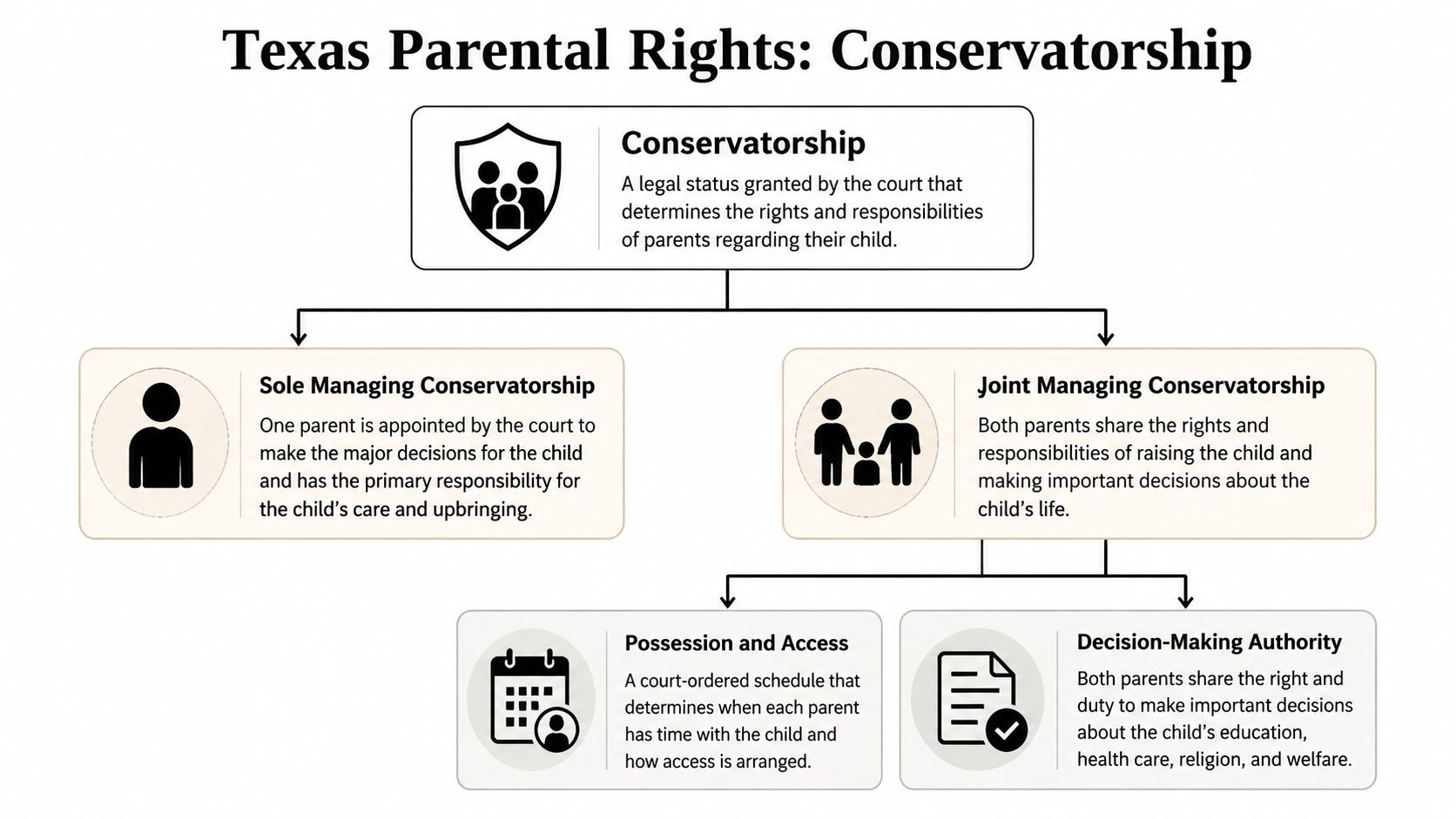
Under Texas Family Code §153.002, courts decide custody issues based on the best interest of the child. Courts also presume that Joint Managing Conservatorship is in the child’s best interest, and Texas fathers’ rights and conservatorship data states that fathers are awarded JMC in approximately 65% of agreed cases. That’s one reason cooperative cases often produce better outcomes than cases driven entirely by hostility.
Joint Managing Conservatorship and Sole Managing Conservatorship
A Joint Managing Conservatorship, or JMC, means both parents share important rights and responsibilities. That does not always mean equal time. It usually means both parents remain legally involved in major parts of the child’s life.
A Sole Managing Conservatorship, or SMC, gives one parent most major decision-making authority. Courts tend to reserve that for situations where shared authority would put the child at risk or seriously undermine stability, such as abuse, neglect, or severe parental dysfunction.
If you want a plain-English overview of how these orders work, this resource on conservatorship in Texas can help.
What best interest means in real life
“Best interest of the child” can sound abstract. In practice, judges look for concrete signs that a parent can meet the child’s day-to-day and long-term needs.
A father who wants a stronger result should think in terms of evidence, not just emotion.
- Stability at home: Is your living situation safe, steady, and suitable for the child?
- Daily involvement: Do you know the child’s teachers, doctors, routines, and needs?
- Follow-through: Have you shown up consistently, on time, and prepared?
- Co-parenting judgment: Do you encourage the child’s relationship with the other parent when appropriate?
- Decision-making ability: Can you handle school, healthcare, discipline, and scheduling responsibly?
Courts don’t award conservatorship based on titles. They look at patterns of conduct.
How to turn legal standards into proof
Fathers often know they’re involved, but they haven’t preserved evidence in a way a judge can use. That gap can hurt a good parent.
Try building your case around records such as:
| Type of proof | Why it matters |
|---|---|
| School emails and portal access | Shows educational involvement |
| Medical records and appointment history | Shows attention to health needs |
| Parenting calendar | Shows actual time and consistency |
| Photos tied to routine activities | Helps show regular involvement |
| Respectful communications | Shows maturity under stress |
What doesn’t help
Some fathers believe passion alone will carry the day. It usually won’t.
Complaining that “mothers always win” is less effective than showing your child has a room in your home, you know the homework routine, and you’ve handled bedtime, meals, transportation, and appointments. Judges respond to facts they can evaluate.
That’s why a careful legal plan matters. The law sets the standard, but your conduct fills in the details.
Crafting Your Possession and Visitation Schedule
Even when parents share conservatorship, they still need a schedule. In Texas, that schedule is usually called possession and access. Most parents call it visitation. Whatever term you use, the practical question is the same: when will your child be with you?

Texas often starts with a Standard Possession Order, commonly called an SPO. Think of it as a baseline, not a ceiling. It gives structure when parents can’t agree, and it can provide a dependable minimum framework for time with your child.
How the standard schedule usually works
The Standard Possession Order often includes a predictable pattern of weekends, holidays, and extended summer time. It’s designed to create consistency. For many families, it becomes the starting point for negotiation rather than the final answer.
A schedule works best when it fits the child’s actual life. School start times, extracurriculars, distance between homes, and each parent’s work demands all matter. A father who can show reliability and flexibility may be in a better position to ask for an expanded schedule.
A possession order should support your child’s routine, not constantly disrupt it.
Why custom schedules often work better
The standard schedule is useful, but families are not standard. Some children do better with more frequent exchanges. Some parents live close enough to share school-week duties. Others need a schedule built around shift work, long commutes, or special medical needs.
When fathers seek more time, the most effective argument is usually practical. Show how your proposed schedule helps the child.
Examples include:
- School-based consistency: You can handle morning drop-offs, homework, and transportation.
- Workable logistics: Your work hours allow hands-on parenting during key parts of the week.
- Child-centered planning: Your proposal reduces transitions or better supports activities and school.
This video gives useful background on how Texas possession issues can play out in real cases:
What fathers should bring to the table
When negotiating possession, don’t walk in with only a complaint about the current schedule. Walk in with a better plan.
A strong proposal usually includes:
- A calendar people can follow: Spell out weekdays, weekends, holidays, and transportation.
- A routine the child can handle: Explain bedtime, school prep, meals, and activities.
- A conflict-reduction method: Include how schedule changes will be communicated.
Some fathers make the mistake of asking for “as much time as possible” without explaining how that time will function. Judges and mediators want details. They want to know who handles pickups, what happens during holidays, and how the child gets to school on Monday morning.
The fathers who do well here usually present themselves as organized, realistic, and focused on the child’s needs instead of symbolic wins.
A Father's Guide to Child Support Rights and Duties
Child support creates a lot of anger because many parents misunderstand what it is. In Texas, child support is not a fee you pay to buy time with your child. It is not a reward for the other parent either. It is a legal duty tied to the child’s needs.
That distinction matters because fathers often hurt their own cases by linking support and visitation in the wrong way. If the other parent blocks access, you still have to follow the support order. If support is being paid, that does not give either parent the right to ignore the possession schedule.
What support is meant to do
A child needs housing, food, clothing, school supplies, and day-to-day care in both homes. Support law tries to create a predictable financial structure around those needs.
Texas uses guideline calculations for many cases. The law also allows modifications when circumstances change enough to justify an update. If your income has shifted in a meaningful way, or the child’s needs look very different now than when the order was signed, it may be time to review the numbers.
Rights fathers often overlook
Fathers sometimes focus only on what they owe and miss the rights they still have in the process.
- The right to an accurate calculation: Support should be based on the proper legal framework, not guesswork.
- The right to seek modification: If the facts have materially changed, the order may need to change too.
- The right to keep support and possession separate: You can pursue enforcement of parenting time even while support issues are being addressed.
Support disputes get easier to handle when you treat them as math and law, not as a measure of your worth as a parent.
What helps and what creates problems
It helps to keep clean records. Save pay stubs, tax information, insurance costs, daycare records, and proof of direct child-related expenses when relevant to your case. If support becomes an issue in court, organized documents matter.
It hurts to make side deals that never get entered into a court order. It also hurts to stop paying because you’re angry about denied visitation. Courts usually view those as separate issues, and mixing them often creates two legal problems instead of one.
For many fathers, the healthiest way to think about support is this: your child should be supported financially and emotionally. One duty doesn’t cancel out the other.
Enforcing and Modifying Your Custody Orders

Friday at 6:00 p.m., you pull up for your weekend possession. Your child is packed and ready, but the other parent says the schedule has changed and closes the door. If that has happened more than once, the problem is no longer just conflict. It is an order-enforcement problem, and the way you respond can affect what a judge does next.
A custody order has real value only if it is specific enough to enforce and current enough to fit your family’s actual routine. Texas courts treat enforcement and modification as different requests. Enforcement asks the court to hold a parent to the order already in place. Modification asks the court to change the order because the facts have materially and substantially changed.
That distinction matters strategically.
If the order is clear and the other parent is violating it, the goal is proof. Fathers do best here when they stop arguing and start documenting. Save text messages, keep a possession log, note exact exchange times, keep school or daycare notices, and preserve anything that shows a pattern instead of a one-time dispute. If you need a clearer picture of what the court looks for, review this guide on a motion to enforce custody in Texas.
Judges usually respond better to a clean timeline than to a stack of emotional accusations. Show what date you arrived, what the order required, what happened, and who witnessed it. If exchanges are tense, communicate in writing and keep the message brief. A father who can calmly prove repeated violations often stands in a stronger position than one who can only describe them.
Modification is a different problem. Sometimes nobody is intentionally breaking the order. The order just no longer matches the child’s school schedule, your work hours, a relocation, military service, or the child’s age and activities. In that situation, asking for enforcement can waste time and money if the underlying issue is that the schedule has become unworkable.
Common facts that can support modification include:
- A parent has moved far enough away that the current exchange plan no longer works.
- Your work schedule has materially changed.
- The child’s educational, medical, or extracurricular needs are different now.
- Ongoing conflict keeps happening because the order is too vague or no longer fits daily life.
The practical question is simple. Are you trying to prove a violation, or are you trying to fix a plan that no longer works?
Military fathers need to address these issues early. Texas law gives deployed parents protections, and as noted in Texas guidance on fathers’ rights and military custody issues, the Uniform Deployed Parents Custody and Visitation Act can allow a father to designate a family member for temporary possession during deployment. Military service also should not be the sole basis for a permanent modification after return. That protection is strongest when the paperwork is handled correctly before deployment disrupts the schedule.
Post-order cases also depend on how evidence is presented. If hearings or depositions will involve remote testimony, good preparation matters. This guide to secure video depositions for lawyers covers practical issues that can affect how testimony is gathered and preserved.
Law Office of Bryan Fagan, PLLC handles enforcement, modification, paternity, and possession disputes for Texas parents.
Use this framework when trouble starts:
| Situation | First move | Likely legal path |
|---|---|---|
| Denied possession | Record the date, time, location, and response. Keep communications in writing. | Enforcement |
| Repeated exchange problems | Compare the order to your current reality and gather proof of the recurring issue. | Modification or enforcement, depending on the facts |
| Planned relocation | Get details fast, including distance, timing, and impact on school and exchanges. | Modification, sometimes emergency relief |
| Deployment or temporary duty change | Put temporary care and possession terms in writing as early as possible. | Temporary orders or modification |
Delay creates problems. A harmful pattern can start to look normal if it goes unchallenged. Fathers who protect their cases usually do two things well. They stay involved in the child’s life, and they build a record that shows the court exactly how that involvement has been blocked or why the current order needs to change.
Frequently Asked Questions from Texas Fathers
Fathers often come into a case thinking they need to “win.” In most custody matters, the better goal is to secure a stable, enforceable parenting plan that protects your relationship with your child for the long term.
Do unmarried fathers have rights in Texas
Yes, but legal rights usually depend on paternity being established. Biology alone may not be enough for you to obtain enforceable conservatorship or possession rights. If you are not yet legally recognized as the father, that issue needs attention first.
Can my child choose which parent to live with
A child’s wishes can matter, but the child does not solely get to decide the case. Texas courts still focus on the child’s best interests and the full family context. Parents often put too much weight on this question and not enough on stability, routine, and evidence.
What if the child’s mother is refusing contact
If you already have a court order, start documenting every denial carefully. Keep communications brief and factual. Show up when the order says to show up unless your lawyer advises otherwise.
As explained in this article on custody interference under Texas law, when a parent interferes with court-ordered possession, it can be a crime under Texas Family Code §42.002, and consistent documentation of denied visitation can become powerful evidence for both enforcement and modification.
How should I document denied visitation
Use a consistent system. A calendar, saved texts, emails, exchange logs, and parenting communication platforms can all help. The key is accuracy and consistency.
Some lawyers also use remote testimony tools and organized digital exhibits when cases require detailed proof. For fathers trying to understand how evidence gets presented in contested cases, this guide to secure video depositions for lawyers gives a practical look at how testimony and documentation can be preserved in a professional setting.
If you think the other parent may deny possession, document before the problem becomes a pattern, not after.
What if I’m falsely accused
Take it seriously and respond carefully. Don’t try to “clear it up” with emotional messages. Follow temporary orders, preserve communications, identify witnesses if they exist, and work with counsel on a structured response.
False allegations can affect temporary orders and the pace of a case. Fathers often do better when they stay calm, avoid retaliation, and let records, timelines, and third-party evidence do the work.
Should I fight for everything at once
Usually not. Courts often trust parents who make focused, workable requests. If your case asks for too much too quickly without a solid factual base, you can lose credibility.
A stronger strategy is to identify what most directly protects your child and your relationship with your child:
- Get legal standing in place
- Secure a clear possession order
- Protect decision-making rights where appropriate
- Document compliance and involvement
- Ask for changes supported by facts
The point isn’t to win a slogan. It’s to leave court with orders you can use, enforce, and live under.
If you need help with a child custody or visitation case in Texas, our experienced attorneys can guide you every step of the way. Contact The Law Office of Bryan Fagan, PLLC today for a free consultation.