
When your child’s future is on the line, understanding your rights matters most.
You get the text. Your co-parent says they’ve accepted a job in another city, or they’re getting remarried, or they plan to move closer to family and want to take your child with them. In a few seconds, your mind jumps to school changes, missed weekends, longer drives, holiday fights, and the fear that your bond with your child could slowly shrink.
That reaction is normal. Parents, grandparents, and caregivers often feel panic first and clarity second.
Texas law gives you a path forward. A move doesn’t automatically mean you lose time with your child, and it doesn’t automatically mean the other parent can’t move. It means the court may need to review the current order and decide whether a custody modification is necessary. In plain English, that means changing an existing court order about conservatorship, possession, or the child’s residence.
Most Texas custody orders also include a geographic restriction. That is a rule limiting where the child may live, usually to a county and nearby counties, so both parents can stay meaningfully involved. When a proposed move crosses that line, the issue becomes serious quickly.
The good news is that there is a roadmap. If you understand the legal standard, act early, and focus on your child’s daily life instead of raw conflict, you can protect your rights and make better decisions.
A Co-Parent's Move and Your Child's Future
One parent I often think about learned about a move in the most modern, most painful way possible. A short message popped up on their phone: “I need to tell you something. We’re moving.” No court papers yet. No details. Just enough information to create fear.
That kind of moment can make a parent want to react fast and emotionally. You may want to say yes just to avoid conflict. You may want to say no immediately and threaten court. Neither impulse is unusual. But neither is the best first step.
A relocation issue in Texas is really two questions wrapped together. First, does the move violate the current order? Second, if it does, should the order be changed because the move serves the child’s best interests?
What many parents worry about first
Usually, the first worries are practical:
- School disruption: Will your child have to leave familiar teachers, friends, and routines?
- Parenting time loss: Will weekday dinners, school pickups, or regular weekends disappear?
- Travel burden: Who will handle long drives, flights, or holiday exchanges?
- Communication breakdown: Is this move being discussed openly, or announced after plans are already made?
Those worries matter because judges care about real-life impact, not just legal labels.
A relocation case is rarely about geography alone. It’s about what the new distance does to the child’s routine and to each parent’s ability to stay involved.
Texas courts try to protect stability while also recognizing that life changes. People remarry. Jobs shift. Military orders happen. Family support may exist in another city or another state. The law doesn’t freeze families in place forever, but it does require a parent to use the right process.
If you’re dealing with custody modification after relocation texas issues right now, the most important thing to know is this: you still have options. Whether you’re the parent who wants to move or the parent trying to prevent a harmful move, the court can review the situation and enter a new order that fits the family’s current reality.
The Legal Foundation for Changing a Custody Order
Texas courts don’t modify custody orders just because life feels different. A judge needs a legal reason to reopen the order.
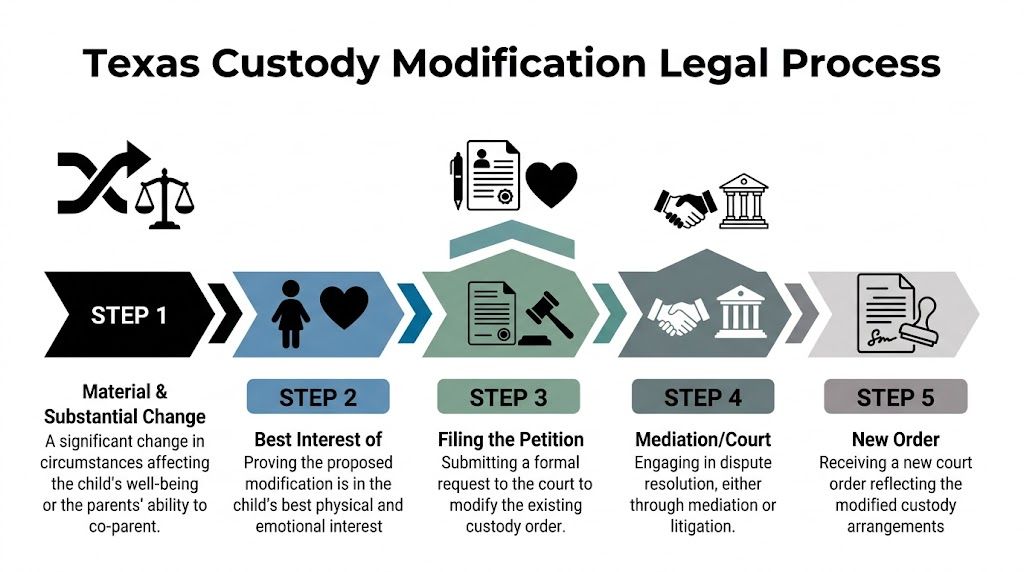
The starting point is Texas Family Code §156.101. That law requires a parent seeking modification to show a material and substantial change in circumstances and then show that the requested change is in the best interest of the child.
What material and substantial change means
In plain English, a material and substantial change is a major shift in the family’s situation since the last order was signed. It has to be something important enough that the old order may no longer fit the child’s needs.
A significant relocation is one of the clearest examples. So is remarriage or engagement when it changes the family structure and is tied to a move. A key Texas appellate case recognized that remarriage or engagement, especially when paired with an intent to relocate a significant distance, can meet the modification threshold under Texas Family Code §156.101. The court treated a mother’s undisputed plan to move out of state with the child as enough to satisfy that first legal hurdle, as discussed in this Texas relocation modification precedent.
That matters because many parents mistakenly think they must prove a disaster before asking for court review. They don’t. They do need to prove a meaningful change.
If you want a closer look at how Texas courts analyze this threshold, this guide on substantial change in circumstances in Texas custody cases is a useful companion.
What best interest of the child means
Even if a move counts as a major change, that doesn’t end the case. The judge still asks whether the requested new order serves the best interest of the child.
This phrase can sound vague, but the idea is practical. The court looks at the child’s real world needs, including emotional stability, physical care, schooling, home life, and each parent’s ability to meet those needs. Texas courts often consider the Holley factors, which include the child’s emotional and physical needs, the stability of each proposed home, and the relationships surrounding the child.
Here is the plain-English version:
| Issue the judge looks at | What it means in real life |
|---|---|
| Emotional ties | Who is deeply involved in the child’s daily life and support |
| Stability | Which home offers steadier routines, housing, and care |
| Parenting ability | How each parent handles school, health, discipline, and communication |
| Child’s needs | Education, medical care, therapy, and social development |
| Future plans | Whether the proposed move actually improves the child’s situation |
A parent saying, “This move is better for me,” isn’t enough by itself. A parent needs to connect the move to the child.
How Texas determines custody and visitation
Texas uses terms that can feel overly technical, so it helps to translate them:
- Joint managing conservatorship: Usually means both parents share major decision-making rights for the child, though one parent may still have the exclusive right to choose the child’s primary residence.
- Possession schedule: This is the visitation calendar. It sets out when each parent has the child.
- Primary conservator: This is the parent with the right to determine the child’s main residence, subject to any geographic restriction in the order.
Many relocation fights happen even when parents are joint managing conservators. Why? Because joint decision-making does not mean one parent can freely move the child anywhere.
Practical rule: If your order says the child must live in a certain county or nearby counties, that restriction remains enforceable until the court changes it or the order itself allows a change.
Why geographic restrictions matter
Most standard Texas orders limit the child’s residence to the same county and contiguous counties. The reason is simple. The law favors frequent and continuing contact between children and parents when that contact is safe and appropriate.
A geographic restriction protects weekday routines, school attendance, extracurricular activities, and ordinary parenting time. Without that boundary, one parent could turn a workable possession schedule into a long-distance arrangement overnight.
Modification is not the same as enforcement
Parents often mix up these two ideas.
A modification asks the court to change the current order because circumstances have changed. An enforcement action asks the court to make a parent follow the order that already exists.
That distinction matters. If a parent is threatening a move that would violate the order, you may need modification, enforcement, temporary orders, or some combination depending on the timing and facts.
Your First Moves When Relocation Is on the Table
Once relocation enters the conversation, timing matters. Good cases are often built in the first days, not the week before the hearing.
If you are the parent planning to move
Texas procedure expects the relocating parent to act transparently. According to this guidance on modifying custody orders due to relocation in Texas, the moving parent must provide 60 days' written notice with the new address, planned move date, and justification for the move. That same guidance explains that inadequate notice can trigger emergency restraining orders in about 15% of contested cases.
That written notice should be clear and complete. If your reasons are vague, the other parent and the court may assume you are hiding the ball.
A strong notice usually covers:
- Where you plan to live: The actual address, if known.
- When the move will happen: Include realistic dates, not rough guesses.
- Why the move is being requested: For example, employment, remarriage, or support from family.
- How parenting time could work: Transportation ideas, school-break schedules, or virtual contact.
If you’re considering leaving Texas with a child, this article on moving out of state with a child in Texas helps explain common trouble spots.
If you are the parent receiving notice
Don’t ignore the letter. Don’t rely on phone calls alone either.
Start by gathering the basics. Save texts, emails, screenshots, envelopes, and any school or housing information tied to the proposed move. Read your current order carefully, especially the section on geographic restriction and notice requirements.
Then ask yourself:
- Does this proposed move fall outside the allowed area?
- Will it disrupt school, childcare, medical care, or your regular possession?
- Is the other parent asking for agreement, or acting as if the decision is already made?
If the move threatens your time with your child, fast legal action may be necessary. Delay can make a difficult case harder.
Filing the right case in the right court
The formal lawsuit is usually a Petition to Modify the Parent-Child Relationship. In plain language, that is the request asking the court to rewrite part of the custody order.
Most of the time, the case is filed in the court that issued the current order. The paperwork may include affidavits, proposed orders, and supporting documents. Once filed, the other parent must be formally served unless service is properly waived.
Here’s the common sequence:
| Step | What happens |
|---|---|
| Notice | The proposed move is disclosed in writing |
| Petition filed | A parent asks the court to modify the existing order |
| Service | The other parent is officially notified through legal process |
| Temporary hearing | The court may set interim rules while the case is pending |
| Final resolution | Parents settle, mediate, or go to a final hearing |
Avoid the mistakes that create emergencies
Parents usually get into trouble in one of three ways. They move first and ask later. They rely on verbal permission. Or they file incomplete paperwork.
Get every important agreement in writing and, when required, signed into a court order. A handshake is not a substitute for a modification order.
If you are the non-moving parent, don’t wait to “see what happens” if the move is close in time. If you are the moving parent, don’t sign a lease, withdraw your child from school, or buy one-way plane tickets as if approval is guaranteed.
Texas judges notice preparation. They also notice when a parent seems to have treated the court process like an afterthought.
Building Your Case and Advanced Legal Strategy
A relocation case is won or lost on details. Not dramatic speeches. Not anger. Details.

If you want the court to approve a move, you need evidence that the new arrangement helps the child. If you want the court to stop a move, you need evidence showing what the child stands to lose.
What persuasive evidence looks like
Judges usually respond best to organized, child-focused proof. Think about categories, not just opinions.
For a parent seeking relocation, useful evidence may include:
- Employment documents: Offer letters, transfer notices, or proof of more stable work.
- School information: Enrollment options, academic programs, or special services relevant to the child.
- Family support: Statements or testimony showing nearby grandparents or relatives can help with care.
- Medical and counseling continuity: Records showing how treatment or support will continue after the move.
- Parenting plan proposals: A practical revised possession schedule that protects the other parent’s role.
For the parent objecting, the most useful evidence often includes the child’s current stability. Show the existing school routine, counseling relationships, sports, religious community, sibling bonds, and your own hands-on involvement.
Tell the child’s story, not your grievance
A common mistake is turning the hearing into a trial about the other parent’s personality. Judges generally care more about function than frustration.
Instead of saying, “She always does whatever she wants,” try proving that the move would eliminate midweek possession, interrupt a successful school year, and reduce the child’s access to established care or family support.
That difference matters. Courts decide custody issues based on the child’s daily experience.
The overlooked issue of short-distance moves
Many online guides discuss interstate relocation but ignore the question parents ask all the time: what if the move is not far enough to cross a county line?
Texas law is less clear for those situations. Existing guidance leaves real ambiguity about intra-county moves, such as a move within Harris County or another large metro county, even when the move still changes commute times, school access, or day-to-day parenting routines. That unresolved question is discussed in this analysis of Texas relocation modification ambiguity.
This is why a short move can still matter. A move may stay inside the same county but still push the child far from school, daycare, a therapist, or the other parent’s home. In a large county, “same county” does not always mean “same life.”
If a move changes exchanges from easy weekday contact to hours in the car, the court may treat the move as significant even without a county or state line being crossed.
That doesn’t mean every neighborhood change requires a modification. It means parents should evaluate impact, not just mileage labels.
Venue strategy can shape the whole case
Another issue most parents don’t hear about early enough is venue transfer. If the child has lived in a different Texas county for at least 6 months, the relocating parent may file a Motion to Transfer venue. TexasLawHelp notes that this choice can affect attorney fees, court backlog, and the non-relocating parent’s litigation costs in ways many guides overlook, as explained in this Texas modification and venue transfer guide.
That decision is strategic, not clerical.
Here are the main considerations:
| Venue question | Why it matters |
|---|---|
| Original county or new county | The judge in the original county may know the case history better |
| Travel burden | Hearings in a distant county can raise cost and time pressure |
| Court schedule | Some counties move cases faster than others |
| Access to witnesses | Teachers, counselors, and caregivers may be easier to present locally |
A transfer is not automatically good or bad. Sometimes staying in the original court preserves continuity. Sometimes transferring makes practical sense because the child’s life is now centered elsewhere.
For parents trying to frame the move around the child’s welfare, this resource on how to prove best interest of the child can help you organize evidence and arguments.
Here is a short video that helps put relocation disputes in practical terms:
Use professionals carefully
Some cases benefit from teachers, counselors, therapists, or other professionals who can explain the child’s needs. In some disputes, an amicus attorney or social study may also shape the court’s view.
Parents should use expert input to clarify the child’s experience, not to overwhelm the case. A simple, well-supported explanation of why the move helps or harms the child is usually stronger than a stack of loosely related papers.
When parents want structured help with relocation modification strategy, one available option is Law Office of Bryan Fagan, PLLC, which handles Texas custody modification and relocation matters involving parents, grandparents, and military families.
Choosing Your Path: Mediation vs. the Courtroom
Most relocation cases end one of two ways. Parents either negotiate a new plan, often through mediation, or they ask a judge to decide.

Why mediation often works better than parents expect
Mediation is a private settlement process where a neutral mediator helps both sides negotiate. The mediator doesn’t act as a judge and usually doesn’t impose an outcome. The goal is to help parents reach a written agreement they can live with.
In relocation disputes, mediation can be especially useful because distance creates scheduling problems that standard orders don’t solve neatly. Parents can build custom terms around school breaks, flights, exchange points, holiday rotations, and regular video contact.
Creative terms might include:
- Longer summer periods for the non-moving parent
- Alternating major holidays with travel details spelled out
- Virtual contact schedules on set days and times
- Cost-sharing rules for airfare or long-distance transportation
For military families, mediation can also help address deployment changes or transfer orders in a more flexible way than a simple win-or-lose court ruling.
When litigation becomes necessary
Some parents can’t settle because they disagree on the core issue. One believes the move is a genuine opportunity for the child. The other believes it would damage the child’s stability and the parent-child relationship.
When that happens, the court decides.
Contested relocation hearings carry real risk. According to appellate patterns discussed in this Texas custody modification article, 40 to 50% of contested relocation modification requests are denied when the moving parent fails to prove the move is in the child’s best interest under the Holley factors.
That number tells parents something important. A contested relocation case is not a formality. It’s a proof case.
Come to court with facts tied to the child’s life. Judges are far more persuaded by school records, calendars, and concrete plans than by broad claims that a move is “obviously better.”
What the courtroom process usually looks like
A judge may first hear a request for temporary orders. That is a short-term ruling that sets ground rules while the case is still pending. Temporary orders can address where the child will stay, how exchanges will happen, and whether a move can occur before final trial.
Later comes the final hearing. That is where each side presents testimony, documents, and sometimes professional witnesses. If the child is old enough, the court may also consider the child’s preference under Texas procedure.
Courtroom conduct matters more than many parents realize:
| Helpful in court | Harmful in court |
|---|---|
| Calm answers | Interrupting the other side |
| Child-focused testimony | Turning the hearing into a personal attack |
| Organized exhibits | Last-minute, scattered paperwork |
| Realistic proposals | All-or-nothing demands |
Mothers and fathers often make the same mistake in different ways. One parent may sound too defensive. The other may sound too controlling. The stronger approach is almost always the same: stay measured, focus on the child, and offer a practical plan.
Your Next Steps to Protect Your Parental Rights
If a move is being discussed, threatened, or already underway, your next steps matter a lot. In many custody cases, parents must wait at least a year before seeking a modification, but relocation can be an exception. An unauthorized move can also lead to contempt, fines, loss of custody, or even criminal interference with child custody issues, as noted earlier in the linked Branch Firm discussion of Texas modification law.
That is why speed and accuracy matter together.
A simple checklist you can use now
Start with the basics and do them well:
- Review your current order: Look for the geographic restriction, conservatorship terms, and possession schedule.
- Document everything: Save written notice, texts, emails, school information, and travel discussions.
- Keep it in writing: Don’t rely on verbal permission or informal side agreements.
- Map the impact on your child: School, medical care, therapy, activities, and parenting time all matter.
- Prepare a child-focused plan: Whether you support or oppose the move, show the court a workable alternative.
What parents often miss
Parents often focus only on whether the move feels fair. Courts focus on whether the new arrangement works for the child.
That means a father opposing a move should do more than say, “I’ll miss my child.” He should show his school pickups, homework help, sports attendance, and regular weekday involvement. A mother requesting the move should do more than say, “I need a fresh start.” She should show how the move improves the child’s structure, support, or opportunities.
Grandparents and other caregivers should also pay attention. A move can affect transportation help, after-school care, and extended family support in ways that may become part of the larger best-interest picture.
Key takeaway
The strongest response to a relocation issue is usually not anger. It’s preparation.
If you’re dealing with custody modification after relocation texas concerns, act before the move turns into a new normal. Read the order. Gather the facts. Get legal guidance. And keep your message centered on your child’s stability, not your conflict with the other parent.
If you need help with a child custody or visitation case in Texas, our experienced attorneys can guide you every step of the way. Contact The Law Office of Bryan Fagan, PLLC today for a free consultation.