Skip to content
When your child’s future is on the line, understanding your rights matters most.
A parent gets a job offer in another state. A grandparent becomes ill and needs help. A safer home, stronger support system, or new beginning suddenly feels possible. Then the hard question lands. Can you take your child with you?
In Texas, moving out of state with child texas issues are never just about a moving truck or a new address. They touch your custody order, your co-parent’s rights, your child’s routine, and the court’s duty to protect the child’s best interests. The legal process can feel cold when your reasons are personal.
Parents often come into this problem carrying two fears at once. One is fear of losing an opportunity. The other is fear of making the wrong legal move and hurting their case. Both fears are real. Both deserve careful attention.
Your Guide to Moving Out of State with Your Child from Texas
A parent calls my office after a job offer arrives, or after childcare collapses, or after a family member in another state needs help. The question is usually the same: Can I move with my child, or will that put my custody rights at risk?
The answer depends on planning.
You may have good reasons to leave Texas. Better pay, more reliable family support, safer housing, and a fresh start all matter. Courts know parents do not ask for relocation on a whim. But once a court order is in place, an out-of-state move becomes a legal problem that has to be handled carefully, not a personal decision you can make alone.

Texas judges look closely at relocation because a move can reshape the child’s school life, family support, travel schedule, and day-to-day contact with the other parent. Texas law also reflects a policy favoring "frequent and continuing contact" with both parents when that is safe and appropriate. That does not mean a move is impossible. It means a parent asking to relocate should be ready to show why the move helps the child and how the other parent’s relationship can still remain meaningful.
That is the part many parents miss.
Relocation cases rarely turn on who wants the move more. They turn on who prepared better. A parent with a clear housing plan, school information, childcare arrangements, transportation details, and a realistic long-distance possession proposal usually stands in a far stronger position than a parent who says, “This is a better opportunity, and I’ll work out the rest later.”
Why this feels so hard
These cases are emotionally heavy because both parents often have legitimate concerns.
One parent sees a chance to stabilize finances or get needed help. The other sees fewer school pickups, fewer dinners, fewer ordinary moments that make up real parenting. A judge will take both concerns seriously. That is why a relocation request should be built with discipline and care, not frustration or blame.
A strong relocation case does more than explain why you want to move. It shows how your child’s life will improve, what the transition will look like, and how you will protect the other parent’s role.
What helps your case, and what hurts it
Some choices put a parent on solid ground early:
- Start with the current order: The exact language in your order often decides what must happen next.
- Give proper written notice: Informal texts and rushed conversations create avoidable disputes.
- Prepare specific facts: Judges respond to details about housing, school, childcare, and travel far better than broad promises.
- Keep the focus on the child: Courts notice the difference between a parent solving a real family problem and a parent trying to gain an advantage over the other side.
Other choices create problems fast:
- Leaving first and asking later
- Assuming verbal permission is enough
- Minimizing the other parent’s involvement
- Treating relocation like a lifestyle choice instead of a custody modification issue
Parents do not need to be perfect. They do need to be careful, organized, and honest about the trade-offs. That approach gives the court something it can trust, and it gives you a better chance to protect both your child’s stability and your own future.
The First Step Understanding Your Texas Custody Order
Before discussing schools, housing, or flights, pull out your current order and read it closely.
That document is the operating manual for your parenting arrangement. It tells you who holds specific rights, where the child may live, and what schedule currently controls time with each parent. If you are serious about moving out of state with child texas concerns, your current order is the starting point for analysis.
Texas courts require court approval for out-of-state moves involving children under existing custody orders. Many orders include geographic restrictions that limit residence to certain counties, such as Harris County or Dallas County and contiguous counties. Even an unrestricted order can still lead to a modification case if the move harms visitation. A move that leaves the child in another state for six months can also shift jurisdiction under the UCCJEA, which can make enforcement more complicated, as noted in this discussion of unauthorized out-of-state moves under Texas custody orders.
Joint managing conservatorship in plain English
Most Texas parents hear the term joint managing conservatorship, or JMC, and assume it means equal time.
It does not always mean that.
JMC usually means both parents share major rights and duties relating to the child. That can include access to records, involvement in education, and participation in medical decisions. But one parent may still have the exclusive right to decide the child’s primary residence.
Think of it this way. JMC is about shared authority. It is not automatically a fifty-fifty calendar.
Find the right to designate the primary residence
This part of the order matters more than many parents realize.
Look for language about the parent who has the exclusive right to designate the child’s primary residence. That parent often has more flexibility about where the child lives, but only within the limits of the order. If a geographic restriction applies, that right is not unlimited.
If you do not have that right, an out-of-state move is much more difficult unless the other parent agrees or the court changes the order.
Geographic restrictions matter more than parents expect
A geographic restriction is a court-ordered boundary on where the child’s primary residence can be.
It may name:
- A single county
- A county plus contiguous counties
- A mileage-based radius
- A broader region within Texas
A move from one neighborhood to another may fit inside the restriction. A move to another state almost never does.
Here is a comparison:
| Order language | What it usually means |
|---|---|
| Child must remain in Harris County and contiguous counties | You may move locally within that area, but not out of state without agreement or court approval |
| Child’s residence restricted to Dallas County | Even nearby moves outside Dallas County may require action |
| No stated geographic restriction | The move may still trigger litigation if it disrupts the current parenting arrangement |
Read the possession schedule carefully
Texas uses the term possession schedule where many parents would say visitation schedule.
This section shows when each parent has the child. It may be a standard possession order, a custom schedule, or something shaped around school, distance, or work. If the current schedule depends on short driving distances, an out-of-state move may make it unworkable.
That matters because a judge will not look only at whether you can move. The judge will look at what must replace the current schedule if you do.
What to pull from your order today
Review your order with a pen or highlighter and identify these items:
- Who has the right to designate residence
- Whether there is a geographic restriction
- The current possession schedule
- Notice requirements already written into the order
- Any terms about school enrollment, travel, or passport control
If you cannot explain your order in plain English, pause before making relocation plans. Confusion at this stage often turns into expensive mistakes later.
Why fathers, mothers, and grandparents should all care about the wording
Fathers often discover that regular school-week contact gives them stronger footing than they realized. Mothers sometimes assume primary custody means automatic freedom to relocate, which is often not true. Grandparents with court-recognized rights may also be affected if a move makes the existing arrangement impossible.
The order tells the court what family structure already exists. If you want to change that structure, you need to know exactly what you are changing.
Navigating Texas Relocation and Notice Requirements
A parent gets a job offer in another state, the lease starts in six weeks, and school enrollment deadlines are approaching. That is usually when panic sets in. The better approach is slower and more disciplined. In relocation cases, early planning often matters as much as the reason for the move.
Texas courts expect parents to treat a proposed relocation as a serious change to the child’s routine and the other parent’s time. A rushed text, a vague heads-up, or a last-minute announcement can make a reasonable move look careless. Judges notice that.
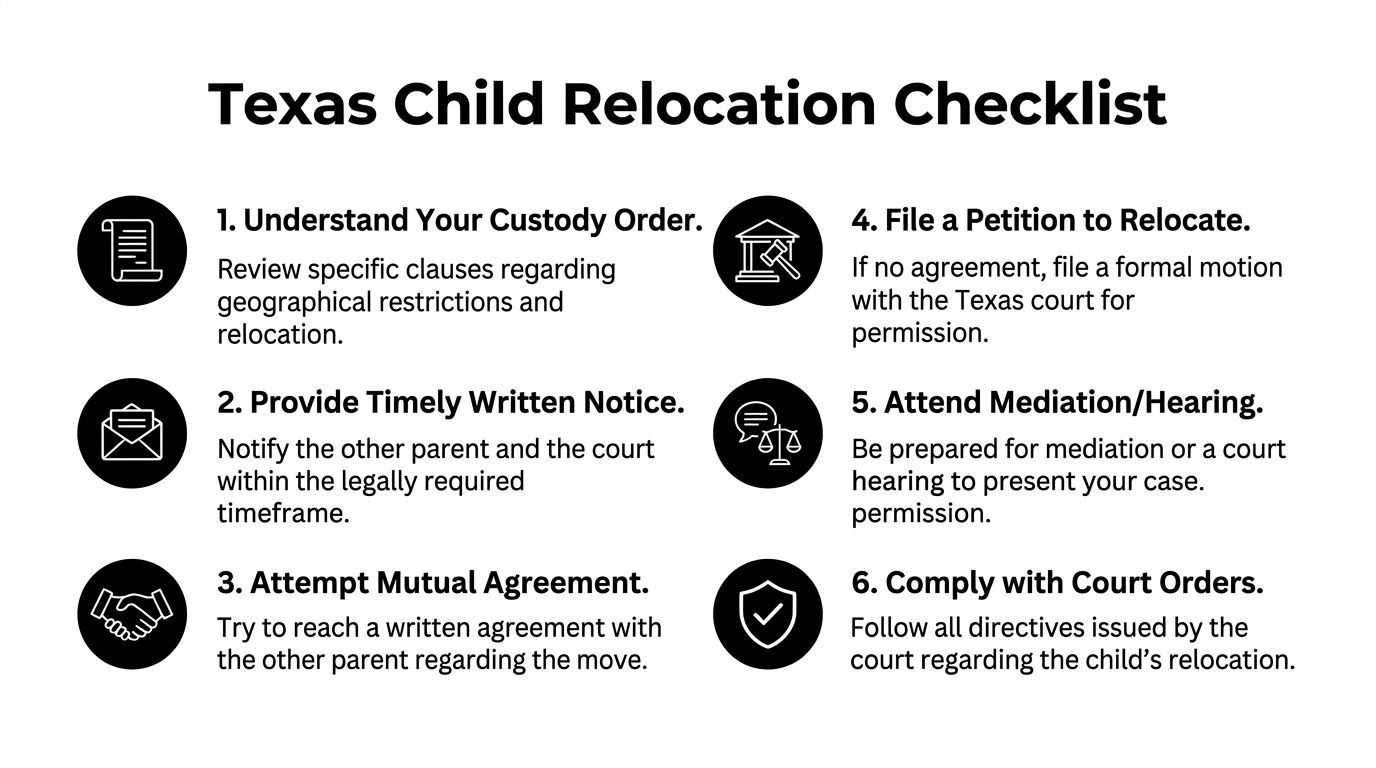
What proper written notice should do
Written notice serves two purposes. It informs the other parent, and it starts building your credibility.
Good notice is clear, specific, and calm. It should state:
- The proposed new address
- The planned move date
- Why the move is being requested
- How you believe the child’s schedule can be adjusted
- How the child will maintain contact with the other parent
Tone matters here. A notice letter is not the place to argue about old grievances or assign blame. It should read like a serious parenting proposal, because that is how a court is likely to view it later.
Why informal deals fail
Parents often rely on a phone call, a few text messages, or a vague verbal agreement. That creates risk for both sides.
If the move affects possession, access, or a geographic restriction, an informal agreement may fall apart the moment conflict starts. A parent may back away from what was said. A judge may view the situation very differently from how each parent remembers it. The safer course is to reduce any agreement to writing and get court approval when the order needs to change.
A practical notice checklist
Before you send notice, slow down and prepare it like an exhibit that may later end up in court.
Check the current order first
Confirm whether your order already sets a notice deadline, delivery method, or geographic limit.Write the notice with specifics
Statements like “I may move soon” invite confusion and objections.Attach support where you can
A job offer, housing details, school information, or evidence of family support helps show the move is real and thought through.Propose a workable long-distance plan
Address travel, holiday periods, summer possession, virtual contact, and who will handle transportation costs.Keep proof of what you sent
Save the notice, attachments, and delivery confirmation.
This preparation does more than satisfy a procedural step. It shows that you are focused on the child’s stability, not just your own relocation plans.
What if the other parent objects
An objection does not end the request. It does mean you should stop treating the move as settled.
At that point, the issue usually shifts from discussion to evidence. The parent requesting the move needs to show a real plan, not optimism. Courts tend to respond better to parents who can explain school options, travel schedules, costs, family support, and how the child will keep a meaningful relationship with the other parent.
If your case may involve interstate enforcement or multi-state parenting disputes, this guide on child custody across state lines can help you understand the planning issues that come with a move beyond Texas.
Common mistakes that hurt relocation cases
Some errors appear small at first and later become the center of the case.
- Giving late notice: This can make the move look impulsive or dismissive of the other parent’s role.
- Presenting the move as a done deal: Judges generally want to see respect for the existing order and the legal process.
- Skipping the logistics: A court will want details about travel, school breaks, communication, and cost sharing.
- Telling the child too early: Children can feel pulled between parents when adults announce plans before the legal issues are addressed.
Strong relocation cases are usually built with care. Review the order, prepare the notice carefully, gather documents, and avoid turning a difficult decision into an avoidable emergency.
What cooperation can look like
Cooperation does not mean weakness. It means giving the other parent enough information to respond to a real proposal.
A parent who explains the job opportunity, shares school research, offers realistic makeup time, and discusses transportation in concrete terms often comes across as more credible than a parent who announces a move. That does not guarantee agreement. It does improve your position.
The emotional side matters too. Many parents are not just arguing about miles on a map. They are reacting to fear of lost time, reduced influence, and a changed bond with their child. Recognizing that concern, while still holding your ground, often leads to better decisions and a stronger record if the case reaches court.
How to File a Relocation Case in a Texas Court
If the other parent says no, the issue shifts from discussion to proof.
At that point, you are usually asking the court to change an existing order. In Texas, that often means filing a petition to modify the parent-child relationship or a similar motion to modify the custody order. The legal burden is on the parent requesting the move.
Texas relocation procedure requires formal 60-day written notice first. If the other parent disagrees, the moving parent must file to modify and prove a material and substantial change in circumstances. Moving without approval is a serious violation and can be treated as parental kidnapping, a state jail felony in Texas, according to this step-by-step explanation of relocation procedure.

What the court needs you to prove
The court generally wants to see two things.
First, something important has changed. That is the material and substantial change in circumstances part. A genuine job transfer, a major support-system change, or a family need can fit here.
Second, the requested move benefits the child enough to justify changing the current arrangement. Many cases often become difficult when addressing that second part.
Build the case like a project
Relocation cases are easier to manage when you treat them like a document-heavy project instead of an emotional appeal.
Gather evidence in categories:
Employment evidence
Written offer letters, start dates, work location, and why the opportunity matters for family stability.Housing information
Details about the proposed living situation, safety, school access, and household support.School and community records
Information about the child’s likely school, available services, and community resources.Parenting plan details
A proposed long-distance possession schedule with holidays, summers, video calls, and transportation arrangements.Child-centered history
Medical records, activity schedules, counseling information if relevant, and proof that you have planned for continuity.
Some parents also benefit from legal guidance in preparing filings and evidence. For a basic overview of process and paperwork, review these Texas custody modification forms. The Law Office of Bryan Fagan, PLLC also handles custody modification and relocation matters for Texas families who need help preparing or contesting these requests.
What a strong filing usually looks like
The most persuasive filings are specific.
A weak filing says, “I have better opportunities out of state.”
A stronger filing says, “I have accepted a position in another state, secured housing near the child’s proposed school, identified family support nearby, and created a detailed schedule that protects the other parent’s access.”
Judges are not persuaded by broad hope alone. They want a plan that can work.
Mediation, temporary orders, and hearings
Many relocation disputes involve negotiation before a final hearing.
You may face:
- Mediation to see whether a revised agreement is possible
- Temporary orders if one parent wants immediate court direction while the case is pending
- A final hearing where both parents present evidence and testimony
Military families can face added pressure because PCS orders or deployment schedules may compress timelines and complicate parenting plans. Courts still focus on stability and workable access for the child.
What not to do while the case is pending
Parents can unintentionally weaken a solid case with poor conduct during litigation.
Avoid these choices:
- Do not move the child first
- Do not cut off communication with the other parent
- Do not coach the child to support your side
- Do not ignore school and possession obligations while waiting for court
Judges often form impressions long before trial ends. A parent who stays organized, respectful, and child-focused usually presents better than a parent who treats the case like a personal grievance.
If you are the parent opposing the move
This process matters for you too.
You will want to document your involvement with the child, explain how the current schedule serves the child well, and point out any weakness in the proposed plan. If travel, school disruption, or loss of regular contact would harm the child, that should be shown clearly and calmly.
Relocation litigation is not only about who wants the move more. It is about who can show the judge a safer, more workable arrangement for the child.
What Texas Courts Consider The Best Interest of the Child
The phrase best interest of the child can sound broad, but in court it becomes concrete.
Judges want evidence. They compare the child’s current life to the proposed life after the move. They look at stability, educational opportunities, emotional needs, the reason for the move, and whether the other parent’s relationship can survive the distance in a meaningful way.
Texas courts evaluate relocation requests using a best-interests benchmark. In one cited example, moves tied to a school district with significantly higher API scores were more likely to be approved. A workable long-distance parenting plan achieved a much higher success rate compared with vague proposals, and a significant portion of contested relocation modifications were approved in major Texas districts during 2023 to 2025, according to this discussion of relocation outcomes and evidence.
The judge’s scorecard is practical
A court is usually asking questions like these:
| Question | Why it matters |
|---|---|
| Does the move create a real benefit for the child | Courts look for tangible improvements, not just a parent’s preference |
| Will the child lose meaningful time with the other parent | Preserving that relationship is a major concern |
| Is the reason for moving credible and clean | Motive matters, especially if the other parent claims interference |
| Can the new schedule work | Logistics can decide the case |
Benefits must be tied to the child
Parents often focus too heavily on what the move does for them.
That is understandable, but not enough. A stronger argument links the move to the child’s daily life. Better educational options, closer family support, more stable housing, and a calmer home environment are the kinds of facts courts examine more carefully than a parent’s personal preference for a fresh start.
The parenting plan can make or break the request
The parenting plan can make or break the request. Good cases often separate from weak ones here.
A detailed long-distance plan shows maturity and foresight. It tells the court when the child will spend holidays and summers with the other parent, how regular communication will happen, and how transportation will be managed. A vague promise to “be flexible” usually does not inspire confidence.
For parents who want to understand how courts evaluate child-focused evidence, this guide on how to prove best interest of child is a helpful companion.
Motive always matters
Judges pay close attention to why the move is happening.
A relocation request driven by a serious opportunity or support need is different from one that appears timed to frustrate the other parent’s possession. If your communication history, notice, and proposed schedule show openness, that can help. If your actions suggest you are trying to reduce the other parent’s role, that can hurt badly.
The court does not need a perfect parent. It looks for the parent who made the most child-centered, workable, and honest plan.
Emotional truth matters too
Children are not spreadsheets.
A child may be excited about a move and still grieve the loss of regular contact with the other parent. A child may resist a move and still benefit from improved stability elsewhere. Good relocation cases take those emotional realities seriously. They do not ignore them or use them as weapons.
That is why careful preparation matters. The legal question is technical, but the court’s concern is human.
Key Takeaways and Your Next Steps for Relocation
A relocation case asks you to do two hard things at once. Protect your child’s future and respect the legal structure already in place.
That is why parents need both emotional steadiness and strategy. If you are considering moving out of state with child texas concerns, do not start with packing. Start with the order, the timeline, and the evidence.
The short version
Keep these points in front of you:
Read the custody order closely
The wording about conservatorship, the right to designate residence, and geographic restrictions shapes everything else.Treat notice as a legal step, not a casual conversation
Written, timely, and specific communication puts you in a stronger position.Expect to prove more than your own need to move
The court will focus on the child, not just your opportunity.Bring a workable parenting plan
Travel, holidays, school breaks, and communication all need clear answers.Avoid self-help
Moving first and asking permission later can trigger serious consequences.
Frequently asked questions
What if the other parent agrees to the move
Get the agreement put into a new court order.
A signed order protects both parents and gives clear rules on possession, communication, and travel. Without that update, old terms may still govern even if everyone initially meant well.
Can I move temporarily while the case is pending
Do not move the child out of state without court authorization or a legally sound written agreement.
Temporary moves can still create major legal problems. They can also make the court question whether you respect the existing order.
Who usually pays travel costs
That depends on the facts, negotiation, and what the judge finds fair.
Some parents split travel expenses. In other cases, the relocating parent may take on more of that burden because the move created the distance. The key is to address the issue directly rather than leaving it vague.
How should I prepare beyond the legal case
A legal plan matters, but so does the actual move.
As you organize records, school information, and scheduling details, it can also help to review a broader legal checklist for moving to a new state. That kind of practical planning can reduce last-minute stress while your custody issues are being addressed properly.
A grounded next step
If you are worried, that makes sense. Relocation cases affect your child, your co-parenting relationship, and your legal rights all at once.
The best next move is simple. Put the order, the proposed move details, and your questions in one place. Then get informed advice before you send a notice, promise a start date, or tell your child that the move is certain.
Parents do better in these cases when they act early, stay calm, and build a child-centered record. Fathers, mothers, grandparents, and military families all face different facts, but the same rule applies. The court wants a stable, realistic plan that protects the child’s well-being and important family relationships.
If you need help with a child custody or visitation case in Texas, our experienced attorneys can guide you every step of the way. Contact The Law Office of Bryan Fagan, PLLC today for a free consultation.