
When your child’s future is on the line, understanding your rights matters most.
A new marriage can bring joy, relief, and a sense that life is moving forward. It can also bring a knot in your stomach if you already have a Texas custody order. Maybe you’re wondering whether your ex can use your remarriage against you. Maybe your ex just remarried, and you’re worried about who is now around your child when you’re not there.
Those fears are common. They’re also manageable when you understand how custody modification after remarriage Texas cases really work.
Texas courts do not rewrite custody orders just because someone gets married again. A wedding changes family life, but it doesn’t automatically change conservatorship, possession, or parental rights. In Texas, conservatorship means custody and decision-making authority. Joint managing conservatorship usually means both parents share important rights and duties, even if one parent has the right to decide the child’s primary residence. Possession schedules are the written parenting time rules that say when the child is with each parent.
What matters most is not the marriage itself. It’s whether the remarriage has changed the child’s life in a meaningful way, and whether a court order should change to protect or support that child.
Your New Chapter and Your Existing Custody Order
You may be living a scene that feels both hopeful and fragile. Your child has met your new spouse. You’re trying to blend routines, school pickups, meals, bedtime, and holidays. Everyone is doing their best, but you still hear the question in your head: “Will this affect my custody order?”
That question matters whether you’re the parent who remarried or the parent watching your child enter a blended family.

Why parents feel unsettled after remarriage
A custody order can feel stable until a major life event happens. Remarriage often changes more than a last name. It may change where the child sleeps, who helps with homework, who is present at exchanges, and how the household works day to day.
Parents also worry about very practical things:
- Household Rules: Will the child now follow a completely different routine?
- New Adult Influence: Is the stepparent supportive, or controlling and disruptive?
- Schedule Pressure: Will new work hours, step-siblings, or travel affect the current possession schedule?
- Decision-Making Confusion: Will the new spouse start acting like a legal parent?
Those concerns are real. But they don’t automatically mean the current order should change.
What the court cares about most
Texas family courts stay focused on the child, not the parents’ relationship status. Judges look at whether the child is safe, supported, stable, and emotionally well cared for. They also look at whether the existing order still works.
A new marriage can change a household. It does not erase a court order.
That’s often where parents get confused. They assume remarriage either means “nothing matters” or “everything changes.” Usually, the answer is somewhere in the middle.
If you’re a mother, a father, a grandparent, or another caregiver trying to protect a child’s routine, the first step is to stop guessing and start looking at facts. Is the child thriving? Is the home more stable? Is there conflict, fear, or danger? Those details matter far more than the wedding itself.
Understanding The 'Material and Substantial Change' Standard
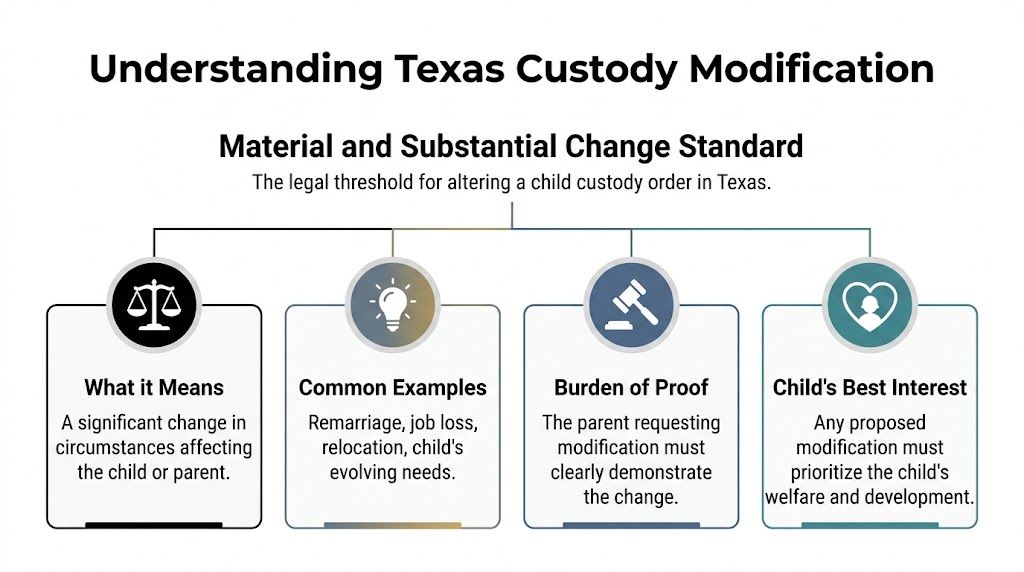
Texas law uses a phrase that sounds technical but becomes clearer once you break it down: material and substantial change in circumstances.
A court generally won’t modify a custody order because life has changed a little. Life always changes. Kids grow. Work schedules shift. Parents move on. The court is looking for a change that is important enough to justify revisiting an existing order.
Think of it like a house foundation
If you notice one loose floorboard, you probably don’t rebuild the whole house. But if the foundation shifts, doors stop closing properly, cracks spread, and the structure works differently. That is closer to how Texas courts think about modification.
Remarriage is often more like the first sign that something has changed. The court still needs to know whether that change affects the child’s living environment, well-being, or parenting arrangement in a serious way.
For a deeper look at how courts analyze this issue, see this discussion of substantial change in circumstances in Texas custody cases.
Why remarriage alone usually isn’t enough
Under Texas Family Code Section 156.101(a)(1)(A), a court must find two things before modifying custody: the change must be in the child’s best interest, and there must be a material and substantial change in circumstances since the earlier order. A recent discussion of Texas precedent explains that remarriage alone does not automatically trigger modification, even when courts closely examine new family dynamics after a parent remarries, as discussed in this review of recent Texas relocation and modification precedent.
That means a parent usually needs to show the effects of remarriage, not just the fact of remarriage.
Examples can help:
- A parent remarries, and the new household becomes calmer, more structured, and better able to support the child’s school routine.
- A parent remarries, and the new spouse has a history of substance abuse that creates safety concerns.
- A parent remarries, and the child now has strong step-sibling bonds that make the current schedule harder on the child.
- A parent remarries, and conflict in the home starts affecting the child’s behavior or emotional health.
Each of those examples focuses on the child’s actual life.
The court wants proof, not assumptions
Many parents lose credibility by speaking in conclusions. They say, “My ex’s new spouse is bad for my child,” or “My remarriage makes me the better home now.” Courts need more than opinions.
Practical rule: Judges usually want to see specific facts tied to the child’s daily experience.
Good proof often includes:
- School records showing attendance or performance changes
- Messages or emails that show schedule problems or conflict
- Counseling records if emotional distress is part of the issue
- Witness testimony from people who observe the child
- Detailed timelines showing when changes began after remarriage
This standard can feel demanding, but there’s comfort in that. Your custody order is not supposed to swing wildly every time an adult relationship changes.
How Texas Courts Evaluate a Parent's Remarriage
When a judge looks at remarriage in a modification case, the central question is simple: How does this new family situation affect the child?
The legal framework is strict. In Texas modification proceedings after a parent remarries, courts apply a two-part test under Texas Family Code Section 156.101(a)(1)(A). The requested change must serve the child’s best interest, and there must be a material and substantial change in circumstances. Texas courts have also recognized that remarriage alone does not automatically require modification, even when new family dynamics deserve close review.
Best interest is the center of the analysis
Best interest of the child is the guiding standard in Texas custody cases. In plain English, it means the court asks what arrangement most supports the child’s safety, emotional health, development, stability, and relationship with both parents.
A judge may study questions like these:
- Is the new household calm and reliable?
- Does the stepparent support the child’s relationship with the other parent?
- Has the remarriage improved routines, housing, and supervision?
- Is there new conflict, substance abuse, or family violence in the home?
- Does the child feel secure in the blended family?
- Are there positive or harmful changes in school, behavior, or health?
A stepparent can matter a great deal. If you want to understand the legal limits of that role, this overview of stepparent custody rights in Texas helps explain the difference between daily involvement and legal rights.
How courts may view a new spouse's impact
| Potential Positive Factors | Potential Negative Factors |
|---|---|
| A stable home with consistent routines | Frequent conflict in the home |
| A supportive adult who helps with school and daily care | A new spouse with a criminal record relevant to child safety |
| Better housing or more reliable scheduling | Substance abuse concerns |
| Healthy step-sibling relationships | Efforts to interfere with the child’s bond with the other parent |
| Emotional support that helps the child adjust | Instability, fear, or disruptive discipline patterns |
The same remarriage can look very different depending on the evidence. One parent may see a “fresh start.” A court may see either a stronger support system or a new source of stress.
A positive remarriage can matter too
Many parents assume remarriage only becomes relevant when something goes wrong. That’s not always true.
The verified materials note that recent Texas precedent, including In the Interest of J.R.J. from the Texarkana Court of Appeals, involved close review of how a new family structure affected the child. That matters because some remarriages create real benefits for a child, such as emotional support, stronger routines, or positive sibling relationships. If those benefits are supported with evidence and tied to the child’s well-being, they can become part of a modification request.
Some blended families create strain. Others create structure. Courts look at the child’s lived experience, not stereotypes about remarriage.
What judges tend to distrust
Judges often become skeptical when a case sounds more like adult resentment than child-focused concern.
Claims are weaker when they sound like this:
- “I just don’t like the new spouse.”
- “They got married too fast.”
- “My child likes the stepfamily more than me.”
- “Their house rules are different from mine.”
Those feelings may be sincere, but they don’t automatically prove a legal basis for changing custody. Courts usually want a clearer link between the new marriage and the child’s actual best interests.
Practical Steps to File for a Custody Modification
A lot of parents reach this point after one specific moment. Your child comes home from the other house acting different. A new household rule, a new adult in the home, a new conflict, or even a new source of stability has changed daily life. You are not just asking, “Can I file?” You are asking, “What exactly should I ask the court to change, and how do I show why it matters for my child?”
That is the right question.

Start with your current order, not your frustration
A custody modification case works a lot like remodeling a house. You need to know the existing floor plan before you can ask to change a room.
Read your current order carefully. Focus on the conservatorship terms, possession schedule, geographic restriction, rights and duties, and any provisions that affect school, medical care, travel, or exchanges. Many parents know something feels wrong, but the order tells you what the court can modify.
If you need a clearer picture of the paperwork, this guide to Texas custody modification forms explains the documents that often come up.
Then narrow your goal. A judge will want a specific request, not a general complaint about the remarriage.
Your request may involve:
- A different possession schedule
- A change in the child’s primary residence
- Added safety terms or supervised periods
- Temporary orders while the case is pending
- A shift in decision-making authority
Specificity matters. “I want custody changed” is too broad. “I want the exchange schedule adjusted because the child’s school attendance has suffered since the remarriage and the current weeknight routine is no longer working” gives the court something concrete to evaluate.
Check the timing before you file
Texas modification law has timing rules, and they can surprise parents who are acting out of real concern.
Texas Family Code §156.102 generally limits certain custody modification requests filed within one year after the current order was signed. There are exceptions. One of the most important applies when the child’s present environment may endanger physical health or significantly impair emotional development. In that situation, the filing must include a detailed affidavit. TexasLawHelp’s explanation of modification within one year of a current Texas custody order gives a helpful overview of that rule.
This timing issue often matters in remarriage cases. Sometimes the new marriage creates a more stable home. Sometimes it introduces serious concerns involving substance abuse, violence, criminal history, unsafe supervision, or emotional harm tied to the new spouse or household. If the problem is urgent, the court may be able to hear it sooner.
If you believe your child is unsafe, act quickly and get legal advice quickly too.
File with a theory of the case
Before any petition is drafted, it helps to identify the story your evidence will need to prove. That does not mean exaggerating. It means choosing a clear legal theory and matching your facts to it.
For example:
- The remarriage improved stability, and the child now does better with more time in that home.
- The remarriage disrupted the child’s routine, schooling, or emotional health.
- The new spouse’s background or behavior creates safety concerns.
- The blended household changed transportation, supervision, or discipline in a way that now affects the child’s best interest.
A good petition grows out of one of those theories. A weak petition often mixes several complaints without showing how they connect to the child’s life.
What the process usually looks like
Many modification cases follow this sequence:
Consultation and order review
You compare the existing order to what has changed since the remarriage and decide what relief fits the facts.Petition to modify
This filing tells the court what you want changed and why the current order no longer serves the child’s best interest.Service on the other parent
The other parent must receive formal legal notice.Temporary orders, if needed
If there is an immediate problem involving safety, access, school stability, or living arrangements, the court can set temporary rules while the case is pending.Discovery and information exchange
Each side may request records, communications, and other evidence.Mediation or settlement efforts
Many courts require mediation before trial.Final hearing or trial
If no agreement is reached, the judge decides whether a modification is justified.
That sequence may sound formal, but each stage serves a purpose. The court is trying to sort out whether the remarriage changed the child’s real-world circumstances enough to justify changing a prior order.
A few legal terms in plain English
Some legal words can make the process feel harder than it is.
- Petition to modify means the document asking the court to change an existing custody order.
- Affidavit means a sworn written statement of facts.
- Discovery means the formal process for getting documents, records, and written answers from the other side.
- Temporary orders means short-term rules the court puts in place before the final result.
- Mediation means a neutral person helps both parents try to reach an agreement.
A short video can also help make the process feel more familiar:
Where legal help can make a real difference
Some parents can begin by organizing records and reviewing forms on their own. Others need counsel early, especially when the remarriage raises urgent safety issues, complicated procedural questions, or concerns about a new stepparent’s criminal history, substance use, or role in day-to-day caregiving.
The Law Office of Bryan Fagan, PLLC handles Texas custody modification matters, including cases involving changed family circumstances after remarriage.
Good legal help does more than file papers. It helps you choose the right request, avoid procedural mistakes, and present evidence that shows how the new marriage affects your child’s best interest in practical, provable ways.
Building Your Case with Strong Evidence and Documentation
If there is one place where custody modification cases are won or lost, it’s evidence.
A parent may be honest, worried, and strongly committed. But in court, concern alone won’t carry the day. Judges need a clear picture of what changed, when it changed, and how it affects the child.

Good evidence tells a story
Strong evidence is detailed and tied to the child’s life. Weak evidence is vague and emotional.
Compare these two examples:
- “My child hates going over there now.”
- “Since the remarriage, my child has had repeated Sunday-night anxiety, missed assignments, and school tardies. I have dated notes, teacher emails, and counseling records.”
The second example gives the court something concrete to evaluate.
What to gather if remarriage changed the child’s life
Useful documentation may include:
Parent journal entries
Keep them factual. Note dates, times, statements the child made, exchange problems, behavior changes, and missed parenting time.School records
Attendance, grades, behavior reports, and communication from teachers can show change over time.Medical or counseling records
If emotional distress, sleep problems, or anxiety became an issue, these records may matter.Photos and communications
Texts, emails, and app messages may show conflict, admissions, schedule breakdowns, or refusal to cooperate.Witness observations
Teachers, counselors, relatives, coaches, or childcare providers may have helpful firsthand observations.
Write things down as they happen. Courts trust specific, dated notes more than memory reconstructed months later.
Why the stepparent’s background can become central
This is one of the most overlooked parts of custody modification after remarriage Texas cases. While remarriage by itself is not enough, a new stepparent’s background can become highly relevant.
Verified guidance on this issue explains that evidence of a stepparent’s criminal record, substance abuse history, or prior child welfare involvement may provide the material and substantial change needed to show the child’s best interests are at risk, as discussed in this analysis of whether remarriage can trigger a custody modification in Plano.
That doesn’t mean every old mistake will control the case. It does mean the court may care if the new spouse’s history creates present risk for the child.
How parents usually obtain that information
Parents often ask whether they can “run a background check” on the new spouse. Sometimes publicly available information helps. In formal litigation, discovery may also allow a parent to request records or information relevant to the child’s safety and household environment.
Possible areas of inquiry may include:
- Criminal history relevant to safety
- Past substance-related incidents
- Prior child welfare investigations
- Protective orders or family violence history
- Household instability that directly affects the child
Be careful here. Courts expect lawful, focused evidence gathering. Random online accusations, gossip, and social media speculation can hurt your credibility.
The best case presentation is child-centered
The strongest cases do not attack the other household just to attack it. They connect facts to the child.
That means instead of arguing, “The stepparent is a bad person,” you show, “The child’s sleeping arrangement changed, exchanges became volatile, and the child began showing fear and school problems after specific incidents.”
That difference matters.
How to Respond When Your Ex-Spouse Seeks a Modification
If your ex has remarried and filed to change custody, it’s easy to feel like the ground just shifted under your feet. Many parents immediately fear they’re about to lose time with their child.
Take a breath. A filed case is not a final result.
Start with stability, not panic
Your first job is to protect your credibility. Keep following the current order unless the court changes it. Show up on time. Communicate calmly. Avoid arguing through text in ways that could later appear in court.
That matters because your conduct during the case can become part of the judge’s overall impression.
Focus on what is working for the child
A response is strongest when it shows the child is doing well under the current arrangement.
You may want to gather proof of:
- Strong school performance
- Reliable attendance and routines
- Positive medical and counseling progress
- Healthy bond with both parents
- Lack of disruption under the current schedule
If the other parent says remarriage created a “better” home, you can still show that the current order remains effective and child-centered.
The question is not whether the other parent’s life changed. The question is whether the court needs to change the order for the child.
Challenge weak assumptions
You can also respond by pointing out what is missing from the other side’s case.
For example:
- Are they relying on general statements instead of specific evidence?
- Are they describing adult preferences rather than child needs?
- Are they assuming a new marriage automatically means more stability?
- Are they asking for a major change without showing harm under the current arrangement?
A remarried parent may sincerely believe the child would benefit from a new schedule. But the burden is still on that parent to prove both the legal change and the child-focused reason for modifying the order.
Practical moves that help
Here are smart early steps if you’ve been served:
Read every filed document carefully
Look for the exact changes requested and any emergency allegations.Preserve records immediately
Save communications, calendars, school notices, and app logs.Prepare your timeline
Put major events in order, including the remarriage, any schedule issues, and the child’s progress.File a formal response on time
Ignoring the case can create serious problems.Get ready for mediation or hearing
Many cases settle, but preparation still matters.
A calm, well-documented parent is often in a stronger position than a reactive one.
Answers to Common Questions and Your Next Steps
Parents often have practical questions that don’t fit neatly into a statute. Here are some of the most common ones.
Does a stepparent get custody rights just by marrying a parent
No. A stepparent does not automatically gain conservatorship or possession rights just because of marriage. A stepparent may help with daily care, but legal parental rights still come from a court order or another legal process.
Can a new spouse’s income change child support automatically
Not usually. Child support and custody are related but separate issues. A remarriage may affect a household’s finances in real life, but support calculations generally focus on the legal parent’s circumstances and the governing rules in the case.
What if my child says they don’t like the stepparent
That may matter, but the court usually looks for context. A child’s discomfort may come from normal adjustment, loyalty conflict, or a serious problem. The court will want more than a single statement. Patterns, behavior changes, and supporting evidence carry more weight.
Can mothers and fathers both file for modification after remarriage
Yes. Texas law applies to both mothers and fathers. Either parent can ask for modification if the legal standard is met. The court is supposed to stay focused on the child’s best interest, not the parent’s gender.
What should grandparents or caregivers do if they’re worried
If you play a major role in the child’s life and see signs of danger or instability after a parent’s remarriage, document what you personally observe. Avoid stepping into adult conflict unless necessary, but don’t ignore serious concerns that affect the child.
Key takeaways
- Remarriage alone usually doesn’t change custody
- Texas courts focus on the child’s best interest
- A material and substantial change must be proved
- The effects of remarriage matter more than the wedding itself
- A stepparent’s background can become highly important
- Strong documentation often makes the difference
- Parents responding to a modification should focus on stability and evidence
If you’re facing uncertainty, don’t wait until frustration turns into a legal crisis. A focused legal review can help you decide whether your case calls for negotiation, a formal modification, or a strong response to the other parent’s request.
If you need help with a child custody or visitation case in Texas, our experienced attorneys can guide you every step of the way. Contact The Law Office of Bryan Fagan, PLLC today for a free consultation.