
When miles separate you from your child, creating a sense of connection and stability can feel like an overwhelming challenge. This is where a long-distance parenting plan becomes your most essential tool. Think of it as a detailed, court-ordered roadmap designed specifically to help you maintain a strong, consistent relationship despite the distance. For Texas families navigating this difficult terrain, these plans are absolutely critical for ensuring your child continues to benefit from having both parents actively involved in their life.
Why a Thoughtful Long Distance Parenting Plan Matters
When your child’s future is on the line, understanding your rights matters most. A carefully drafted long-distance parenting plan does more than just schedule visits; it provides the predictability and structure your family needs to thrive during a period of significant change. For many parents we work with, the idea of co-parenting from another city—or even another state—is daunting, filled with tough questions about how to stay connected and truly involved.
This guide is your starting point for building that secure and loving connection with your child, no matter where you each call home. We'll walk through how Texas courts approach these unique situations, always focusing on what is in the “best interest of the child.” This isn't just a legal phrase; it's the guiding principle in every custody decision under Texas Family Code Chapter 153, ensuring your child’s emotional, physical, and developmental needs are the top priority.
How Texas Determines Custody: Key Terms Explained
To feel confident in this process, it helps to understand the court's language. In Texas, the law strongly favors what’s called Joint Managing Conservatorship. In plain English, this means both parents share the rights and responsibilities of raising their child, such as making decisions about school and medical care. This holds true even when one parent lives hundreds of miles away.
The plan itself is officially known as a Possession Order or possession schedule. For long-distance families, this order looks quite different from a standard plan. Instead of frequent, short visits, it focuses on creating longer, more meaningful blocks of time together—think extended summer visits and alternating major holidays.
A strong parenting plan is proactive, not reactive. It anticipates potential conflicts over travel, communication, and decision-making and provides clear solutions before disagreements can arise, protecting your child from unnecessary stress.
Navigating custody arrangements that cross state lines adds another layer of complexity. It's crucial to understand how Texas law works with federal regulations to determine which state has the authority to make decisions. For a deeper dive, you can explore our guide on child custody across state lines, which breaks down these jurisdictional rules. Ultimately, a solid plan gives both you and your child the peace of mind that comes from knowing exactly what to expect.
Core Elements of an Enforceable Long Distance Parenting Plan
When you’re co-parenting across state lines—or even just a few counties—a vague, handshake-style agreement is a recipe for conflict. An effective and enforceable long distance parenting plan is all about the details. Texas courts need to see that you’ve thought through every angle, creating a clear framework that puts your child’s stability first. This isn't just about scheduling visits; it's about building a predictable and secure world for your child, no matter the distance.
First, the court will designate one parent as the primary managing conservator—this is the parent who has the exclusive right to determine the child's residence. The other parent is typically named a possessory conservator. However, it's crucial to remember that both parents are almost always named Joint Managing Conservators, meaning you both retain a host of critical rights and responsibilities in raising your child.
Defining Rights and Duties for Each Parent
In a long-distance arrangement, clarity is your best friend. Your plan needs to spell out, in no uncertain terms, who is responsible for what. While many big decisions are made together, Texas law allows certain rights to be given exclusively to one parent. This is a practical way to prevent getting stuck in a deadlock over every decision.
These rights and duties often include:
- Major Decisions: Clarifying who has the final say (or if you must agree) on significant life decisions, like non-emergency surgery, psychiatric care, or choosing a private school.
- Emergency Contacts: Designating which parent the school or daycare should call first in an emergency.
- Information Access: Ensuring both parents have the legal right to access medical, dental, and school records directly from the providers.
Getting this specific prevents future arguments. For instance, your plan can state that both parents must confer on non-emergency medical decisions, but the primary parent can consent to emergency treatment if the other parent cannot be reached.
Communication Protocols: The Lifeline of Your Plan
Consistent communication is the glue that holds a long-distance co-parenting relationship together. Your parenting plan should treat your communication rules with the same seriousness as your visitation schedule.
An enforceable plan transforms “we should talk more” into a court-ordered requirement. It specifies how and when you will communicate about your child, creating a reliable structure that supports both co-parenting and the parent-child bond.
It's not enough to just say you'll keep each other in the loop. The reality is, a parent moving away after a separation can create significant hurdles for maintaining strong parent-child relationships. Studies have shown that a parent's relocation, especially when it separates kids from a parent before age 12, can be linked to more behavioral and emotional challenges. You can read the research about these long-term effects on child wellbeing to see just how vital that connection is. A detailed communication plan is your best tool to counteract those challenges.
This means your long distance parenting plan should explicitly outline:
- Parent-to-Parent Updates: Schedule a recurring weekly or bi-weekly phone call or email exchange dedicated only to discussing the children—school progress, health updates, and upcoming activities.
- Virtual Visitation: Define a clear, consistent schedule for your child’s video calls with the long-distance parent. For example, “The possessory conservator shall have a video call with the child every Tuesday and Thursday evening from 7:00 PM to 7:30 PM.” This makes virtual time a mandatory, enforceable part of your order.
- Shared Information Hubs: Consider a provision requiring the use of a co-parenting app to manage shared calendars, upload important documents, and track expenses.
By setting these clear expectations, you build a system that encourages cooperation and ensures your child feels the consistent presence of both parents in their life, no matter the distance.
Crafting a Realistic Possession Schedule
This is where your parenting plan becomes the real, living schedule your family will depend on. When you live in different cities or states, a long-distance parenting plan must look different from a standard Texas possession schedule. The focus shifts from short, frequent visits to longer, more substantial blocks of time that allow you and your child to truly connect.
The best way to tackle this is to map out an entire year on a calendar. This simple step forces you to think through the school year, holidays, and extracurriculars, ensuring the final plan is practical. The goal isn't just to count days; it's to create meaningful time.
Structuring Summer and School Breaks
For most long-distance parents, summer is the main event. A common and effective arrangement is giving the non-primary parent the majority of the summer, often six to seven weeks. This extended stretch is long enough to establish a real routine and a sense of normalcy that a quick weekend visit cannot provide.
Spring break is another golden opportunity. Many families assign this week to the non-primary parent every year, creating a consistent, predictable visit. Don't overlook three-day school holiday weekends, either, as they are perfect for breaking up the long stretches between bigger holiday visits.
To get a clear picture of how these schedules add up, you can use our parenting time calculator. It helps you visualize how different arrangements translate into actual possession percentages, which is key for making sure the plan feels balanced and fair.
A well-crafted schedule prioritizes your child's stability. It works with their school calendar and activities, not against them, which minimizes disruption and helps them feel secure and supported by both parents.
This infographic breaks down the essential steps in building your plan, from designating roles to establishing clear communication.
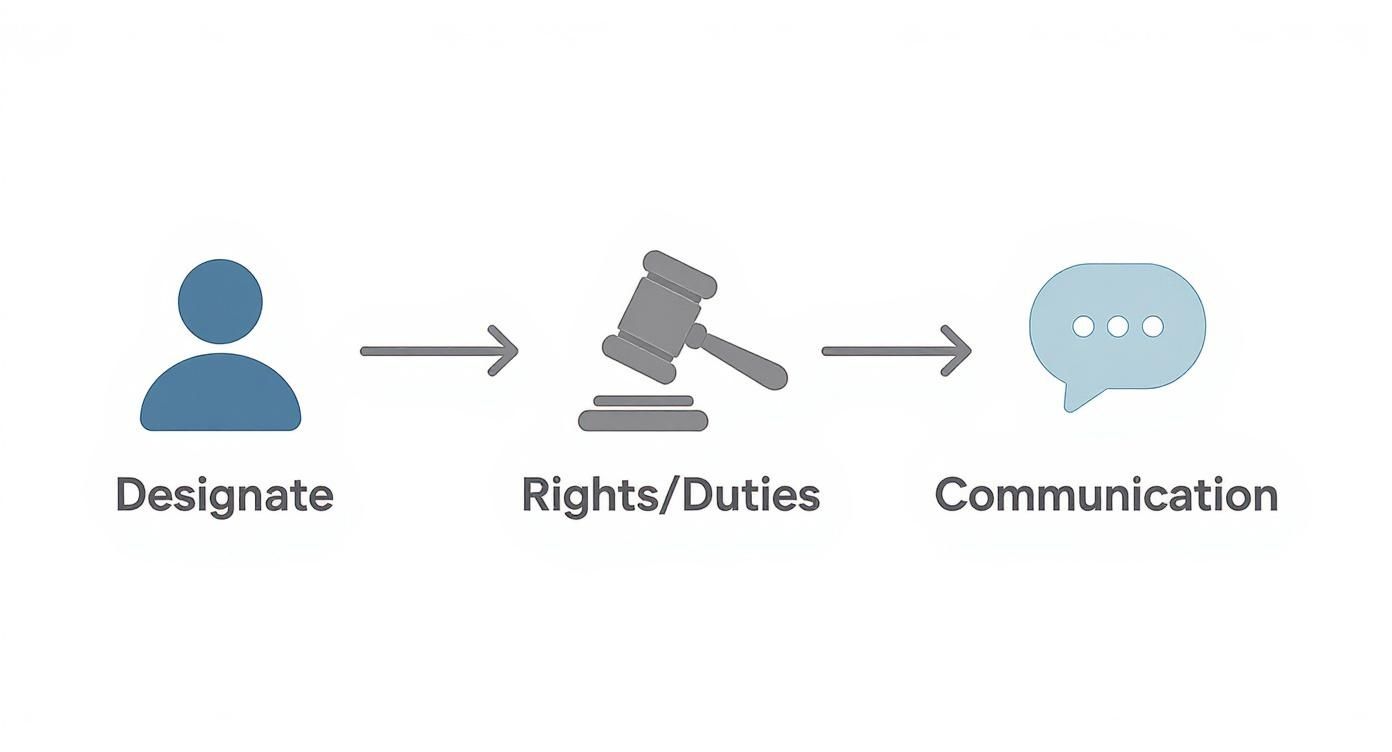
As you can see, each piece of the plan builds on the one before it, creating a solid, enforceable order that holds up in court.
Alternating Major Holidays
When it comes to big holidays like Thanksgiving and Christmas, the fairest and most common approach is to alternate them each year. For instance, the non-primary parent might get Thanksgiving in even-numbered years, while the primary parent has it in odd-numbered years.
The same logic applies to the Christmas school break, which is almost always split into two halves so that both parents get to celebrate with the child every single year.
- Even Years: The non-primary parent has Thanksgiving, and the primary parent has the first part of Christmas break.
- Odd Years: The primary parent has Thanksgiving, and the non-primary parent has the first part of Christmas break.
It’s also smart to spell out what happens on other important days, like the child's birthday, Mother's Day, and Father's Day. Putting it in writing now prevents future disagreements.
A 50/50 split is nearly impossible with long-distance parenting due to school. Instead, these plans give the non-primary parent huge chunks of time during school breaks to make up for the lack of regular weekend visits. A plan that looks like a 70/30 split during the school year can shift dramatically once you factor in a long summer possession.
Sample Long-Distance Possession Schedule Framework
This table outlines common ways to allocate parenting time in a long-distance plan, showing how major holidays and school breaks are typically divided to maximize time for the non-primary parent.
| Time Period | Typical Arrangement for Non-Primary Parent | Key Consideration |
|---|---|---|
| School Year | Limited to school holidays (e.g., three-day weekends) or one designated weekend per month if travel is feasible. | The child's academic stability is the top priority, so minimizing school-day travel is crucial. |
| Summer Break | Receives a large, continuous block of time, often 6-8 weeks. | This is the primary time for bonding and creating a "second home" environment. |
| Spring Break | Receives the entire break every year. | Provides a consistent and predictable mid-year visit. |
| Thanksgiving | Alternates possession of the entire holiday break each year (e.g., even-numbered years). | Ensures each parent gets to share this major family holiday. |
| Christmas Break | Alternates possession of the first half of the break each year. | Allows both parents to celebrate with the child every year without fail. |
This framework is a starting point, but it shows how schedules can be creatively structured to give the long-distance parent significant, quality time throughout the year.
Planning for Travel Logistics
A schedule is useless without a rock-solid travel plan. Vague travel logistics are a common source of conflict. Your long-distance parenting plan needs to address travel with painstaking detail. Don't leave anything up for debate—create a checklist of rules that will become part of your final court order.
Your travel section must clearly answer:
- Who pays for what? Will costs be split 50/50? Will they be proportional to income? Or will the parent who moved away cover the costs?
- Who books the travel? It’s best to designate one parent to handle all arrangements to prevent confusion.
- What are the transportation details? Be specific. Will it be by plane, train, or car? Do flights have to be non-stop? At what age can the child fly alone, and who must accompany them before that?
- What is the pickup/drop-off protocol? Define exactly where and when exchanges happen. Is it at the airport gate? Curbside? At the parent's front door?
- What’s the backup plan? What if a flight is canceled or a child gets sick? Address how missed parenting time will be made up.
By tackling these questions head-on in your plan, you're not just scheduling visits—you're building a conflict-proof foundation that will serve your family for years to come.
Managing Communication and Decisions from Afar

When you're co-parenting from different cities, communication is the absolute glue holding everything together. A solid long distance parenting plan does more than just outline vague promises to "stay in touch." It creates a clear, enforceable roadmap for how you'll keep each other informed and make decisions together. Getting this right protects your relationship with your child and prevents small misunderstandings from becoming major legal fights.
Staying Connected with Your Co-Parent
Effective co-parenting from a distance depends on a steady flow of information about your child’s life. Your parenting plan needs to mandate specific, regular check-ins, such as a scheduled 15-minute call every Sunday night or a detailed email update every Wednesday morning. Consistency is key. For parents in different time zones, using a meeting planner for time zones can help schedule these essential calls.
Many families find success with co-parenting apps, which create a single, business-like space to handle logistics:
- Shared Calendars: Keep track of visitation dates, school events, and appointments in one place.
- Important Documents: Upload report cards, medical forms, and birth certificates for instant access.
- Expense Tracking: Log shared costs and request reimbursements to reduce financial disagreements.
Using a dedicated app helps keep conversations focused on the kids and minimizes emotional conflict.
Making Major Decisions Together
While the parent who has the child will handle day-to-day choices, your long distance parenting plan must have a clear process for major decisions. These are the life-altering choices that Texas law expects both parents, as Joint Managing Conservators, to make together.
Your plan should explicitly list which decisions require mutual agreement, including:
- Education: Choosing a school, consenting to special education services, or agreeing to hold a child back a grade.
- Healthcare: Authorizing non-emergency surgery, starting a new prescription medication, or seeking psychological counseling.
- General Welfare: Giving consent for the child to get a driver's license, join the military, or get married before age 18.
A critical piece of this is the "tie-breaker" clause. If you can't agree, your plan can designate one parent—often the primary one—to have the final say on a specific issue after you've both discussed it in good faith. This prevents a stalemate from harming the child.
The decision-making process itself needs to be spelled out. For example, a parent proposing a change must notify the other in writing and give them a set time (e.g., 10 days) to respond. If you still disagree, the plan can require mediation before court action. This proactive approach saves time, money, and stress by providing a clear path forward and ensuring both parents stay meaningfully involved.
How to Modify or Enforce Your Parenting Plan in Texas
When your child’s future is on the line, knowing your rights is everything. You've created a solid long distance parenting plan, but life is rarely static. Jobs change, kids get older, and what worked last year might not be what’s best for your family today. This is a normal part of co-parenting from a distance. The good news is that Texas law anticipates these changes and provides a clear path for updating your plan or enforcing it when one parent isn't holding up their end of the deal.
Feeling like your current order is no longer working can be incredibly stressful, but you aren't stuck. The law gives you legal tools for both modification and enforcement to protect your child's stability and your rights as a parent.
When Can You Modify a Long-Distance Plan?
You can’t change a court order on a whim. In Texas, you must prove a “material and substantial change in circumstances” has occurred since your last order was signed. This is a high legal standard because courts prioritize stability for children. However, a "material and substantial change" refers to a real, significant shift in your family's life that makes the current possession schedule impractical or no longer in your child’s best interest.
Common examples include:
- A Parent Relocates: The primary parent wants to move even farther away, or the non-primary parent moves closer, making the old travel plan obsolete.
- The Child's Needs Evolve: A teenager's demanding sports schedule may conflict with long summer visitations, requiring a new plan.
- A Parent's Situation Changes: A new job, a serious health issue, or remarriage could affect a parent’s ability to follow the original plan.
- Repeated Violations: If one parent consistently ignores the possession schedule, that pattern of behavior can itself be grounds for a modification.
Successfully modifying an order requires compelling evidence and a clear argument for why a change is necessary. Learning how to win a custody modification case is about careful preparation and understanding what a judge needs to see to rule in your favor.
Steps to Enforce a Parenting Plan
There's nothing more frustrating than when the other parent disregards a court-ordered parenting plan. This isn't just an inconvenience; it’s a violation of a legal order that can damage your relationship with your child. Fortunately, you have a powerful tool: an enforcement action.
An enforcement action is a formal lawsuit asking the court to force the other parent to comply with the order. It's a serious step, but it's often the only way to protect your possession time.
Don’t let violations slide. Documenting every missed visit, late exchange, or denied phone call creates a factual record that a judge can act on. Your detailed notes are your most powerful evidence.
If you find yourself in this situation, take these practical steps:
- Document Everything. Keep a detailed log of the date, time, and specifics of every violation. Save texts and emails where the other parent denies possession.
- Communicate in Writing. Whenever possible, communicate with the other parent about the violations via email or a co-parenting app to create a clear paper trail.
- File an Enforcement Suit. An attorney can help you file a formal lawsuit that lists each specific violation of the court order, date by date.
When a judge finds that a parent has violated a possession order, they can order make-up visitation, force the non-compliant parent to pay your attorney's fees, and in serious cases, impose fines or even jail time for contempt of court.
Key Takeaways and Next Steps
Crafting a detailed parenting plan is one of the most important things you can do for your child in a long-distance situation. A solid long distance parenting plan is your family's road map to staying connected and providing stability, no matter the miles between you. A little proactive work today prevents a world of confusion and conflict down the road. The goal is to build a document that is focused on your child, incredibly specific, and enforceable under Texas law.
Your Final Checklist
Before you finalize your plan, run through this checklist one last time to protect your parental rights and your child’s well-being:
- Rock-Solid Schedules: Are holiday, summer, and school-break schedules spelled out with exact dates and times? Avoid vague terms like "reasonable."
- Detailed Travel Logistics: Does the plan clearly state who pays for travel, who books it, and how handoffs will work?
- Clear Communication Rules: Have you set up a predictable schedule for video calls and parent-to-parent updates?
- Decision-Making Protocols: Is there a clear, step-by-step process for making joint decisions on major issues like healthcare and education?
A comprehensive plan is more than a legal requirement—it's a promise to your child that both parents will remain actively and lovingly involved in their life.
If you need help with a child custody or visitation case in Texas, our experienced attorneys can guide you every step of the way. Contact The Law Office of Bryan Fagan, PLLC today for a free consultation.
Frequently Asked Questions About Long Distance Parenting
Navigating a long-distance parenting plan brings up many specific questions. Here are straightforward, legally-sound answers to some of the most common concerns we hear from Texas parents, both mothers and fathers.
What if the Primary Parent Wants to Move Even Farther Away?
The primary parent can't just pack up and move farther away if it interferes with your court-ordered time. If their proposed move would make it significantly harder for you to see your child, you have the right to file a modification suit. A judge will evaluate the situation based on the best interest of the child, considering the reason for the move and its impact on your relationship with your child.
How Does Distance Affect Child Support Calculations?
In Texas, child support is primarily based on the paying parent's income. However, significant travel costs can be a factor. Your parenting plan must be clear about who pays for flights or gas. A judge can order a credit or deviate from standard child support guidelines to offset unusually high travel costs for the non-primary parent exercising their visitation rights.
Can My Teenager Refuse to Follow the Visitation Schedule?
Legally, a child, even a teenager, cannot refuse court-ordered visitation. While a Texas court will listen to the preferences of a child 12 years or older, the possession order is a legal command that both parents must follow. It is always better to understand why a teen is refusing and address the root cause through honest conversation or counseling, as forcing the issue through court can damage the parent-child relationship. Studies on evolving child custody arrangements show how families are adapting to the changing needs of older children.
What Is the Best Way to Handle Last-Minute Changes?
Life happens—flights get canceled and kids get sick. The smartest approach is to plan for these issues from the start. Your parenting order should include a specific clause detailing how missed possession time will be made up. This gives you a clear, enforceable game plan when things go wrong and helps you avoid last-minute arguments.
If you need help with a child custody or visitation case in Texas, our experienced attorneys can guide you every step of the way. Contact The Law Office of Bryan Fagan, PLLC today for a free consultation.