Skip to content
When your child’s future is on the line, understanding your rights matters most.
A lot of parents find out about geographic restriction custody texas issues in the most stressful way possible. The other parent mentions a new job in another city. A fiancé lives out of state. A grandparent needs care. Or worse, you hear that boxes are already packed.
If you are worried that a move could change how often you see your child, you are not overreacting. In Texas, where a child lives can shape school life, friendships, daily routines, and your ability to stay closely involved as a parent.
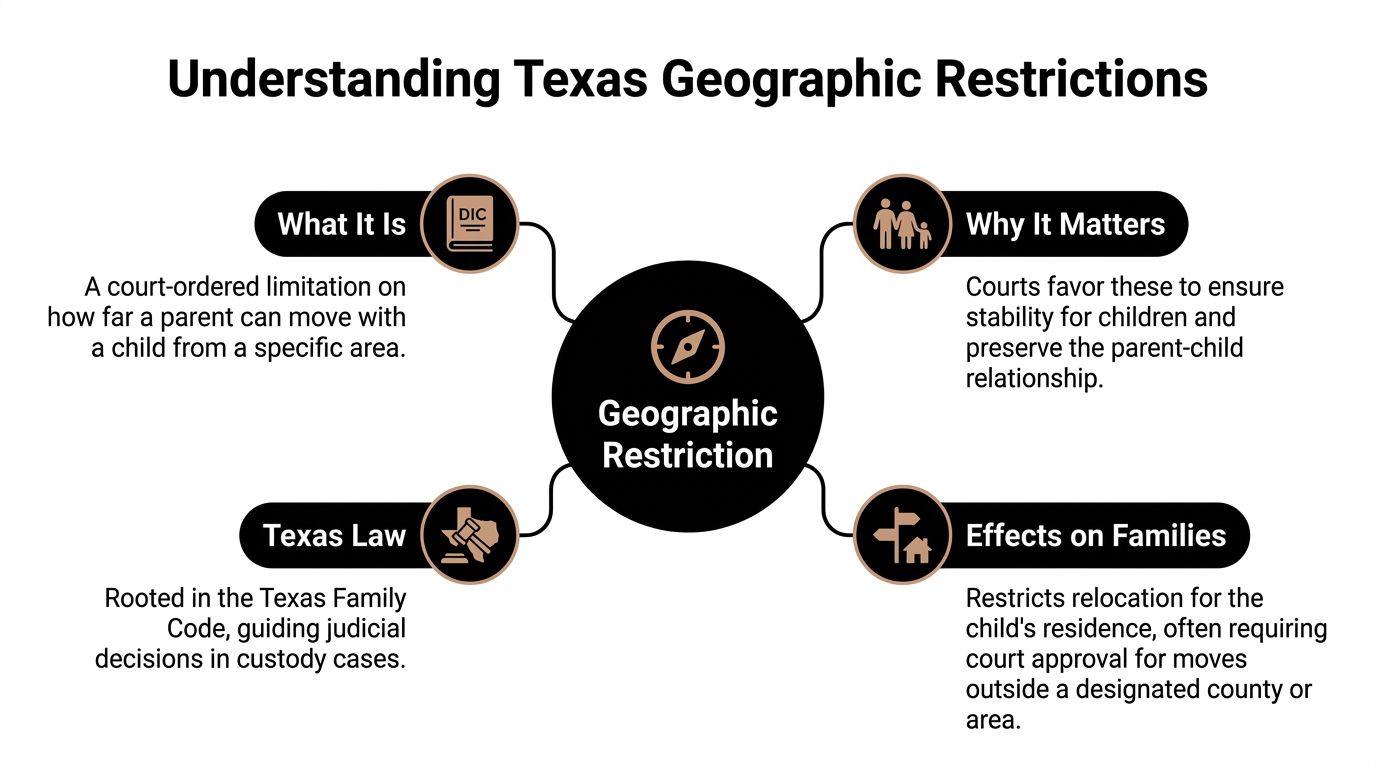
A geographic restriction is a court-ordered limit on where a child’s primary residence can be. In many Texas custody orders, that means the child must live in a certain county and the counties that touch it. That rule often becomes the line between stable co-parenting and a relocation fight.
Parents also get confused because the law uses terms that sound technical. Words like conservatorship, possession, and modification can make a hard situation feel even harder. The good news is that these rules can be understood in plain English.
If you are dealing with a possible move, trying to change a restriction, or responding to a move that already happened, it helps to know the difference between modifying an order and enforcing one. Those are two different legal paths.
If your concern is a parent leaving Texas or crossing state lines, this overview of a custodial parent moving out of state can help you see how relocation disputes often begin.
Your Child's Future and The Challenge of Relocation
The fear usually sounds the same, even when families are very different.
A father worries that a move will turn weekend visits into holiday-only contact. A mother worries she will have to choose between a better support system and a court order. A grandparent worries that a child they help care for will suddenly be gone. Military parents may face orders they did not choose. Remote workers may wonder whether a move should matter if they can work anywhere.
Texas courts understand that relocation cases are emotional. They also know that a child is not a suitcase to be moved back and forth based only on adult convenience. The law focuses on the child’s life, not just the parent’s plan.
That is why courts often use geographic restrictions in custody orders. The point is not to trap a parent. The point is to protect the child’s stability and preserve meaningful contact with both parents.
Key idea: A relocation case is usually not about whether a parent has a “good reason” to move. It is about whether the move fits the child’s best interests under the existing court order and the facts of the family’s life.
Some parents come into these cases thinking, “I am the primary parent, so I can move wherever I need to.” Others think, “The other parent can never move.” Neither view is fully accurate. Texas courts look closely at the wording of the current order, the reason for the move, and how the move would affect the child.
You do have options. Some involve careful planning and a formal request to modify the order. Others involve immediate enforcement if the order has already been violated. Knowing which path fits your situation is often the first step toward regaining control.
What Is a Geographic Restriction in a Texas Custody Order
A geographic restriction is one of the most common parts of a Texas custody order. It limits the area where the child’s primary residence can be established.
In plain language, it tells the parent with the right to choose the child’s home, “You can choose the home, but only within this area unless the other parent agrees or the court changes the order.”
Texas courts commonly use a county-plus-neighboring-counties model. According to Rudd Legal’s discussion of geographic restrictions in Texas custody cases, courts often limit the child’s residence to the county where the child lives at the time of divorce and the contiguous counties, meaning the counties that border it. That same source explains that this practice supports stability, school continuity, and frequent contact with both parents under Texas public policy in Family Code §153.001(a).
Why courts use this rule
Think of a child like a plant that grows best in familiar soil. The child’s school, doctors, relatives, activities, and daily habits are that soil. A sudden move can pull the child out of that environment.
A geographic restriction helps preserve:
- School continuity so the child is less likely to face unnecessary disruption
- Community ties such as friends, activities, and extended family
- Regular parenting time so one parent is not pushed into a long-distance role without court review
This rule is tied to the child’s best interest, which is the guiding standard in Texas custody law. In plain English, “best interest of the child” means the court asks what arrangement most supports the child’s welfare, emotional needs, safety, and long-term stability.
What the legal terms mean
Parents often get lost in the language of Chapter 153. Here are the terms that matter most.
Joint managing conservator
A joint managing conservator is usually what people mean when they say both parents have custody rights. It does not always mean a perfectly equal schedule. It means both parents may share important rights and duties, though one parent may still have special authority over certain decisions.
Primary parent
The primary parent is the parent who has the right to designate the child’s primary residence. Many parents use this phrase informally. The court order may describe it more formally.
That right is powerful, but it may still be limited by a geographic restriction.
Possession schedule
A possession schedule is the calendar for when each parent has the child. Many people casually call this visitation. Texas often uses the word possession. The schedule matters a lot in relocation disputes because distance can make the existing schedule hard or impossible to follow.
What contiguous counties means in real life
“Contiguous counties” means counties that touch the main county.
If an order says the child must live in Collin County and counties contiguous to Collin County, the child can live within that zone without violating the order. But moving outside that zone usually requires agreement or court approval.
That is why the exact wording matters. One family may have enough flexibility to move across a metro area. Another may discover that a move that sounds small on a map crosses the legal boundary.
Practical tip: Read the exact language in your order. Do not rely on memory, texts, or what the other parent says the order means.
A geographic restriction is not meant to punish mothers or fathers. It is a tool the court uses to protect the child’s routine and the parent-child relationship. Once you understand that purpose, the rest of the custody analysis starts to make more sense.
How Texas Courts Decide Relocation and Restriction Cases
Texas judges have broad discretion in these cases. That means there is no single formula that decides every dispute. The judge studies the facts of your family, your order, and the child’s needs.
As explained in Texas Advocates’ discussion of relocation and child custody agreements, Texas courts have broad discretion to impose or deny geographic restrictions based on the child’s best interest, and courts review proposed relocations for their effect on co-parenting, routines, and family ties. That same source notes that Texas public policy favors continuing and frequent contact with both parents.

What judges look at in plain English
A judge usually looks at the child’s daily life, not just the parent’s reasons for moving.
That may include:
- School and routine: Is the child doing well where they are?
- Parent involvement: Who gets the child ready for school, helps with homework, handles appointments, and attends activities?
- Distance and logistics: Would the move make the possession schedule unrealistic?
- Support system: Are there grandparents, siblings, or other relatives who play a steady role?
- Co-parenting history: Do the parents communicate well and follow the order?
The legal phrase best interest of the child covers many of these ideas. Courts may also consider factors often discussed in Texas custody law, including the child’s needs now and in the future, the stability of each home, and how each parent supports the child’s relationship with the other parent.
Initial orders and later modifications are different
The court’s mindset often changes depending on when the issue arises.
During the original custody case
If the court is entering the first final order, the judge is building a structure from the ground up. The court decides what area makes sense for the child’s life and the parents’ involvement.
At that stage, both parents should think carefully about the language. A broad area may help with flexibility. A narrow one may preserve school stability but create problems later.
After the order is already in place
Once a geographic restriction exists, changing it usually becomes harder. The court often expects stability after a final order. A parent who wants to move must usually show more than preference or convenience.
That does not mean a move request will fail. It means the judge will ask why the current arrangement should be changed and how the proposed change helps the child.
Evidence matters more than emotion
Parents often come to court with strong feelings. That is normal. But judges make decisions based on evidence.
Helpful evidence can include:
| Type of evidence | Why it matters |
|---|---|
| School records | Shows how the child is doing in the current environment |
| Work documents | Helps explain job-related relocation requests |
| Calendar records | Shows who handles day-to-day parenting tasks |
| Messages and app records | Can reflect communication and co-parenting patterns |
| Testimony from people involved in the child’s life | Can explain routines, support systems, and the child’s needs |
A judge may listen closely if one parent can show that the child is thriving where they are, and that the move would sharply reduce contact with the other parent. A judge may also listen closely if the moving parent can show that the move creates a more stable home, better caregiving support, or a safer environment.
Courtroom reality: A relocation case is rarely won by one dramatic argument. It is usually shaped by the everyday facts of the child’s life.
The role of mothers and fathers
Both mothers and fathers should know this. Texas courts do not start with the assumption that one parent matters more because of gender. What matters is the child’s needs, the order in place, and the evidence presented.
A father opposing a move should document his consistent involvement. A mother requesting a move should be ready to explain how the child’s connection with the other parent will still be protected. The same logic applies in reverse. Courts look at conduct, planning, and credibility.
Steps to Modify or Lift a Geographic Restriction in Texas
If your order no longer fits real life, you usually need a modification, not an informal agreement and not a quick text exchange.
In Texas, a parent seeking to change a geographic restriction generally files a Petition to Modify the Parent-Child Relationship. The parent must usually prove a material and substantial change in circumstances and show that the requested change serves the child’s best interests.

Step one read your current order closely
Start with the exact language.
Look for:
- The defined geographic area: Is it one county, a set of counties, or something broader?
- Who holds the residence right: Which parent chooses the child’s primary residence?
- Any exception language: Some orders allow the restriction to lift if the other parent moves away
- Current possession terms: The current schedule may not work if distance changes
Do not assume the order says what you remember. The wording controls.
Step two identify the change in circumstances
A material and substantial change means life has changed in a meaningful way since the prior order.
Texas parents often ask what kinds of changes may matter. The answer depends on the facts, but common examples can include a major job opportunity, a remarriage, a serious change in a parent’s health, a major shift in the child’s needs, or a parent’s move outside the restricted area.
If you want a fuller explanation of how courts think about this standard, this article on substantial change in circumstances in Texas custody cases is a helpful starting point.
Step three build a child-focused plan
Many parents make the mistake of focusing only on their own reason for moving. Courts want to see the child’s plan.
A stronger request usually addresses practical questions such as:
- Schooling: Where will the child attend school?
- Healthcare: Who are the doctors and providers?
- Travel details: How will exchanges happen?
- Communication: How will the child maintain contact with the other parent?
- Extended family: What support will be available in the new location?
If the move is approved, the possession schedule may need major revision. A long-distance schedule often includes longer holiday blocks, summer periods, and planned video communication.
Step four gather records that support your request
Good preparation often matters as much as the legal theory.
Useful records may include employment documents, housing information, school records, calendars showing parenting involvement, communication records, and any documentation about the child’s special needs or support network.
Parents who use tools such as OurFamilyWizard or a similar co-parenting app may be able to show communication patterns and scheduling history in a cleaner format than a chain of angry texts.
Practical tip: Judges often respond better to organized records than to a broad claim that the other parent is “difficult.” Dates, documents, and concrete examples matter.
Step five prepare for mediation and court
Many custody disputes resolve through negotiation before a full hearing. That is often better for the child and less disruptive for everyone involved.
Mediation works best when both parents arrive with realistic proposals, not all-or-nothing positions. One option some families explore alongside legal counsel is co-parenting support. A resource like Why Separated Couples Should Consider Co Parent Counselling can help parents think about communication habits that make long-term co-parenting more manageable.
If settlement does not happen, the court decides.
Here is a short explainer many parents find useful before filing or responding to a modification request:
Military families face a different kind of pressure
Military families often do not control the timing or location of a move. That matters.
A military parent may be dealing with deployment, a transfer, or a permanent change of station. The key issue is often whether the move is voluntary, how long it will last, and what arrangement protects the child while preserving both parent relationships.
Texas law includes special protections in some military custody situations. But that does not mean an existing geographic restriction disappears automatically. The family still may need a court order developed specifically to address the move, temporary caregiving plans, and how contact will continue.
If you are a military mother or father, gather your orders early, identify timelines, and avoid assuming your service paperwork changes the family court order by itself. It usually does not.
Remote work creates new arguments, but not automatic freedom
Remote work has changed how parents think about relocation.
A parent may say, “I can work from anywhere, so moving should not matter.” Sometimes that helps. Sometimes it hurts. The court may ask a simple question. If you can work from anywhere, why move the child farther from the other parent?
On the other hand, remote work may support a modification request if it allows a parent to relocate for family support, lower stress, or a more stable home while still preserving the child’s schedule and the other parent’s access.
Remote work does not make a geographic restriction meaningless. It changes the argument.
Step six choose your support wisely
Some parents handle early information gathering on their own, then consult a lawyer once the facts are organized. Others need immediate counsel because a move is coming fast. Services can range from mediation support to full representation. The Law Office of Bryan Fagan, PLLC handles Texas custody modifications, enforcement matters, and relocation disputes, including military and emergency cases.
The right legal path depends on timing, the wording of your order, and how urgent the situation is.
What to Do When a Parent Violates a Geographic Restriction
A parent cannot decide that the court order no longer applies.
If the other parent has moved or is about to move outside the restricted area without agreement or court approval, treat that as a legal problem that may need fast action. Delay can make the situation harder.
According to Jason Wright Law’s discussion of Texas geographic restrictions, the primary remedy for the non-custodial parent is to file a motion to enforce the order. That source also states that Texas law allows immediate action, including seeking an emergency order for the child’s return, and that a violation can lead to contempt charges or even a change in which parent has the right to determine the child’s residence.

The first moves to make
Start with your paperwork. You need the signed court order, not a draft and not a verbal summary.
Then move quickly:
- Confirm the violation
Make sure the move falls outside the restricted area in the order. - Preserve evidence
Save texts, emails, school notices, social media posts, address changes, and travel details. - File for enforcement
A motion to enforce a custody order in Texas is often the formal way to ask the court to act. - Ask about emergency relief
In some cases, a parent may request immediate court action to return the child or stop the relocation from going further.
What the court can do
Enforcement is serious. Courts expect parents to follow orders until those orders are changed.
Possible outcomes can include:
- Contempt findings if the court concludes the parent knowingly violated the order
- Orders requiring return of the child to the restricted area
- Changes to conservatorship terms including who can choose the child’s residence
- Make-up parenting time if the violation interfered with possession
Avoid two common mistakes
The first mistake is self-help. Parents sometimes respond by withholding the child later, stopping child support, or refusing communication. Those choices can create new legal problems.
The second mistake is waiting too long because you hope the issue will calm down on its own. In relocation disputes, delay can give the other side time to argue that the child is already settled in the new place.
Important: Enforcement and modification are different. If a parent violated the current order, the answer is not to shrug and start negotiating from scratch. The existing order still matters unless the court changes it.
Crafting Your Custody Order and Avoiding Common Pitfalls
A well-written custody order can prevent many relocation fights before they start.
Parents often sign final orders when they are exhausted and ready to be done. That is understandable. But vague language today can create expensive conflict later.
What clear restriction language usually does
A solid order usually answers basic questions directly.
For example, it may clearly state:
- Who designates the primary residence
- What geographic area applies
- Whether the restriction stays in place if one parent moves
- What happens if both parents later agree to a change
- How exchanges and possession work if distance increases
An order should be specific enough that both parents can read it and reach the same conclusion. If one parent thinks “the metro area” is allowed and the other thinks only one county is allowed, trouble is coming.
Common drafting mistakes
Making the area too vague
Terms like “local area” or “greater Houston area” can invite fights. County-based wording is usually clearer.
Making the area too narrow
A restriction that is too tight may create unnecessary pressure if a parent changes jobs, housing, or school zones within the same broader community.
Ignoring future changes
Parents should think about realistic future events. A non-primary parent may later move away. A child may age into a different school routine. A military parent may face orders. A remote worker may gain flexibility but still need nearby support.
Think beyond the courtroom
A custody order should support a workable co-parenting relationship, not just end a lawsuit.
That is why parents benefit from discussing communication tools, exchange details, and dispute resolution methods before a conflict explodes. Practical planning often matters just as much as legal wording.
Key Takeaway: A geographic restriction works best when the order is clear, realistic, and built around the child’s life. Good drafting reduces future enforcement and modification battles.
Frequently Asked Questions About Texas Geographic Restrictions
Parents usually have a few practical questions that do not fit neatly into the main legal discussion. Here are some of the most common ones.
Quick Guide to Common Relocation Questions
| Question | Brief Answer |
|---|---|
| Does a geographic restriction apply to the child’s primary residence only? | Usually, yes. The key issue is where the child primarily lives, not ordinary travel for visitation unless the order says otherwise. |
| Can a parent move first and ask the court later? | That is risky. If the move violates the order, the other parent may seek enforcement and emergency relief. |
| If my child is 12 or older, does the child choose where to live? | Not automatically. A court may consider the child’s views, but the judge still decides based on the child’s best interests. |
| What if the non-primary parent is the one moving away? | That can affect whether the restriction still makes sense. The order language and the facts matter. |
| Do summer visits cancel the restriction? | Usually not. Summer possession and primary residence are different issues. |
| Can remote work alone justify lifting a restriction? | Not by itself. The court still looks at the child’s routine, access to both parents, and the overall plan. |
Does the court care why a parent wants to move
Yes, but not in isolation.
A new job, family support, remarriage, or military obligations may all matter. The judge still asks how the move affects the child’s life and the other parent’s role.
Can grandparents raise the issue
Sometimes, yes.
Grandparents who have court-ordered rights or who play a major caregiving role may be significantly affected by relocation. Their exact legal options depend on the current order and their legal standing in the case.
Is joint managing conservatorship the same as equal time
No.
Joint managing conservatorship usually means both parents share important legal rights and duties. It does not guarantee a 50-50 possession schedule. One parent may still have the right to determine the child’s primary residence, subject to any geographic restriction.
What if both parents agree to the move
Agreement helps, but formal court approval is often still wise.
A signed order provides clarity and enforcement power. Private side agreements can create confusion later, especially if the relationship between the parents changes.
Next steps that help most
If you are facing a move or trying to stop one, focus on three things first:
- Read the exact court order
- Gather documents and timelines
- Get legal advice before reacting emotionally
Small decisions early in a relocation dispute can shape the whole case.
If you need help with a child custody or visitation case in Texas, our experienced attorneys can guide you every step of the way. Contact The Law Office of Bryan Fagan, PLLC today for a free consultation.